Articles — InterMarketEdge

Articles

Financial intelligence, macro research, and inter-market analysis.

USOIL W41: Supply Fears Meet Demand Doubts

USOIL W41: Supply Fears Meet Demand Doubts

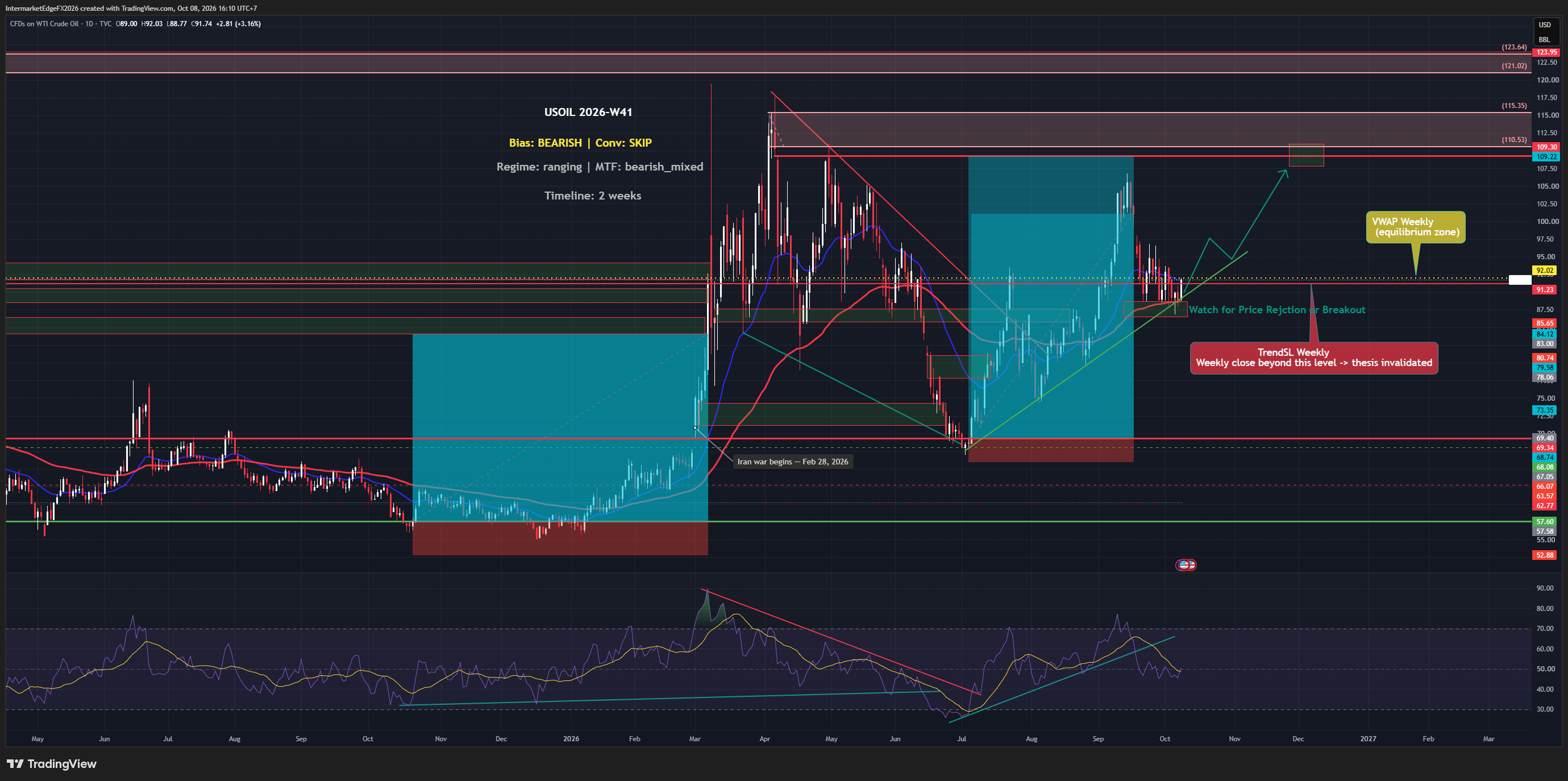
USOIL W41 | Supply fears, demand doubts, no confirmed short setup USOIL was 91.836 at 08:44 UTC on October 8, 2026 (MT5 USOIL.sml:1m), displayed as 91.84. Price is below weekly VWAP 92.02 and already above weekly TrendSL 91.23. The structural conflict with the bearish view is active now, not a future risk. A completed weekly close below 91.23 would provide bearish structural confirmation for the first time. This is confirmation, not invalidation, and remains pending. An intraday crossing is insufficient. If price sustains above 92.02, momentum would work against the bearish view and call for a short-side risk review. This warning is pending and does not require a weekly close. Shipping and storm headlines describe supply risks, not quantified outages. Trading Economics, citing EIA for the week ended October 2, reported crude stocks down 3.186 million barrels, Cushing up 0.444 million and gasoline up 0.382 million. The components are mixed. Barchart reported a demand-forecast reduction; no exact revision is asserted here. Compare fresh dollar moves with oil-specific evidence. A weaker dollar is not another bearish oil signal by itself. The decision is to stand aside over a two-week review horizon while structure and direction disagree. This is a dated broker quote, not an exchange futures settlement. Intermarket Edge | Institutional Macro & Intermarket Analysis For informational purposes only. Not financial advice.
EURUSD W41: Fiscal Stress Weighs, but the Entry Case Remains Unclear

EURUSD W41: Fiscal Stress Weighs, but the Entry Case Remains Unclear

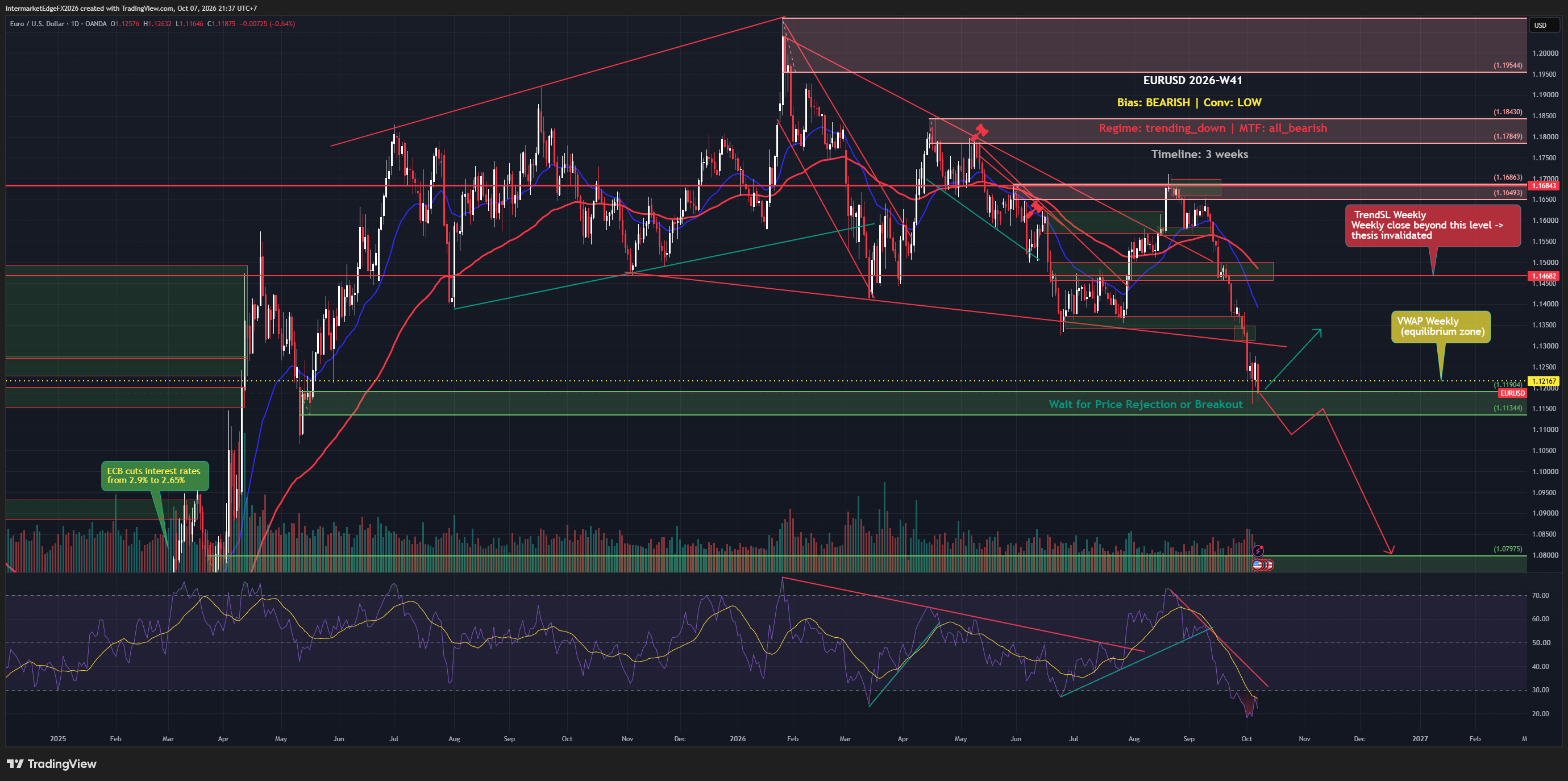
EURUSD W41 | Fiscal pressure, uncertain entry timing At 14:24 UTC on October 7, 2026, EURUSD was 1.11881 (MT5 EURUSD.sml:1m), below weekly VWAP 1.12167 and weekly TrendSL 1.14682. The broader trend points downward, but positive short-term signals reduce agreement. The bearish view has low conviction; standing aside avoids forcing a fresh entry. If price sustains above 1.12167, momentum would work against the bearish view and call for a short-side risk review. Only a completed weekly close above 1.14682 would invalidate the bearish structure. Both conditions remain pending at the quoted observation. FXSSI collected at 14:24:09 UTC on October 7: 77% Buy / 23% Sell. This is collection time. The broker retail sample does not represent the entire FX market or provide a standalone entry signal. Watch the dollar, comparable US-euro-area yields and French-German sovereign spreads. Related French fiscal headlines are not independent bearish confirmations. ForexFactory lists Fed minutes at 18:00 UTC on October 7 (01:00 GMT+7, October 8), after this snapshot. This secondary calendar is not officially verified. The minutes describe an earlier meeting, not its response to later data. Three weeks is a review horizon, not a target deadline. Prices are dated references, not live quotes. Intermarket Edge | Institutional Macro & Intermarket Analysis For informational purposes only. Not financial advice.
GBPUSD W41: Sterling Outperforms the Euro, but the Dollar Test Remains

GBPUSD W41: Sterling Outperforms the Euro, but the Dollar Test Remains

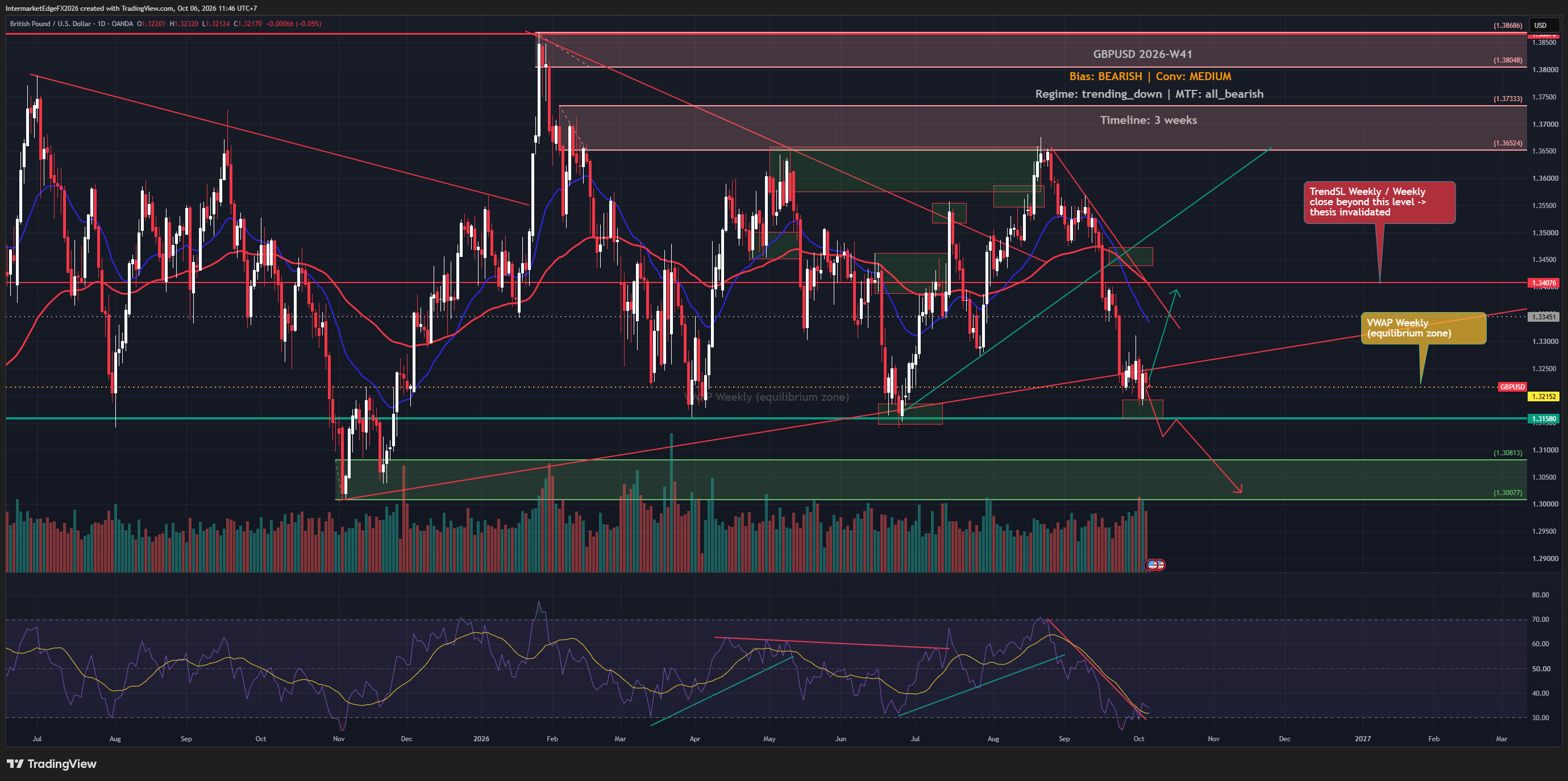
GBPUSD W41 | A bearish structure with an active momentum warning Sterling strength against the euro does not establish strength against USD. Amundi's more favorable GBP view also came alongside a positive dollar view. At 04:36 UTC on 06 October 2026, GBPUSD was 1.3228 (MT5 GBPUSD.sml:1m). Price is already above weekly VWAP 1.32152; the warning against bearish momentum is active now. Price is below weekly TrendSL 1.34076. Only a completed weekly close above 1.34076 would invalidate the bearish structure. That condition remains pending; an intraday touch is insufficient. The outlook remains bearish with medium conviction over a three-week review horizon. Timing is less clear. Existing shorts warrant a risk review now; a new position can wait for stronger agreement. Compare fresh dollar moves and matching UK-US yield observations rather than inferring the pair's direction from EURGBP alone. ForexFactory lists FOMC minutes for October 7 and Bailey remarks for October 8 on its UTC calendar. These are secondary-source listings, not officially verified schedules. Prices above are dated references, not live quotes. FXSSI collected on October 6 at 04:36:18 UTC: 69% Buy / 31% Sell for GBPUSD. Collection time, not provider observation time. This broker retail sample does not represent the entire FX market and is not a standalone entry signal. Intermarket Edge | Institutional Macro & Intermarket Analysis For informational purposes only. Not financial advice.
Gold W41: Softer Jobs Offer Relief, but the Downtrend Remains

Gold W41: Softer Jobs Offer Relief, but the Downtrend Remains

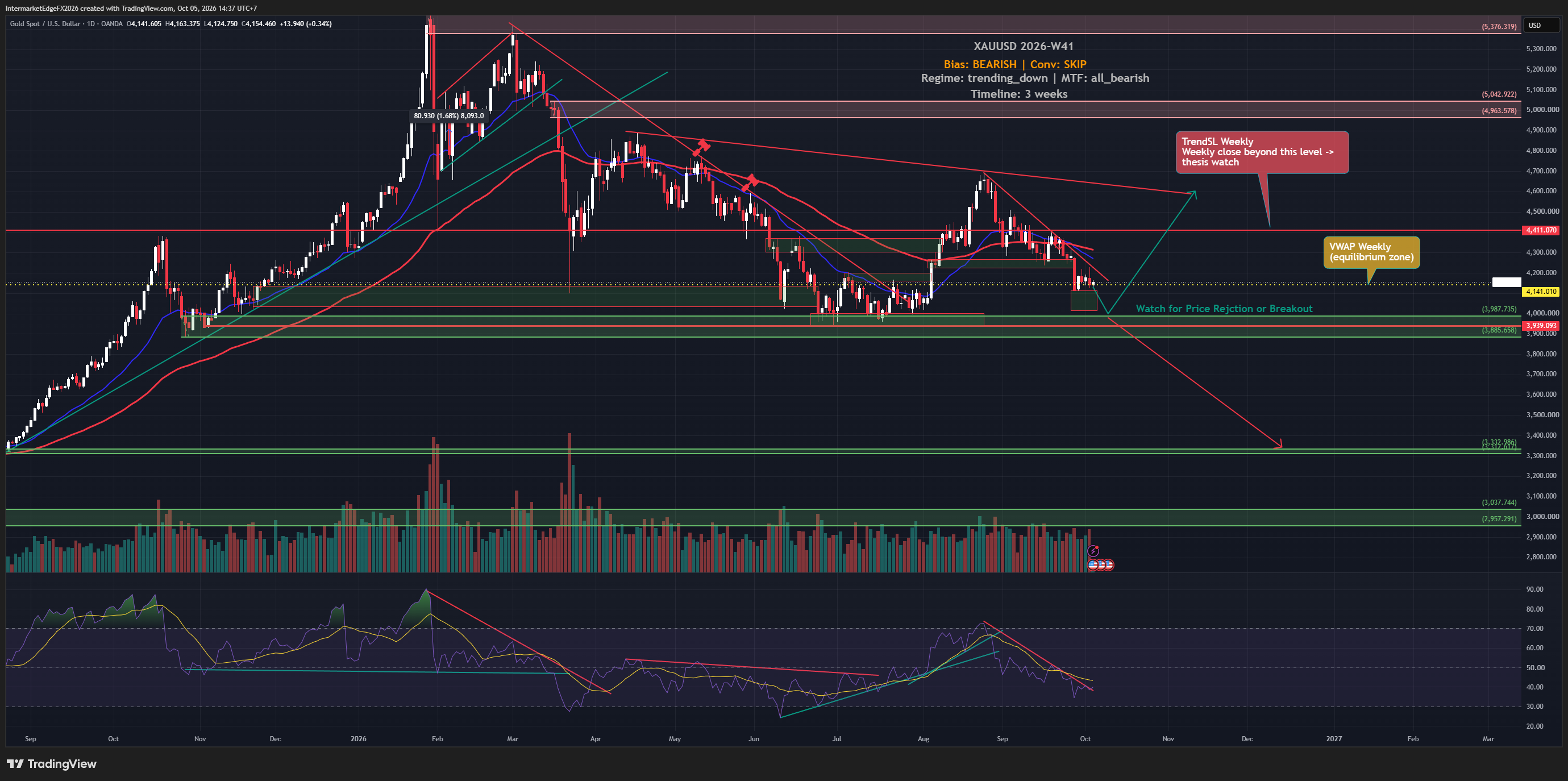
Softer September US hiring reduced expectations of an October Fed increase, supporting gold at one point in Monday's trading. A separate Reuters update reported pressure from a firmer dollar. Those observations describe different moments, not a confirmed reversal or the latest market quote. At 07:15 UTC on 05 October 2026, gold was 4135.09 USD per ounce (MT5, XAUUSD.sml, 1-minute feed). It was below weekly VWAP 4141.01 and weekly TrendSL 4411.07. The downward trend assessment across daily, weekly and monthly charts conflicts with a positive short-term price signal. The decision is to stand aside while that disagreement remains unresolved. Two conditions have different meanings: • If price sustains above 4141.01, near-term momentum would work against the bearish view. VWAP is a dynamic reference, not structural invalidation. • A completed weekly close above 4411.07 would invalidate the bearish structure. This remains pending; an intraday touch is insufficient. For readers without a position, waiting avoids forcing an entry into conflicting evidence. Readers already holding exposure should assess those conditions against their own risk limits. Reduced odds of another hike do not establish a rate-cut cycle, and a downward trend does not guarantee a favorable short entry. -- Intermarket Edge

DXY W41: Softer US Jobs Meet a Weaker Euro

DXY W41: Softer US Jobs Meet a Weaker Euro

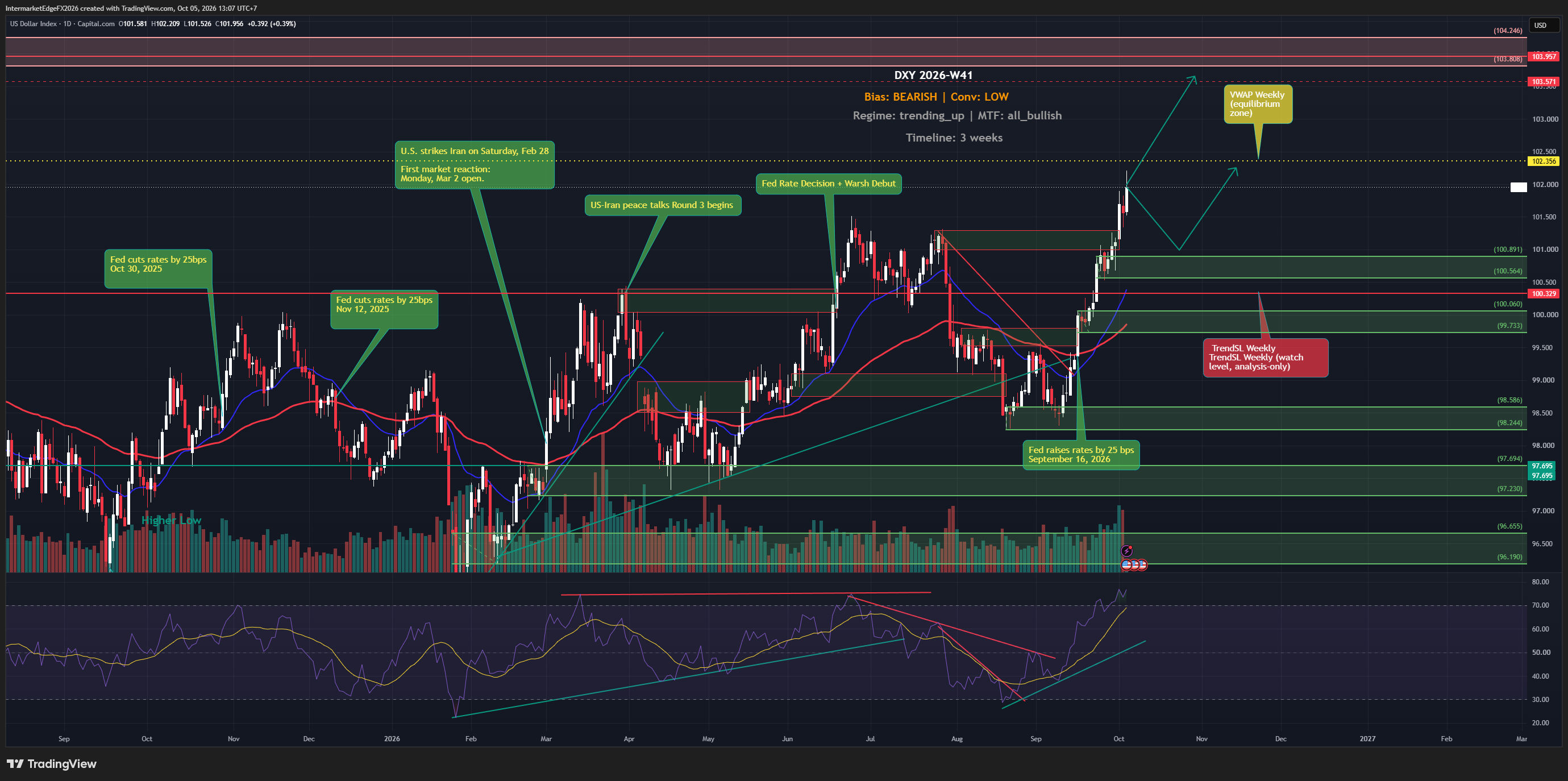
Weaker US hiring has reduced expectations of an October Fed increase, while French fiscal concerns are weighing on the euro. Those forces pull DXY in opposite directions: a less supportive US policy outlook versus weakness in the index's largest currency component. At 05/10/2026 05:55 UTC, DXY was 102.350 (source: yfinance:DX-Y.NYB:1m). Price was effectively at weekly VWAP 102.347 and above weekly TrendSL 100.329. Near-term momentum is balanced around the weekly average; a decisive move is not established. The broader trend assessment remains upward across daily, weekly and monthly charts at thesis generation. The bearish view therefore carries low confidence over the three-week horizon. Two references matter: • Weekly VWAP is a momentum reference, not an automatic structural break. A sustained recovery on its higher side would work against the bearish view. • Price is already above weekly TrendSL. A completed weekly close below 100.329 would provide bearish structural confirmation. That condition remains pending; an intraday move cannot activate it. -- Intermarket Edge

EURJPY W40: Hotter Tokyo Inflation Supports Yen, but Bears Still Lack Confirmation

EURJPY W40: Hotter Tokyo Inflation Supports Yen, but Bears Still Lack Confirmation

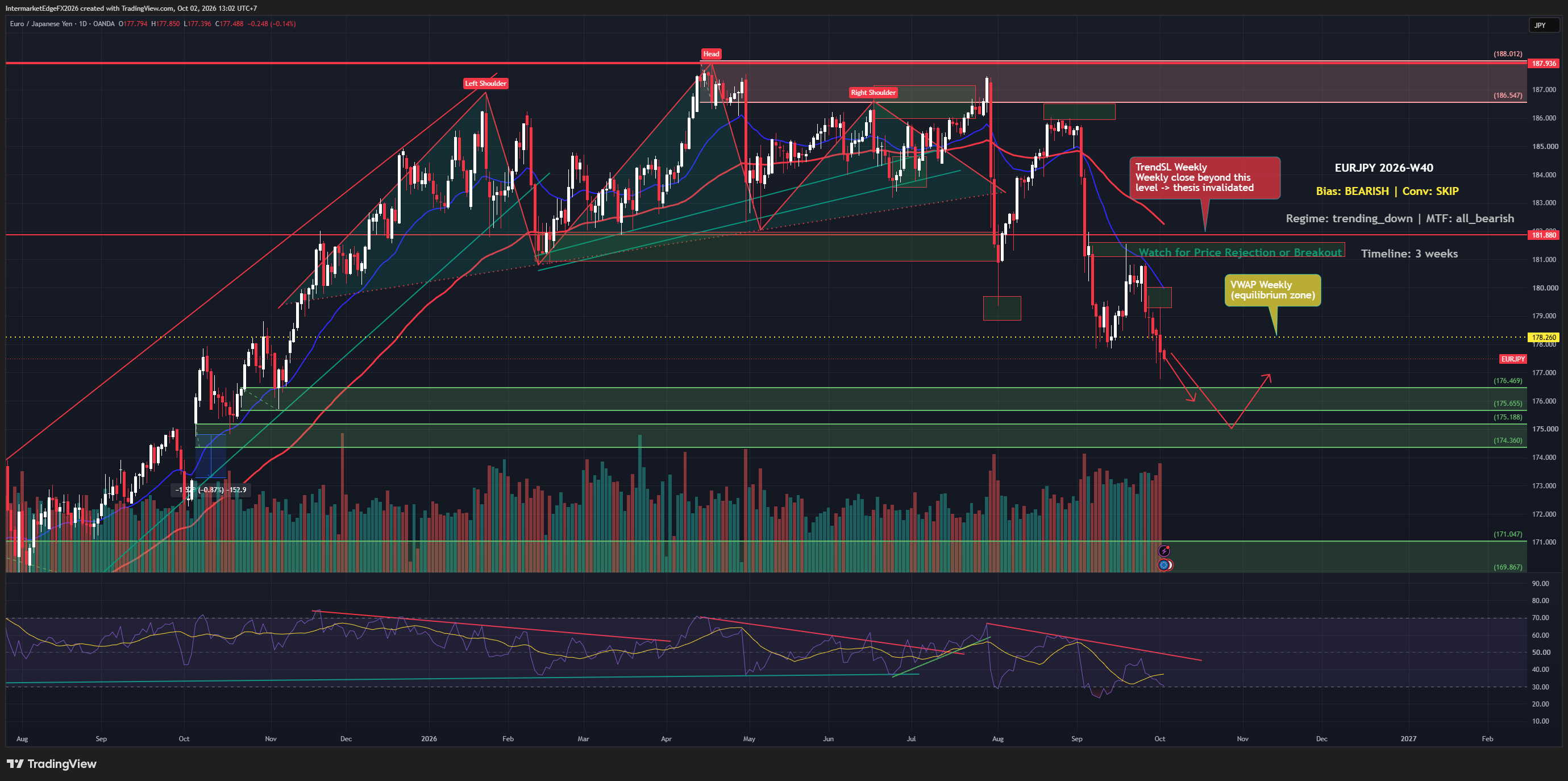
Japan's September Tokyo core-core CPI just printed 3.0% year-on-year against a 2.4% forecast, a significant beat that strengthens the case for BOJ policy tightening and yen appreciation. EURJPY is sitting at 177.59 early Friday, below the weekly VWAP at 178.26, with all timeframes aligned bearishly. The directional case looks clean. The conviction, however, does not, and that gap between direction and certainty is exactly where traders get hurt. The directional lean for EURJPY over the next three weeks is bearish, driven by two converging forces: a BOJ that is being pushed toward further tightening by inflation data that keeps exceeding expectations, and a euro that Reuters described as lagging the dollar during September. When the yen strengthens and the euro weakens simultaneously, EURJPY gets hit from both sides, the numerator falls and the denominator rises. That is the structural setup here. However, the analytical framework is deliberately standing aside rather than treating this as an actionable bearish entry. The reason is a direct conflict between the macro and technical signals: while the regime reads trending-down and all timeframes align bearishly, raw price action is generating a bullish technical signal that cannot be dismissed. This is not a minor discrepancy, it is an explicit disagreement between two evidence streams that normally need to be in agreement before sizing a position. Layered on top of this, the structural longer-term bias for EURJPY remains bullish, meaning that any short positioning is trading against the underlying trend. The retail crowd is 60% net long the pair as of October 2, which provides a contrarian lean toward the bear case, when the crowd is wrong, it tends to be wrong in the direction they are positioned, but this reading alone is not enough to override the technical conflict. -- Intermarket Edge

USDCAD Week W40-2026: CAD Drops to a 17-Month Low as USD Strength and Stalled Canadian Growth Collide

USDCAD Week W40-2026: CAD Drops to a 17-Month Low as USD Strength and Stalled Canadian Growth Collide

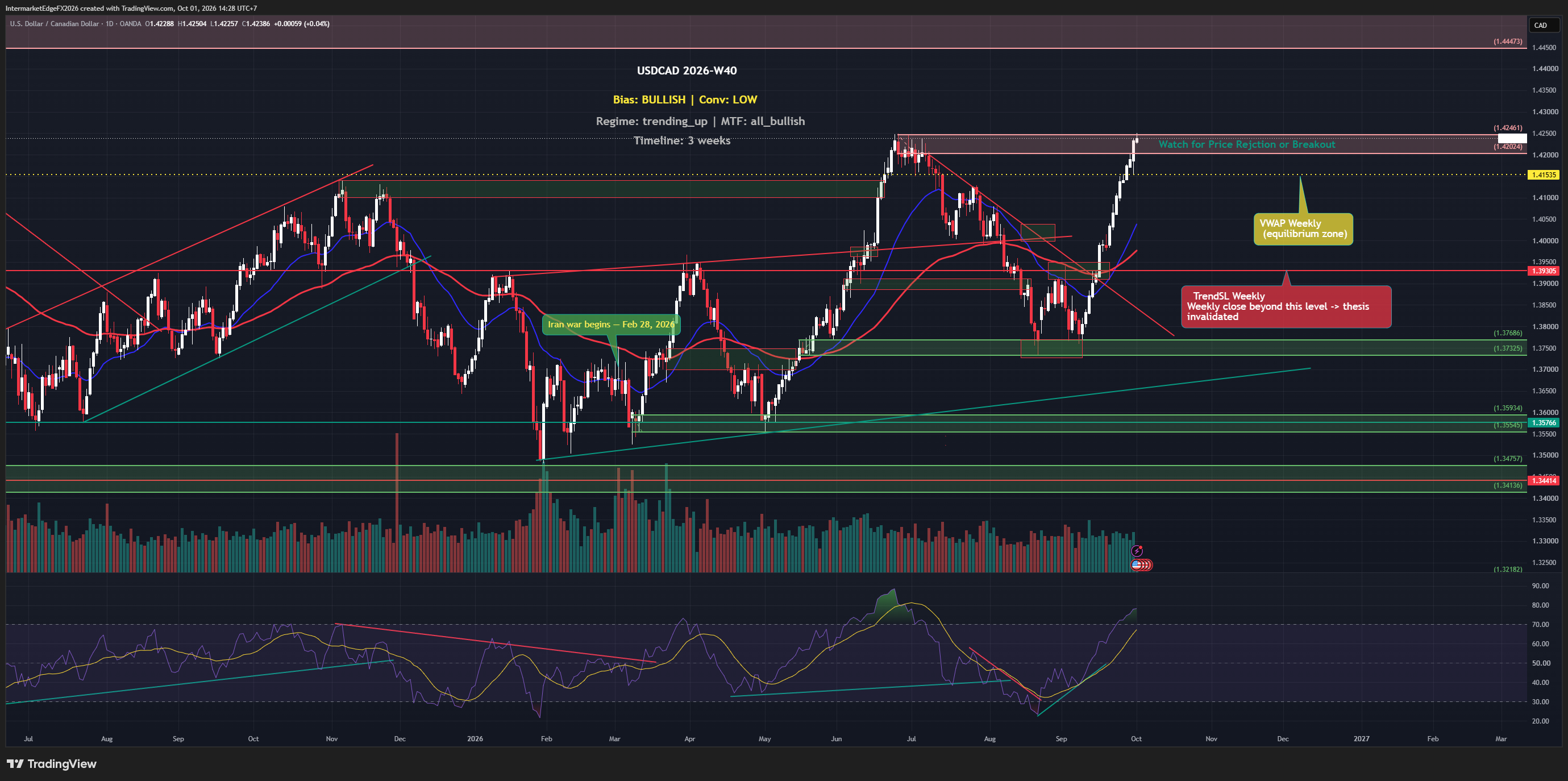
The Canadian dollar just touched a 17-month low even as domestic bond yields climbed, a setup that seems contradictory until you understand what is actually driving it. When US 10-year real yields reach 2.9% and Canadian GDP growth stalls simultaneously, higher local yields stop being a support and start being a symptom of stress. USDCAD is trading at 1.42467 as of Thursday, 1 October 2026, sitting above its weekly VWAP at 1.41535 and well clear of trend support at 1.39305. The bullish structure is intact, but conviction remains deliberately low. The bullish case for USDCAD rests on three mutually reinforcing forces that are currently aligned across every measured timeframe. First and most durable is the macro driver: a Fed that is holding rates high, with real yields near multi-year peaks, against a Bank of Canada that is increasingly constrained by a domestic growth slowdown. That divergence, the Fed-BOC policy gap, does not need to widen further to support the pair; it simply needs to persist, and stalled Canadian GDP makes persistence the base case. Second, COT positioning data, which tracks how large non-commercial futures participants are positioned, providing a directional read on professional sentiment though the available source does not specify the exact report week or net-position figure, so it should be read as a directional lean rather than a precisely dated statistic, shows a bullish tilt with a meaningful score, adding an institutional-positioning layer to what is otherwise a pure macro story. Third, the market is in an established uptrend with bullish alignment across the tracked timeframes, meaning shorter-term momentum and longer-term structure are pointing the same direction rather than in conflict. Conviction, however, sits at low, and that framing matters. This is not a weak signal dressed up as a trade. The overall score is below the threshold where position sizing would be straightforward. -- Intermarket Edge

EURUSD Week W40-2026: Dollar Posts Its Largest September Gain at the Euro's Expense, But the Real Trap Is What Comes Next

EURUSD Week W40-2026: Dollar Posts Its Largest September Gain at the Euro's Expense, But the Real Trap Is What Comes Next

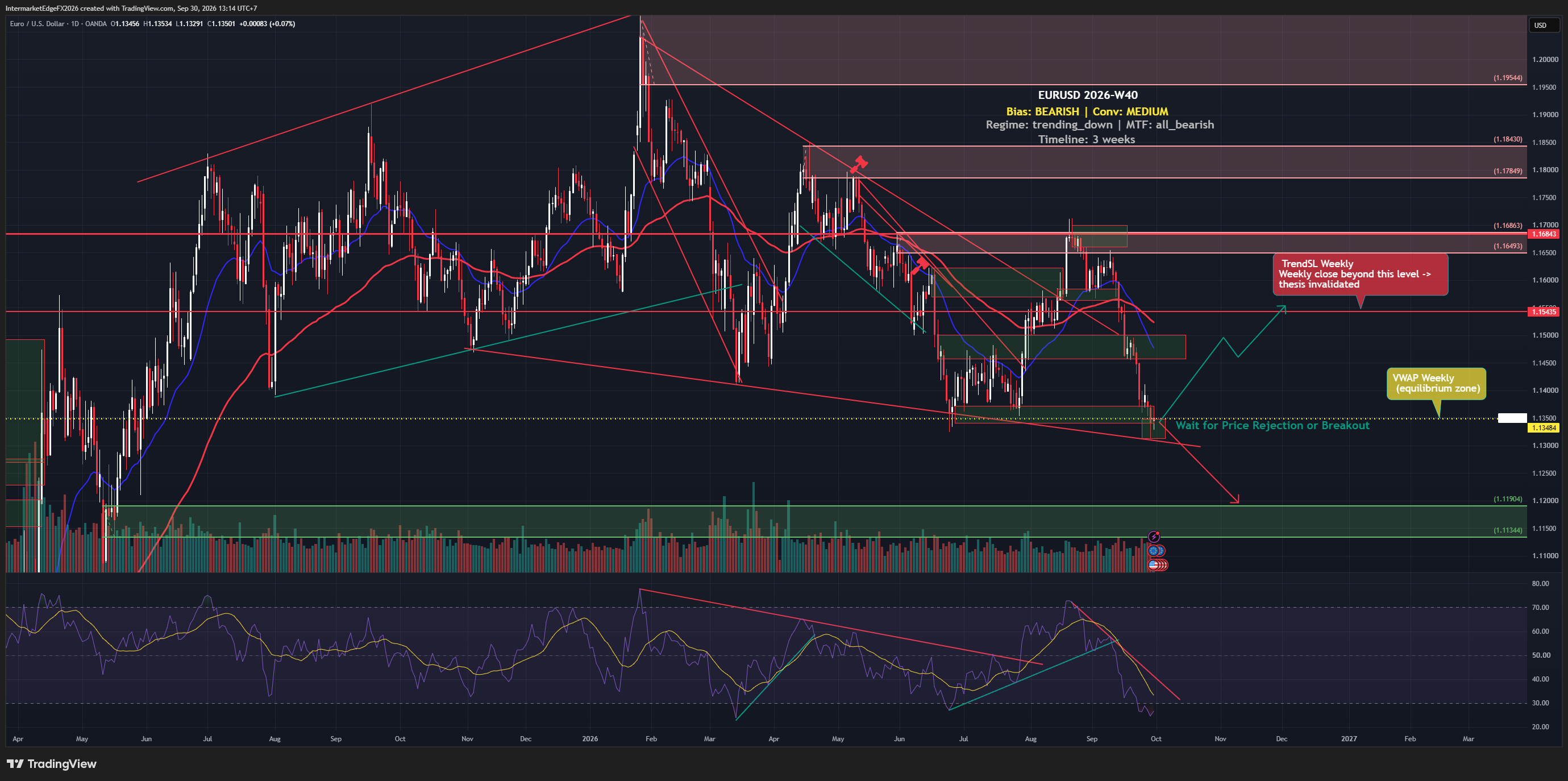
EURUSD is trading at 1.134 as of Wednesday, 30 September 2026, capping a month that Reuters confirms was the dollar's largest September gain, predominantly at the euro's expense. New York Fed President Williams has left the door open for one more rate hike this year, and with US 10-year real yields at 2.9%, the interest-rate math continues to favor the dollar structurally. The trend is down across every timeframe, but signal conflicts mean the path isn't as clean as the headline suggests. The bearish case on EURUSD rests primarily on the rate differential and the Fed's demonstrated willingness to keep it wide. When one central bank is signaling additional tightening while the other faces structurally slower growth and a different inflation profile, the currency on the higher-yield side tends to attract demand, and that demand compounds over weeks, not sessions. Reuters confirming the dollar's outsized September gain at the euro's expense is not just a data point; it's confirmation that the macro argument has already been expressing itself in price. That said, this is a medium-conviction view, not a high-conviction one, and traders should weigh that carefully. The conflict worth naming directly: price action signals and COT positioning, which reflects the aggregate stance of large futures traders, though the specific report week and net-position figures are not available here, so treat it as directional context rather than a precise citable stat, are both leaning bullish. When the macro framework points one direction and the market's actual positioning leans the other, the overall call carries more uncertainty than a clean trend setup would. The retail picture adds a contrarian lean: 72% of retail EURUSD accounts tracked by FXSSI as of 30 September are net long, and historically, when retail crowds are this lopsided on a major pair, it tends to lean against their position. -- Intermarket Edge

GBPUSD Week W40-2026: Sterling Remains Under Pressure as the BoE Bounce Fades

GBPUSD Week W40-2026: Sterling Remains Under Pressure as the BoE Bounce Fades

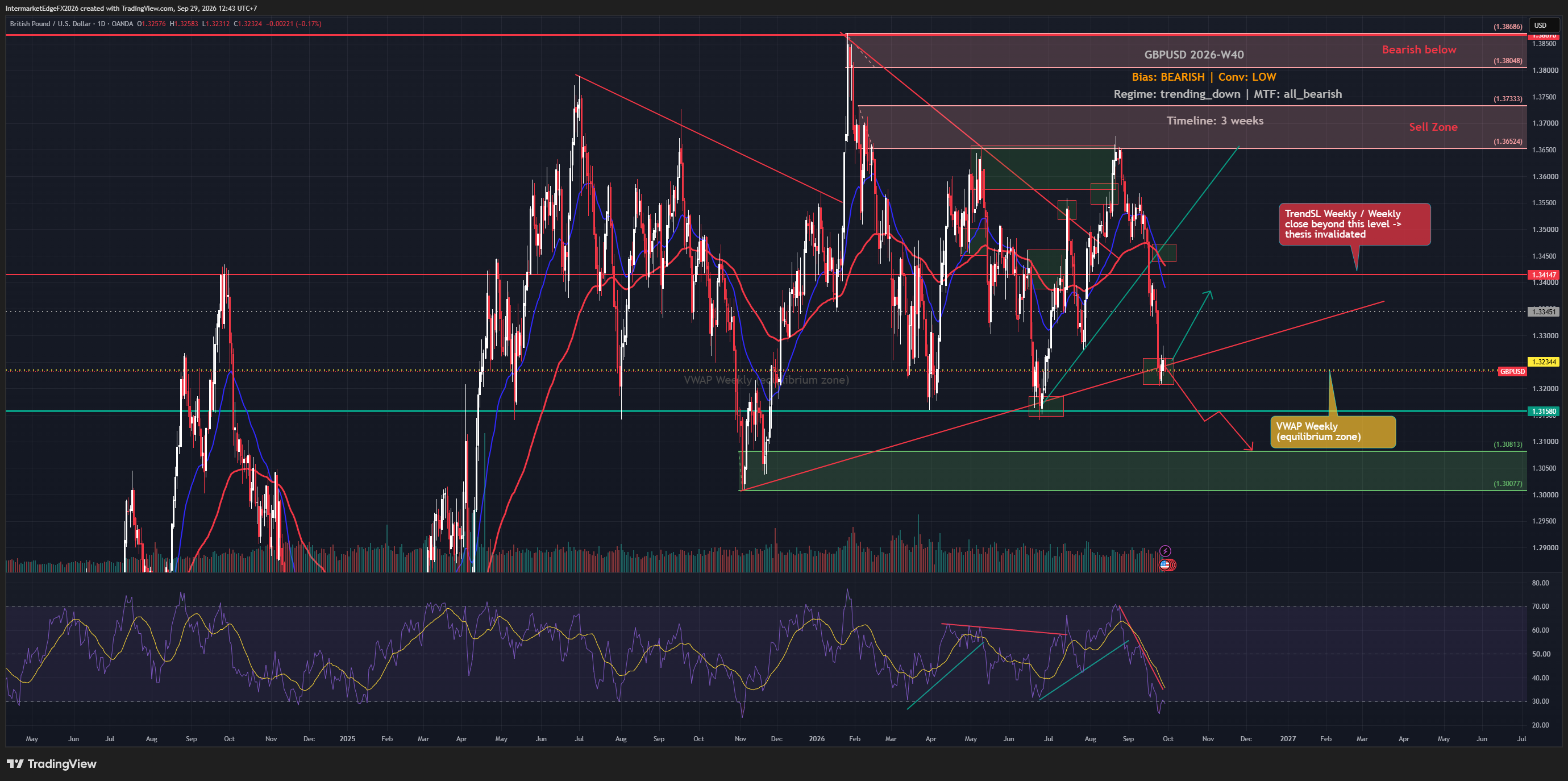
GBPUSD is sitting just above its weekly VWAP at 1.32344 as of Tuesday 29 September, close enough to look like support, but the structural current underneath is still running lower. The BoE's Deputy Governor Ramsden flagged upside inflation risks and hinted at a possible rate increase, producing a short-lived sterling rebound. The problem: US real yields at 2.85% are one of the most powerful headwinds the pound can face, and that wall hasn't moved. The structural bias for GBPUSD remains bearish, but this is a low-conviction bearish call, and that distinction matters enormously for how to treat any signal from the current price. The dominant driver is the Fed hawkish causal chain: rising US real yields attract capital toward dollar assets, which strengthens DXY, which in turn presses GBPUSD lower through the rate differential. That chain is active and has clear mechanical weight in the analysis. What makes conviction low rather than high is the internal conflict visible across signal types. Price action itself is registering near-term bullish momentum, the pair is trading above its weekly VWAP at 1.32344 as of Tuesday 29 September, which means short-term momentum is already running against the bearish thesis. That is not a future risk; it is the current reality. The BoE's hawkish shift adds a fundamental reason why sterling might hold or recover near-term, even if the longer-term rate differential remains dollar-positive. Retail positioning, 75% of retail traders net long GBPUSD as of 29 September (FXSSI, broker sample, not the full market), provides contrarian context that leans bearish, but without a calibrated framework it cannot lift conviction on its own. The multi-timeframe structure is aligned bearish from the weekly level down, which keeps the directional bias intact, but the signals that would normally support sizing a position with confidence are not consistently pointing the same way. -- Intermarket Edge

Stay in the loop

Get notified about new research, macro insights, and market analysis.

InterMarketEdge

© 2026 InterMarketEdge. Financial intelligence for inter-market traders.