Tag: sterling — InterMarketEdge

Tag: sterling

EURGBP Week W36-2026: Technicals Hold Bullish Structure Above 0.85647, But the Macro Story Has a Hole in It

EURGBP Week W36-2026: Technicals Hold Bullish Structure Above 0.85647, But the Macro Story Has a Hole in It

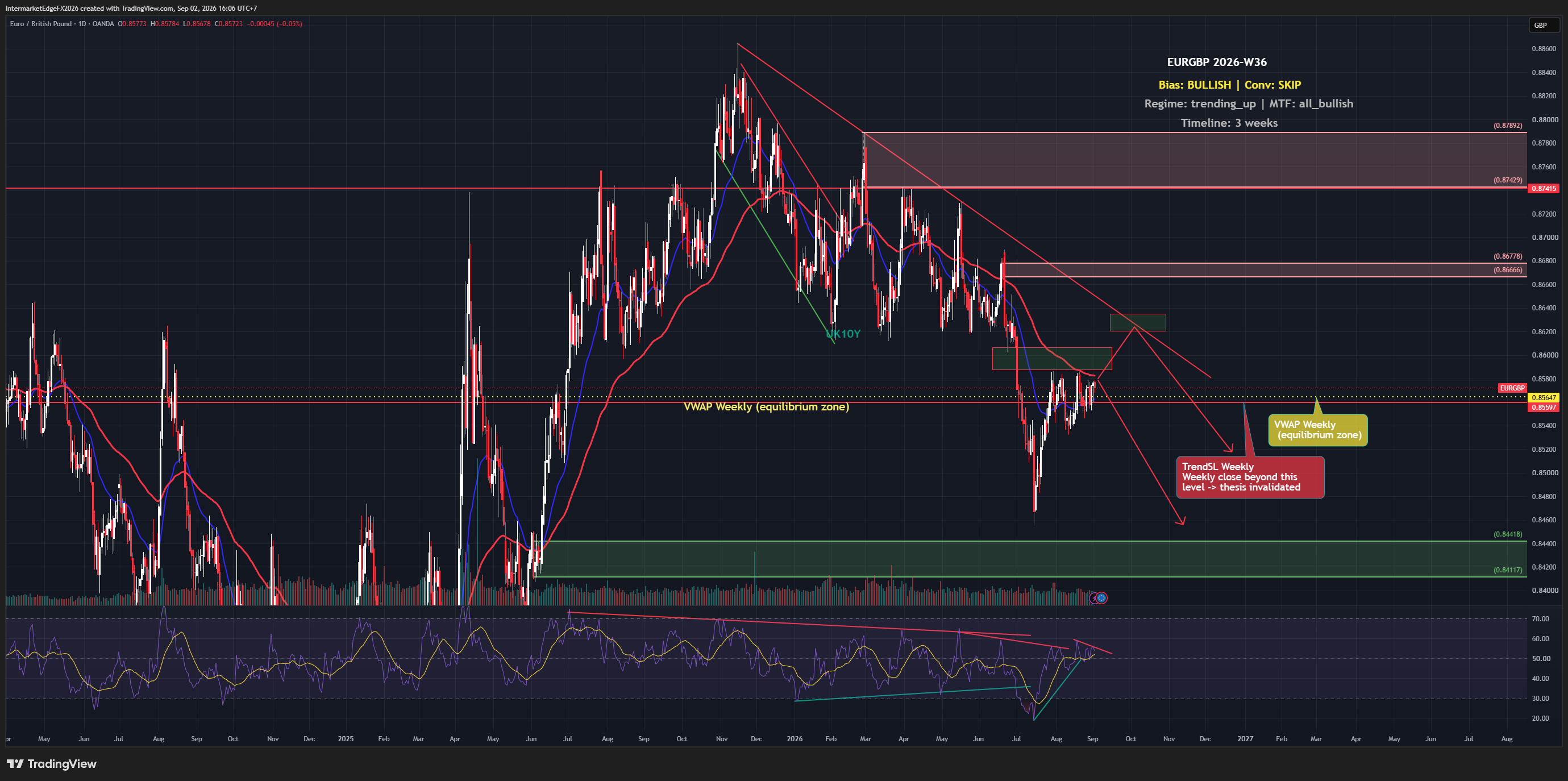
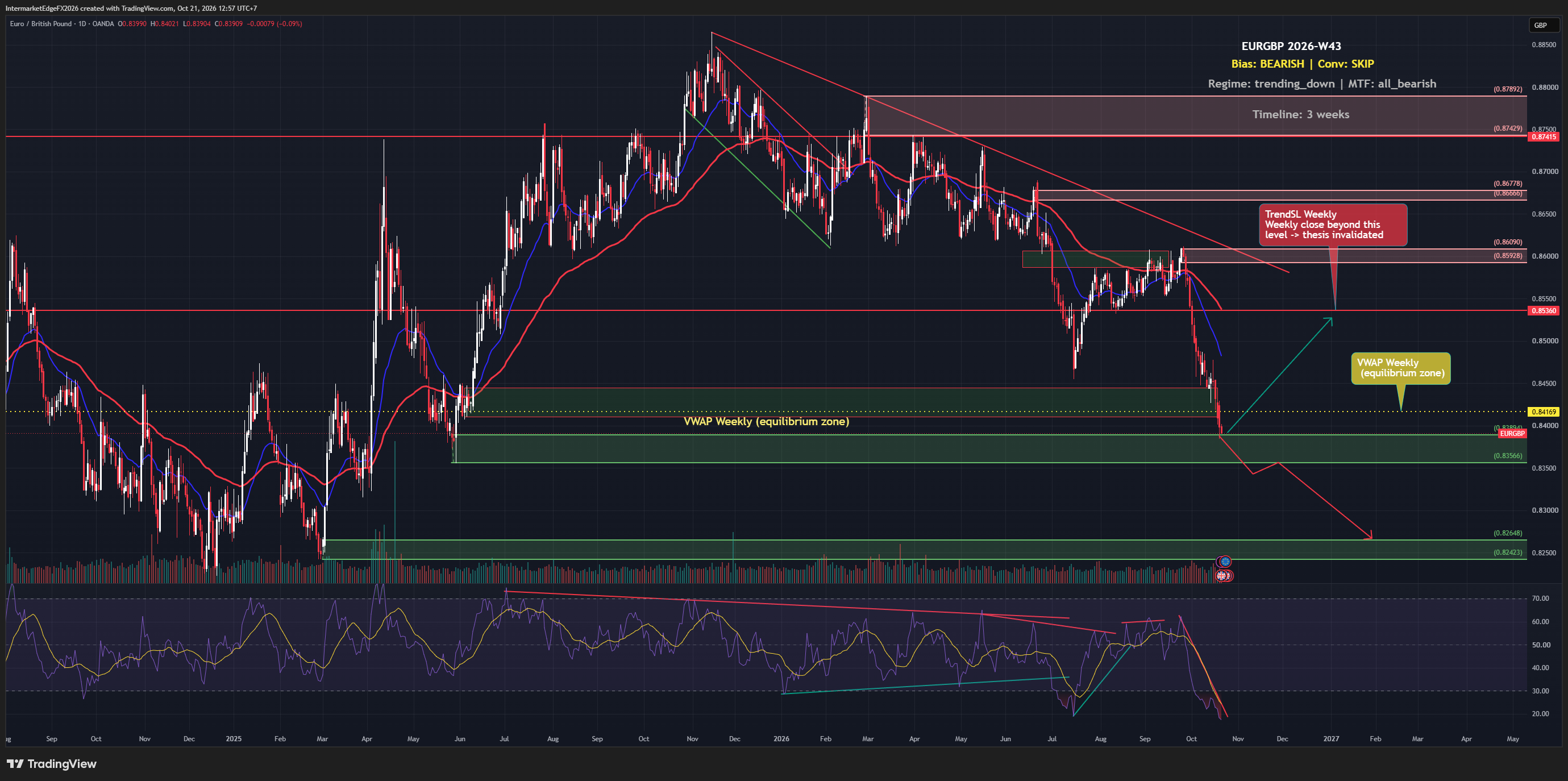
EURGBP is trading above its weekly VWAP at 0.8577 as of Wednesday, 02 September 2026, with charts aligned bullish across every timeframe. The catch: the entire bullish case rests on technical structure alone, no macro confirmation, no positioning signal, nothing beyond price telling you which way to lean. That narrow foundation is exactly what makes this week's setup worth watching carefully rather than trading aggressively. The bullish bias on EURGBP this week is real but structurally thin. Daily, weekly, and monthly technical trend signals are all pointing the same direction, that multi-timeframe alignment, where price structure agrees across short, medium, and long horizons, is the strongest argument for the upside case. It reduces the probability that you are catching a random short-term noise move against a larger trend. What it does not do is tell you why the move should continue or how far it goes. The stated fundamental driver for this pair is the ECB versus BoE rate differential, the gap between where the two central banks are setting rates and where markets expect them to go, which directly affects the relative attractiveness of holding euros versus pounds. That differential is a plausible and historically significant driver for EURGBP. The problem this week is that the macro evidence has produced no confirming signal. The rate differential is the narrative, but the data behind it has not fired. That gap between a coherent story and an absent signal is the defining tension. The practical consequence is that the conviction level here amounts to a deliberate decision to stand aside. The technical foundation is present; everything else that would normally underpin a higher-confidence directional trade, positioning data, a macro catalyst, sentiment confirmation, is not contributing. -- Intermarket Edge

EURJPY Week W36-2026: Technicals Hold Above 185.37 as Japan's Retail Sales Surge Meets a Dollar Bidding for Rate Hikes

EURJPY Week W36-2026: Technicals Hold Above 185.37 as Japan's Retail Sales Surge Meets a Dollar Bidding for Rate Hikes

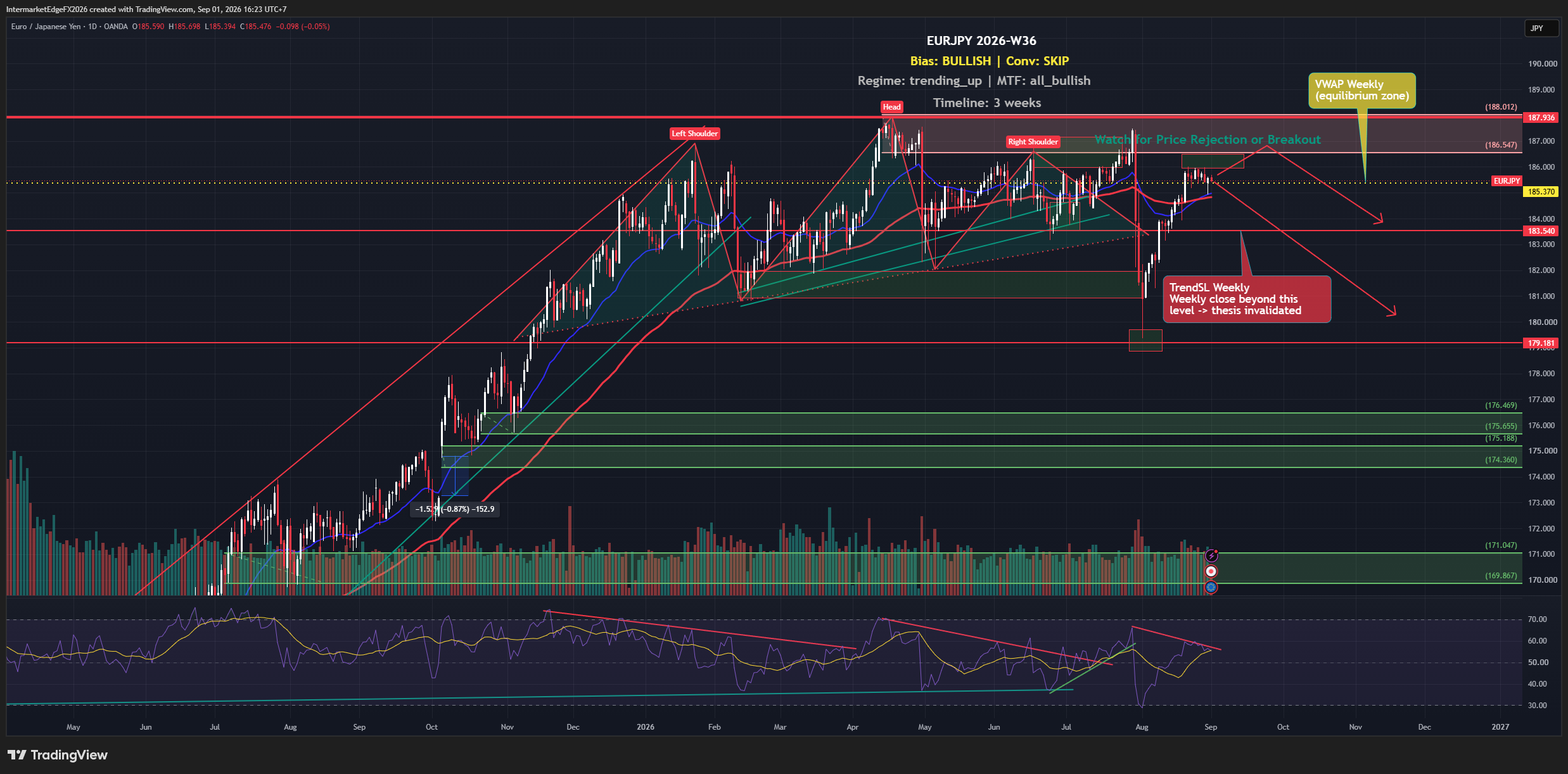
EURJPY is trading at 185.6 as of Tuesday, 01 September 2026, sitting just above its weekly VWAP at 185.37 with every timeframe technically aligned to the upside. Japan just delivered a retail sales print of 4.0% YoY, nearly double the forecast, and industrial output surprised to the upside as well. Yet the overall bullish conviction here is deliberately low, and that gap between clean technicals and absent macro support is exactly the tension worth understanding before sizing any exposure. The bullish bias on EURJPY for week W36-2026 rests on a single, structurally sound but narrowly sourced pillar: every technical timeframe, daily, weekly, and monthly, is aligned to the upside. That kind of multi-timeframe agreement is not common and is not trivial; it indicates the dominant trend is consistently reproduced at every analytical resolution, which reduces the probability that any one signal is noise. The practical effect is that the path of least resistance, absent a disrupting catalyst, points higher. What complicates this is that technical alignment is the only signal firing. COT positioning, which measures how leveraged and institutional accounts are positioned and would indicate whether professional capital is actually behind the move, has returned neutral with no directional read this week, so it is not possible to say the trend is being driven by the kind of committed positioning that sustains extended moves. Macro signals, sentiment gauges, and liquidity conditions have all returned similarly flat. This matters because a trend that rests solely on price-derived signals, without confirmation from who is positioned and why, carries crowding risk in a different form: the risk that the apparent trend is thin and vulnerable to a rapid unwind the moment a real macro trigger appears. The BOJ policy trajectory is the most direct potential disruptor on the JPY leg. -- Intermarket Edge (Note: COT (Commitment of Traders) data is released weekly by the CFTC with a report

GBPUSD Weekly Outlook W36: Bullish Structure, Bearish Macro Pressure

GBPUSD Weekly Outlook W36: Bullish Structure, Bearish Macro Pressure

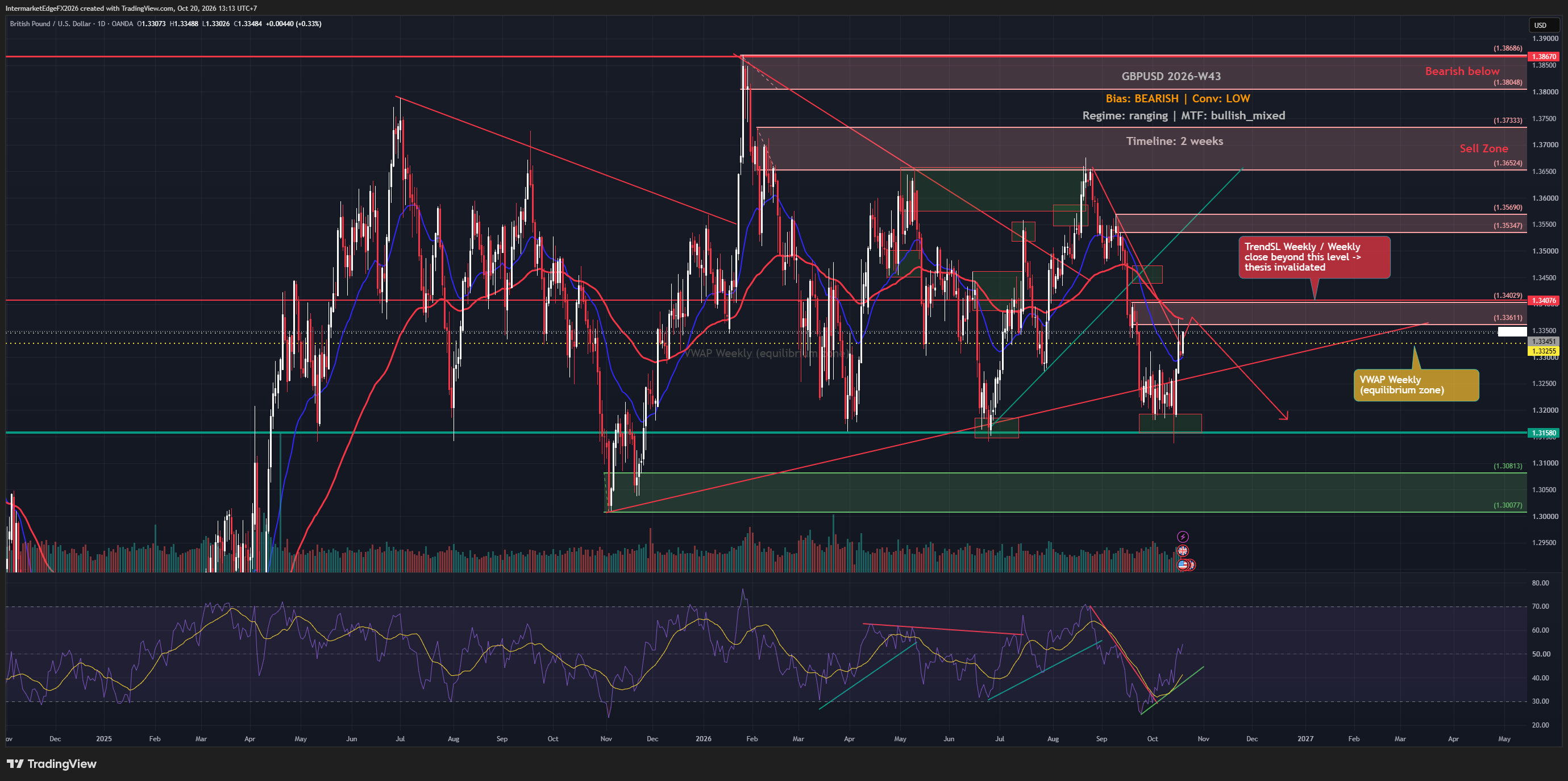
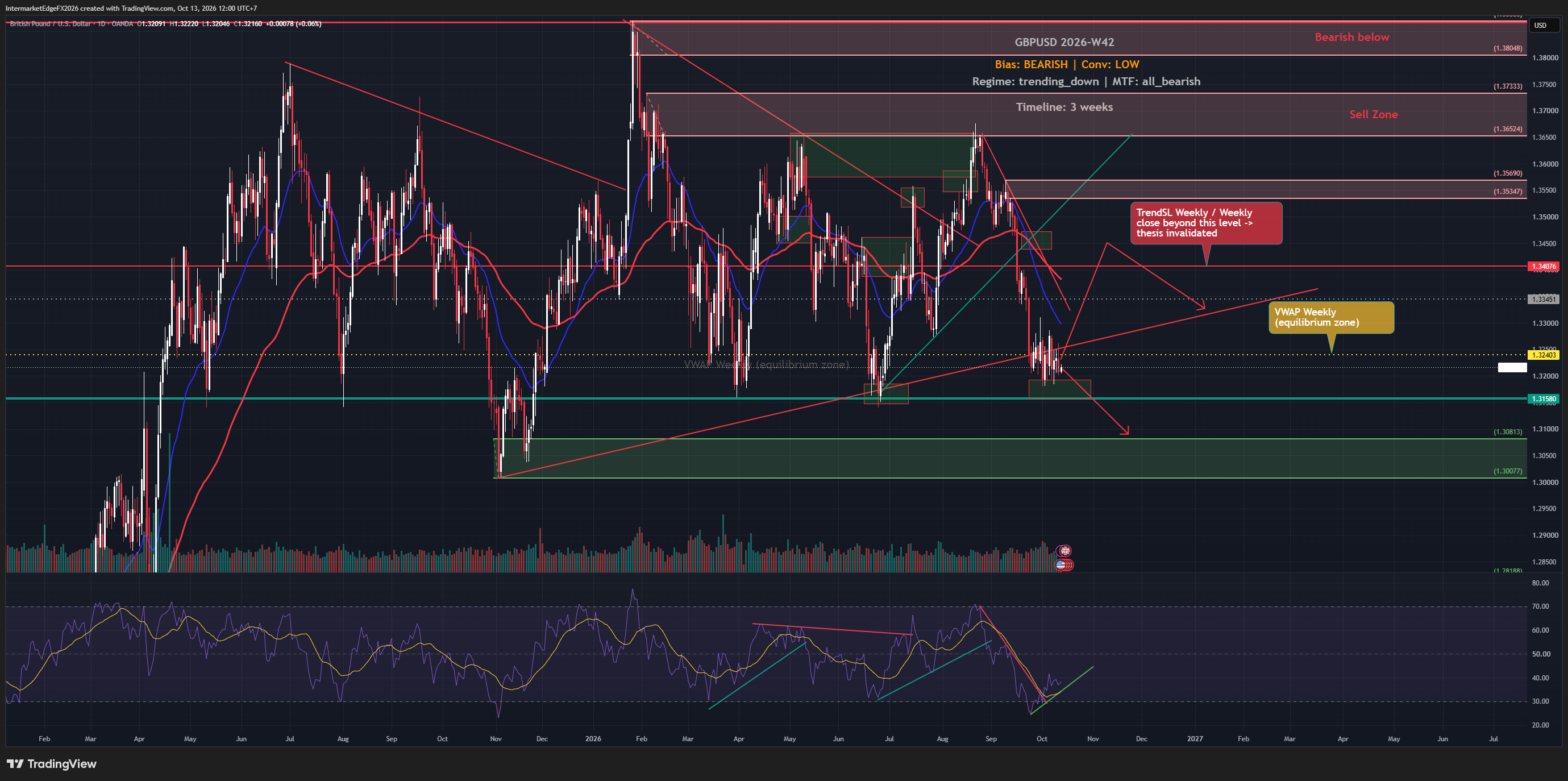
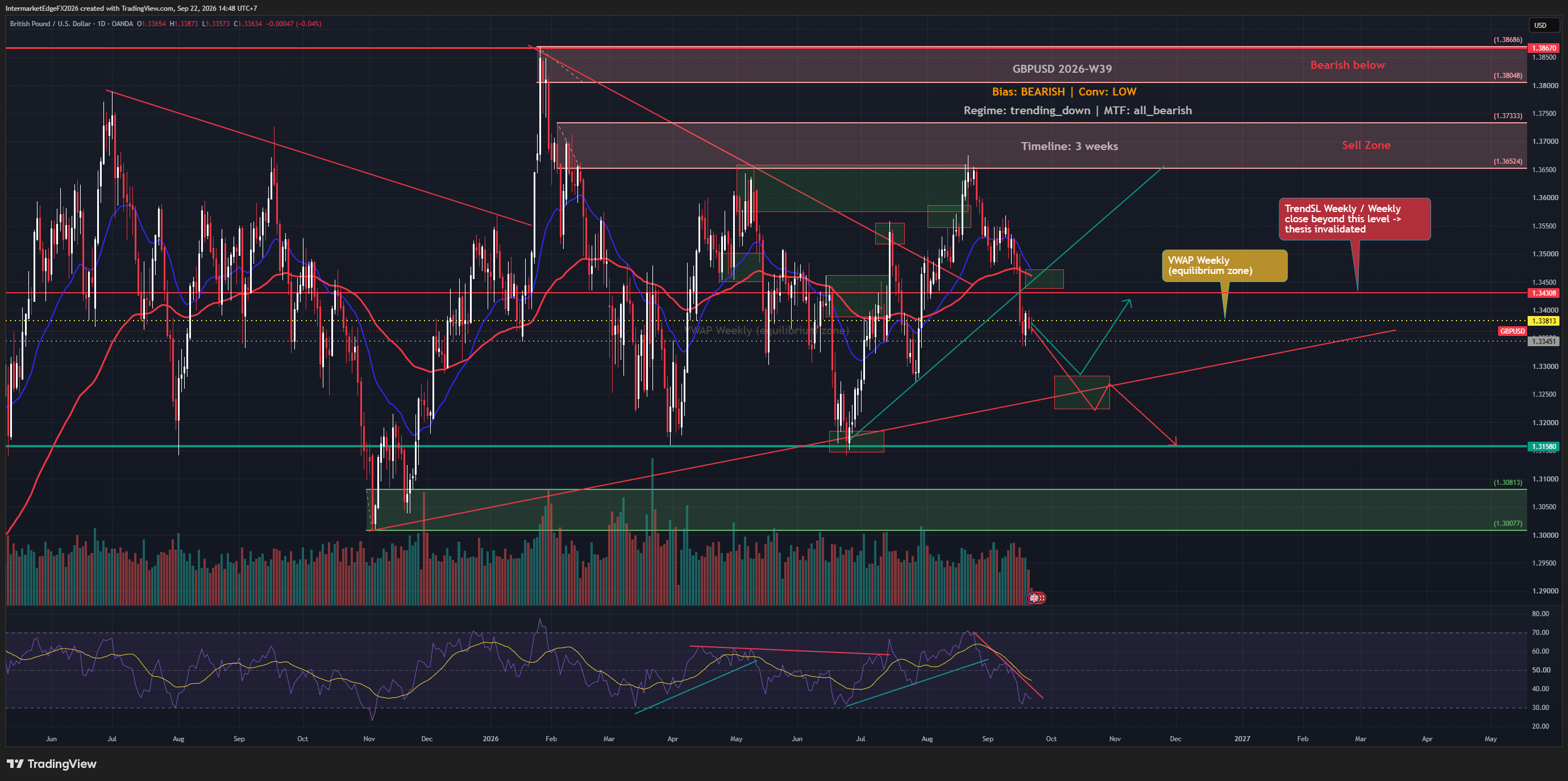
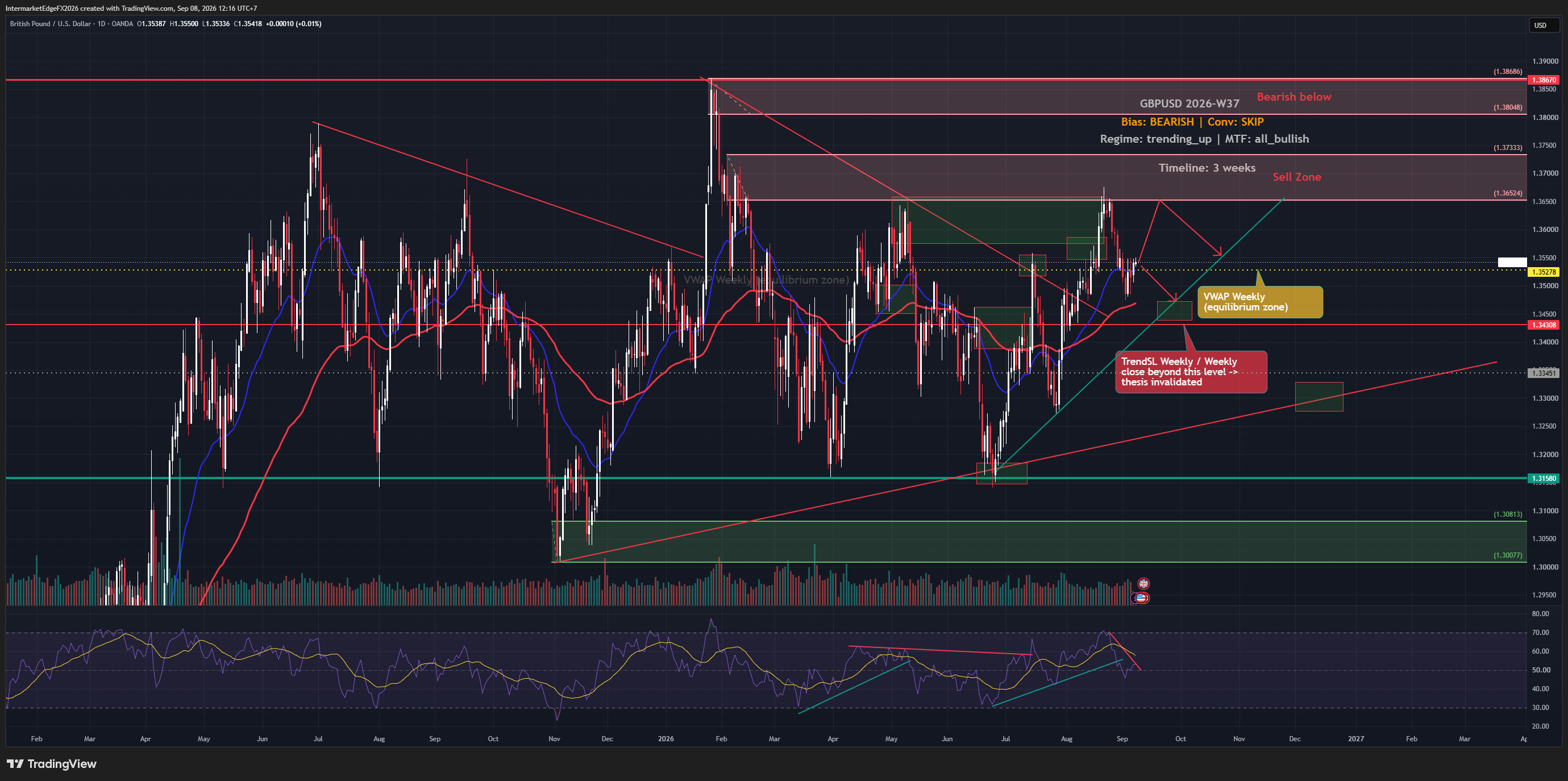
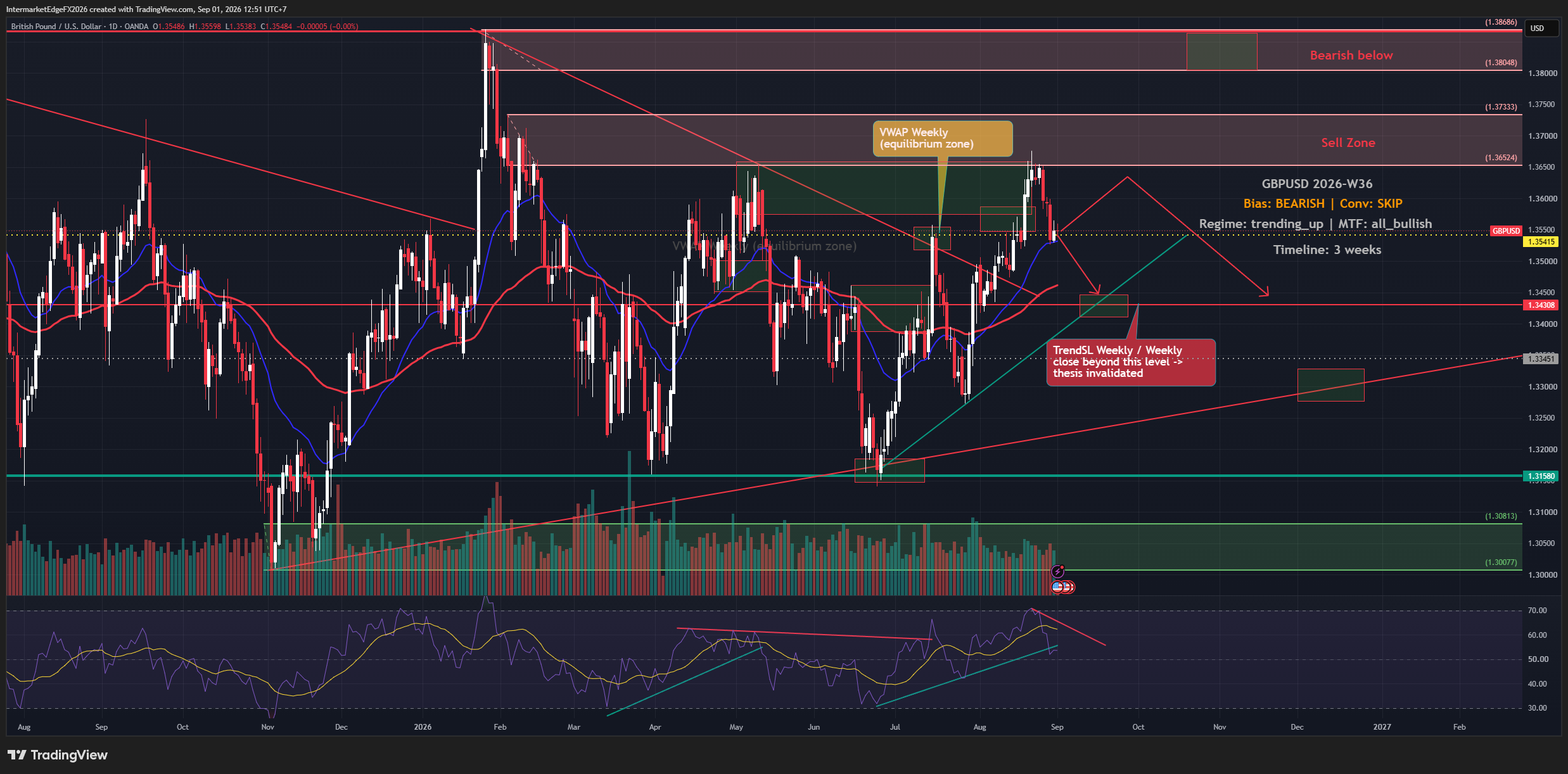
GBPUSD is printing a weekly loss as markets reassess the BoE-Fed policy divergence, but the technical structure refuses to cooperate with the bearish story. As of Tuesday, 01 September 2026, price sits at 1.35433, holding above the weekly VWAP at 1.35415 and well above the weekly trend support at 1.34308. The macro case for sterling weakness is building, yet the chart is not confirming it. That disconnect is the entire trade problem this week. The framework lands on a bearish bias for GBPUSD over a three-week horizon, but that label carries a deliberate caveat: this is a case where the evidence is not yet convincing enough to size a position, and staying out is itself a reasoned decision rather than the absence of a view. The bearish case rests on two causal chains that are both active right now. First, Fed hawkishness combined with rising real yields creates a structural USD bid, when real yields rise, the opportunity cost of holding non-dollar assets increases, pulling capital toward the dollar and mechanically weighing on GBPUSD. Second, DXY strength, itself driven by the same real yield dynamic, amplifies that pressure through a separate channel, since broad dollar appreciation tends to compress GBPUSD regardless of sterling-specific factors. COT data adds a warning layer: speculative positioning in GBP is already tilted heavily long, which matters because crowding risk, the danger that most participants who want to be long are already long, leaving fewer buyers to sustain the move, raises the probability of a disorderly unwind if sentiment shifts. The positioning evidence here should be read as directional in character, not as a citable statistic, since the specific report date, net position figure, and sample context are not available in this brief. -- Intermarket Edge

GBPUSD Week W35-2026: Sterling Pauses at Six-Month Highs as Iran Sanctions and Debt Nerves Pull in Opposite Directions

GBPUSD Week W35-2026: Sterling Pauses at Six-Month Highs as Iran Sanctions and Debt Nerves Pull in Opposite Directions

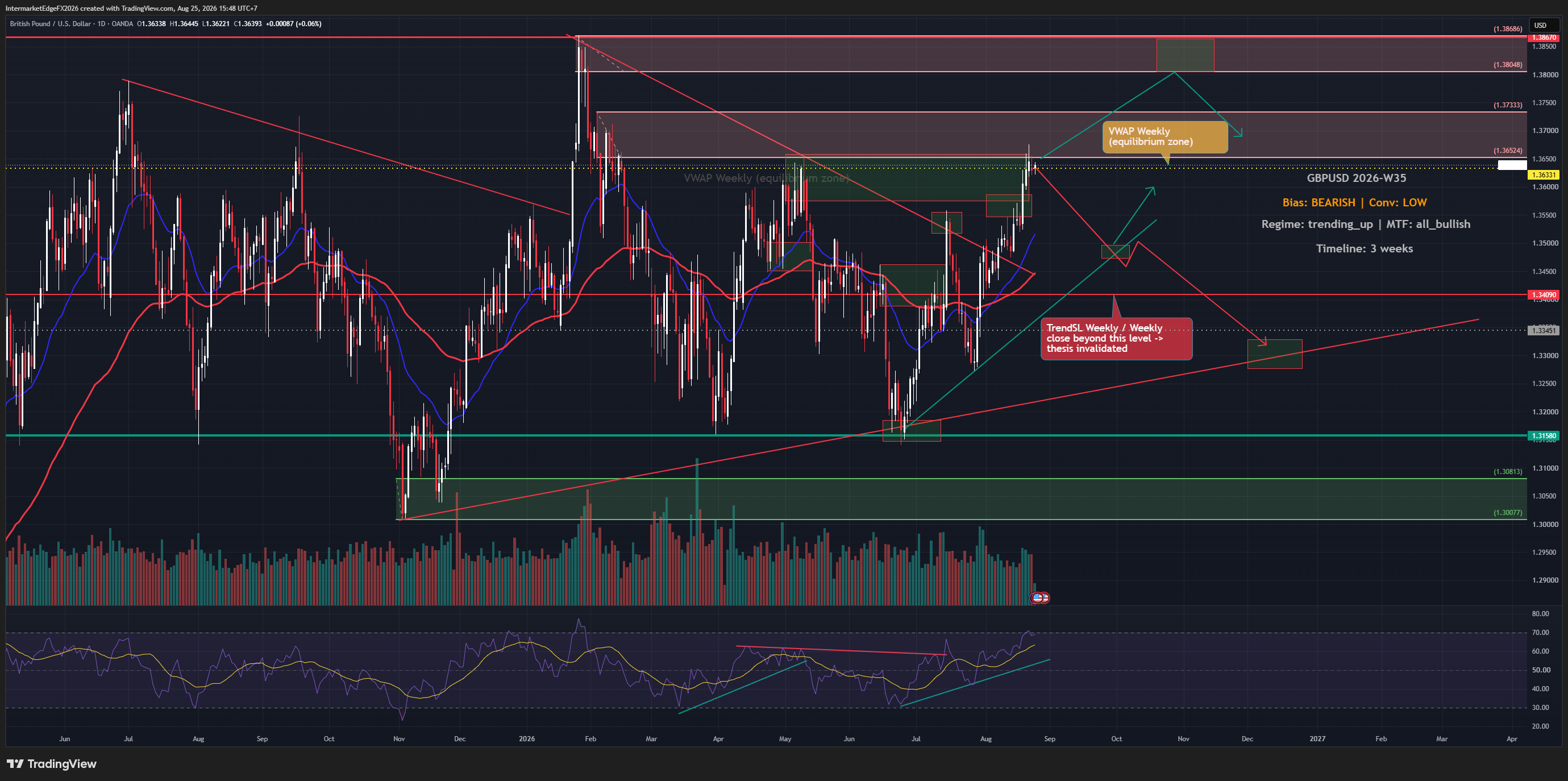
Sterling has climbed for four straight weeks, but as of Tuesday 25 August the rally has quietly stalled just beneath the weekly VWAP at 1.36331, a ceiling the market is testing from underneath. The pause is not random: speculators are already extreme long GBP according to COT data, and US real yields are sitting at 2.4%, a level that mechanically favors dollar strength. The direction everyone thinks they know may be the setup that punishes them. The framework carries a bearish bias on GBPUSD this week, but the conviction behind that call is deliberately low, and understanding why matters more than the label itself. The bearish case rests on two pillars: macro and positioning. On the macro side, Fed hawkishness combined with a 2.4% real yield creates conditions where the dollar should attract flows regardless of what the BOE does, because the USD is offering inflation-adjusted return that sterling cannot easily match. On the positioning side, COT data, which tracks the net futures positioning of speculative accounts, used here as a directional sentiment gauge rather than a standalone citable statistic since the specific report week and net-position figures are not available in this brief, shows speculators are already extremely long GBP. The practical implication of crowding risk, meaning positioning so concentrated on one side that the market runs out of new buyers, is that any negative catalyst does not just stop the rally: it triggers a cascade of exits from the same crowded trade, accelerating the move lower far beyond what fundamentals alone would justify. The problem is that everything else is still pointing up. Price action scores bullishly, the multi-timeframe alignment is entirely bullish, and the macro backdrop for sterling, firm rate-hike bets, subdued dollar, has not broken down. -- Intermarket Edge

EURGBP Week W35-2026: Sterling Pauses Its Four-Week Rally, but the Bullish Case Sits Below Every Key Level

EURGBP Week W35-2026: Sterling Pauses Its Four-Week Rally, but the Bullish Case Sits Below Every Key Level

EURGBP is sitting below its weekly VWAP of 0.85608 as of Tuesday, 25 August 2026, and the technical structure already contradicts the tentative bullish lean this week carries. Sterling just paused a four-week rally as investors repositioned around US sanctions on Iran, while the ECB is signaling caution on rates even as the eurozone shows unexpected resilience. The pair is caught between two central banks pulling in different directions, and right now, neither side has won. The framework labels EURGBP bullish for the two-week horizon beginning W35-2026, but the honest description of that label is that it rests on a single thin pillar: price action alone. Every other input, positioning data, macro signals, liquidity conditions, sentiment, is neutral and contributing nothing to the directional call. That kind of setup, where one source carries the entire argument, is precisely where conviction becomes a problem, and this analysis treats it as such. The decision here is deliberately to stand aside rather than size a position, because the evidence is not yet convincing enough to justify the directional risk. The stated primary driver is the ECB versus Bank of England rate differential, the practical meaning of which is that when the ECB is expected to hold or cut while the BOE is expected to hike, Sterling strengthens relative to the euro, pushing EURGBP down, and vice versa. But here is the disconnect that matters: no rate-specific or macro-specific signals have actually fired in support of the bullish label. The driver is named but not confirmed by the inputs. Compounding that, the structural or longer-term bias is neutral, which conflicts with the short-term bullish lean. -- Intermarket Edge

GBPUSD Week W34-2026: Pound Climbs Toward $1.36 as UK Inflation Test Looms, but Crowded Longs Warn of a Trap

GBPUSD Week W34-2026: Pound Climbs Toward $1.36 as UK Inflation Test Looms, but Crowded Longs Warn of a Trap

GBPUSD is trading at 1.35421 as of Tuesday, 18 August 2026, 06:14 UTC, trading below the weekly VWAP at 1.35532 while remaining above weekly TrendSL at 1.33774. The broader technical structure remains bullish, but price has lost the weekly VWAP in the short term. The available COT summary points to crowded long positioning, but it lacks the report week, release date, and exact net-position figure. Treat it as a directional risk flag, not standalone proof. The macro headwind from Fed real yields at 2.39% hasn't gone away. The framework carries a bearish bias on GBPUSD for the next three weeks, but the evidence supporting that bearish label is not currently strong enough to act on, and that distinction matters enormously. The primary bearish driver is the BOE-versus-Fed rate differential, where rising US real yields at 2.39% create structural pressure on GBPUSD by making dollar-denominated assets more attractive on a return-adjusted basis. A hawkish Fed, one that keeps real yields elevated even as nominal rate hike bets fluctuate, sustains that pressure without needing an outright rate increase. Layered on top is a qualified COT crowding risk: the available summary leans toward heavy sterling longs, but missing provenance prevents treating that description as a standalone statistic. When everyone is already long, the fuel for the next leg higher is thin, and any negative catalyst, a hot CPI that reprices UK rate cuts, or FOMC Minutes more hawkish than expected, can trigger a carry unwind, where traders exit leveraged long positions simultaneously, accelerating the move down far faster than fundamentals alone would justify. However, the higher-timeframe structure remains aligned bullish. Price remains above weekly TrendSL at 1.33774, but it has slipped below weekly VWAP at 1.35532. Short-term momentum now supports the bearish warning while the broader trend still conflicts with it. That technical structure directly contradicts the bearish label. -- Intermarket Edge (

GBPUSD Week W33-2026: Sterling Climbs to a One-Month High While the Bearish Macro Case Quietly Builds Against It

GBPUSD Week W33-2026: Sterling Climbs to a One-Month High While the Bearish Macro Case Quietly Builds Against It

GBPUSD is trading at 1.35276 as of Wednesday, 12 August 2026, sitting above its weekly VWAP at 1.35004 and hovering near a one-month high for Sterling. A surprise Core CPI miss-actual 0.0% against a 0.2% forecast-briefly knocked the dollar's footing, but the broader macro argument for USD strength through elevated real yields hasn't structurally changed. The tension between what price is doing right now and what the macro environment implies is exactly the kind of setup that quietly catches traders off-guard. The framework's overall bias for GBPUSD this week is bearish over a three-week horizon, driven primarily by the BOE-versus-Fed rate differential-the gap between where each central bank's policy rate sits and where markets expect it to go-which currently favors the dollar because the Fed's commitment to restrictive policy is backed by real yields that remain historically elevated. When real yields are positive and rising, as the 2.4% US 10-year real yield suggests, capital tends to seek dollar exposure, which mechanically pressures currency pairs where the dollar is the quote side, like GBPUSD. Several reinforcing causal chains support this logic: Fed hawkishness sustains USD demand, and a DXY that finds its footing would directly compound downward pressure on Cable. The critical caveat-and it is not a minor one-is that the price-based and positioning-based evidence is pointing in the opposite direction. COT data (directional evidence only; the brief does not specify the report week, net-position figure, or release date, so treat this as a sentiment lean rather than a precise citable statistic) is reading bullish on Cable positioning. -- Intermarket Edge

EURGBP Week W33-2026: BOE Holds at 3.75% But Sterling Fights Back, Leaving Bulls Stranded Below 0.8566

EURGBP Week W33-2026: BOE Holds at 3.75% But Sterling Fights Back, Leaving Bulls Stranded Below 0.8566

EURGBP is technically labelled bullish this week, yet as of Wednesday 12 August 2026, price at 0.85407 is sitting below the weekly VWAP at 0.8566, testing from underneath rather than pushing through it. That gap between the label and the price reality is exactly the kind of setup where traders get caught leaning on a bias that the market itself hasn't confirmed yet. With a BOE divided 6-3 on holding rates and a Euro-area CPI miss already in the books, neither side has a clean fundamental edge right now. The framework arrives at a weak bullish lean on EURGBP for this two-week window, but it is important to understand precisely how thin that lean is. The only active signal driving the bullish label comes from price action itself; positioning data, macro rules, liquidity signals, and sentiment indicators all contribute nothing, they fired no confirming evidence. A bias resting on a single source with no corroboration from other analytical layers is, by design, a low-confidence read that demands a correspondingly cautious posture. The analysis explicitly flags a structural conflict at the heart of the thesis: the overall directional label is bullish, but the structural bias is neutral, meaning the two core components of the framework are not pointing the same way. That internal contradiction is not a rounding error, it is a direct signal that the environment has not yet organised itself into a tradeable directional setup. The ECB-versus-BOE rate differential is cited as the primary fundamental narrative, the idea being that if ECB policy holds firmer relative to BOE policy, euro support should outpace sterling support over time. But no macro rule within the analysis has fired to validate that narrative in a quantifiable way this week, so it remains a story rather than a confirmed driver. What this means practically: the bullish label should be read as a directional lean, not a conviction call. -- Intermarket Edge

GBPUSD Week W32-2026: Sterling Slips Below 1.35 Despite Broad Dollar Weakness, Bearish Label Undercut by All-Bullish Technical Alignment Above TrendSL 1.33859

GBPUSD Week W32-2026: Sterling Slips Below 1.35 Despite Broad Dollar Weakness, Bearish Label Undercut by All-Bullish Technical Alignment Above TrendSL 1.33859

GBPUSD is caught in a genuine tug-of-war this week. The pound has slipped below 1.3500 despite broader dollar weakness, and the technical regime remains firmly bullish, yet macro headwinds from a hawkish Fed, rising real yields, and crowded long positioning in the futures market are building a credible case for downside. The honest read here is that this setup is too conflicted for a clean directional trade, and forcing a bias in either direction would be a mistake. The formal bias on GBPUSD for Week W32-2026 is bearish, but the conviction level is explicitly rated as skip, meaning this is not a setup where a position is warranted, and traders should treat that designation seriously rather than looking for a way to rationalize an entry. The bearish case rests on three macro causal chains that each carry meaningful weight: a hawkish Fed posture pushing USD higher, the core CPI miss notwithstanding; the structural linkage between DXY strength and GBPUSD downside; and Treasury General Account refill dynamics that drain liquidity from the banking system and tighten credit conditions, creating an indirect headwind for risk-correlated assets including sterling. The rate differential between the BoE and the Fed remains a focal point, if the Fed holds rates elevated while the BoE pivots or pauses, the interest rate carry shifts against GBP/USD longs over a multi-week horizon. That said, the bullish signals are not noise to be dismissed. Multi-timeframe alignment is fully bullish, price action over the recent sessions has been constructive, and the macro read independently scores bullish given pound strength driven by lingering rate-hike expectations. COT data shows speculator positioning leaning bearish, but the brief does not specify the exact report week, net-position figure, or release date, so this should be read as directional evidence rather than a precise, citable statistic. -- Intermarket Edge

Stay in the loop

Get notified about new research, macro insights, and market analysis.

InterMarketEdge

© 2026 InterMarketEdge. Financial intelligence for inter-market traders.