Tag: sterling — InterMarketEdge

Tag: sterling

EURGBP W43: Sterling Support Meets an Unresolved Price Conflict

EURGBP W43: Sterling Support Meets an Unresolved Price Conflict

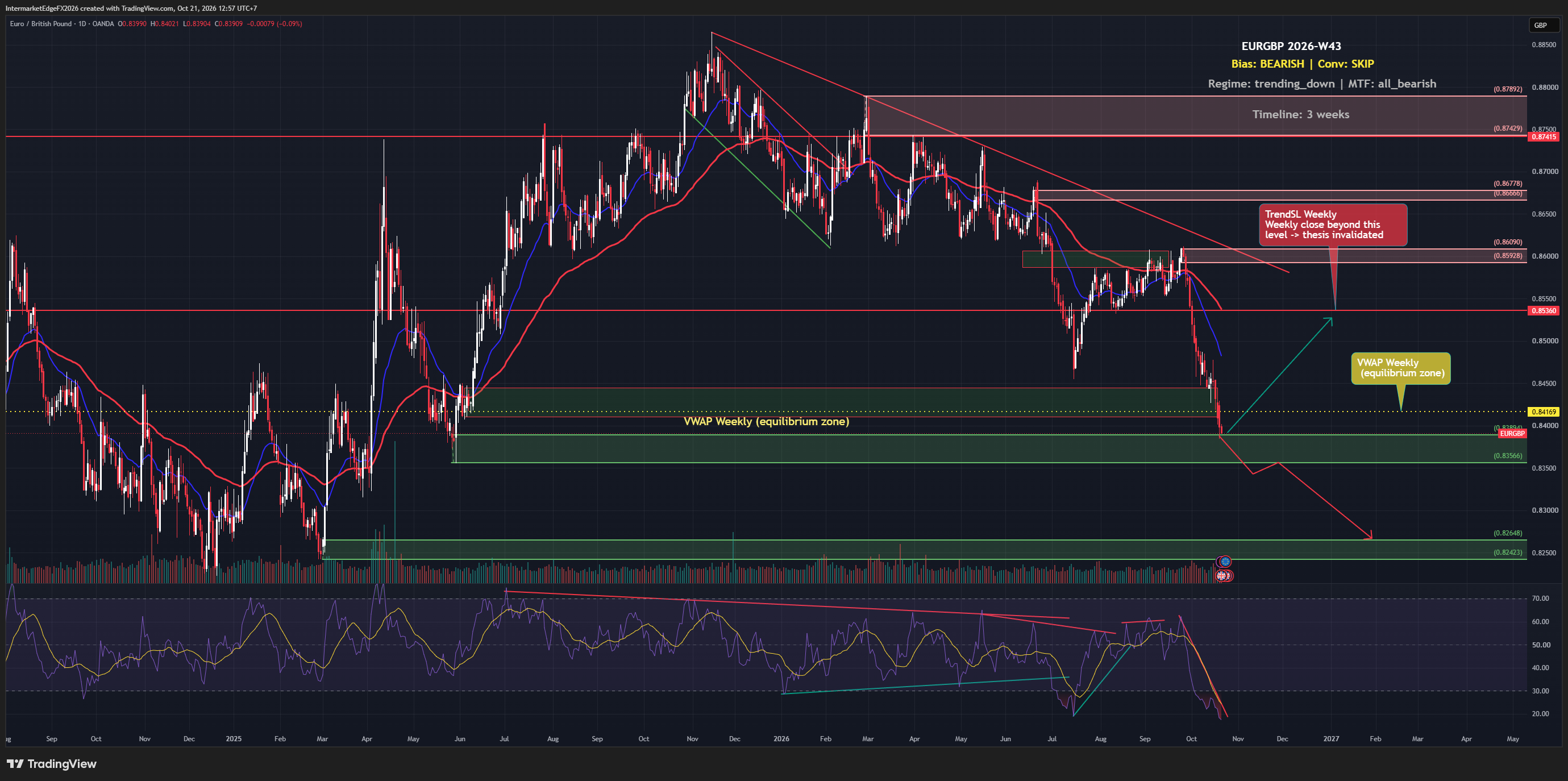
EURGBP W43: bearish three-week view; stand aside. Downward trends coexist with bullish price action. At 05:38 UTC on Wednesday, 21 October 2026, EURGBP was 0.83944, below weekly VWAP 0.84169 and below weekly TrendSL 0.85360. Source: mt5:EURGBP.sml:1m. This is a dated observation, not a live quote. Both risk conditions remain pending in this observation. If price sustains above weekly VWAP 0.84169, momentum would run against the bearish view and short exposure would warrant reduced size. A weekly close above TrendSL 0.85360 would invalidate the bearish structure: exit shorts and reassess. The momentum watch has no added daily or weekly closing requirement. FXSSI: 72% long / 28% short, collected 21 October at 05:38:28 UTC. Broker sample, provider observation time unverified; contrarian context, not an independent sell signal. COT CFTC TFF, Leveraged Funds, report date 2026-10-13: EUR 099741 net short 68,001, net change -23,740; GBP 096742 net long 10,313, change -2,119 contracts versus 6 October. Separate futures components, not direct EURGBP positions; release dates unverified. This is a pre-CPI assessment. ONS scheduled UK September CPI for 21 October at 06:00 UTC. No actual outcome is included. Hotter UK inflation could support GBP if relative rate expectations rise; softer inflation could support a recovery in EURGBP. Check price and relative yields after the release. Intermarket Edge | Institutional Macro & Intermarket Analysis For informational and educational purposes only. Not financial advice.
GBPUSD W43: Sterling Resilience Challenges the Bearish View

GBPUSD W43: Sterling Resilience Challenges the Bearish View

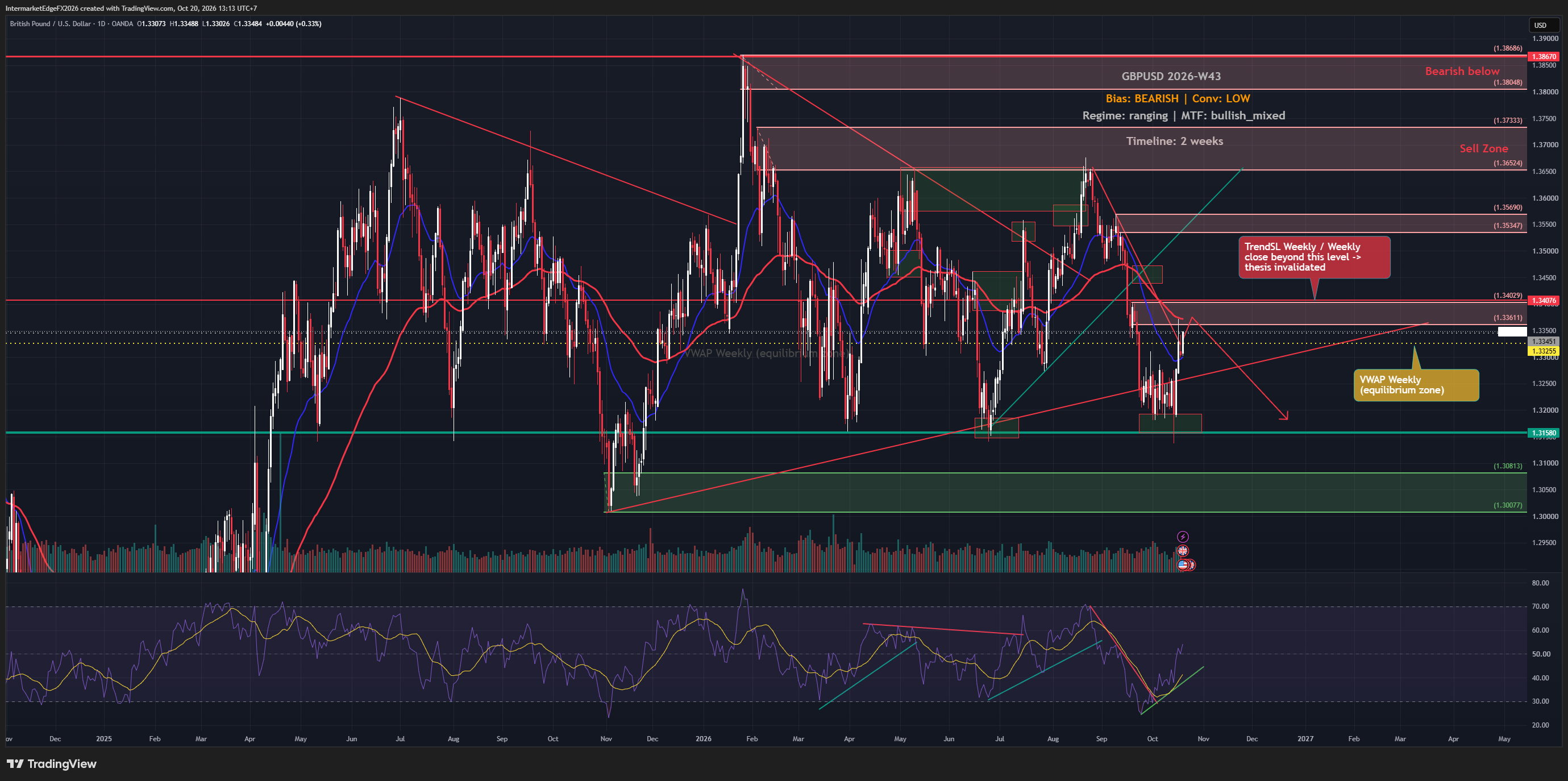
GBPUSD W43: bearish, low confidence; two-week horizon, ranging conditions and mixed bullish signals. At 05:55 UTC on 20 October 2026, GBPUSD was 1.33273, above weekly VWAP 1.33255 and below weekly TrendSL 1.34076. Source: mt5:GBPUSD.sml:1m. This is a dated observation, not a live quote. The momentum warning is already active: existing shorts warrant reduced size now. Structural invalidation remains pending: a weekly close above TrendSL 1.34076 would invalidate the bearish structure; exit shorts and reassess if that condition occurs. The weekly closing rule applies to structural invalidation, not to the momentum warning. FXSSI: 52% long / 48% short, collected at 05:54:49 UTC on 20 October. The four-percentage-point imbalance is small and provides no contrarian lean under the framework. This is a broker sample, not the entire FX market; collection time is not a separately verified provider timestamp. COT CFTC 096742, Leveraged Funds, futures only, report date 2026-10-13: net long 10,313 contracts, down 2,119 from 6 October. Lagged positioning; publication date unverified. Falling net length is not net short. Sterling strength against EUR does not establish strength against USD. The UK growth surprise is a counterweight to the bearish view; comparable UK yields are needed to verify a UK-US rate advantage. UK CPI is listed for 21 October by ForexFactory, not independently confirmed against an official calendar here. New exposure can wait for clearer agreement. Intermarket Edge | Institutional Macro & Intermarket Analysis For informational and educational purposes only. Not financial advice.
GBPUSD W42: A Bearish Trend Meets a Policy Test

GBPUSD W42: A Bearish Trend Meets a Policy Test

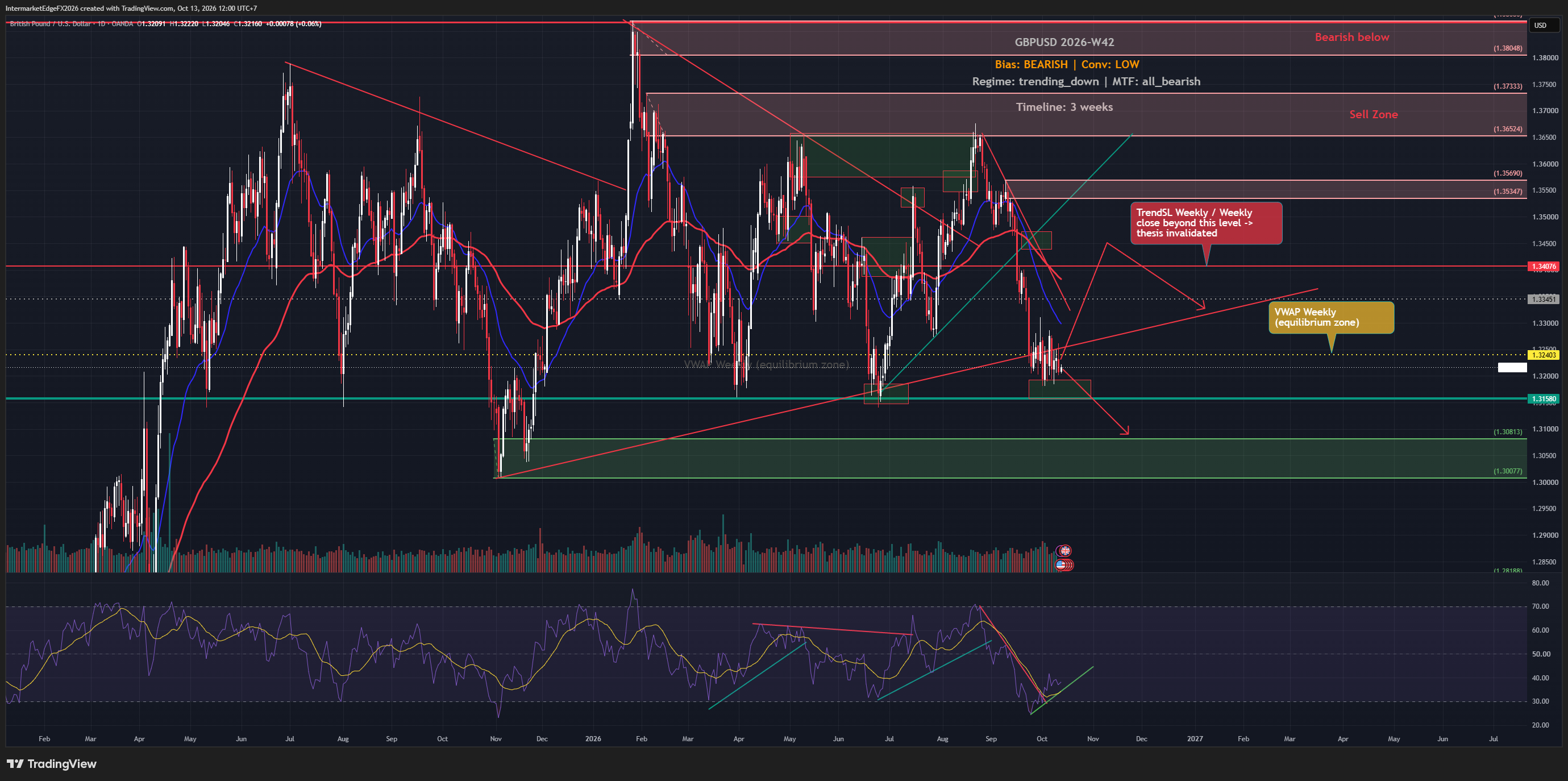
GBPUSD W42: bearish three-week view, low confidence. At 13/10/2026 05:01 UTC, GBPUSD was 1.32168, below weekly VWAP 1.32403 and below weekly TrendSL 1.34076. Source: mt5:GBPUSD.sml:1m, a timestamped broker quote. If price sustains above 1.32403, the momentum warning against the bearish thesis would activate and call for reducing risk. This condition remains pending; it does not require a weekly close. A completed weekly close above 1.34076 would invalidate the bearish structure, requiring an exit from the bearish thesis and reassessment. This condition remains pending. Greene's inflation concerns could support GBP if UK rate expectations rise relative to US expectations. Watch DXY and comparable UK-US yields rather than assuming a spread from US data alone. ForexFactory lists US CPI on 14 October and UK GDP plus US retail sales/PPI on 15 October; this is a secondary calendar source. Wait for the data response before assessing new entries. --- Intermarket Edge | Institutional Macro & Intermarket Analysis For informational and educational purposes only. Not financial advice.
GBPUSD Week W39-2026: Pound Dips Near Seven-Week Lows as Fed-BoE Divergence Tightens the Trap

GBPUSD Week W39-2026: Pound Dips Near Seven-Week Lows as Fed-BoE Divergence Tightens the Trap

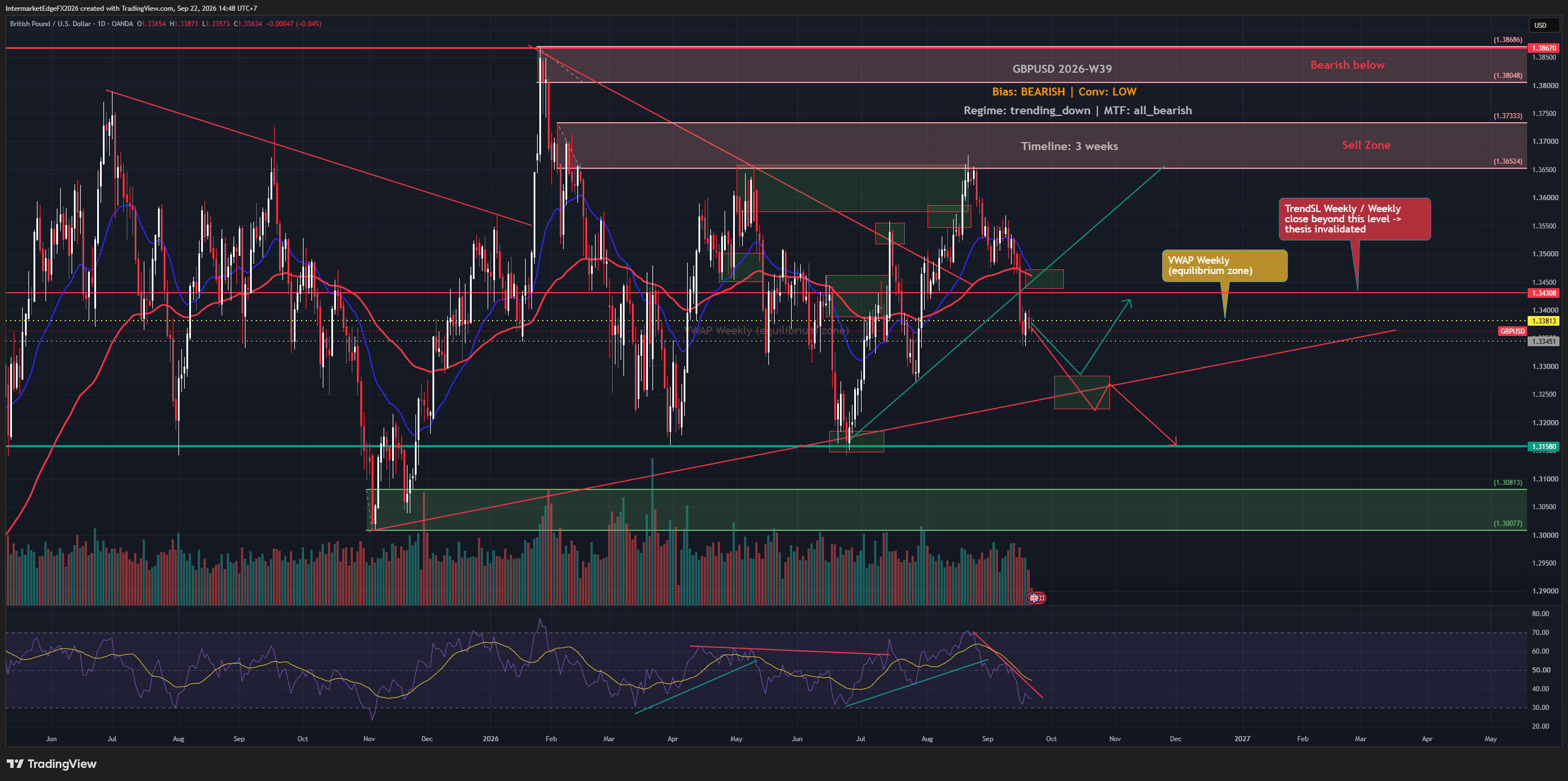
Sterling is trading near seven-week lows as the Fed-BoE policy gap favors the dollar, but this is not a clean sell setup. At the Tuesday, 22 September 2026 observation, GBPUSD was already above weekly VWAP at 1.33813 and testing it from above, so short-term momentum was running against the bearish macro thesis. The broader assessment remains bearish because the rate differential and multi-timeframe structure still point lower, but conviction is low and the timing evidence is incomplete. FXSSI reports that 67% of its broker-level retail sample is net long GBPUSD, which provides contrarian context but no calibrated directional signal and no evidence about institutional flows. The decision is to stand aside. A weekly close above TrendSL at 1.34308 would invalidate the bearish structure and require a reassessment. -- Intermarket Edge

GBPUSD W37-2026: Bullish Technical Structure Conflicts With the Bearish Macro View

GBPUSD W37-2026: Bullish Technical Structure Conflicts With the Bearish Macro View

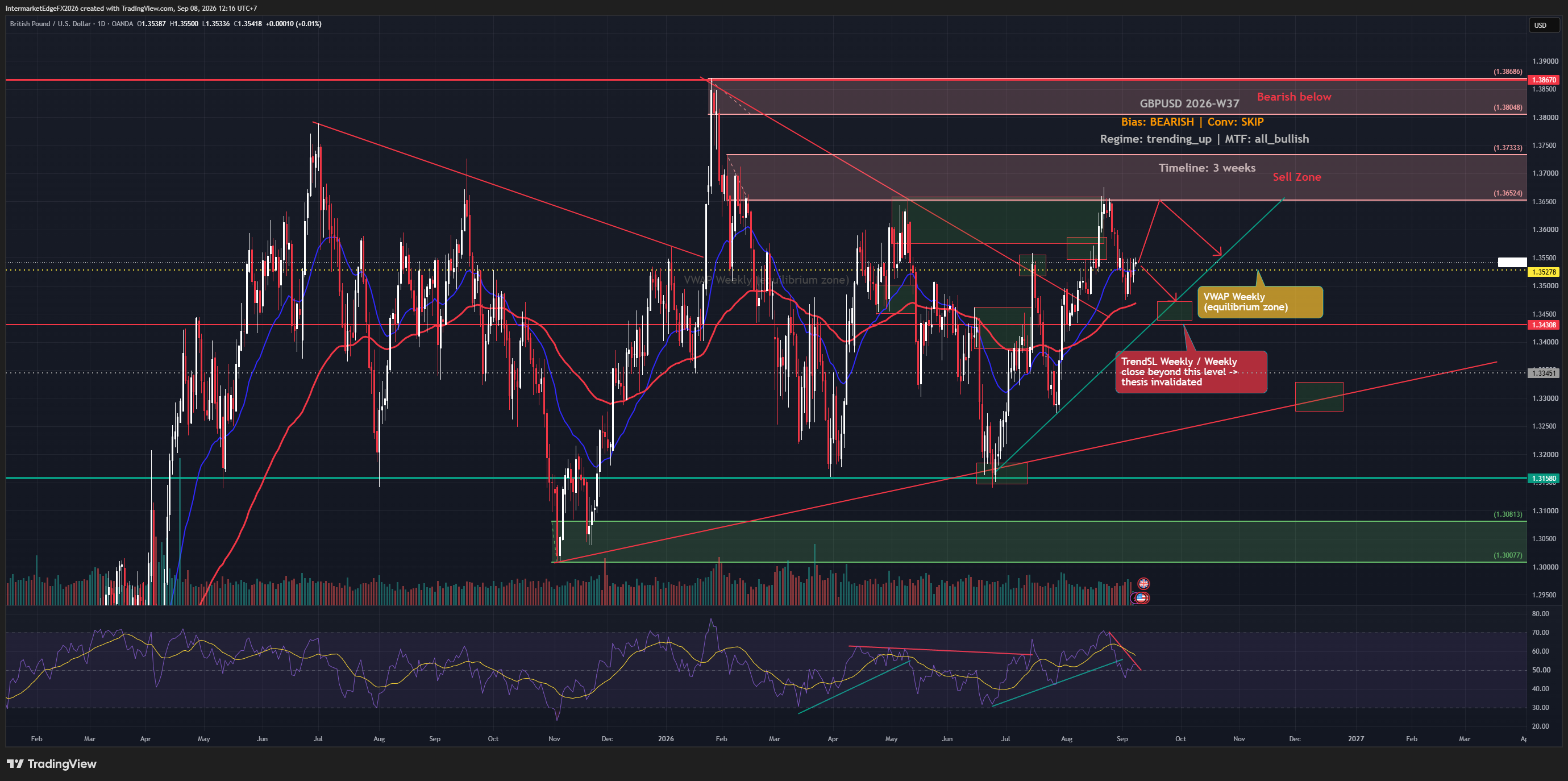
GBPUSD is technically bullish but carries a low-confidence bearish macro bias for W37-2026. The practical decision is to stand aside over a three-week analysis horizon. The locked price was 1.35479 at 05:03 UTC on Tuesday, September 8, 2026, from mt5:GBPUSD.sml:1m. Price was above weekly VWAP 1.35278 by about 20 pips and above weekly TrendSL 1.34308 by about 117 pips. The bullish structure is already active; the bearish label is not technically confirmed. A weekly close below 1.34308 is the defined bearish confirmation condition, not an automatic sell instruction. Strong US payrolls increased expectations of a Fed rate hike, while Reuters reported broad dollar softness ahead of August CPI. The CPI outcome is unknown. The US 10-year real-yield reference is 2.42%, but one level does not prove yields rose or that the US–UK rate differential widened. Huw Pill supported raising Bank Rate to 4% and warned about persistent second-round inflation effects from energy shocks. John Healey pledged fiscal discipline, but sterling received little clear direction from the speech. The COT input is directionally bearish for GBPUSD; its report week, release date and net position are missing, so it cannot establish current crowding or flows. Watch US PPI on September 10, then UK monthly GDP and US CPI on September 11, per ForexFactory calendar data. Outcomes remain unknown. Reassess after the releases and price reaction. Intermarket Edge For informational and educational purposes only. Not financial advice.
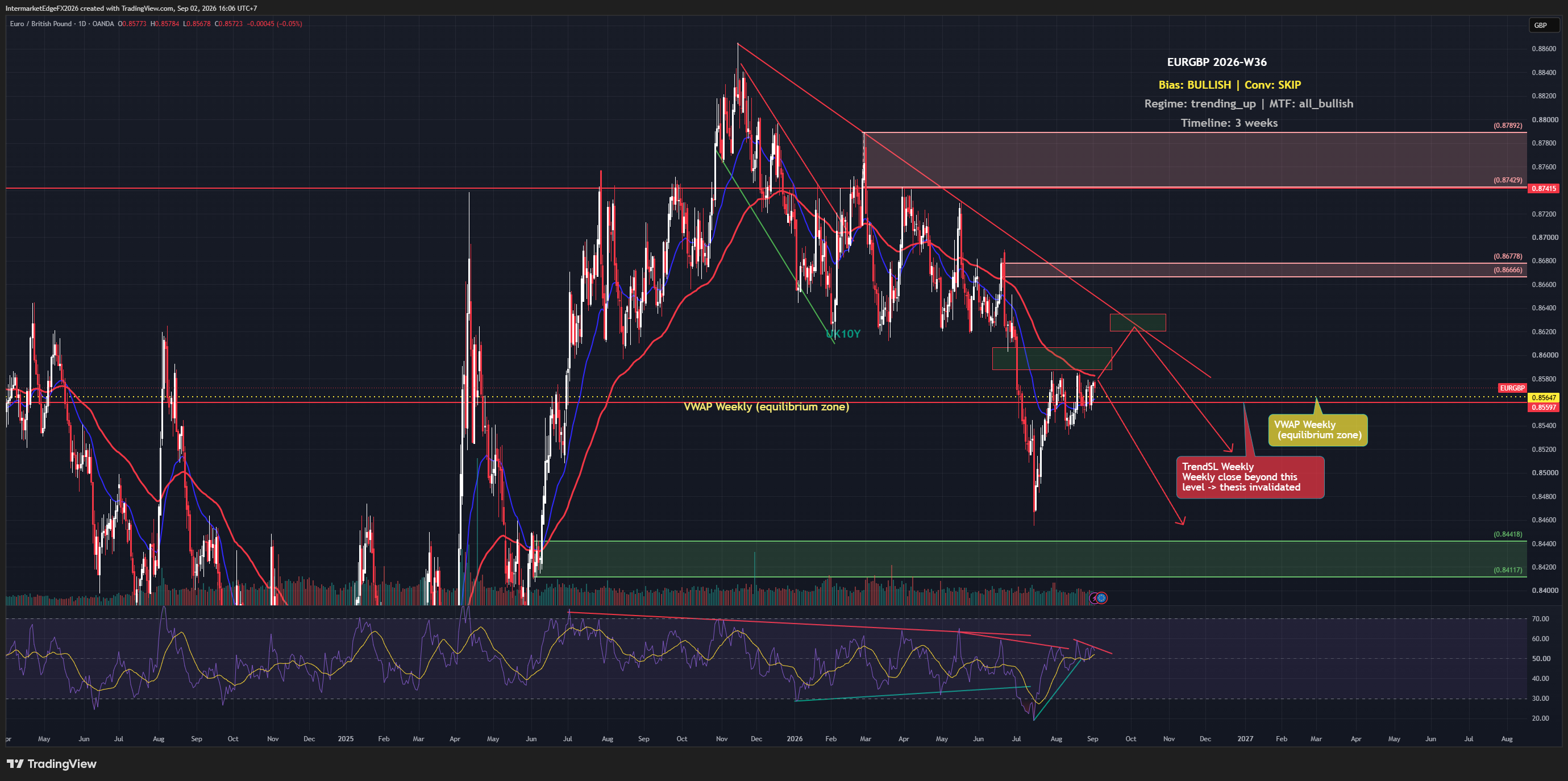
EURGBP Week W36-2026: Technicals Hold Bullish Structure Above 0.85647, But the Macro Story Has a Hole in It

EURGBP Week W36-2026: Technicals Hold Bullish Structure Above 0.85647, But the Macro Story Has a Hole in It

EURGBP is trading above its weekly VWAP at 0.8577 as of Wednesday, 02 September 2026, with charts aligned bullish across every timeframe. The catch: the entire bullish case rests on technical structure alone, no macro confirmation, no positioning signal, nothing beyond price telling you which way to lean. That narrow foundation is exactly what makes this week's setup worth watching carefully rather than trading aggressively. The bullish bias on EURGBP this week is real but structurally thin. Daily, weekly, and monthly technical trend signals are all pointing the same direction, that multi-timeframe alignment, where price structure agrees across short, medium, and long horizons, is the strongest argument for the upside case. It reduces the probability that you are catching a random short-term noise move against a larger trend. What it does not do is tell you why the move should continue or how far it goes. The stated fundamental driver for this pair is the ECB versus BoE rate differential, the gap between where the two central banks are setting rates and where markets expect them to go, which directly affects the relative attractiveness of holding euros versus pounds. That differential is a plausible and historically significant driver for EURGBP. The problem this week is that the macro evidence has produced no confirming signal. The rate differential is the narrative, but the data behind it has not fired. That gap between a coherent story and an absent signal is the defining tension. The practical consequence is that the conviction level here amounts to a deliberate decision to stand aside. The technical foundation is present; everything else that would normally underpin a higher-confidence directional trade, positioning data, a macro catalyst, sentiment confirmation, is not contributing. -- Intermarket Edge

EURJPY Week W36-2026: Technicals Hold Above 185.37 as Japan's Retail Sales Surge Meets a Dollar Bidding for Rate Hikes

EURJPY Week W36-2026: Technicals Hold Above 185.37 as Japan's Retail Sales Surge Meets a Dollar Bidding for Rate Hikes

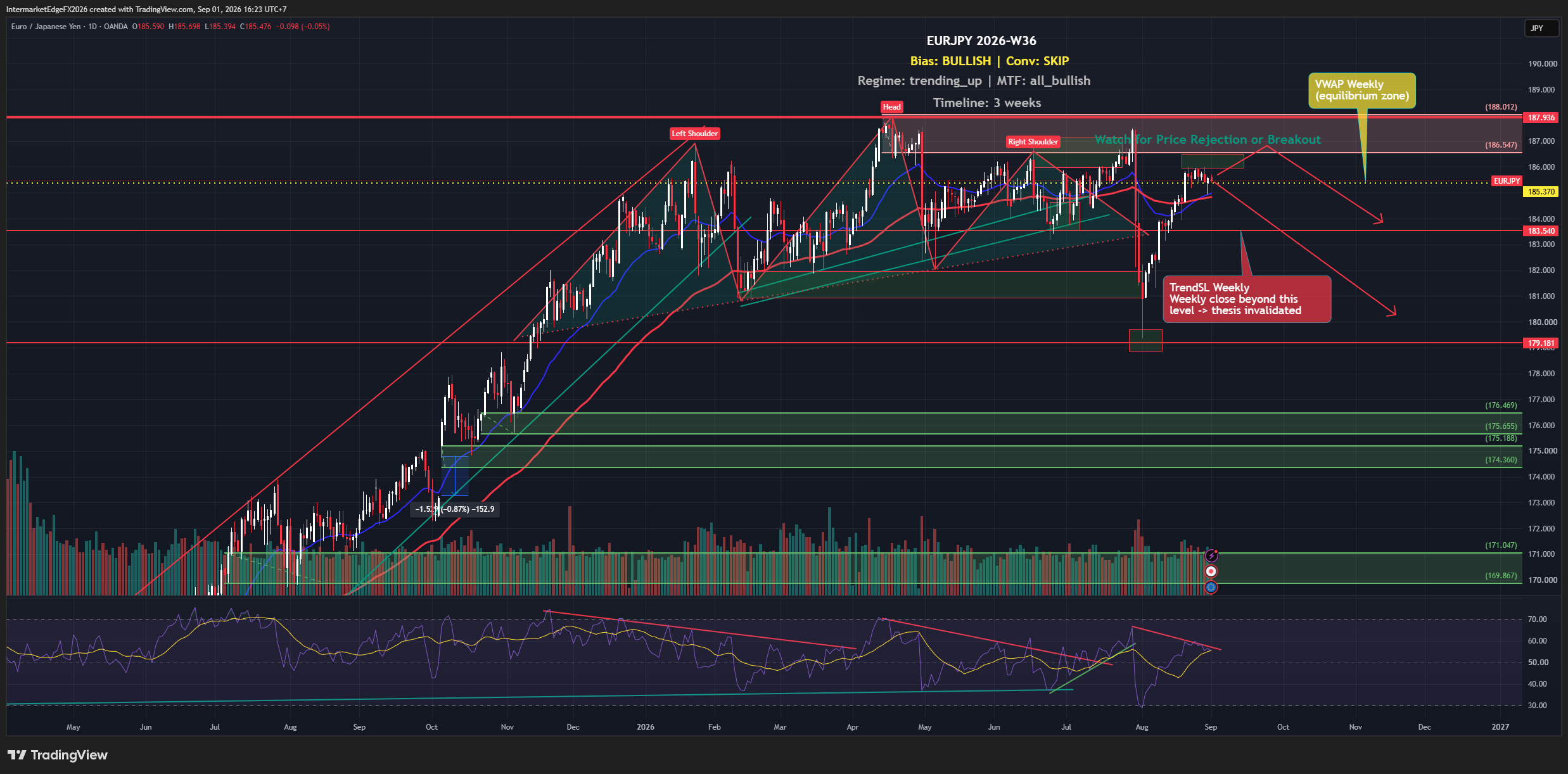
EURJPY is trading at 185.6 as of Tuesday, 01 September 2026, sitting just above its weekly VWAP at 185.37 with every timeframe technically aligned to the upside. Japan just delivered a retail sales print of 4.0% YoY, nearly double the forecast, and industrial output surprised to the upside as well. Yet the overall bullish conviction here is deliberately low, and that gap between clean technicals and absent macro support is exactly the tension worth understanding before sizing any exposure. The bullish bias on EURJPY for week W36-2026 rests on a single, structurally sound but narrowly sourced pillar: every technical timeframe, daily, weekly, and monthly, is aligned to the upside. That kind of multi-timeframe agreement is not common and is not trivial; it indicates the dominant trend is consistently reproduced at every analytical resolution, which reduces the probability that any one signal is noise. The practical effect is that the path of least resistance, absent a disrupting catalyst, points higher. What complicates this is that technical alignment is the only signal firing. COT positioning, which measures how leveraged and institutional accounts are positioned and would indicate whether professional capital is actually behind the move, has returned neutral with no directional read this week, so it is not possible to say the trend is being driven by the kind of committed positioning that sustains extended moves. Macro signals, sentiment gauges, and liquidity conditions have all returned similarly flat. This matters because a trend that rests solely on price-derived signals, without confirmation from who is positioned and why, carries crowding risk in a different form: the risk that the apparent trend is thin and vulnerable to a rapid unwind the moment a real macro trigger appears. The BOJ policy trajectory is the most direct potential disruptor on the JPY leg. -- Intermarket Edge (Note: COT (Commitment of Traders) data is released weekly by the CFTC with a report

GBPUSD Weekly Outlook W36: Bullish Structure, Bearish Macro Pressure

GBPUSD Weekly Outlook W36: Bullish Structure, Bearish Macro Pressure

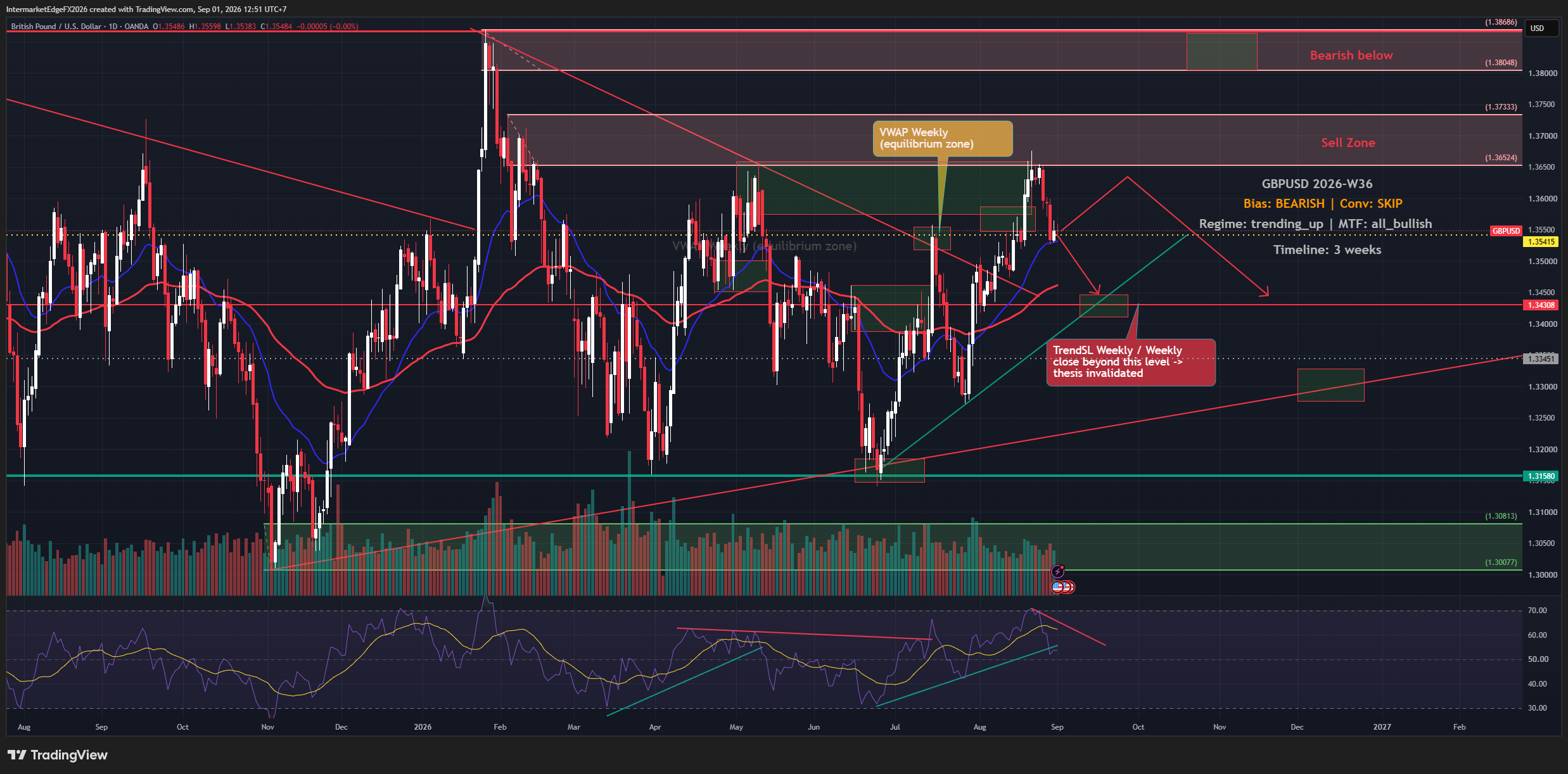
GBPUSD is printing a weekly loss as markets reassess the BoE-Fed policy divergence, but the technical structure refuses to cooperate with the bearish story. As of Tuesday, 01 September 2026, price sits at 1.35433, holding above the weekly VWAP at 1.35415 and well above the weekly trend support at 1.34308. The macro case for sterling weakness is building, yet the chart is not confirming it. That disconnect is the entire trade problem this week. The framework lands on a bearish bias for GBPUSD over a three-week horizon, but that label carries a deliberate caveat: this is a case where the evidence is not yet convincing enough to size a position, and staying out is itself a reasoned decision rather than the absence of a view. The bearish case rests on two causal chains that are both active right now. First, Fed hawkishness combined with rising real yields creates a structural USD bid, when real yields rise, the opportunity cost of holding non-dollar assets increases, pulling capital toward the dollar and mechanically weighing on GBPUSD. Second, DXY strength, itself driven by the same real yield dynamic, amplifies that pressure through a separate channel, since broad dollar appreciation tends to compress GBPUSD regardless of sterling-specific factors. COT data adds a warning layer: speculative positioning in GBP is already tilted heavily long, which matters because crowding risk, the danger that most participants who want to be long are already long, leaving fewer buyers to sustain the move, raises the probability of a disorderly unwind if sentiment shifts. The positioning evidence here should be read as directional in character, not as a citable statistic, since the specific report date, net position figure, and sample context are not available in this brief. -- Intermarket Edge

GBPUSD Week W35-2026: Sterling Pauses at Six-Month Highs as Iran Sanctions and Debt Nerves Pull in Opposite Directions

GBPUSD Week W35-2026: Sterling Pauses at Six-Month Highs as Iran Sanctions and Debt Nerves Pull in Opposite Directions

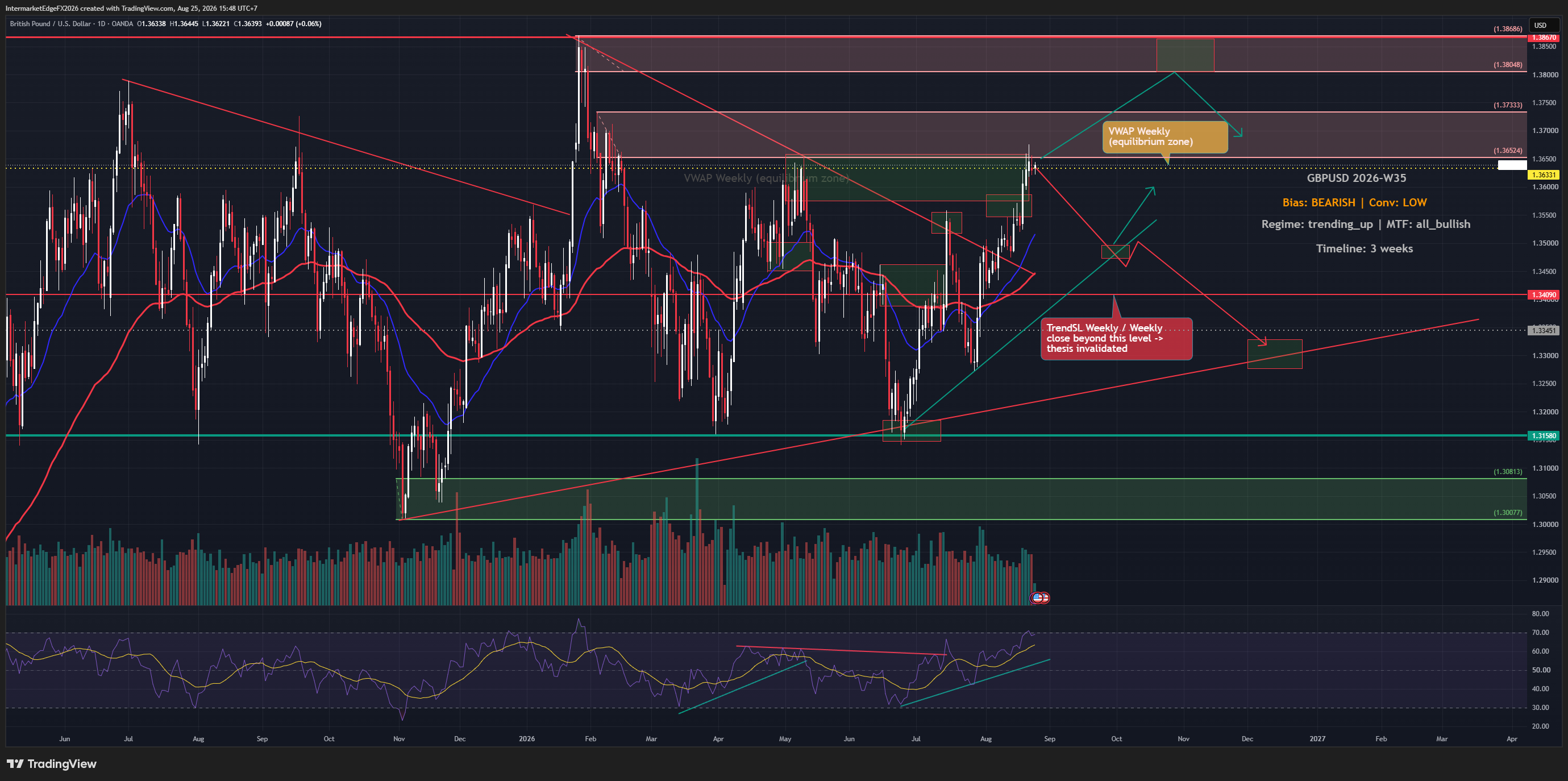
Sterling has climbed for four straight weeks, but as of Tuesday 25 August the rally has quietly stalled just beneath the weekly VWAP at 1.36331, a ceiling the market is testing from underneath. The pause is not random: speculators are already extreme long GBP according to COT data, and US real yields are sitting at 2.4%, a level that mechanically favors dollar strength. The direction everyone thinks they know may be the setup that punishes them. The framework carries a bearish bias on GBPUSD this week, but the conviction behind that call is deliberately low, and understanding why matters more than the label itself. The bearish case rests on two pillars: macro and positioning. On the macro side, Fed hawkishness combined with a 2.4% real yield creates conditions where the dollar should attract flows regardless of what the BOE does, because the USD is offering inflation-adjusted return that sterling cannot easily match. On the positioning side, COT data, which tracks the net futures positioning of speculative accounts, used here as a directional sentiment gauge rather than a standalone citable statistic since the specific report week and net-position figures are not available in this brief, shows speculators are already extremely long GBP. The practical implication of crowding risk, meaning positioning so concentrated on one side that the market runs out of new buyers, is that any negative catalyst does not just stop the rally: it triggers a cascade of exits from the same crowded trade, accelerating the move lower far beyond what fundamentals alone would justify. The problem is that everything else is still pointing up. Price action scores bullishly, the multi-timeframe alignment is entirely bullish, and the macro backdrop for sterling, firm rate-hike bets, subdued dollar, has not broken down. -- Intermarket Edge

Stay in the loop

Get notified about new research, macro insights, and market analysis.

InterMarketEdge

© 2026 InterMarketEdge. Financial intelligence for inter-market traders.