Tag: BoE — InterMarketEdge

Tag: BoE

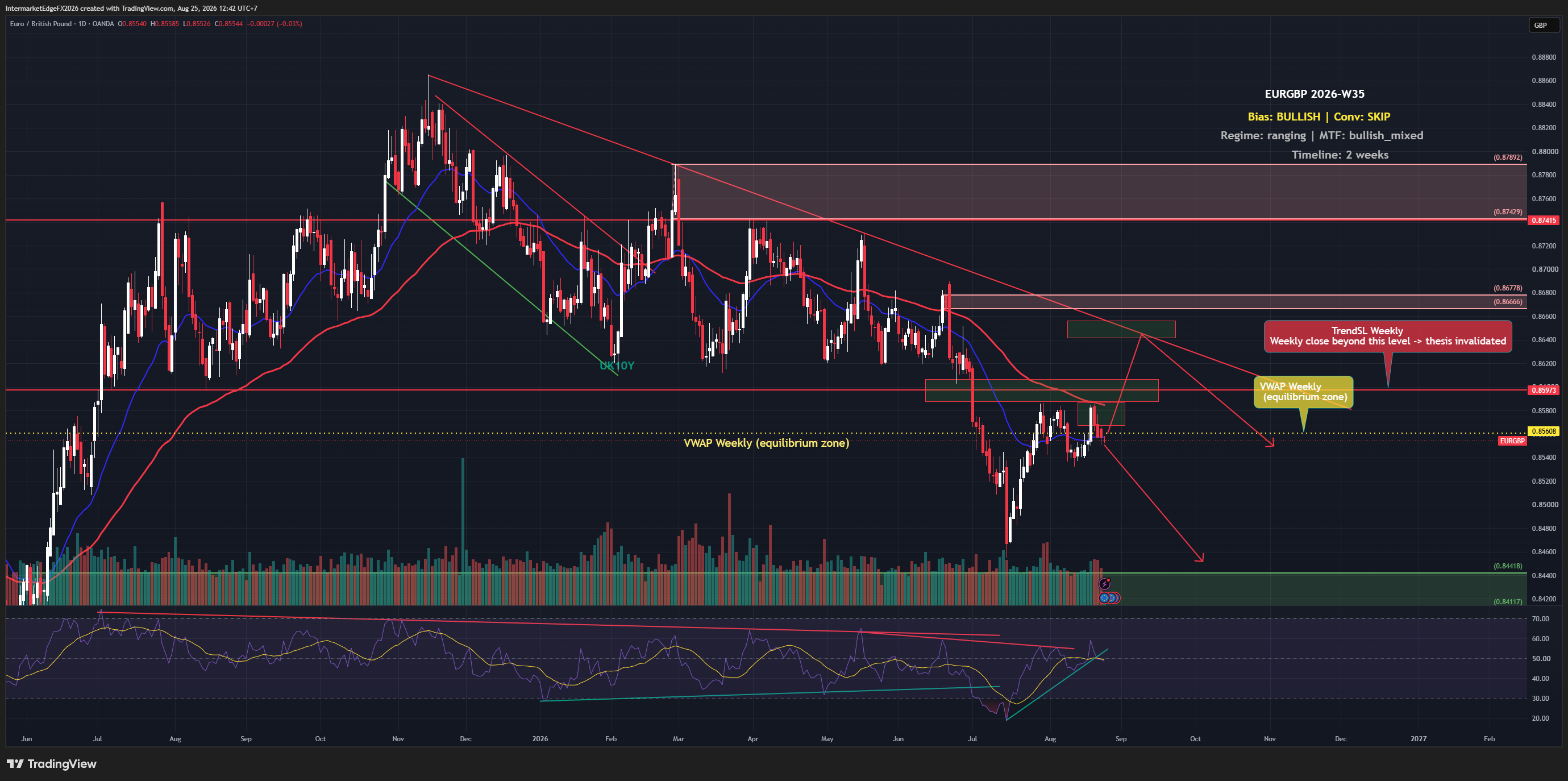
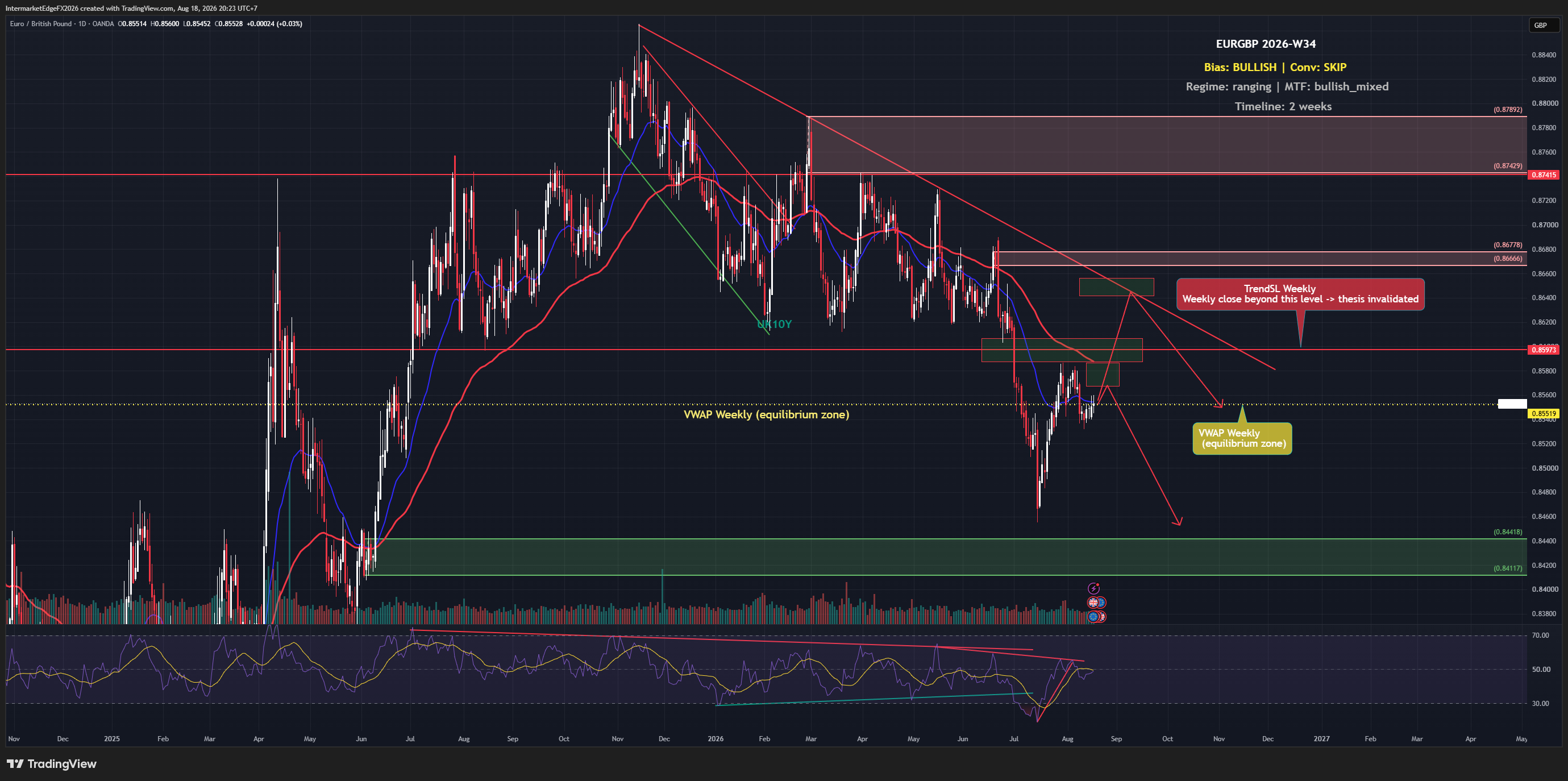
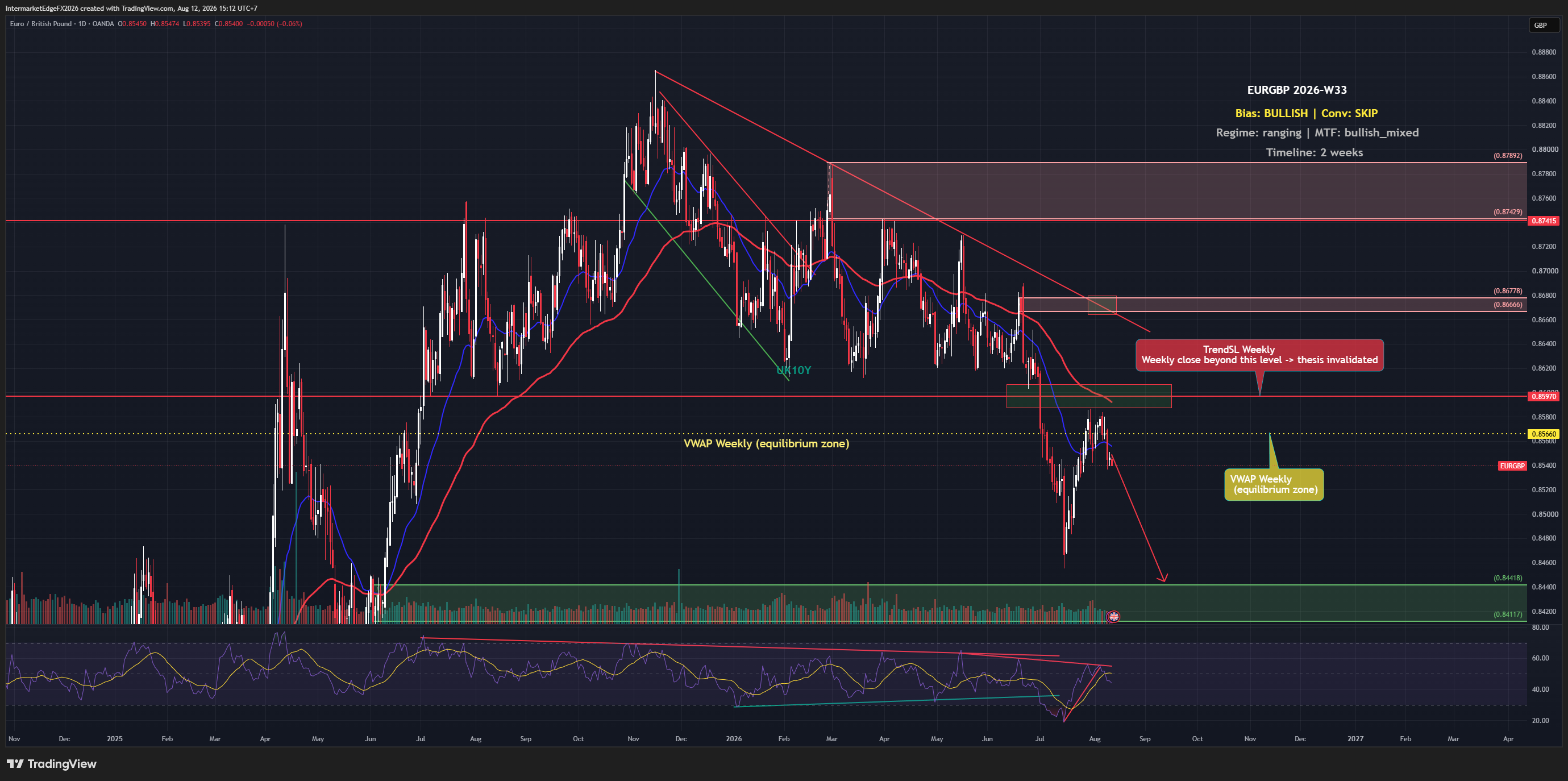
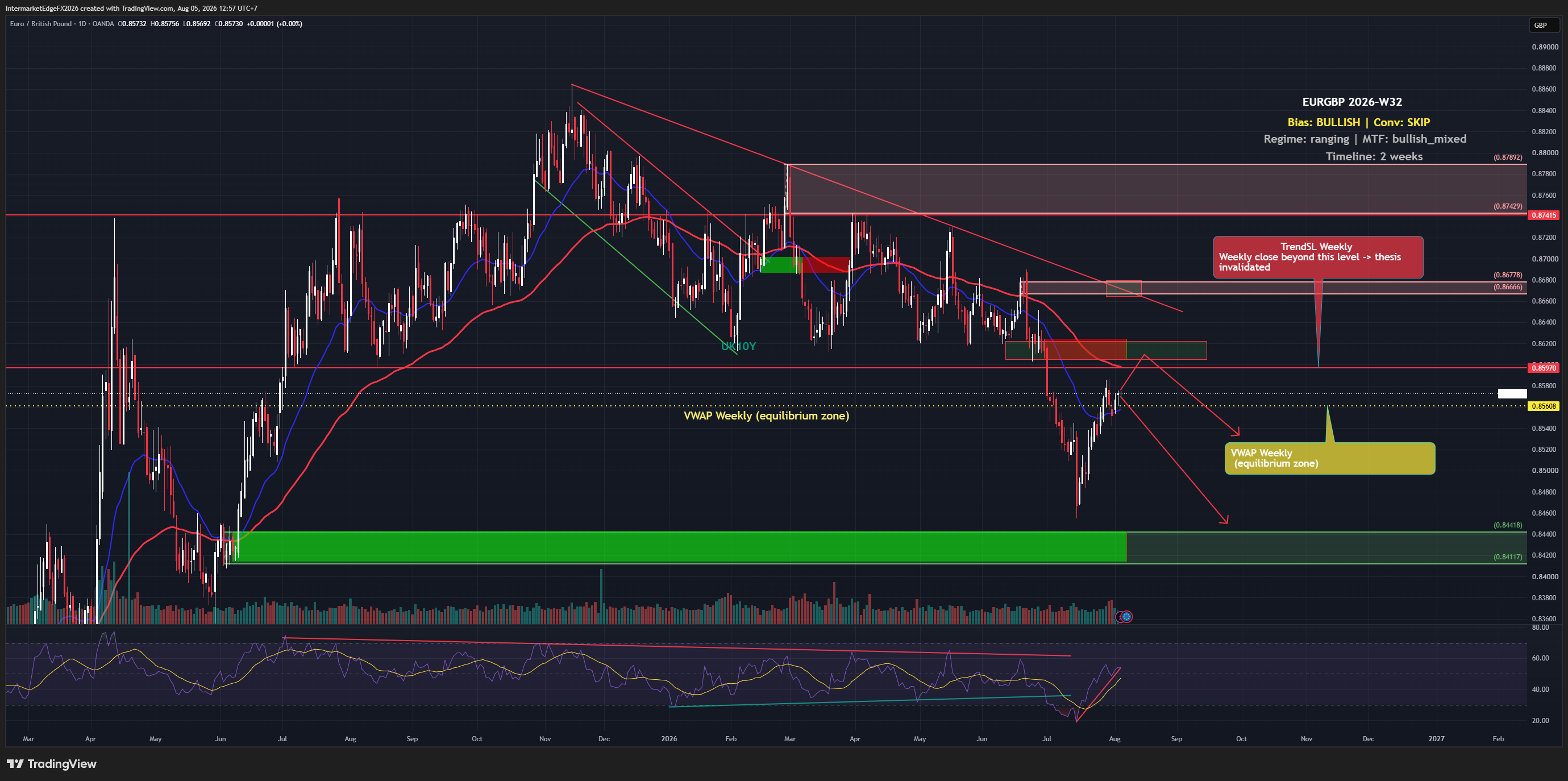
EURGBP Week W32-2026: BOE Holds at 3.75% but Bailey Pushes Back on Hike Bets, Price Tests From Underneath TrendSL 0.8597 With Conviction Too Thin to Chase

EURGBP Week W32-2026: BOE Holds at 3.75% but Bailey Pushes Back on Hike Bets, Price Tests From Underneath TrendSL 0.8597 With Conviction Too Thin to Chase

EURGBP is flashing a nominal bullish bias this week, but the setup is paper-thin. The Bank of England held rates at 3.75% on Wednesday 05 August 2026, and Governor Bailey went out of his way to shut down hike speculation, yet sterling is barely moving. With conviction at skip level and the technical structure already contradicting the directional label, this is one of those weeks where discipline means watching, not trading. The system flags a bullish bias on EURGBP for Week W32-2026, but the conviction level is explicitly rated as skip, meaning the framework itself is telling traders to stand aside rather than position. It is worth unpacking why the bullish label exists at all, and why it should be treated with significant scepticism. The sole active signal driving the directional tilt is price action; contributions from commitments of traders positioning, macro data, liquidity conditions, and sentiment are all neutral, registering zero weight. That means the bullish thesis rests on a single, thin pillar with no corroborating evidence from any other analytical lens. The stated primary driver is the ECB versus BOE rate differential, a legitimate structural theme in principle, but no macro or positioning rules have fired to confirm this narrative in the current week. There is a direct conflict between the cited driver and the absence of any supporting data firing in its favour, which should give traders real pause. Adding to the complexity, the eurozone core CPI miss removes a near-term catalyst for ECB hawkishness, while Bailey's explicit pushback on BOE hike expectations muddies the rate-differential story from the other side. Structural bias is assessed as neutral, which further undermines the weak bullish lean. -- Intermarket Edge

EURJPY Week W32-2026: US Yen-Buying Intervention Drives Price Below 184.58 VWAP as BOJ Holds at 1% and Flags Further Hike

EURJPY Week W32-2026: US Yen-Buying Intervention Drives Price Below 184.58 VWAP as BOJ Holds at 1% and Flags Further Hike

EURJPY is trading at 181.67 as of Tuesday, 04 August 2026, 09:09 UTC, nearly 3 full points below the weekly VWAP of 184.58, after the US shook currency markets by buying yen directly through euro sales. The BOJ held its overnight rate at 1% but reiterated its hiking path, keeping carry-unwind pressure alive. The multi-timeframe picture is all-bearish, yet conflicting signals between price action and macro mean conviction sits at skip level: the trend is real, but the evidence base is thin. The overall bias for EURJPY in Week W32-2026 is bearish, but the conviction level is explicitly rated skip, meaning the signal exists, but the evidence base is too thin and too conflicted to support a high-confidence directional trade. Let that framing govern everything that follows. The primary bearish driver is structural: BOJ hawkishness, reinforced by this week's hold-with-hike-guidance, pressures the rate differential that underpins euro-yen carry positioning. When the BOJ signals continued tightening while the ECB faces disinflationary data, the carry unwind dynamic, where traders exit long-EURJPY positions funded by cheap yen borrowing, becomes a credible medium-term force. The US intervention reported this week, specifically buying yen through euro sales rather than through the conventional dollar channel, is an unusually direct policy statement that adds event-driven downside pressure on top of the structural story. The regime is classified as trending down with moderate confidence, and the multi-timeframe alignment reads all-bearish, which in isolation would support a trend-follow posture. However, the thesis-level signal contains a direct conflict: price action scores bullish while the macro overlay scores bearish, producing a weak net bearish read with very low conviction overall. -- Intermarket Edge

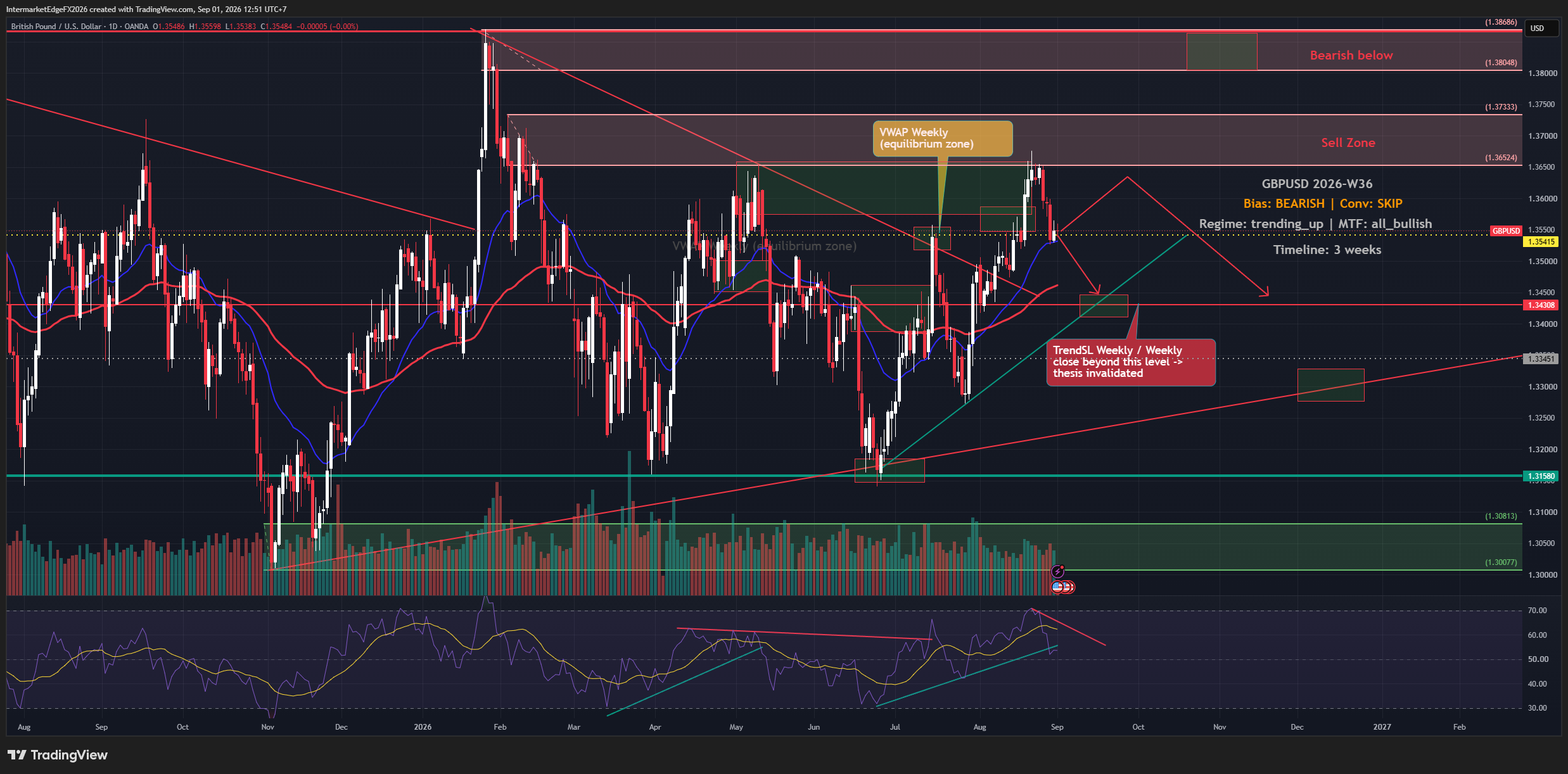
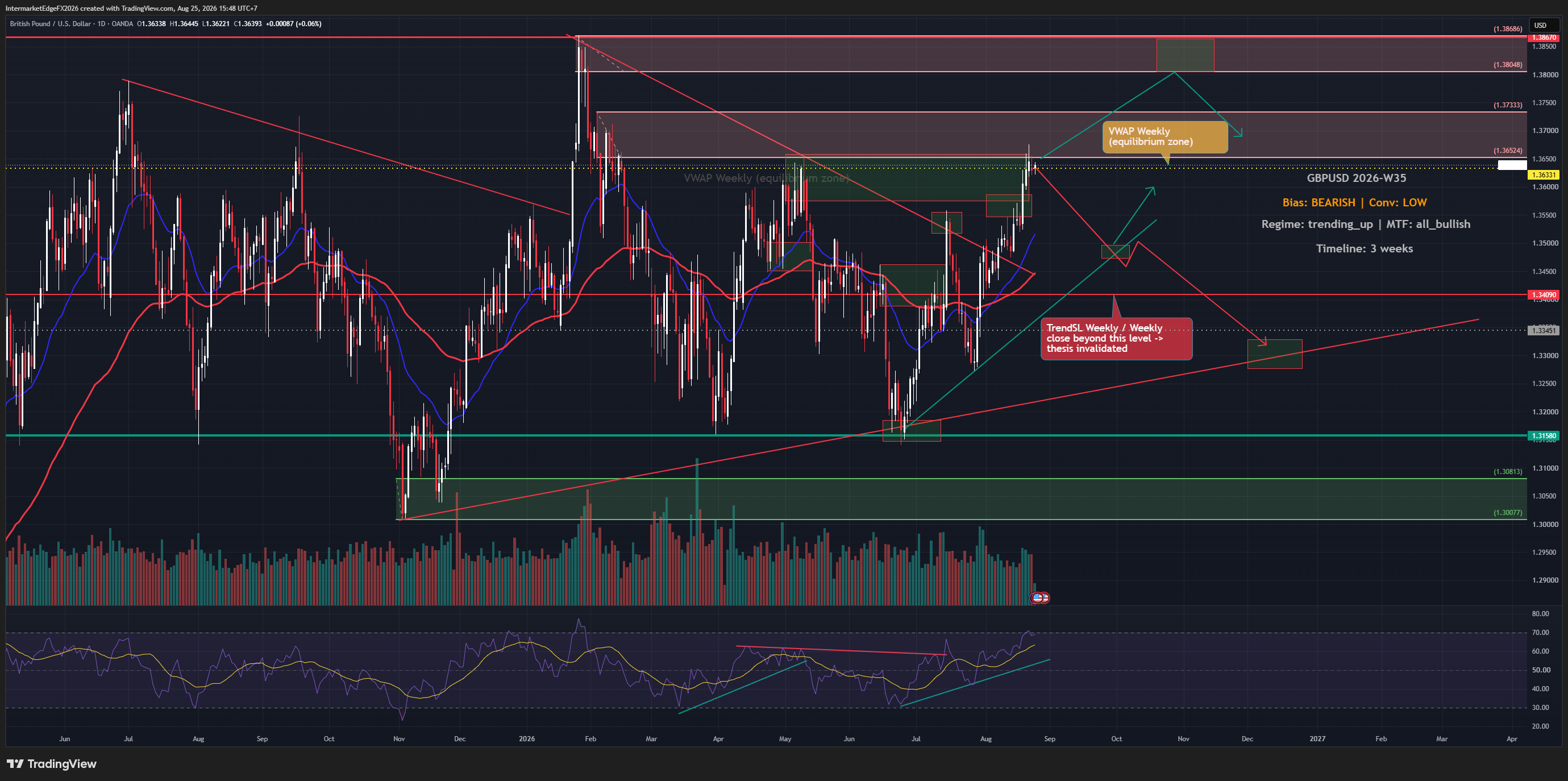
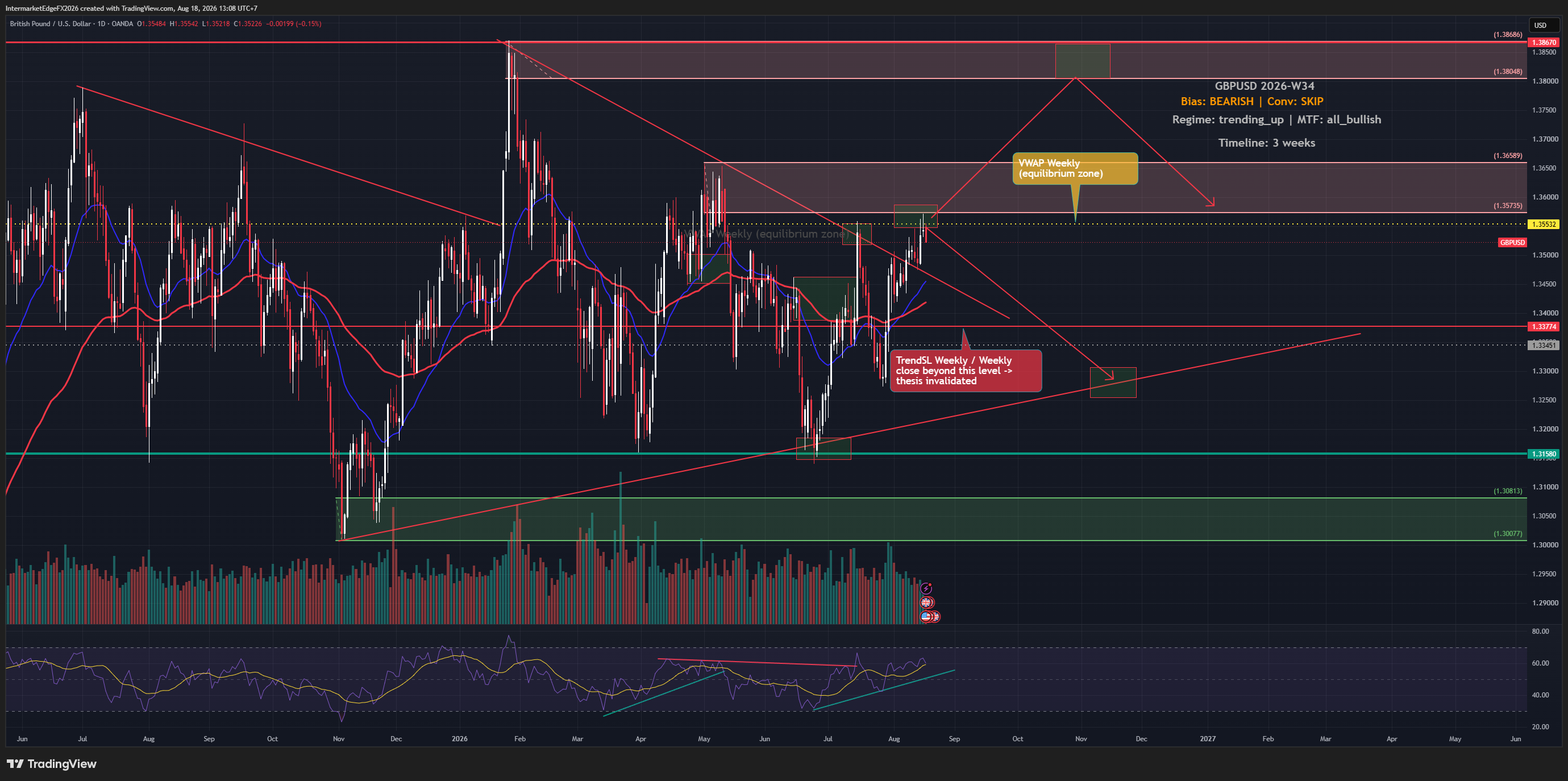
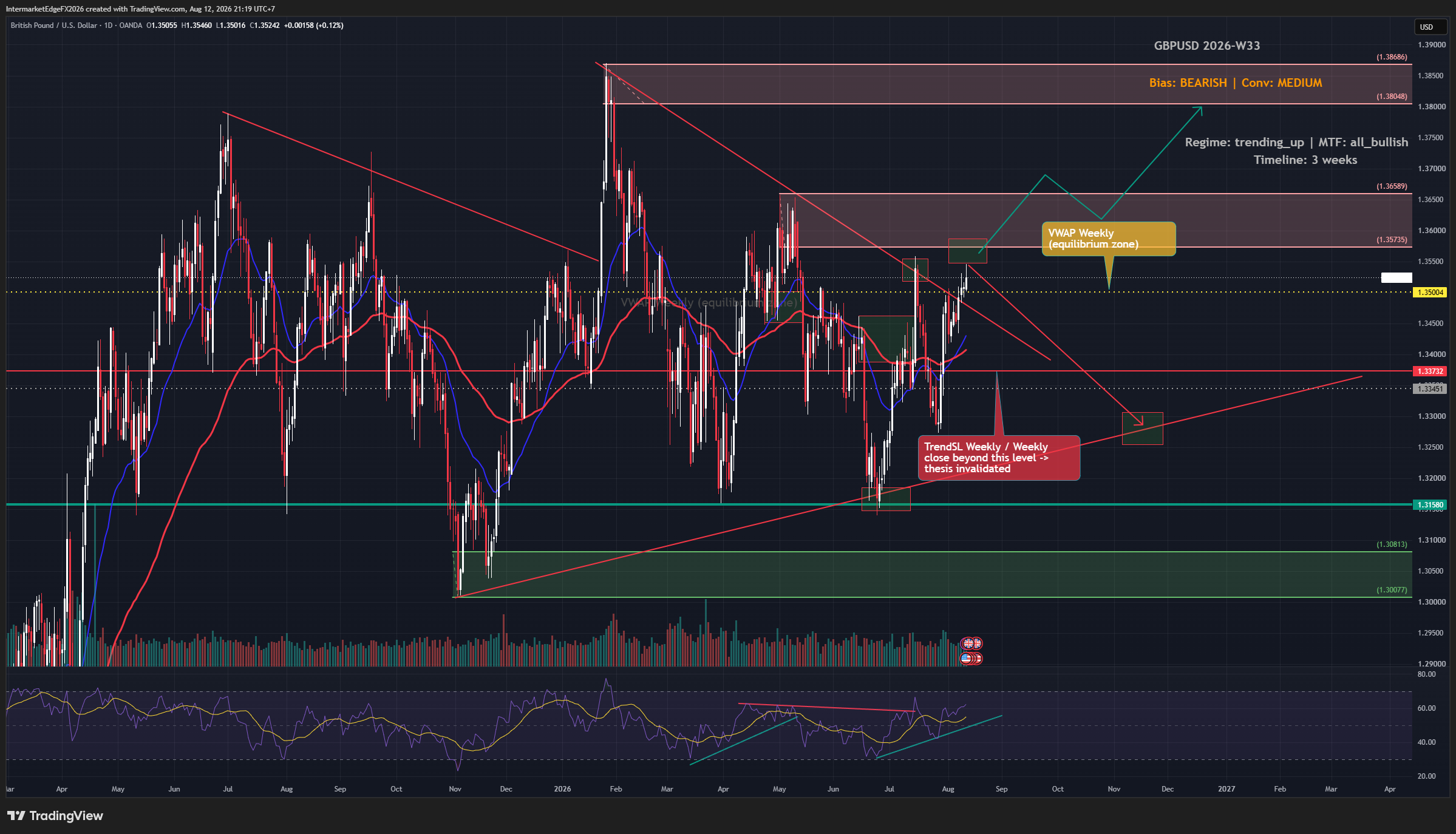
GBPUSD Week W32-2026: Sterling Slips Below 1.35 Despite Broad Dollar Weakness, Bearish Label Undercut by All-Bullish Technical Alignment Above TrendSL 1.33859

GBPUSD Week W32-2026: Sterling Slips Below 1.35 Despite Broad Dollar Weakness, Bearish Label Undercut by All-Bullish Technical Alignment Above TrendSL 1.33859

GBPUSD is caught in a genuine tug-of-war this week. The pound has slipped below 1.3500 despite broader dollar weakness, and the technical regime remains firmly bullish, yet macro headwinds from a hawkish Fed, rising real yields, and crowded long positioning in the futures market are building a credible case for downside. The honest read here is that this setup is too conflicted for a clean directional trade, and forcing a bias in either direction would be a mistake. The formal bias on GBPUSD for Week W32-2026 is bearish, but the conviction level is explicitly rated as skip, meaning this is not a setup where a position is warranted, and traders should treat that designation seriously rather than looking for a way to rationalize an entry. The bearish case rests on three macro causal chains that each carry meaningful weight: a hawkish Fed posture pushing USD higher, the core CPI miss notwithstanding; the structural linkage between DXY strength and GBPUSD downside; and Treasury General Account refill dynamics that drain liquidity from the banking system and tighten credit conditions, creating an indirect headwind for risk-correlated assets including sterling. The rate differential between the BoE and the Fed remains a focal point, if the Fed holds rates elevated while the BoE pivots or pauses, the interest rate carry shifts against GBP/USD longs over a multi-week horizon. That said, the bullish signals are not noise to be dismissed. Multi-timeframe alignment is fully bullish, price action over the recent sessions has been constructive, and the macro read independently scores bullish given pound strength driven by lingering rate-hike expectations. COT data shows speculator positioning leaning bearish, but the brief does not specify the exact report week, net-position figure, or release date, so this should be read as directional evidence rather than a precise, citable statistic. -- Intermarket Edge

EURUSD Week W31-2026: Euro Climbs to Two-Week High as Fed Holds Rates Steady, Dollar Sinks and Bearish Thesis Faces Short-Term Counter-Trend Pressure

EURUSD Week W31-2026: Euro Climbs to Two-Week High as Fed Holds Rates Steady, Dollar Sinks and Bearish Thesis Faces Short-Term Counter-Trend Pressure

The Euro hit a two-week high this week as the Fed held rates steady and the dollar sank in the immediate aftermath, but don't mistake a short-term relief rally for a trend reversal. With US 10-year real yields running at 2.43% and the ECB-Fed rate differential still firmly favoring the dollar, the structural bearish case for EURUSD remains intact. The current bounce is trading against the macro grain, and that matters. The overall bias for EURUSD in W31-2026 is bearish with medium conviction, driven primarily by the ECB versus Fed rate differential that continues to favor USD strength across the medium-term horizon of roughly three weeks. The multi-timeframe technical alignment is fully bearish, every timeframe in the review is pointing in the same direction, which adds structural weight to the macro thesis even if short-term price action is temporarily running the other way. It is important to be explicit about the signal conflict present this week: both recent price action and COT positioning data are reading bullish, and the Euro is indeed trading above the weekly VWAP of 1.13779 as of Thursday, 30 July 2026 at 05:32 UTC. That is not a minor footnote, price at 1.14574 is already running against the thesis snapshot close, and that gap of roughly 80 pips is real counter-trend pressure that deserves respect. The COT signal showing net bullish positioning should also be noted, though the brief does not specify the exact report week, release date, or net contract figure, so it should be read as directional evidence rather than a precise citable statistic. The bearish thesis this week rests entirely on macro and causal-chain logic: Fed hawkishness feeds USD bullish pressure, which feeds EURUSD bearish pressure, with DXY directional weight being the strongest single input into the pair. -- Intermarket Edge

EURGBP Week W31-2026: Price Pushes Above VWAP at 0.85345 as BoE Decision Looms and ECB's Lane Flags Oil as a Medium-Sized Shock

EURGBP Week W31-2026: Price Pushes Above VWAP at 0.85345 as BoE Decision Looms and ECB's Lane Flags Oil as a Medium-Sized Shock

EURGBP is trading at 0.85703 as of Wednesday, 29 July 2026, above the weekly VWAP of 0.85345 and pressing up toward the trend stop-loss at 0.8597. The broader trend regime remains down, multi-timeframe alignment is fully bearish, and the ECB just printed a softer-than-expected core CPI reading. Yet the near-term price action is running directly against the directional bias, and conviction is low enough that sitting on the sidelines is the disciplined call right now. The structural bias for EURGBP during the week of 2026-W31 is bearish, sitting within a confirmed trending-down regime where multi-timeframe alignment is fully bearish across all measured timeframes. In a clean trending environment, the appropriate FX implication is trend-following, meaning the directional lean is to sell rallies rather than chase breakdowns. However, and this is the critical caveat that shapes the entire week's approach: conviction is too low to justify entering a directional trade at this time. The sole active signal driving any conviction this week comes from price action itself, and it is pointing bullish, running directly against the stated bearish bias. All other inputs that would normally reinforce a short case, including positioning data, macro rules, liquidity conditions, and sentiment readings, are producing no active signals at all this week. That vacuum means the bearish thesis rests almost entirely on regime classification rather than on converging, real-time evidence. The structural driver cited for the pair remains the ECB versus Bank of England rate differential, but no macro rules are currently firing to quantify or confirm how that differential is expressing itself in price this week. The ECB's softer-than-expected core CPI miss modestly shifts the rate-differential calculus in favour of sterling over the euro on the margin, which is consistent with the short-term price pressure we are observing. -- Intermarket Edge

GBPUSD Week W31-2026: Sellers Push Price to Lowest Since July 2 as Fed Decision Looms and Rate Differential Widens Against Sterling

GBPUSD Week W31-2026: Sellers Push Price to Lowest Since July 2 as Fed Decision Looms and Rate Differential Widens Against Sterling

GBPUSD is trading at 1.32988 as of Wednesday, 29 July 2026 at 05:39 UTC, testing from underneath its weekly VWAP at 1.32996, a technically fragile position heading into one of the most catalyst-dense 48-hour windows of the quarter. The Fed decision, BOE rate announcement, UK GDP, and US Core PCE all land within two sessions. With multi-timeframe alignment firmly bearish and the macro rate-differential story still pointing toward USD strength, the setup demands discipline over conviction. The core bearish thesis on GBPUSD rests on a rate-differential argument: the BOE versus Fed policy divergence currently favors USD strength, with the Fed maintaining a restrictive stance anchored by elevated real yields while the Bank of England faces a more ambiguous inflation and growth environment. The Fed hawkish causal chain is the dominant driver here, a tightening bias from the Fed mechanically supports the dollar (USD bullish) and, as the quote currency in GBPUSD, exerts downward pressure on the pair. DXY bullish pressure adds a compounding secondary vector, reinforcing the USD-strength narrative from a broader basket perspective. Multi-timeframe alignment is uniformly bearish, which increases trend-follow confidence when price and structure agree with the macro backdrop. That said, the conviction level here is medium, not high, and the reason matters: there is a genuine signal conflict that traders should not dismiss. Both price action and COT positioning (directional survey data, note the brief does not specify report week, net-position figures, or release date, so this should be read as indicative rather than a precise citable statistic) are reading bullish. This means you have institutional-grade positioning and near-term price momentum potentially working against the bearish macro thesis. The practical implication is clear: this is not a setup to chase aggressively. -- Intermarket Edge

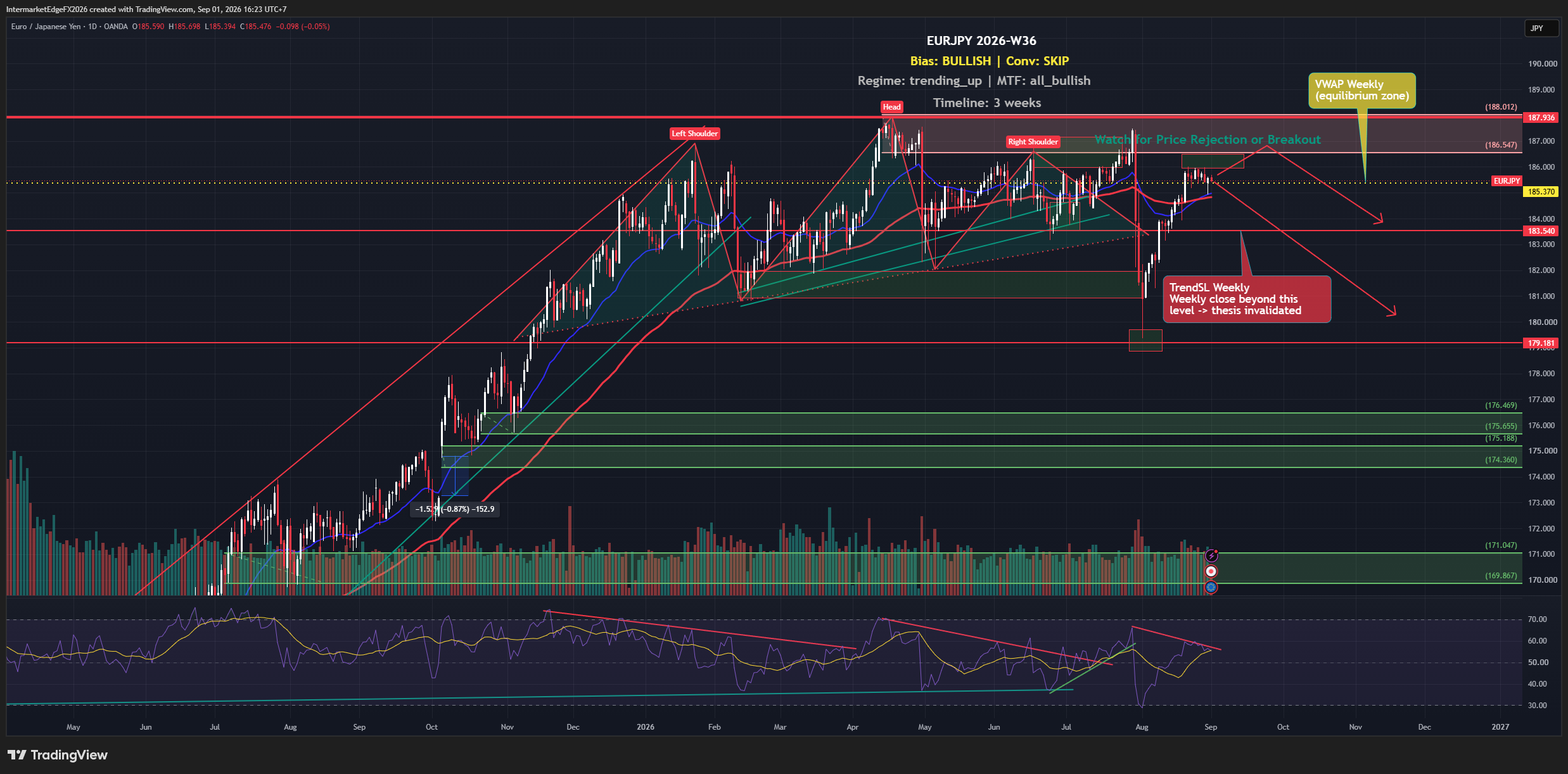
EURJPY Week W29-2026: Yen Slides Past 163 as Intervention Talks Mount, Bullish Trend Holds Above 184.56 But Carry-Unwind Risk Keeps Conviction Muted

EURJPY Week W29-2026: Yen Slides Past 163 as Intervention Talks Mount, Bullish Trend Holds Above 184.56 But Carry-Unwind Risk Keeps Conviction Muted

EURJPY sits at 185.75, hugging weekly VWAP exactly, with multi-timeframe alignment fully bullish and the trending regime intact. The technical picture hasn't broken — TrendSL at 184.56 remains unchallenged. That's the straightforward part. The macro backdrop is far messier. The yen has slid past 163, triggering intervention alerts and raising the prospect of a sudden BOJ/MOF response. Intervention risk is not theoretical at these levels — it's the single biggest tail risk to any long EURJPY position. Meanwhile, Japan's economy faces inflationary pressure partly driven by the weak yen making imports expensive, which ironically supports BOJ rate-hike bets. A surprise hike or credible intervention threat can produce a violent carry unwind (rapid JPY short-covering) with little warning. Adding complexity: US-Iran conflict has intensified, lifting Brent and supporting the dollar near-term. DXY bias is bearish but conviction is low, so EUR-side support is tepid at best. Euro CPI came in at 2.4% vs 2.6% forecast — a miss that modestly softens ECB hawkishness and limits EUR upside. Bottom line: bias is bullish, regime is trending up, but conviction is skip-level this week. The conflict between clean technicals and elevated geopolitical/intervention risk is real. If price closes below 184.56, the bullish structure is invalidated. Below 185.75 VWAP on a sustained basis, reduce exposure. Do not size aggressively into a crowded yen-short trade when intervention chatter is this loud. -- Intermarket Edge

EURUSD Week W29-2026: Dollar Rallies on Iran Strikes and Yield Surge, But a Core CPI Miss at 0.0% Puts the Bullish USD Story on Trial

EURUSD Week W29-2026: Dollar Rallies on Iran Strikes and Yield Surge, But a Core CPI Miss at 0.0% Puts the Bullish USD Story on Trial

EURUSD closed the week at 1.1440, right on weekly VWAP (1.1440), a technically neutral position inside a confirmed trending-down regime. All timeframes are aligned bearish — trend-following logic favors the downside. The dominant driver was USD strength: US-Iran strikes lifted oil prices, and Treasury yields pushed to new highs, pulling the dollar broadly higher. The Euro held near 1.14 with markets in a wait-and-see posture ahead of the upcoming ECB meeting — no fresh policy signal yet. But a key contradicting data point arrived: Core CPI (MoM) printed 0.0% vs. 0.2% forecast — a clean miss. With US 10Y real yield at 2.31% and the 2Y at 4.18%, the Fed's hawkish stance is still intact structurally, but a second consecutive CPI undershoot would accelerate dovish repricing and undercut the rate differential argument for USD longs. ADP private payrolls also slowed (16,500 vs. 19,250 prior), adding softness to the labor picture. Overall bias remains bullish (EURUSD higher) with high conviction over a 3-week horizon, driven by macro and positioning factors. However, the near-term technical picture is clearly bearish — a genuine conflict that demands caution on sizing. Key levels: A weekly close below TrendSL 1.1590 invalidates the bullish structure entirely. Sustained price below VWAP 1.1440 signals momentum is working against the thesis — reduce exposure if that holds. -- Intermarket Edge

EURGBP Week W29-2026: Sterling Whipsaws on Surprise Chancellor Pick, Bearish Trend Holds Near One-Year Lows at 0.85021

EURGBP Week W29-2026: Sterling Whipsaws on Surprise Chancellor Pick, Bearish Trend Holds Near One-Year Lows at 0.85021

Sterling whipsawed sharply this week around UK political headlines. EURGBP briefly touched a one-year low for the pair — pound's strongest level vs euro in a year — on FT reports that Shabana Mahmood would be Chancellor. The actual appointment of John Healey defied those expectations, triggering a reversal: gilt yields rose and sterling dipped as markets repriced fiscal credibility risk under the new Burnham government. The pair closed at 0.8502, sitting right on the weekly VWAP (0.8502). The broader trend remains down — multi-timeframe alignment is fully bearish, regime reads trending_down — and the Euro side offered no support: Eurozone Core CPI (YoY) printed 2.4% vs 2.6% forecast, a clean miss that removes ECB hawkish optionality. DXY bias is also bearish with low conviction, broadly USD-neutral for the cross. Despite aligned bearish structure, conviction is skip this week. The political noise creates two-way headline risk: any further surprise around the Burnham cabinet or fiscal announcements could spike volatility unpredictably. Price hugging weekly VWAP (0.8502) is also a caution flag — sustained acceptance above that level would signal short-term momentum turning against the thesis. Key levels: bull invalidation above TrendSL 0.8609 (exit shorts, reassess); reduce size if price holds above VWAP 0.8502. Wait for cleaner entry. -- Intermarket Edge

Stay in the loop

Get notified about new research, macro insights, and market analysis.

InterMarketEdge

© 2026 InterMarketEdge. Financial intelligence for inter-market traders.