Intermarket Analysis — InterMarketEdge

Intermarket Analysis

Cross-asset correlation studies — how oil, yields, equities, and FX interact and what divergences signal

USOIL Week W33-2026: Inventory Builds and Hormuz Uncertainty Leave Oil Caught Between 81.12 and 85.31

USOIL Week W33-2026: Inventory Builds and Hormuz Uncertainty Leave Oil Caught Between 81.12 and 85.31

USOIL is trading at 82.90 on the CL=F futures contract used as proxy, caught between a four-week streak of crude inventory builds averaging above 1.5 million barrels and a COT positioning read that still leans bullish. The macro story, rising real yields, a stronger dollar impulse, and China's structural shift away from gasoline, points lower. But price has not broken down yet, and that gap between the fundamental case and actual price behavior is exactly where traders get into trouble this week. The framework's output for W33-2026 is a bearish bias on USOIL, but the conviction is deliberately low, and that low conviction is not a soft bearish call, it is a signal that the evidence is conflicted enough to warrant real caution before sizing any directional position. Here is why the conflict matters: price, COT positioning, and the technical read all carry bullish signals in isolation. COT data shows a bullish lean among non-commercial participants, though the brief does not specify the exact report week, net-position figure, or sample, so this should be read as directional evidence rather than a precise citable statistic. Price itself is above the weekly VWAP at 82.90, meaning short-term momentum has not rolled over yet. And the multi-timeframe alignment reads as bullish-mixed, not cleanly bearish. What flips the framework's output to bearish despite all that is the macro overlay: the combination of a rising real yield environment creating dollar-bullish pressure, four consecutive weeks of crude inventory accumulation averaging above 1.5 million barrels per the EIA's actual reported figures, and the structural demand erosion from China's accelerating EV adoption together form a weight that the bullish positioning signals have not yet been able to lift price through. -- Intermarket Edge

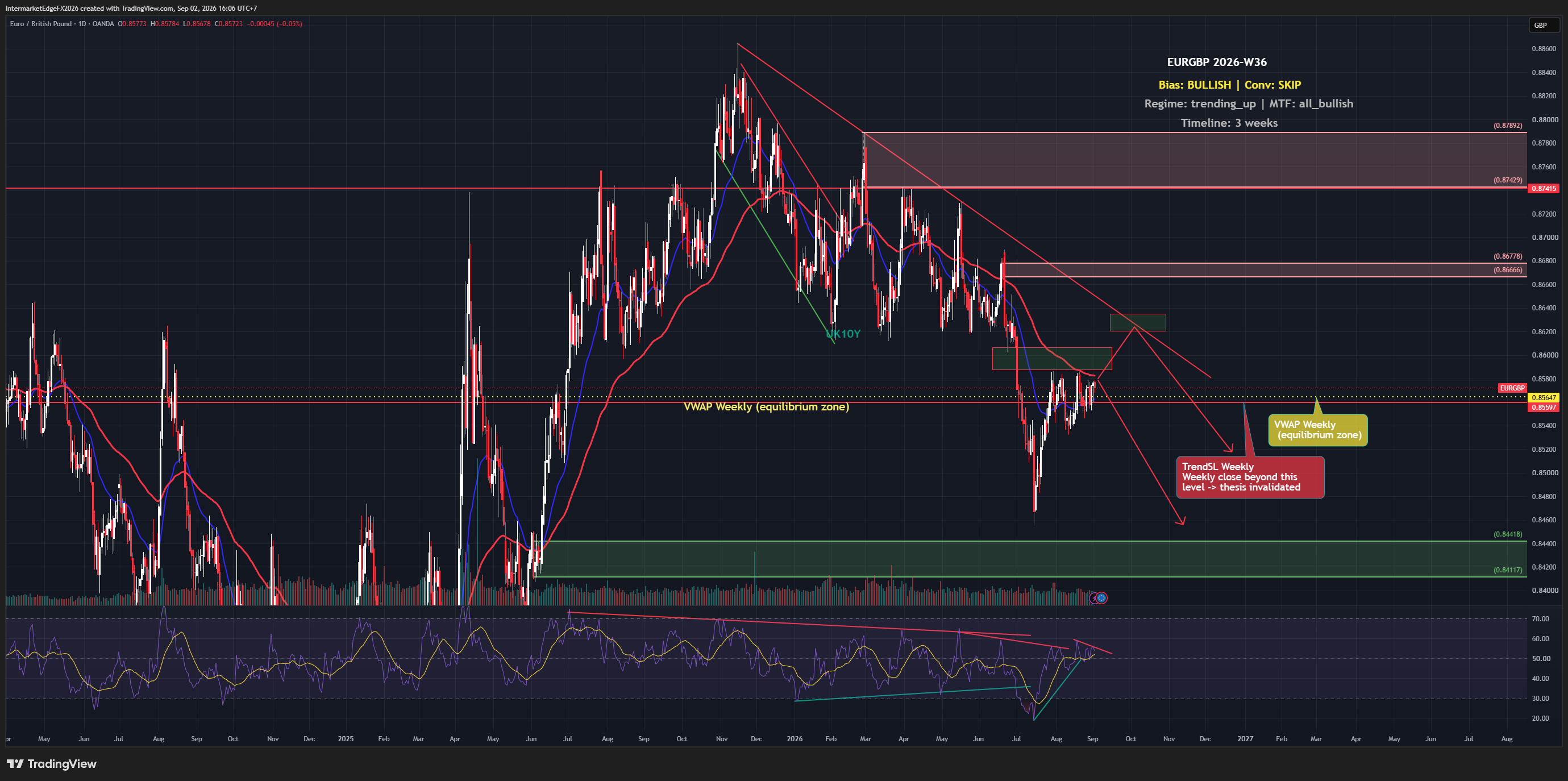
EURGBP Week W33-2026: BOE Holds at 3.75% But Sterling Fights Back, Leaving Bulls Stranded Below 0.8566

EURGBP Week W33-2026: BOE Holds at 3.75% But Sterling Fights Back, Leaving Bulls Stranded Below 0.8566

EURGBP is technically labelled bullish this week, yet as of Wednesday 12 August 2026, price at 0.85407 is sitting below the weekly VWAP at 0.8566, testing from underneath rather than pushing through it. That gap between the label and the price reality is exactly the kind of setup where traders get caught leaning on a bias that the market itself hasn't confirmed yet. With a BOE divided 6-3 on holding rates and a Euro-area CPI miss already in the books, neither side has a clean fundamental edge right now. The framework arrives at a weak bullish lean on EURGBP for this two-week window, but it is important to understand precisely how thin that lean is. The only active signal driving the bullish label comes from price action itself; positioning data, macro rules, liquidity signals, and sentiment indicators all contribute nothing, they fired no confirming evidence. A bias resting on a single source with no corroboration from other analytical layers is, by design, a low-confidence read that demands a correspondingly cautious posture. The analysis explicitly flags a structural conflict at the heart of the thesis: the overall directional label is bullish, but the structural bias is neutral, meaning the two core components of the framework are not pointing the same way. That internal contradiction is not a rounding error, it is a direct signal that the environment has not yet organised itself into a tradeable directional setup. The ECB-versus-BOE rate differential is cited as the primary fundamental narrative, the idea being that if ECB policy holds firmer relative to BOE policy, euro support should outpace sterling support over time. But no macro rule within the analysis has fired to validate that narrative in a quantifiable way this week, so it remains a story rather than a confirmed driver. What this means practically: the bullish label should be read as a directional lean, not a conviction call. -- Intermarket Edge

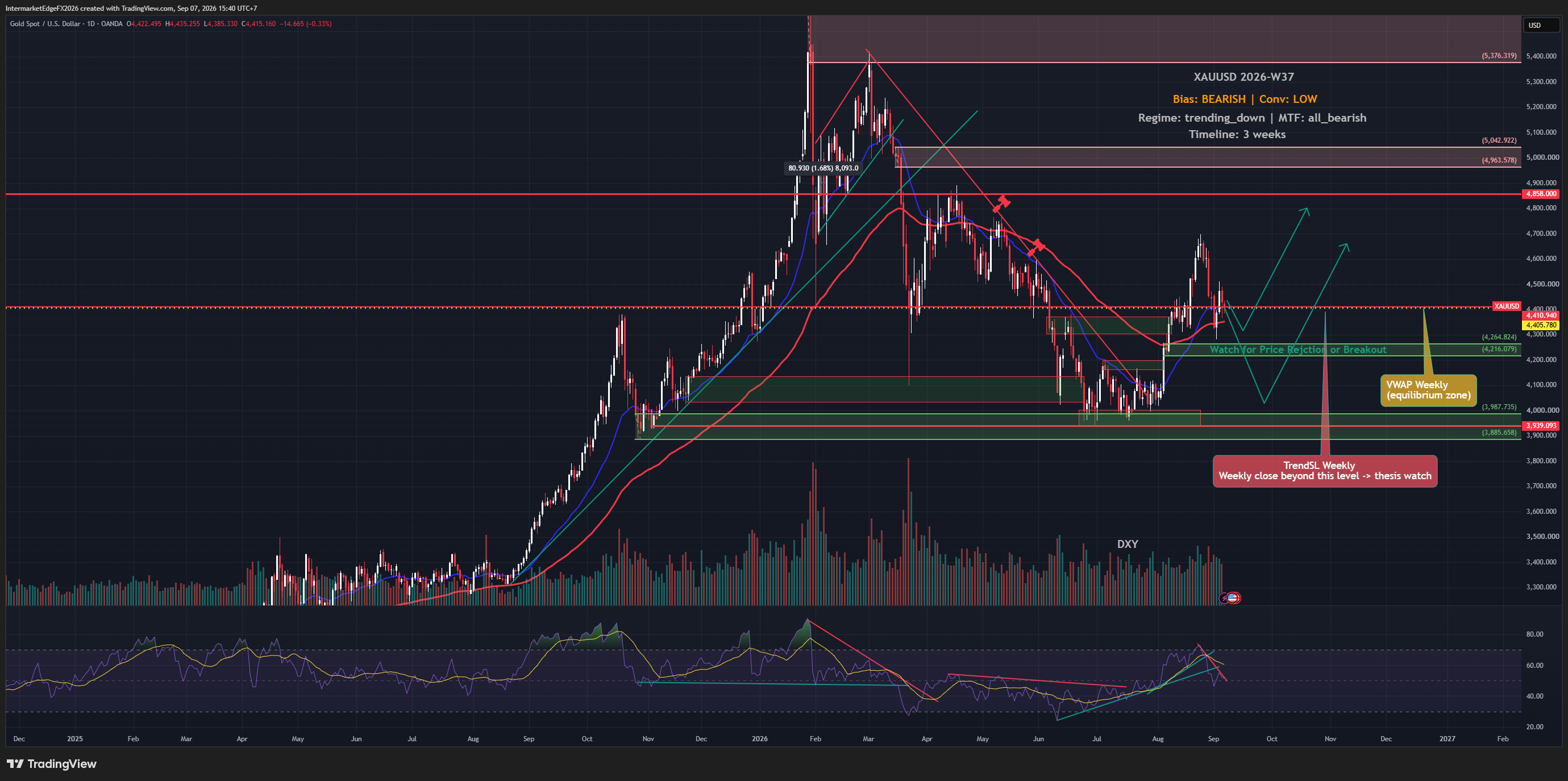
XAUUSD Week W33-2026: Gold Crosses the Line, but Confirmation Must Wait

XAUUSD Week W33-2026: Gold Crosses the Line, but Confirmation Must Wait

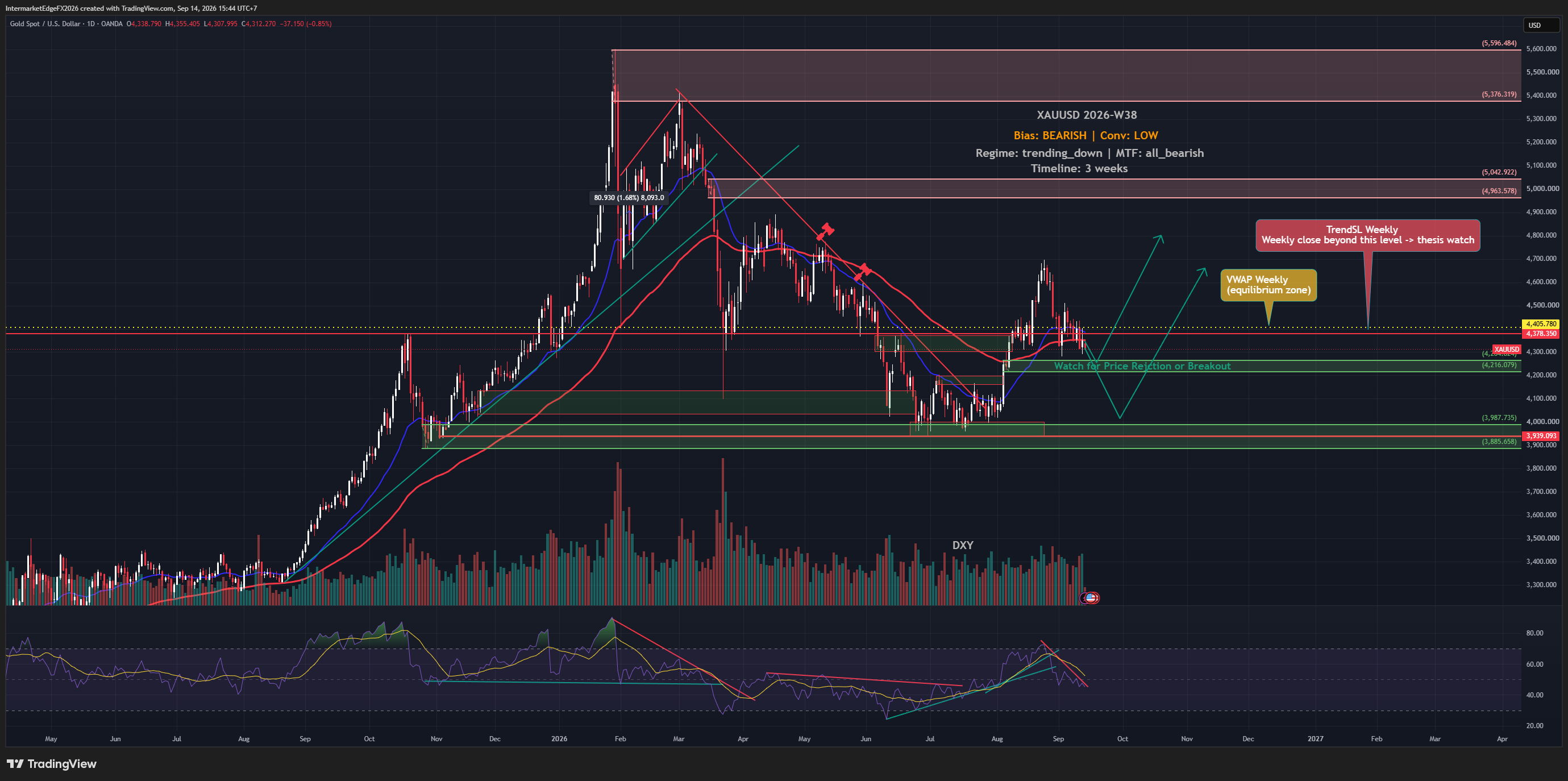
Gold printed a flat zero on the July Core CPI reading, the kind of number that should send an inflation hedge sharply higher. Instead, XAUUSD is hovering within a handful of dollars of a technical level that the bullish case still needs to close above on a weekly basis. The contradiction between a cooling inflation print and a 2.4% real yield that keeps the Fed's pressure alive is exactly the tension defining this week's tape. The overall lean for gold this week is bullish, but the honest framing is that this is a low-conviction technical bias rather than a macro-supported directional call. Price action and COT positioning, where large speculator positioning is tilted bullish, though the specific report date, net-position figure, and sample period are not disclosed in the underlying data, so treat this as directional evidence rather than a citable statistic, are carrying most of the analytical weight. The macro contribution is marginal, and both liquidity and sentiment indicators are quiet, offering no additional confirmation in either direction. The hawkish Fed causal chain is the key headwind worth understanding precisely: higher real yields reduce gold's relative appeal because bonds now compete meaningfully for capital, creating persistent downward pressure on prices. That chain has been deliberately downweighted in the framework after backtesting showed it produced correct directional calls only roughly 35.9% of the time when applied to XAUUSD specifically, a figure that comes without disclosed sample size or test period, so treat it as a caution flag rather than a hard statistical rule. The practical takeaway is that price and positioning should lead the analysis, not macro narratives alone. What makes this week's setup particularly difficult is that the CPI miss does not resolve the conflict, it creates a new one. -- Intermarket Edge

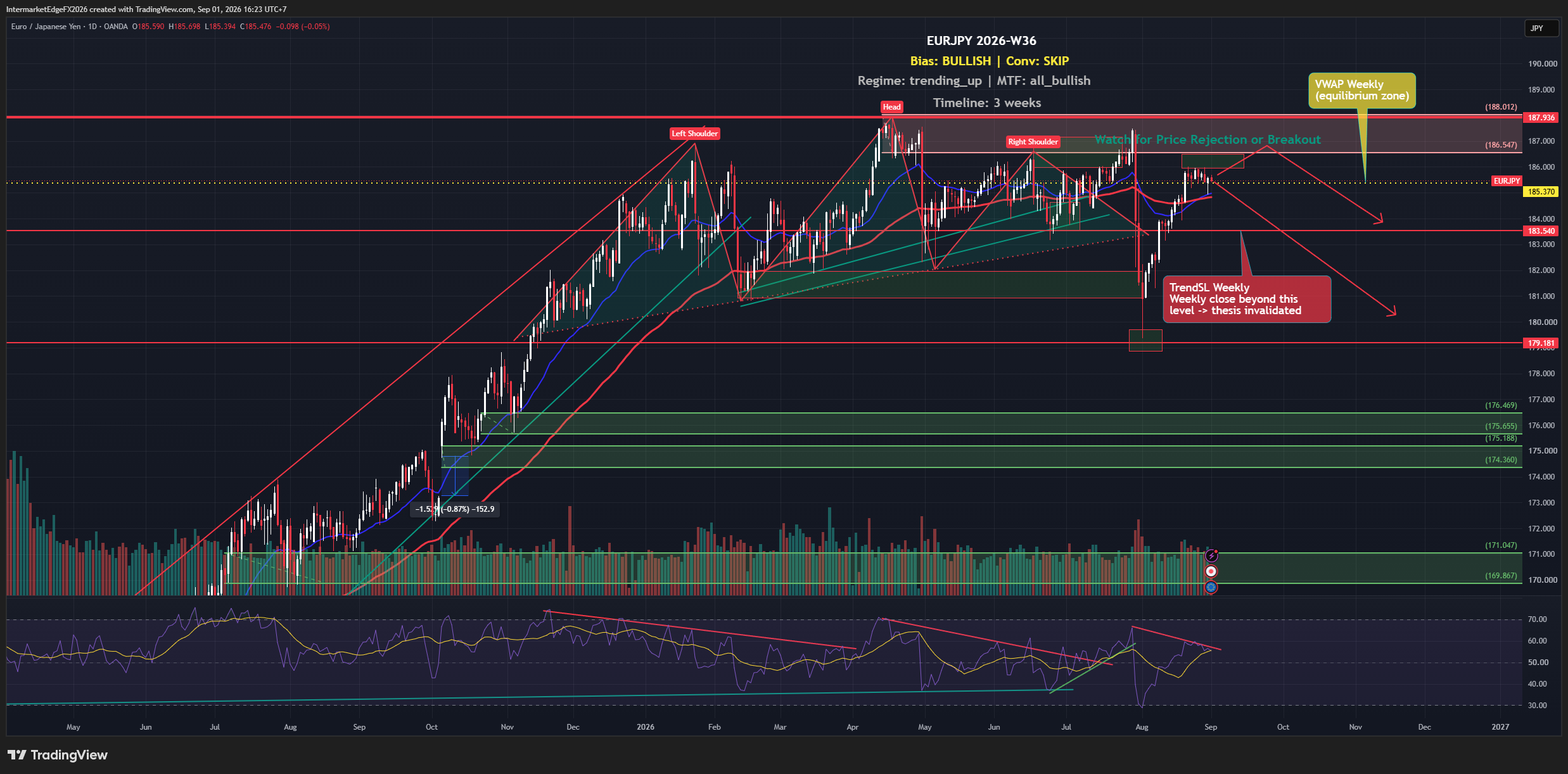
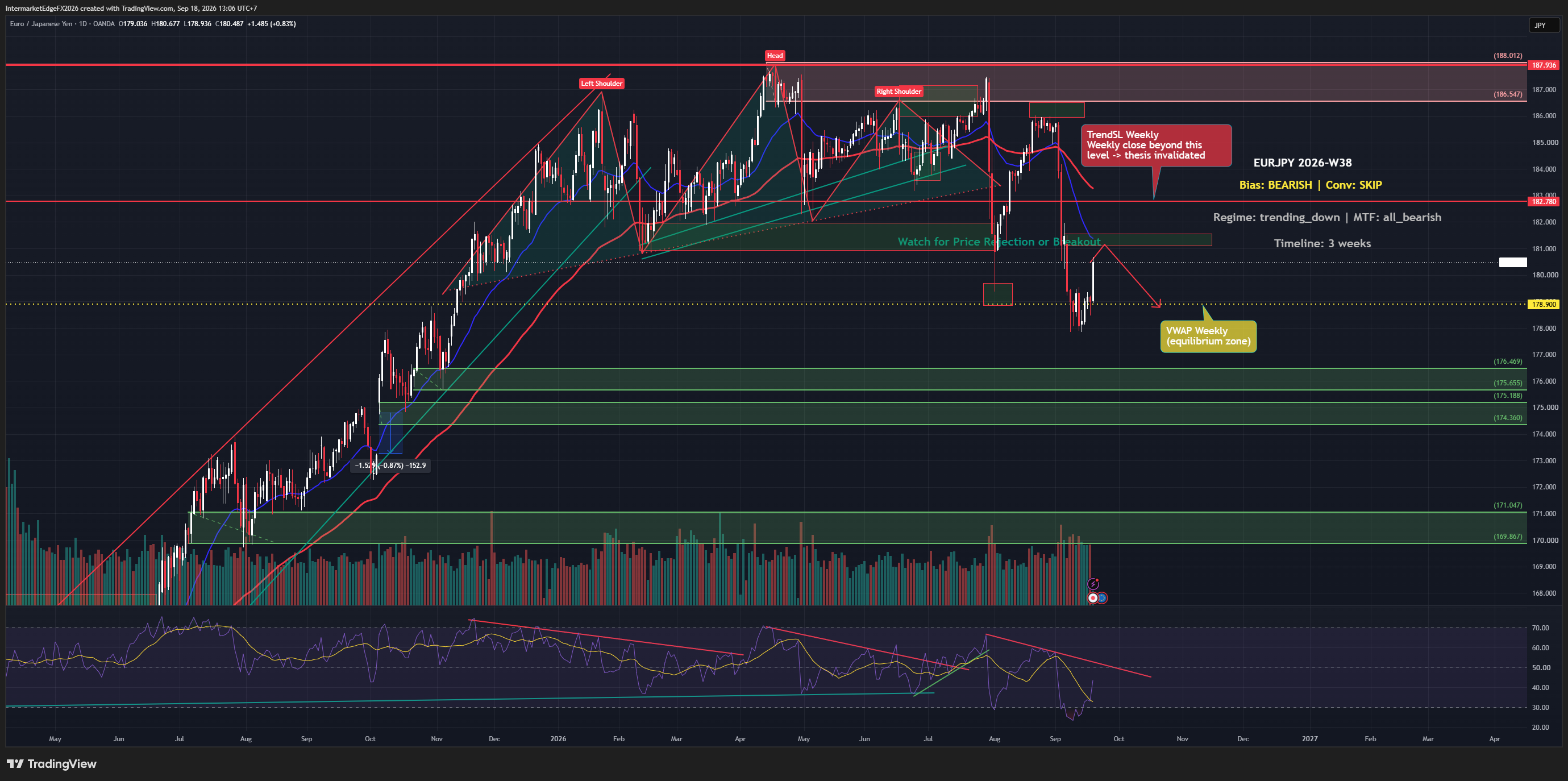
EURJPY Week W32-2026: US Yen-Buying Intervention Drives Price Below 184.58 VWAP as BOJ Holds at 1% and Flags Further Hike

EURJPY Week W32-2026: US Yen-Buying Intervention Drives Price Below 184.58 VWAP as BOJ Holds at 1% and Flags Further Hike

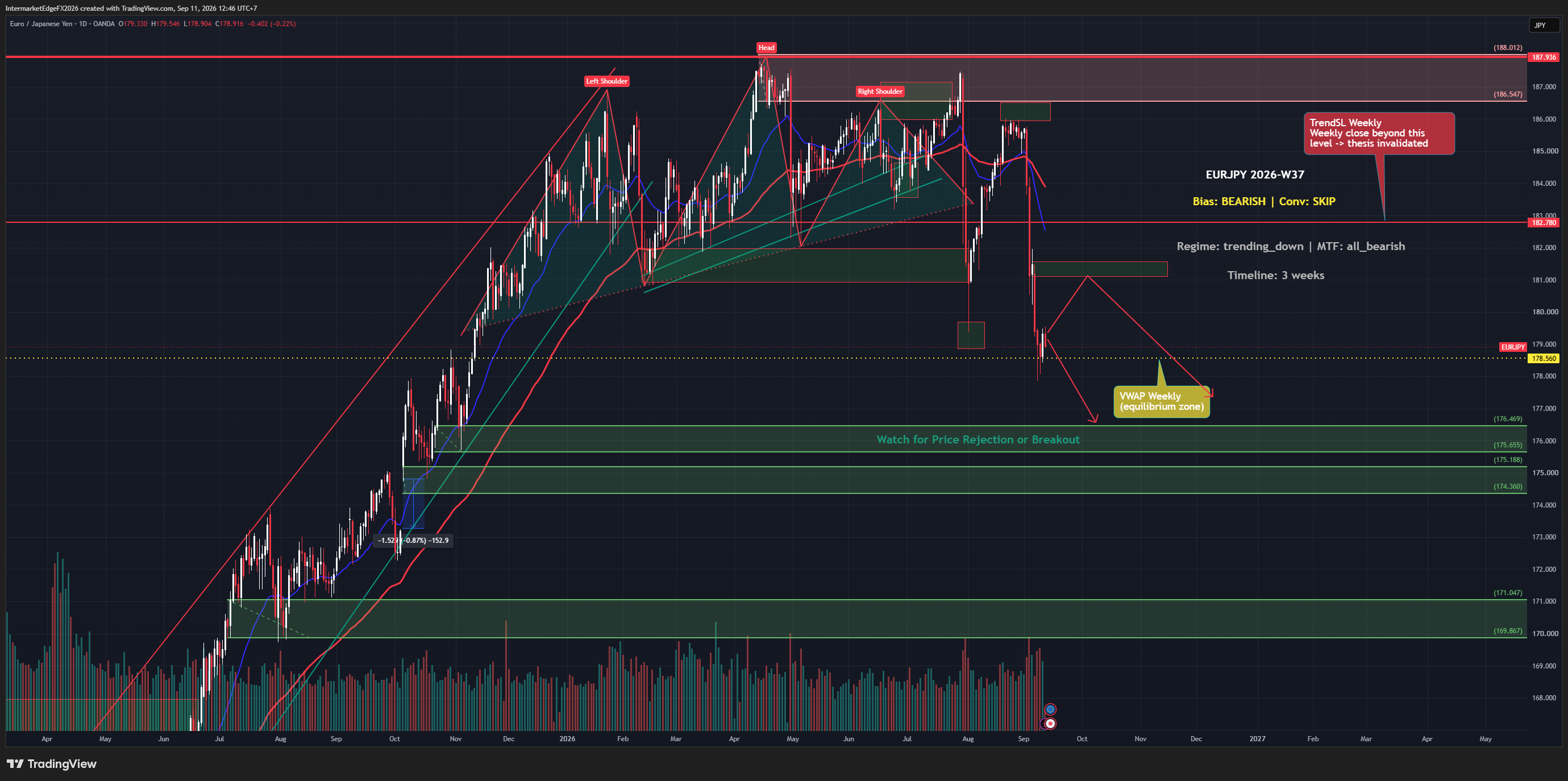
EURJPY is trading at 181.67 as of Tuesday, 04 August 2026, 09:09 UTC, nearly 3 full points below the weekly VWAP of 184.58, after the US shook currency markets by buying yen directly through euro sales. The BOJ held its overnight rate at 1% but reiterated its hiking path, keeping carry-unwind pressure alive. The multi-timeframe picture is all-bearish, yet conflicting signals between price action and macro mean conviction sits at skip level: the trend is real, but the evidence base is thin. The overall bias for EURJPY in Week W32-2026 is bearish, but the conviction level is explicitly rated skip, meaning the signal exists, but the evidence base is too thin and too conflicted to support a high-confidence directional trade. Let that framing govern everything that follows. The primary bearish driver is structural: BOJ hawkishness, reinforced by this week's hold-with-hike-guidance, pressures the rate differential that underpins euro-yen carry positioning. When the BOJ signals continued tightening while the ECB faces disinflationary data, the carry unwind dynamic, where traders exit long-EURJPY positions funded by cheap yen borrowing, becomes a credible medium-term force. The US intervention reported this week, specifically buying yen through euro sales rather than through the conventional dollar channel, is an unusually direct policy statement that adds event-driven downside pressure on top of the structural story. The regime is classified as trending down with moderate confidence, and the multi-timeframe alignment reads all-bearish, which in isolation would support a trend-follow posture. However, the thesis-level signal contains a direct conflict: price action scores bullish while the macro overlay scores bearish, producing a weak net bearish read with very low conviction overall. -- Intermarket Edge

EURUSD Week W31-2026: Euro Climbs to Two-Week High as Fed Holds Rates Steady, Dollar Sinks and Bearish Thesis Faces Short-Term Counter-Trend Pressure

EURUSD Week W31-2026: Euro Climbs to Two-Week High as Fed Holds Rates Steady, Dollar Sinks and Bearish Thesis Faces Short-Term Counter-Trend Pressure

The Euro hit a two-week high this week as the Fed held rates steady and the dollar sank in the immediate aftermath, but don't mistake a short-term relief rally for a trend reversal. With US 10-year real yields running at 2.43% and the ECB-Fed rate differential still firmly favoring the dollar, the structural bearish case for EURUSD remains intact. The current bounce is trading against the macro grain, and that matters. The overall bias for EURUSD in W31-2026 is bearish with medium conviction, driven primarily by the ECB versus Fed rate differential that continues to favor USD strength across the medium-term horizon of roughly three weeks. The multi-timeframe technical alignment is fully bearish, every timeframe in the review is pointing in the same direction, which adds structural weight to the macro thesis even if short-term price action is temporarily running the other way. It is important to be explicit about the signal conflict present this week: both recent price action and COT positioning data are reading bullish, and the Euro is indeed trading above the weekly VWAP of 1.13779 as of Thursday, 30 July 2026 at 05:32 UTC. That is not a minor footnote, price at 1.14574 is already running against the thesis snapshot close, and that gap of roughly 80 pips is real counter-trend pressure that deserves respect. The COT signal showing net bullish positioning should also be noted, though the brief does not specify the exact report week, release date, or net contract figure, so it should be read as directional evidence rather than a precise citable statistic. The bearish thesis this week rests entirely on macro and causal-chain logic: Fed hawkishness feeds USD bullish pressure, which feeds EURUSD bearish pressure, with DXY directional weight being the strongest single input into the pair. -- Intermarket Edge

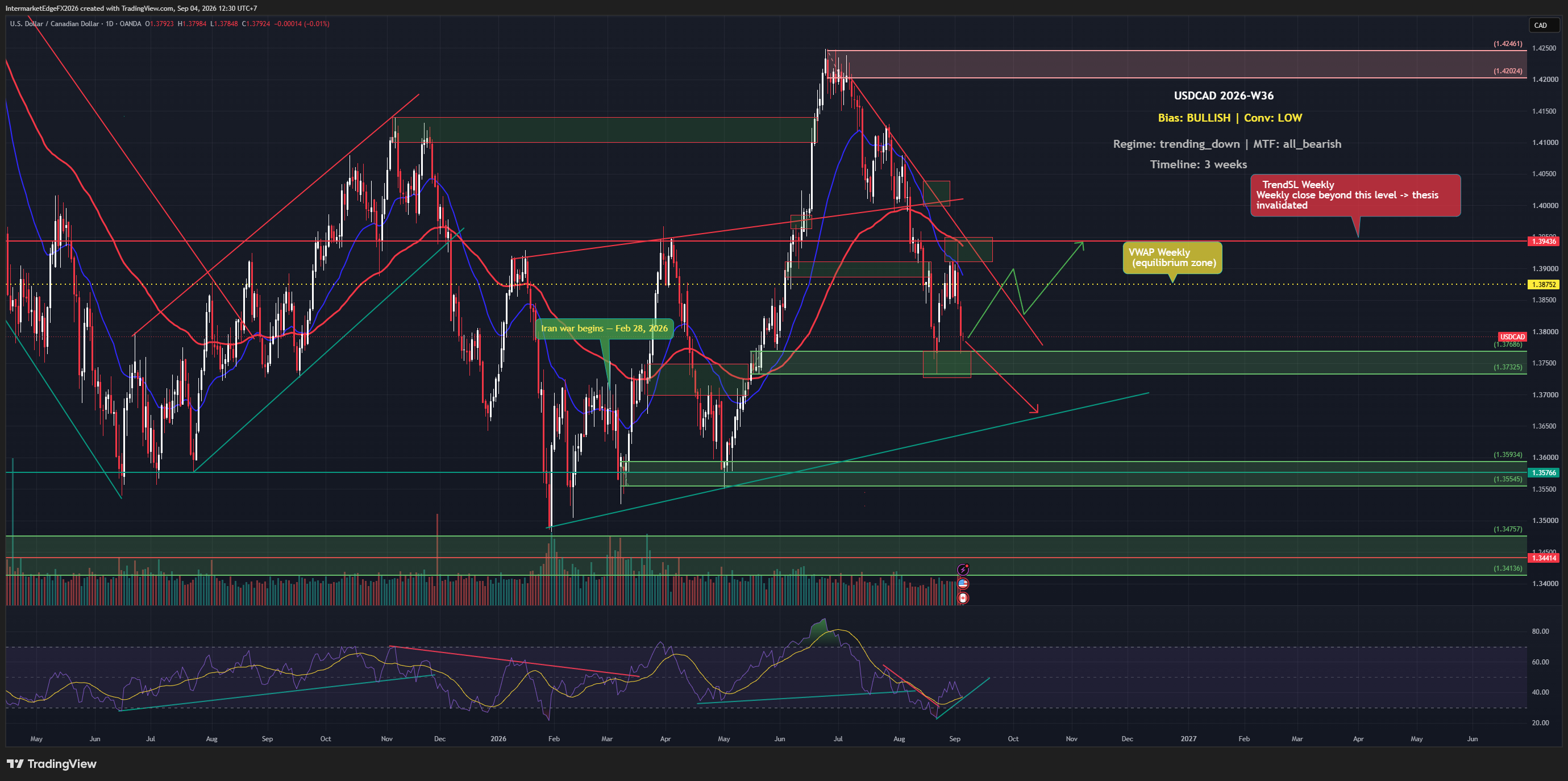
USDCAD Week W30-2026: Tariff Threats and Yield Spread Widening Push Pair to a One-Week Low, But VWAP at 1.40594 Keeps Bulls Cautiously Alive

USDCAD Week W30-2026: Tariff Threats and Yield Spread Widening Push Pair to a One-Week Low, But VWAP at 1.40594 Keeps Bulls Cautiously Alive

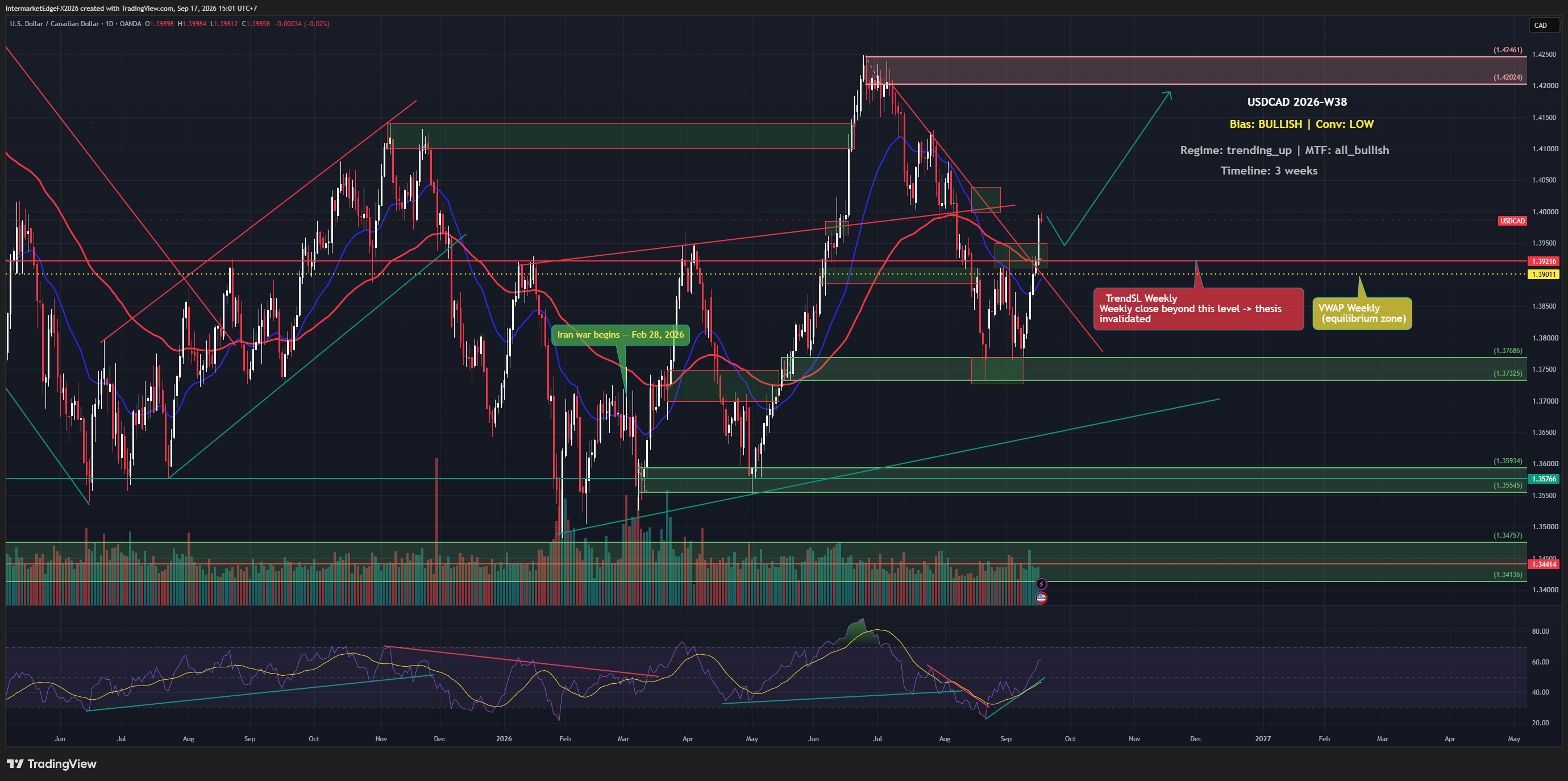
USDCAD is trading at 1.4083 (as of 2026-07-23T13:15 UTC, yfinance near-realtime), marginally above the weekly VWAP of 1.4059 and well above the trend support at 1.3937. The regime is ranging with a mean-reversion implication — not a trending environment. The news backdrop is mixed. The Canadian dollar briefly strengthened on rising benchmark yields, but then hit a one-week low as yield spreads widened following renewed U.S. tariff threats. Ottawa's response was sharp — PM Carney called the latest tariff move a USMCA violation, while USTR Greer countered that Canada is offering better deals to third parties. Separately, USD is finding a bid from U.S.-Iran tensions pushing Brent higher — which cuts both ways for USDCAD since oil strength typically supports CAD. The bullish bias rests on two pillars: COT positioning (net bullish) and macro fundamentals — the Fed remains hawkish, real yields are elevated at 2.37%, and the rate differential favors USD. However, conviction is low; price, liquidity, and sentiment signals are all neutral. A TGA drain is flagged as a partial offset, simultaneously supporting risk assets and capping USD upside. Critical override risk: a sustained oil rally would strengthen CAD and could neutralize the entire setup regardless of rate differentials. Structural levels to watch: a weekly close below VWAP (1.4059) warrants size reduction; a close below TrendSL (1.3937) invalidates the bullish structure entirely. Given low conviction, keep sizing conservative and wait for price confirmation before adding directional exposure. -- Intermarket Edge

EURJPY Week W29-2026: Yen Slides Past 163 as Intervention Talks Mount, Bullish Trend Holds Above 184.56 But Carry-Unwind Risk Keeps Conviction Muted

EURJPY Week W29-2026: Yen Slides Past 163 as Intervention Talks Mount, Bullish Trend Holds Above 184.56 But Carry-Unwind Risk Keeps Conviction Muted

EURJPY sits at 185.75, hugging weekly VWAP exactly, with multi-timeframe alignment fully bullish and the trending regime intact. The technical picture hasn't broken — TrendSL at 184.56 remains unchallenged. That's the straightforward part. The macro backdrop is far messier. The yen has slid past 163, triggering intervention alerts and raising the prospect of a sudden BOJ/MOF response. Intervention risk is not theoretical at these levels — it's the single biggest tail risk to any long EURJPY position. Meanwhile, Japan's economy faces inflationary pressure partly driven by the weak yen making imports expensive, which ironically supports BOJ rate-hike bets. A surprise hike or credible intervention threat can produce a violent carry unwind (rapid JPY short-covering) with little warning. Adding complexity: US-Iran conflict has intensified, lifting Brent and supporting the dollar near-term. DXY bias is bearish but conviction is low, so EUR-side support is tepid at best. Euro CPI came in at 2.4% vs 2.6% forecast — a miss that modestly softens ECB hawkishness and limits EUR upside. Bottom line: bias is bullish, regime is trending up, but conviction is skip-level this week. The conflict between clean technicals and elevated geopolitical/intervention risk is real. If price closes below 184.56, the bullish structure is invalidated. Below 185.75 VWAP on a sustained basis, reduce exposure. Do not size aggressively into a crowded yen-short trade when intervention chatter is this loud. -- Intermarket Edge

EURGBP Week W29-2026: Sterling Whipsaws on Surprise Chancellor Pick, Bearish Trend Holds Near One-Year Lows at 0.85021

EURGBP Week W29-2026: Sterling Whipsaws on Surprise Chancellor Pick, Bearish Trend Holds Near One-Year Lows at 0.85021

Sterling whipsawed sharply this week around UK political headlines. EURGBP briefly touched a one-year low for the pair — pound's strongest level vs euro in a year — on FT reports that Shabana Mahmood would be Chancellor. The actual appointment of John Healey defied those expectations, triggering a reversal: gilt yields rose and sterling dipped as markets repriced fiscal credibility risk under the new Burnham government. The pair closed at 0.8502, sitting right on the weekly VWAP (0.8502). The broader trend remains down — multi-timeframe alignment is fully bearish, regime reads trending_down — and the Euro side offered no support: Eurozone Core CPI (YoY) printed 2.4% vs 2.6% forecast, a clean miss that removes ECB hawkish optionality. DXY bias is also bearish with low conviction, broadly USD-neutral for the cross. Despite aligned bearish structure, conviction is skip this week. The political noise creates two-way headline risk: any further surprise around the Burnham cabinet or fiscal announcements could spike volatility unpredictably. Price hugging weekly VWAP (0.8502) is also a caution flag — sustained acceptance above that level would signal short-term momentum turning against the thesis. Key levels: bull invalidation above TrendSL 0.8609 (exit shorts, reassess); reduce size if price holds above VWAP 0.8502. Wait for cleaner entry. -- Intermarket Edge

GBPUSD Week W30-2026: Burnham Takes Power and Core CPI Prints Zero, But Price Holds at VWAP 1.3452 as Bull Technicals Clash With a Bearish Macro Case

GBPUSD Week W30-2026: Burnham Takes Power and Core CPI Prints Zero, But Price Holds at VWAP 1.3452 as Bull Technicals Clash With a Bearish Macro Case

Sterling is caught in a genuine tug-of-war this week. Andy Burnham's move into Downing Street triggered volatile, mixed reactions in GBP — markets are questioning fiscal credibility under the new government, and the appointment of John Healey as Chancellor is reshaping spending expectations. Gilt yields rose and sterling dipped on those concerns, a classic political risk premium repricing. On the USD side, escalating US-Iran tensions and a spike in Brent crude are providing a competing safe-haven bid for the dollar, adding to the bearish GBPUSD case via the BOE vs Fed rate differential — US real yields at 2.35% remain a structural headwind for GBP. However, the core signal conflict here is real and cannot be papered over: price, COT positioning, and the technical structure (Daily, Weekly, Monthly all bullish) are aligned against the macro bearish thesis. Price is sitting exactly at VWAP weekly (1.3452) and above TrendSL weekly (1.3419) — both thesis-break levels are untested. A weekly close above 1.3419 formally invalidates bearish structure. The US Core CPI miss (actual 0.0 vs 0.2 forecast) also complicates the 'Fed stays hawkish' narrative and is a partial offset to USD strength. A TGA drain adds further USD headwind. Bottom line: macro and political forces lean bearish, but technical alignment and a crowded short setup (COT bullish at +0.80) create meaningful reversal risk. Conviction is medium. Size conservatively and watch weekly closes relative to 1.3419 and 1.3452 before committing directionally. -- Intermarket Edge

Stay in the loop

Get notified about new research, macro insights, and market analysis.

InterMarketEdge

© 2026 InterMarketEdge. Financial intelligence for inter-market traders.