Tag: USDJPY — InterMarketEdge

Tag: USDJPY

USDJPY W41: An Uptrend With a Momentum Warning

USDJPY W41: An Uptrend With a Momentum Warning

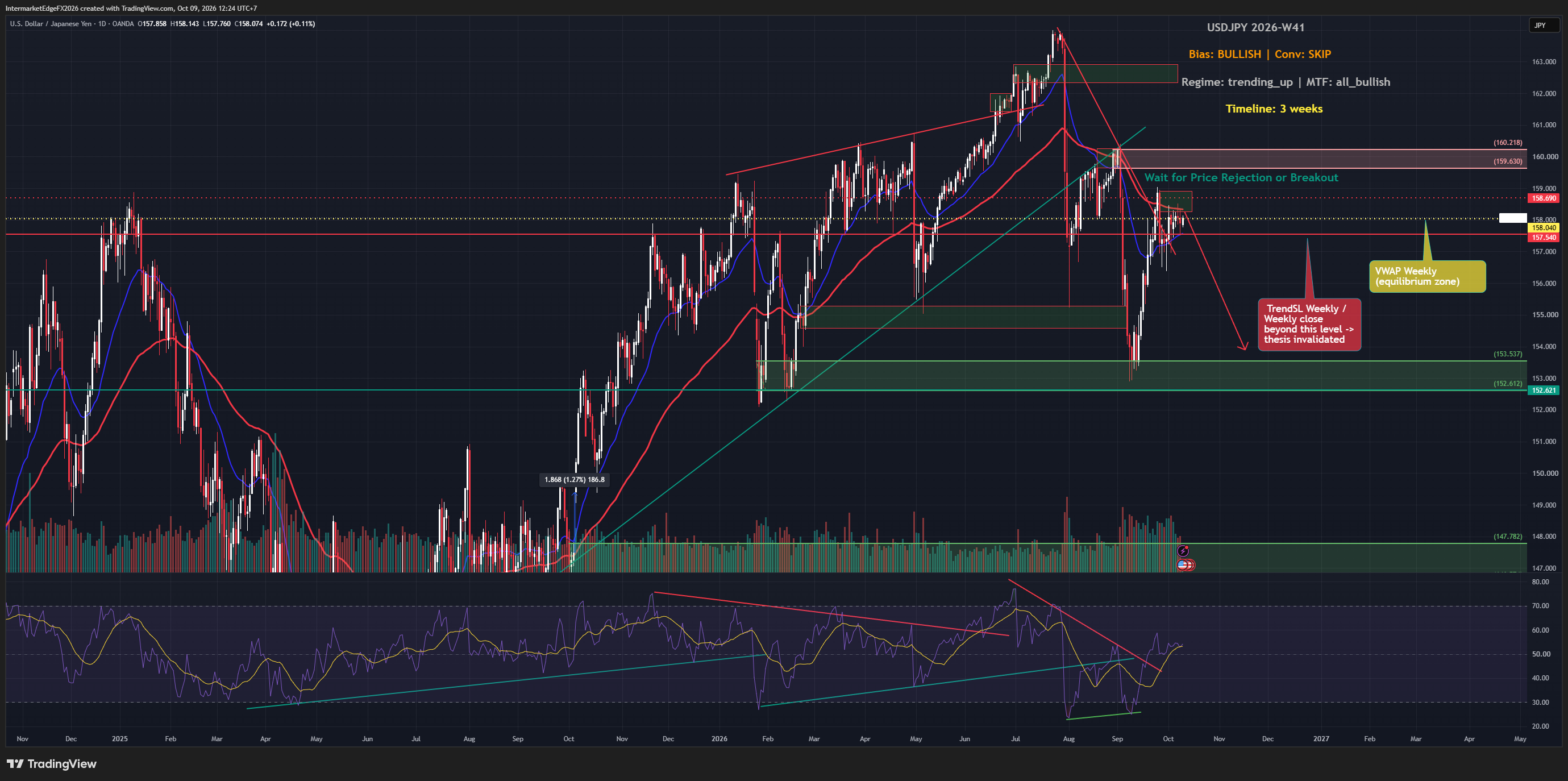
USDJPY W41 | An uptrend with an active momentum warning At 04:54 UTC on October 9, 2026, USDJPY was 157.811 on MT5 USDJPY.sml:1m. Price 157.81 is below weekly VWAP 158.04. The adverse momentum warning is already active, not a future condition. Price remains above TrendSL 157.54. Only a completed weekly close below 157.54 would invalidate the bullish structure. That condition is pending; an intraday crossing is insufficient. A sustained recovery through the weekly average would prompt reassessment of momentum. This does not require a weekly close. The decision at the snapshot is to stand aside, with a three-week review window. Japan's August real household spending fell 3.1% YoY but increased 0.1% MoM seasonally adjusted, according to the supplied Mace News headlines. Compare fresh US-Japan yields and dollar behavior; equity weakness alone does not establish yen inflows. FXSSI Current Ratio collected at 04:54:25 UTC on October 9: 57% Buy / 43% Sell. Collection time, not verified provider observation time. This broker retail sample is not the whole FX market or a standalone entry signal. Intermarket Edge | Institutional Macro & Intermarket Analysis For informational purposes only. Not financial advice.
USDJPY Week W39-2026: JGB Yields Hit 30-Year Highs Yet the Yen Still Can't Rally -- Who Is Trapped?

USDJPY Week W39-2026: JGB Yields Hit 30-Year Highs Yet the Yen Still Can't Rally -- Who Is Trapped?

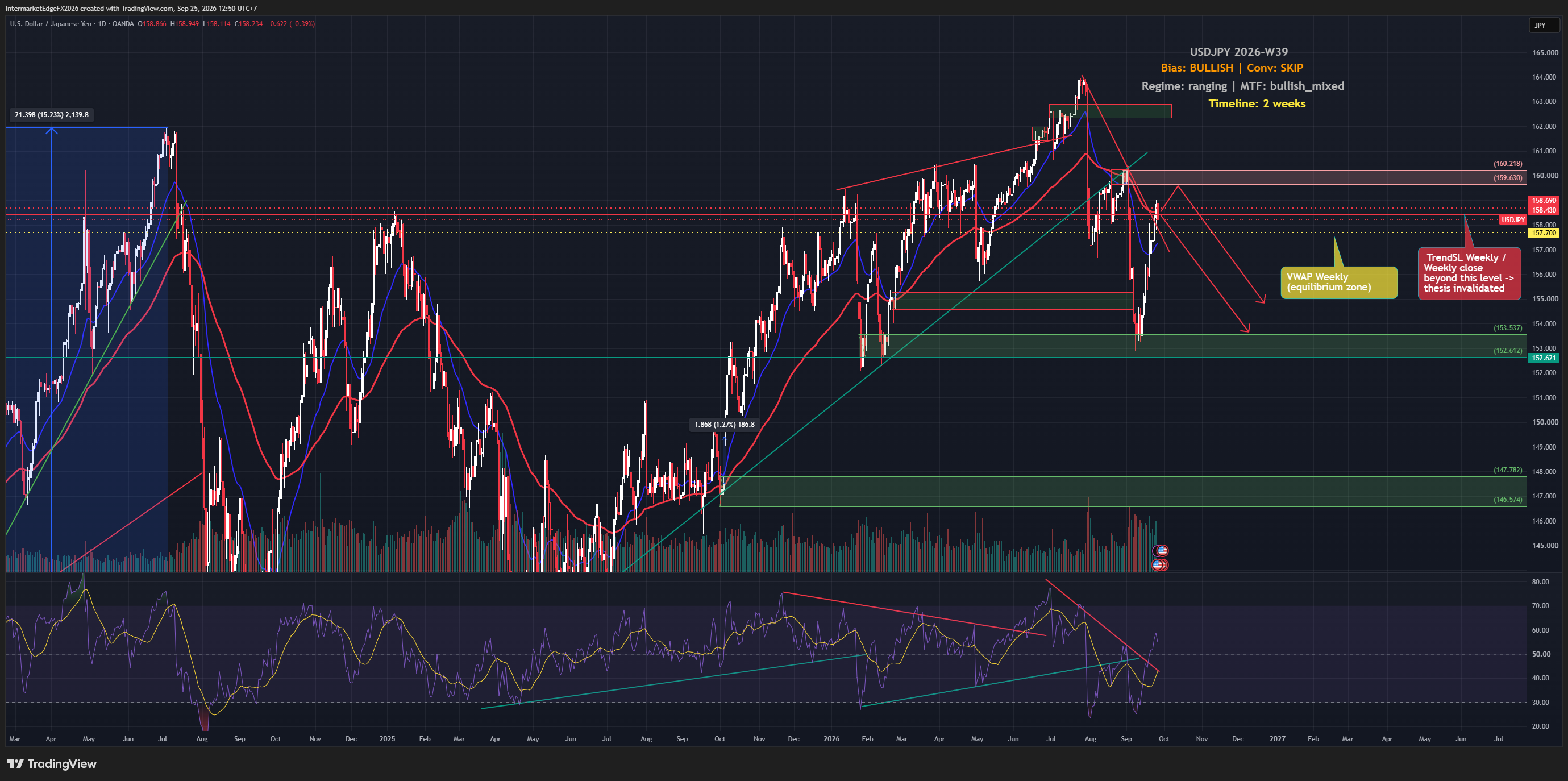
USDJPY is sitting at 158.47 as of Friday, 25 September 2026, having just cleared the weekly TrendSL at 158.43, a level that, if held on close, would mark the first genuine technical alignment with the bullish bias. But that clearance is barely four pips wide, and it arrives at the same moment Japan's 10-year JGB yield has surged to 3.115%, its highest since August 1996, raising serious questions about whether the yen's weakness can last. The analytical framework produces a bullish bias for USDJPY over the next two weeks, but the conviction attached to that bias is low enough that standing aside is the deliberate call, not because the direction is wrong, but because the evidence is not yet convincing enough to size a meaningful position. Understanding why requires separating the two forces that should, in theory, both be clear: macro supports dollar strength through rising US real yields and hawkish Fed expectations, and price action has technically edged above the weekly TrendSL at 158.43. That combination sounds straightforward. What makes it fragile is the COT signal, positioning data from derivatives markets shows speculative traders are already carrying a significant net bearish lean on USDJPY. The COT reading reported here should be read as directional evidence rather than a standalone citable statistic, since the specific report week, release date, and exact net-position figures are not available in this brief, but the directional weight it carries is material enough to cancel the bullish case built by price action alone. The deeper risk is structural. BOJ hawkishness is the most important counterweight in this cycle: higher Japanese yields can encourage repatriation and make yen-funded positions more expensive, allowing USDJPY to fall quickly if policy expectations shift. -- Intermarket Edge

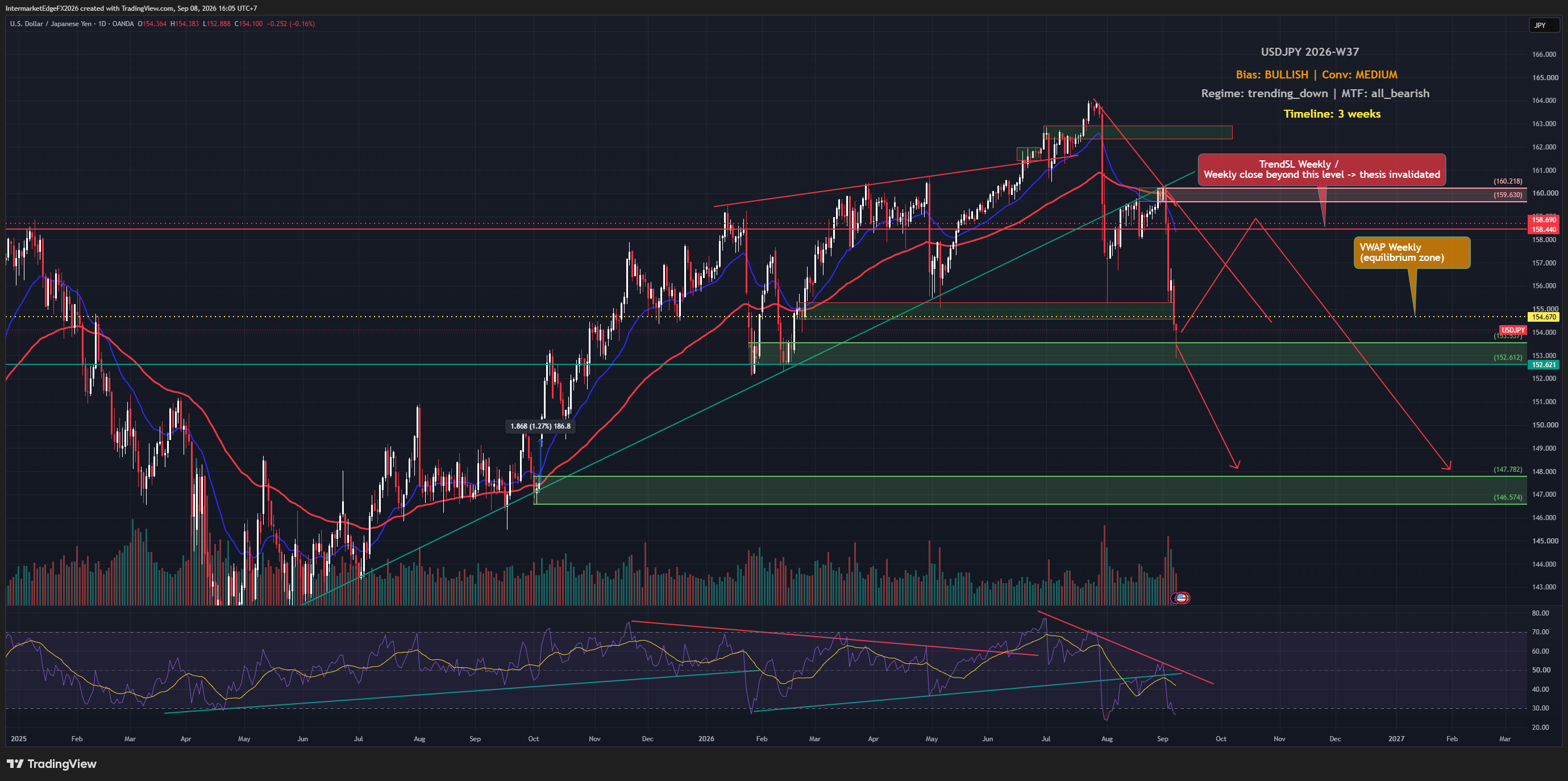
USDJPY Week W37-2026: Yen Hits Seven-Month High as Price Slides Below 154.67, But the Bullish Thesis Hasn't Been Abandoned Yet

USDJPY Week W37-2026: Yen Hits Seven-Month High as Price Slides Below 154.67, But the Bullish Thesis Hasn't Been Abandoned Yet

USDJPY is sitting at 153.55 as of Tuesday, 08 September 2026, with the yen at a seven-month high and every timeframe aligned bearish. The bullish thesis rests on the most extreme Fed-vs-BOJ rate differential in the G7, but price is already below the weekly VWAP at 154.67, meaning the pair hasn't even recovered to average territory yet. Before positioning around a macro argument, the technical structure deserves a hard look. The framework carries a bullish bias on USDJPY this week, but the conviction sits at medium, not high, and understanding why that ceiling exists matters more than the label itself. The core argument is straightforward: the Fed-vs-BOJ rate differential is the most divergent in the G7. A rate differential measures the gap between what investors earn holding one currency versus another; when it is wide and widening, it creates a structural incentive to hold the higher-yielding currency, in this case the dollar. Real yields reinforce this, a 2.42% US 10-year real yield means dollar holders are being compensated above inflation, which is a durable form of carry, not just a nominal illusion. Price action, COT positioning, and macro fundamentals all point the same direction. However, the COT data introduces a specific caution: speculative positioning is already extremely short yen, meaning most of the bearish-yen trade is already on. Crowding risk, the danger that a crowded trade reverses sharply when participants exit simultaneously, actively reduces conviction here. The exact net-position figures and report date for the COT data are not specified in this brief, so the reading should be treated as directional evidence rather than a precisely dated data point. -- Intermarket Edge

USDJPY: A Bullish Macro Lean Still Lacks Technical Confirmation

USDJPY: A Bullish Macro Lean Still Lacks Technical Confirmation

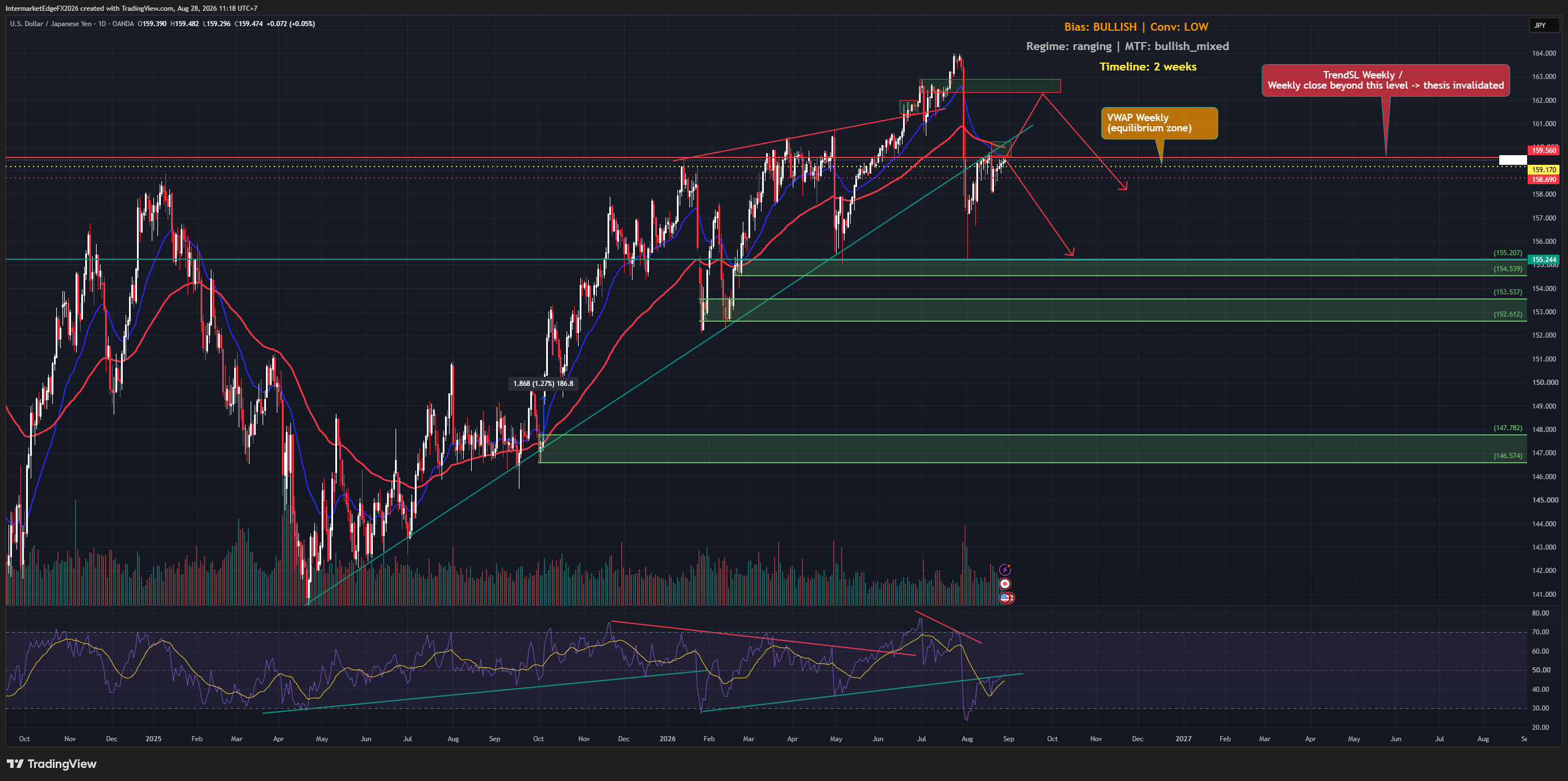
USDJPY is caught between two equally weighted forces right now: a Fed that keeps real yields at 2.34%, firmly supporting the dollar side of the trade, and a BOJ whose hawkish posture remains the single biggest tail risk capable of unraveling the entire carry position. As of Friday 28 August 2026 at 03:59 UTC, the pair sits at 159.37, holding above the weekly VWAP at 159.17 but unable to push through the TrendSL at 159.56. That gap tells the real story this week. The framework flags a bullish bias on USDJPY for the next two weeks, but the conviction attached to that label is deliberately low, meaning the evidence tilts directionally positive without being strong enough to justify aggressive sizing. The two pillars holding the bullish case together are COT positioning, which leans bullish (though the specific report week, net-position figure, and release date are not specified in the available data, so this should be read as directional evidence rather than a precise statistic), and price action itself, which is currently holding above the weekly VWAP at 159.17 as of Friday 28 August at 03:59 UTC. The critical tension sits in the causal chains pulling in opposite directions with roughly equal force. Fed hawkishness, anchored by real yields at 2.34%, pushes USDJPY higher by widening the rate differential and reinforcing dollar demand. BOJ hawkishness, simultaneously, pushes it lower by threatening to narrow that same differential and triggering carry unwinds. Both forces carry substantial weight, and the data this week does not resolve which dominates. Tokyo CPI missed slightly, which temporarily reduces immediate BOJ pressure, but the improving labor market and the BOJ's own gradual recovery narrative keep the hawkish scenario on the table. -- Intermarket Edge

USDJPY Week W34-2026: Price Stalls Below 159.2 as Fed Minutes Flag a September Hike, But the Technical Structure Disagrees

USDJPY Week W34-2026: Price Stalls Below 159.2 as Fed Minutes Flag a September Hike, But the Technical Structure Disagrees

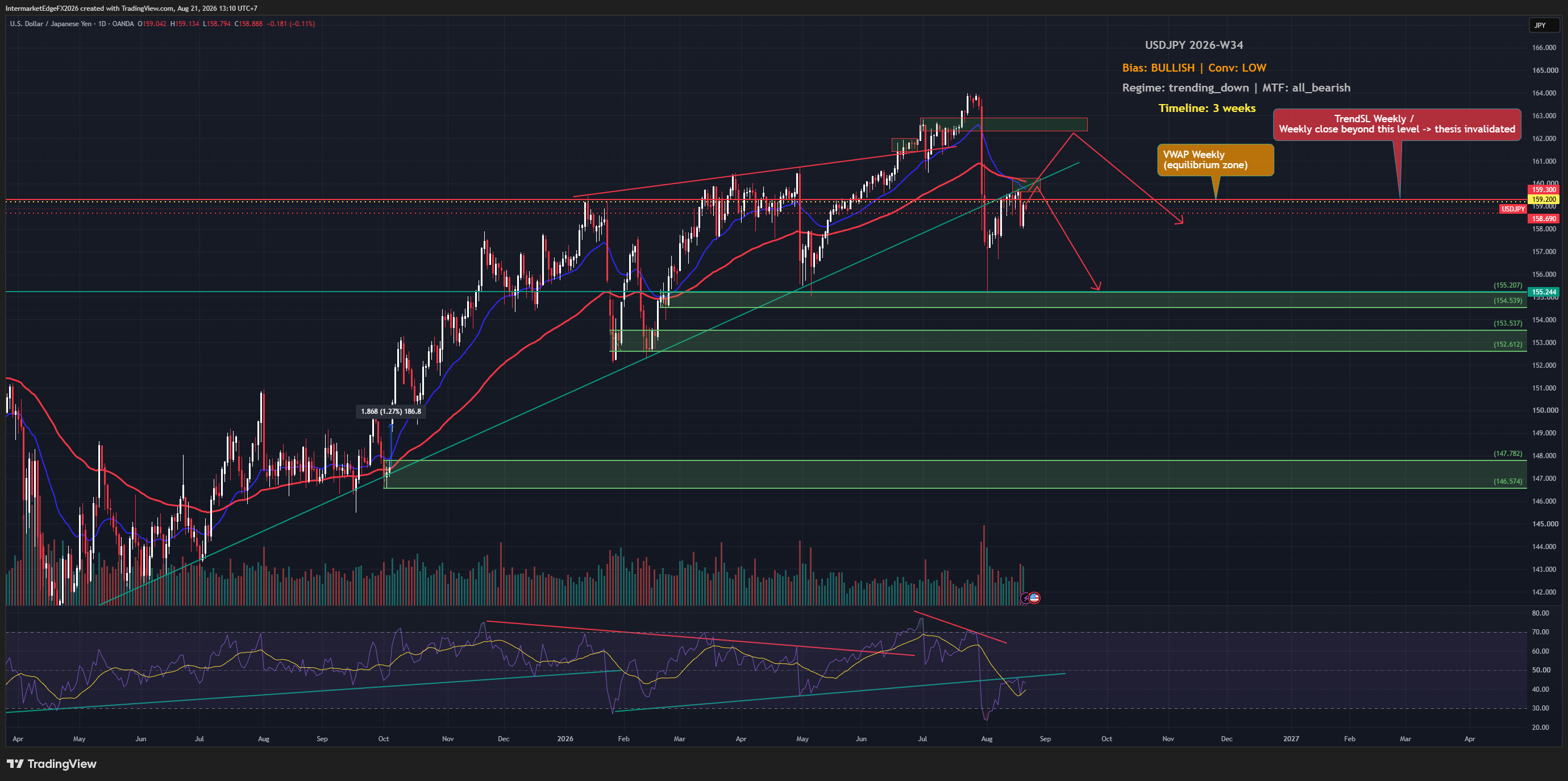
USDJPY carries a bullish bias into Week W34-2026, but the pair is already trading below both the weekly VWAP at 159.2 and the weekly TrendSL at 159.3, testing from underneath, as of Friday, 21 August 2026 at 05:48 UTC. Fed minutes confirming a September hike is still on the table gave the dollar a fundamental argument, yet price has not followed through. The tension between a macro case for dollar strength and a technical structure that disagrees is exactly where traders get hurt. The bullish case for USDJPY rests on one dominant structural argument: the Fed-versus-BOJ rate differential is the most extreme in the G7. Rate differential, in practical terms, means that holding dollars earns you materially more than holding yen, and as long as that gap stays wide, there is a persistent mechanical incentive for traders and institutions to be long USDJPY. COT positioning, which tracks the net futures commitments of large speculators, though the specific report week and net-position figure are not confirmed here, so treat this as directional context rather than a precise citable number, leans clearly bullish, reinforcing the demand-side argument. Fed hawkishness and a real yield above 2% give that rate differential a durable foundation, not just a near-term nominal quirk. That combination is what generates a bullish label. But the conviction attached to that label is explicitly low, and the reason is structural: the thesis was generated with price already below both key weekly levels. The technical read and the macro read are pointing in opposite directions, which means the bullish label is best understood as a macro override of a bearish technical setup, not a technically confirmed trend entry. Adding to the complexity, BOJ hawkishness carries a real bearish weight on USDJPY. If the BOJ accelerates its tightening path, the carry trade that has funded so much yen weakness could begin to unwind rapidly. -- Intermarket Edge

USDJPY W33: The Uptrend Meets a Yen Intervention Test

USDJPY W33: The Uptrend Meets a Yen Intervention Test

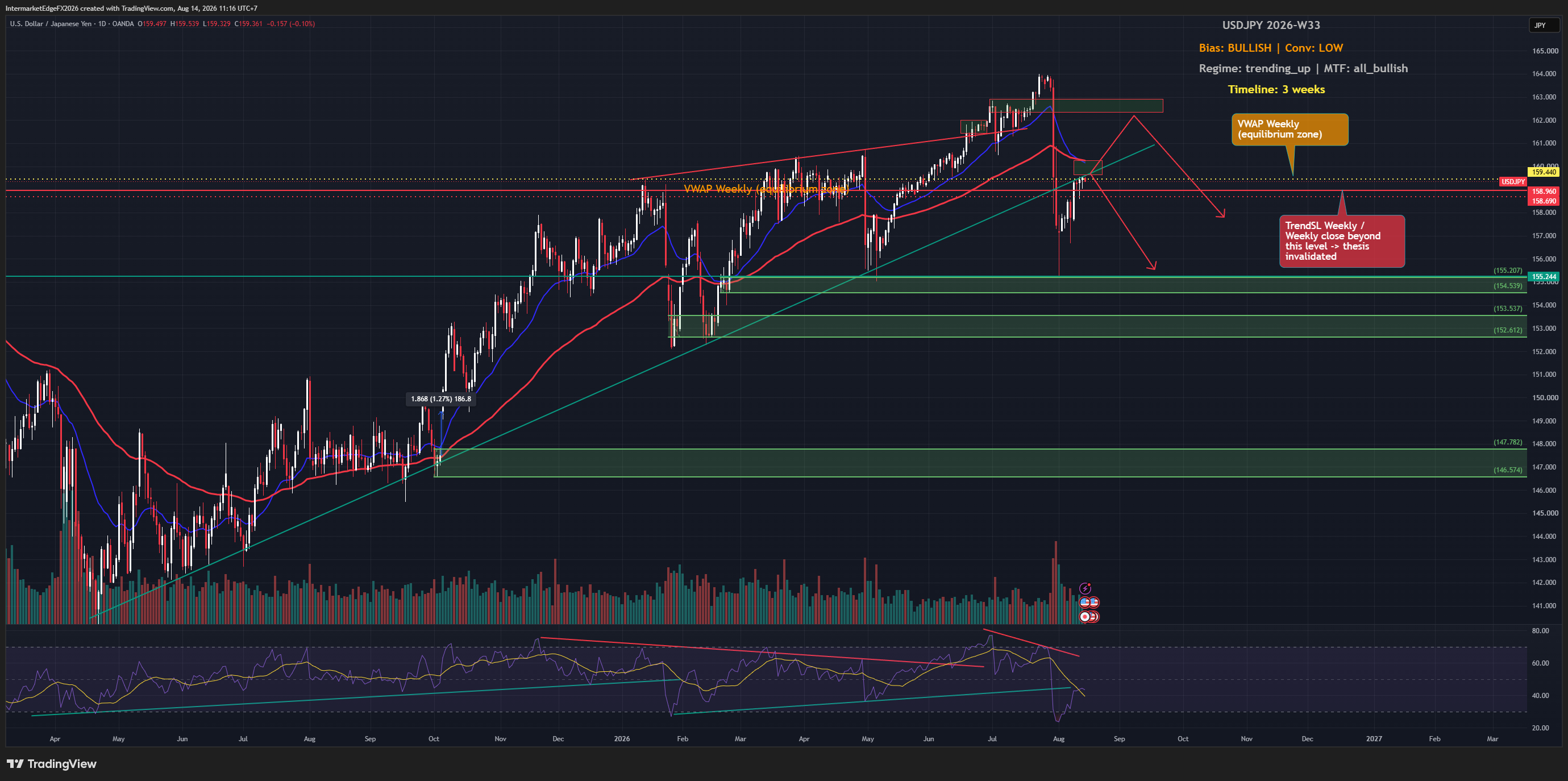
The yen is heading for a weekly loss and Reuters is already reporting bets for another intervention, yet USDJPY is trading below its weekly VWAP at 159.35 as of Friday, 14 August 2026, meaning short-term momentum is running against the very bullish structure that underpins the trend. The Fed-BOJ rate differential remains the most extreme in the G7, but a flat CPI print has cooled rate-hike expectations. The setup is directionally bullish but tactically uncomfortable right now. The directional case for USDJPY remains bullish, but the conviction sitting behind that call is deliberately low, not because the trend is broken, but because the evidence is not yet strong enough to justify sizing a position with confidence. The Fed-BOJ rate differential is the structural anchor: the US 10-year yield at 4.7% against a BOJ that is only beginning to normalize policy creates the widest carry spread in the G7, and COT positioning data, which tracks how large speculative and commercial participants are positioned in futures markets, has been leaning bullish, suggesting the broader market has not abandoned the yen-weakness trade. The caveat is that the COT read here is directional evidence rather than a precise citable statistic, since the brief does not specify the exact report week or net-position figure. What makes the current picture complicated is a direct and acknowledged signal conflict: the Fed's hawkish stance is bullish for USDJPY, while the BOJ's own hawkish pivot is bearish, because a BOJ rate hike erodes the yield advantage that makes holding yen-funded carry trades profitable. Both signals carry equal analytical weight. Add to that a CPI miss that has already begun to cool hike expectations, and the macro pillar of the bullish case is noticeably thinner than it was a week ago. -- Intermarket Edge

USDJPY Week W31-2026: BOJ Holds at 1% as Suspected FX Intervention Pushes Price Below VWAP 163.84, Bullish Trend Hangs by 0.77 Points Above TrendSL

USDJPY Week W31-2026: BOJ Holds at 1% as Suspected FX Intervention Pushes Price Below VWAP 163.84, Bullish Trend Hangs by 0.77 Points Above TrendSL

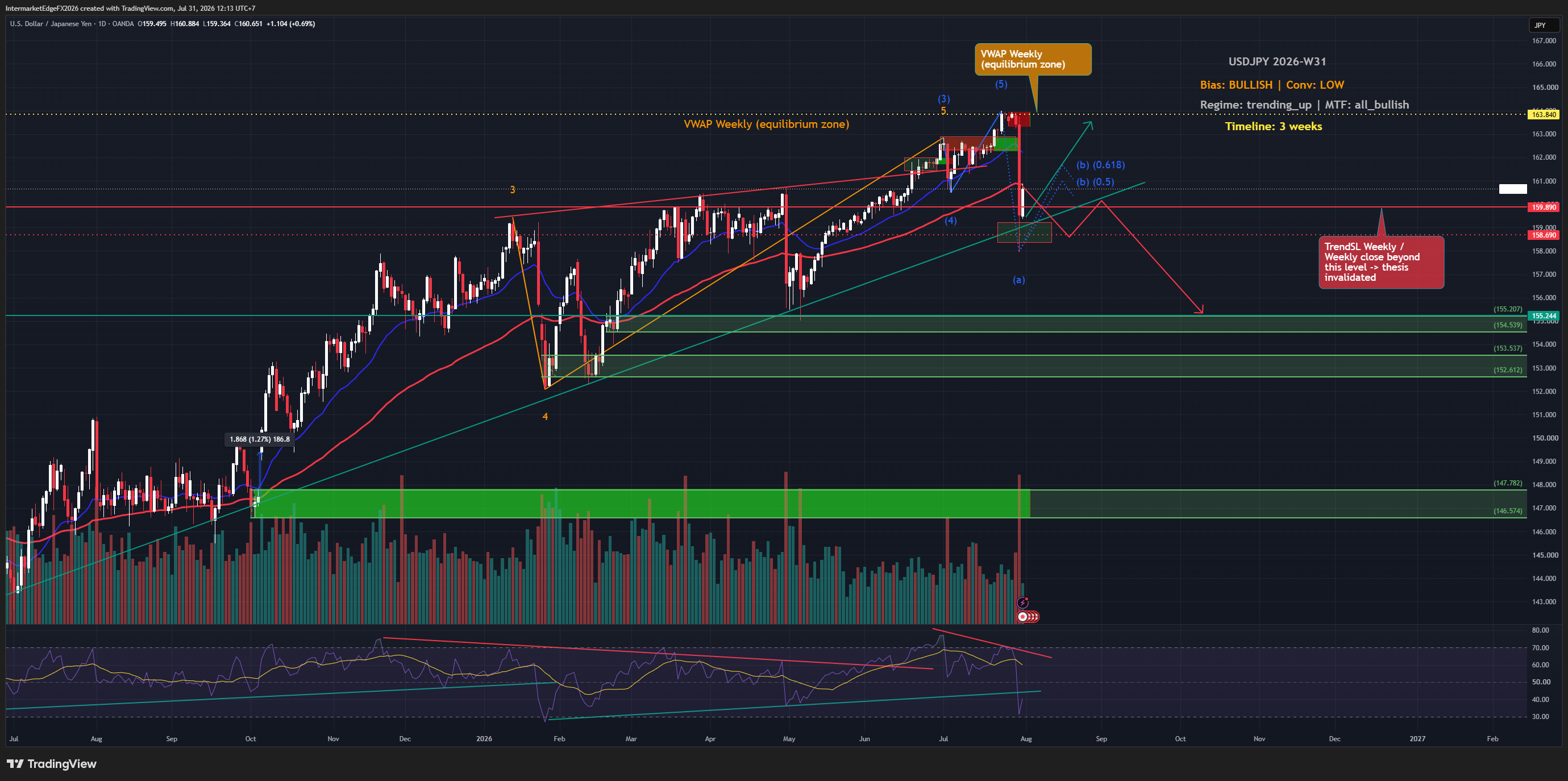
USDJPY is caught between two powerful forces this week: a Fed that remains hawkish with real yields elevated and a BOJ that just held rates at 1% while one board member openly pushed for a hike to 1.25%. As of Friday, 31 July 2026 at 05:00 UTC, price sits at 160.65, below the weekly VWAP of 163.84, with suspected FX intervention having already pushed the yen stronger. The bullish trend structure is intact, but short-term momentum is working against it. The overall bias on USDJPY for the 2026-W31 period is bullish, but conviction is low, low enough that the framework flags this as a 'skip' for active positioning, meaning conservative or zero sizing is the appropriate default, not an aggressive trend-following entry. The primary structural argument for the bullish bias is the Fed-versus-BOJ rate differential, which remains the most extreme divergence in the G7 currency space. The Fed is holding rates at elevated levels with a real yield of 2.43%, while the BOJ, even after five hikes this cycle, sits at just 1%, a gap that makes carry trades into yen-funded long-dollar positions structurally attractive when risk appetite is stable. The multi-timeframe technical trend alignment, daily, weekly, and monthly all pointing bullish, provides the strongest single input to this thesis and is the primary reason the bias is not outright neutral or bearish. However, a direct and unresolved signal conflict is present that traders must take seriously: the Fed hawkish causal chain pushes USDJPY higher through USD strength, while the BOJ hawkish chain, amplified by Takata's dissent and the suspected FX intervention, pushes USDJPY lower through JPY carry trade unwind. A carry unwind occurs when traders who borrowed yen cheaply to fund higher-yielding positions are forced or incentivized to close those trades, buying yen back and driving it higher against the dollar. -- Intermarket Edge

USDJPY Week W30-2026: Yen Languishes Near Four-Decade Low as US Yield Surge and BOJ Inaction Keep Dollar Bulls in Control, but Carry Unwind Risk Clouds the Outlook

USDJPY Week W30-2026: Yen Languishes Near Four-Decade Low as US Yield Surge and BOJ Inaction Keep Dollar Bulls in Control, but Carry Unwind Risk Clouds the Outlook

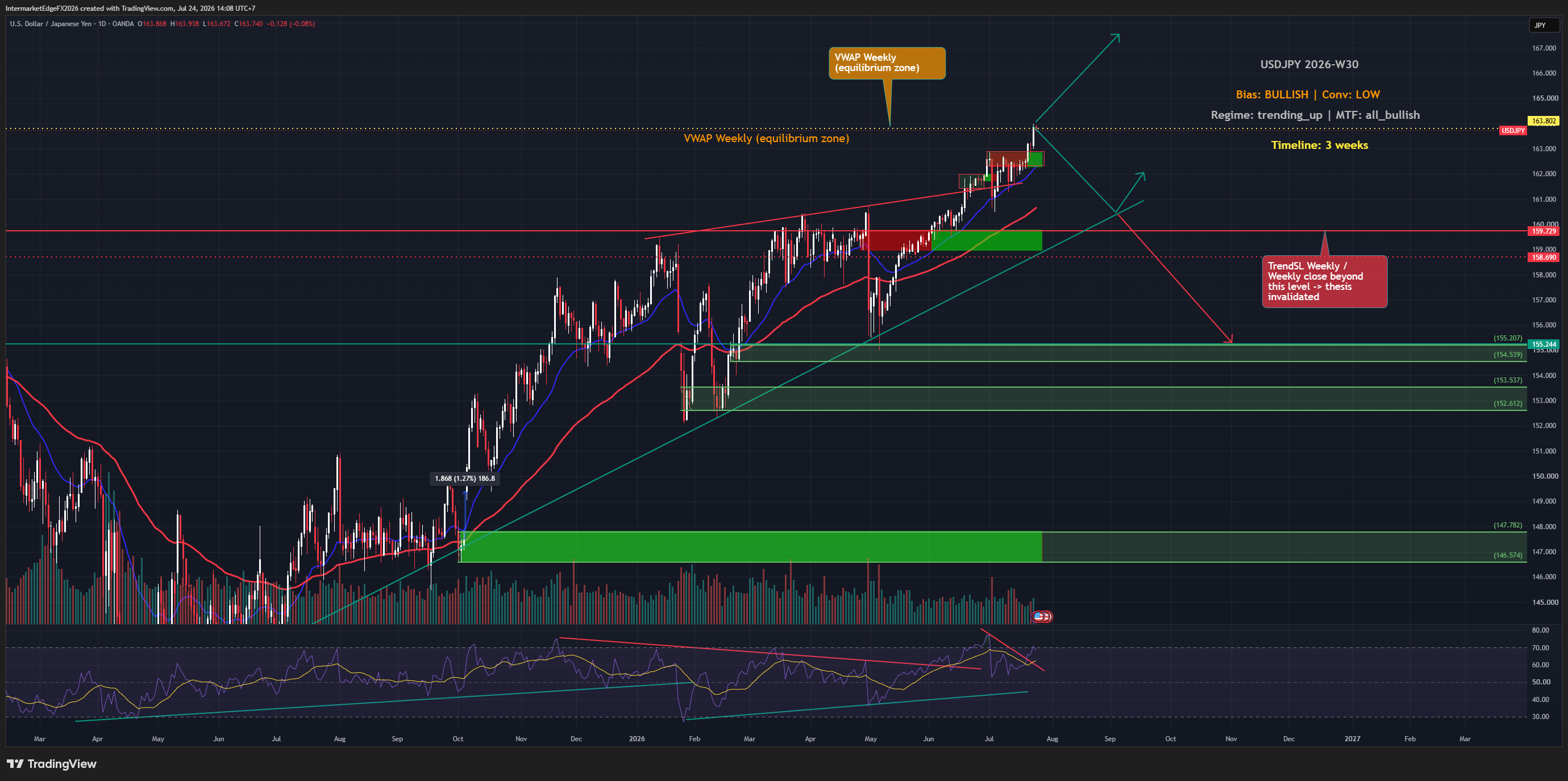
USDJPY is trading around 163.80 (as of 2026-07-24, source: yfinance near-realtime), right at the weekly VWAP of 163.80 — a level to watch for short-term momentum confirmation. Multi-timeframe technicals (daily/weekly/monthly) are all aligned bullish, and COT positioning leans bullish. Trend structure holds above the weekly TrendSL at 159.73. The core driver remains the Fed-BOJ rate differential. US 10Y real yield at 2.39% and nominal at 4.67% keep USD carry attractive. Dollar is also catching a bid from Middle East tensions and trade war inflation fears. However, conviction is LOW, and here's why: two forces are pulling in opposite directions. Japan June core CPI printed +1.6% YoY — below the BOJ's 2% target for a fifth straight month — which normally delays BOJ tightening and supports the yen carry trade. But the US Treasury is publicly calling for more BOJ tightening, and Japan's finance minister flagged readiness for decisive FX action. Simultaneously, US core CPI for June missed at 0.0% vs 0.2% forecast — a dovish surprise that softens the Fed hawkish narrative at the margin. Net result: technicals and COT support a bullish lean, but macro signals partially offset each other. A surprise BOJ rate hike or FX intervention remains the key tail risk — a carry unwind in JPY can reverse this setup sharply regardless of Fed policy. Bias: bullish, low conviction, 3-week horizon. Size accordingly. Exit if weekly close breaks below 159.73. -- Intermarket Edge

USDJPY Week W28-2026: Yen Slides Toward 40-Year Lows at 161.51 as Fed's Waller Reverses Course and BOJ-Fed Divergence Keeps the Carry Trade Alive

USDJPY Week W28-2026: Yen Slides Toward 40-Year Lows at 161.51 as Fed's Waller Reverses Course and BOJ-Fed Divergence Keeps the Carry Trade Alive

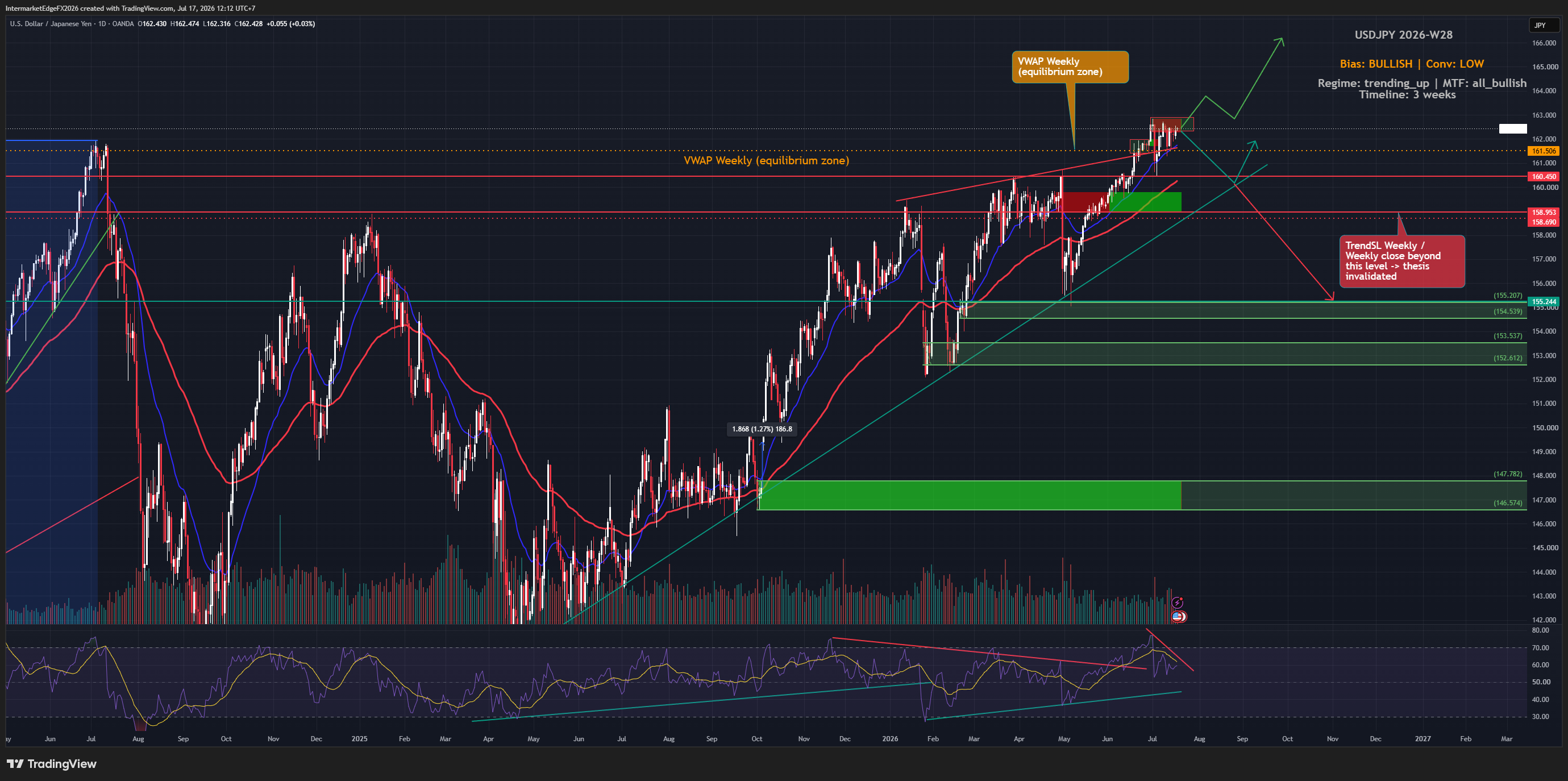
USDJPY sits at 161.51, pinned at weekly VWAP with multi-timeframe alignment fully bullish. The pair is trending higher but conviction is low — price needs to hold above 161.51 (VWAP weekly) to keep near-term momentum intact. Trend structure stays valid down to 158.69 (TrendSL weekly). The macro setup remains straightforward: BOJ-Fed policy divergence is the dominant driver. Yen is hovering near 40-year lows against the dollar as that divergence persists. RSM's Brusuelas flagged Japan's growth-bet posture as the force keeping yen pressured ahead of any BOJ policy pivot — meaning the market isn't pricing a credible near-term shift from Tokyo. On the USD side, Fed's Waller reversed his dovish stance and signaled openness to further rate hikes if inflation stays hot. That lifted US rate-hike odds and helped USD hold gains even after a softer-than-expected June CPI print. US 10Y real yield at 2.32% supports USD as the higher-yielding, positive-carry side of this pair. COT positioning is bullish but crowding risk is worth monitoring — stretched yen shorts have a history of violent unwinds if BOJ surprises. DXY bias is bullish with medium conviction, providing base-currency support. Thesis breaks: weekly close below 158.69 invalidates bullish structure — exit longs. Sustained price below 161.51 signals momentum fade — reduce size. -- Intermarket Edge

Stay in the loop

Get notified about new research, macro insights, and market analysis.

InterMarketEdge

© 2026 InterMarketEdge. Financial intelligence for inter-market traders.