Tag: USD — InterMarketEdge

Tag: USD

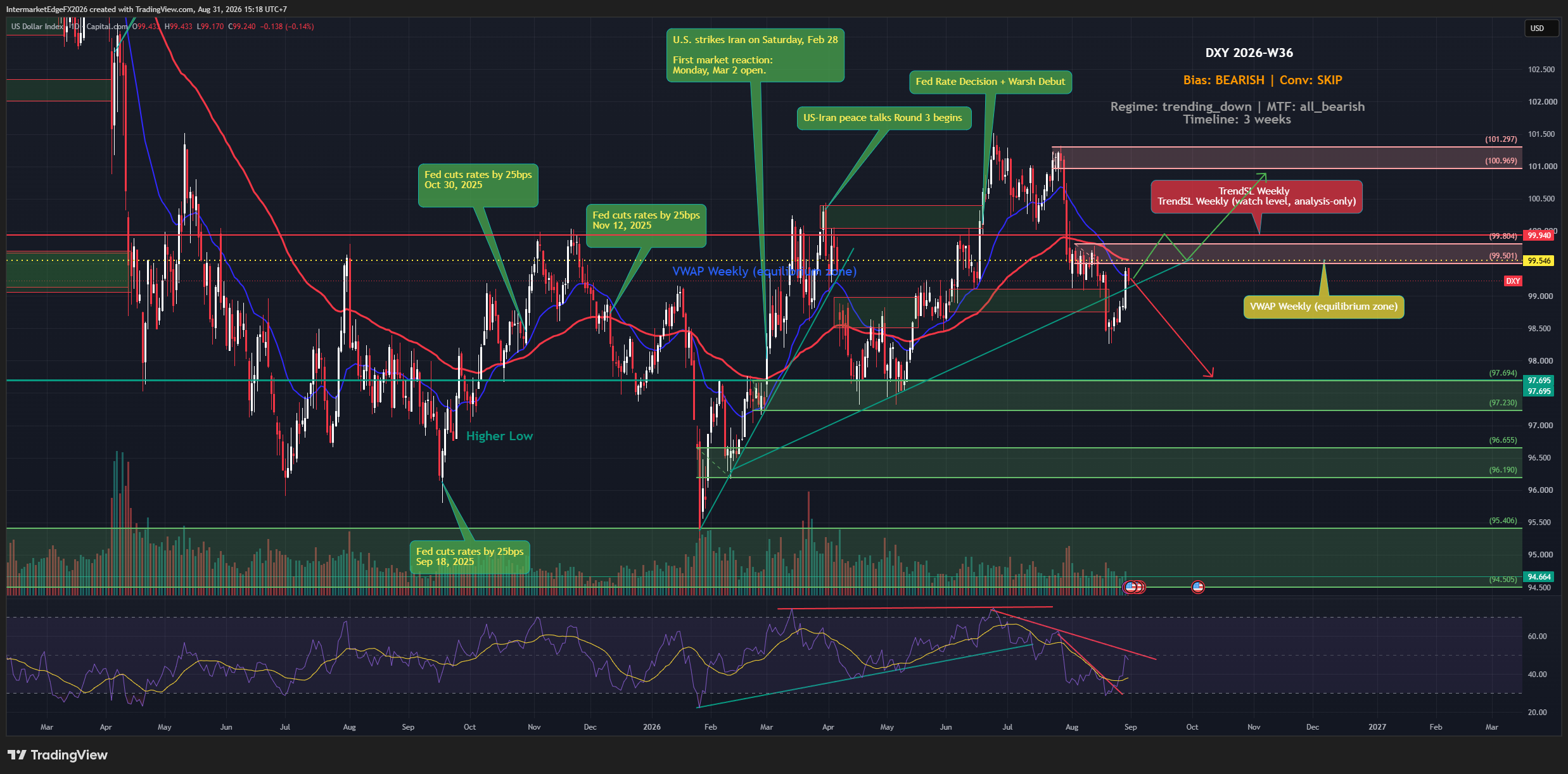
DXY Weekly Outlook W36: Hawkish Fed, Bearish Structure

DXY Weekly Outlook W36: Hawkish Fed, Bearish Structure

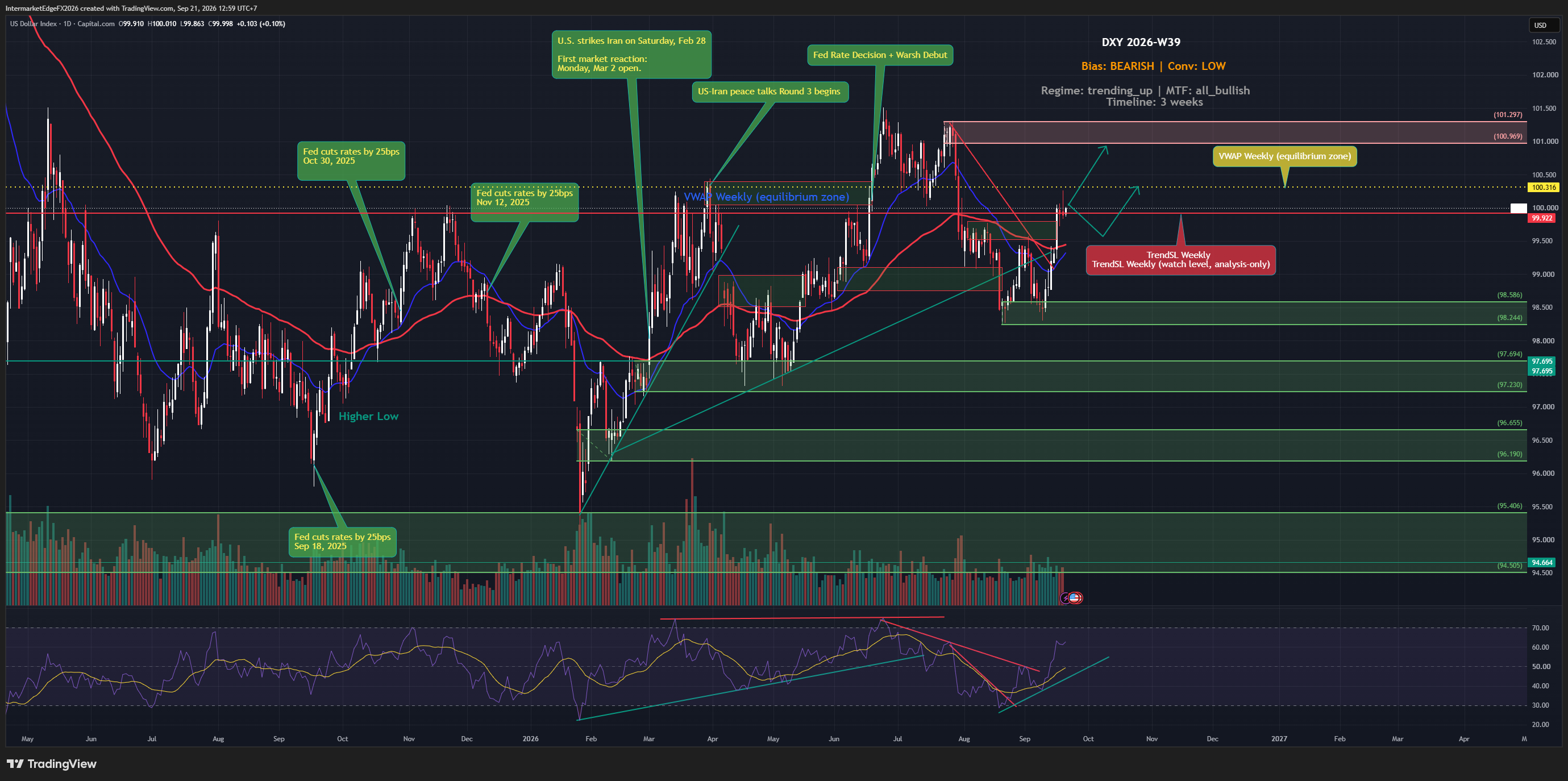
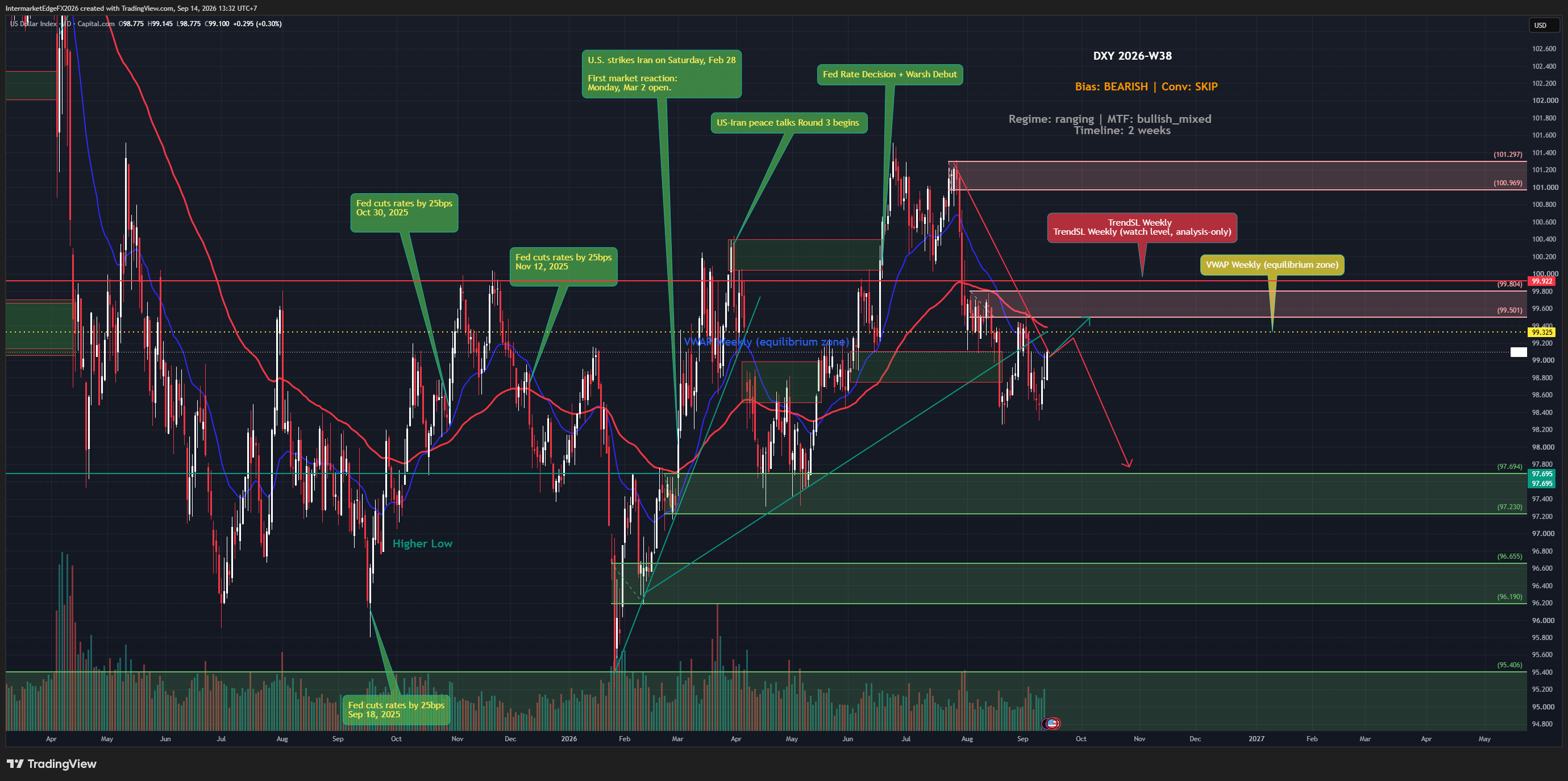
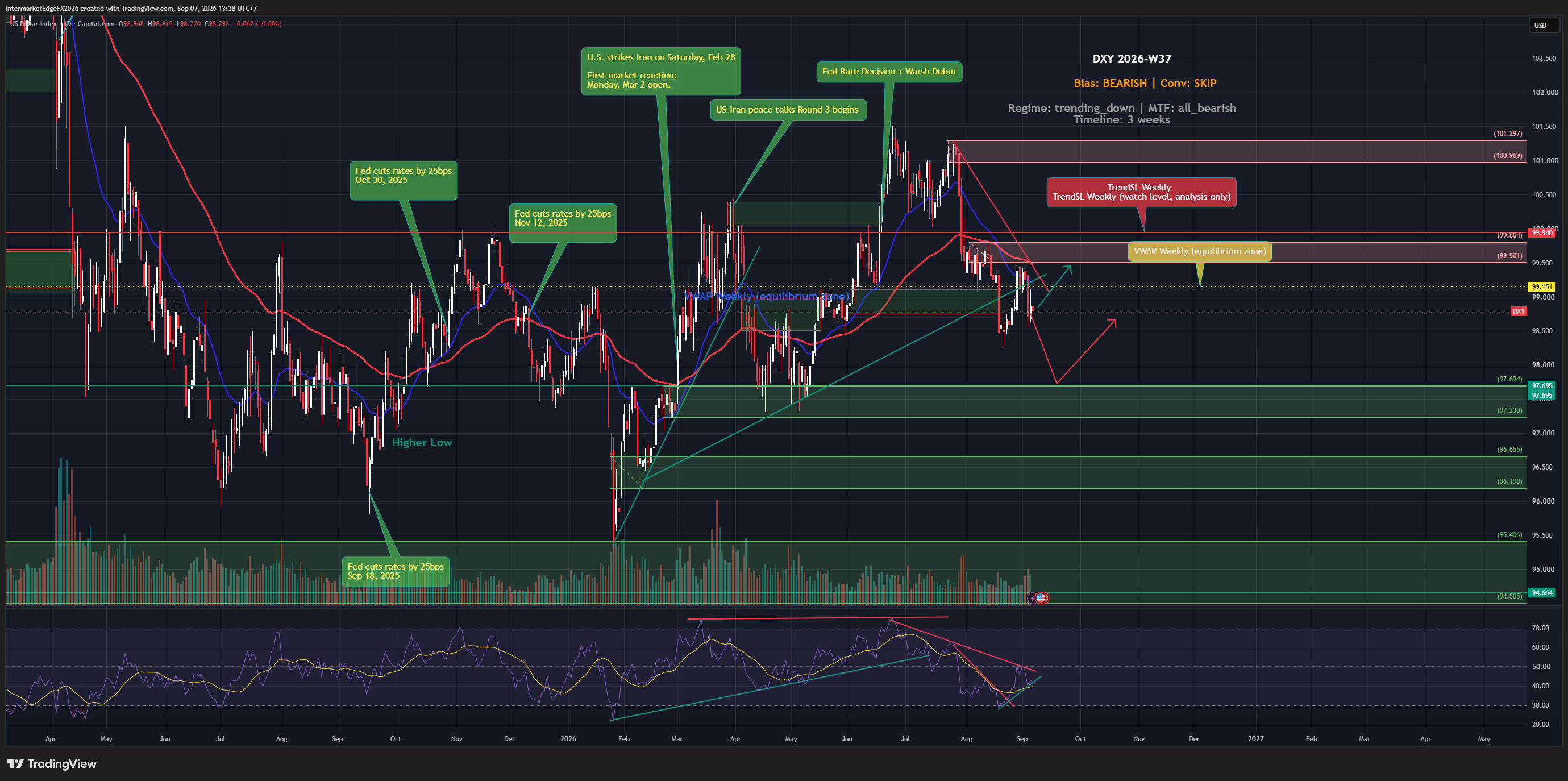
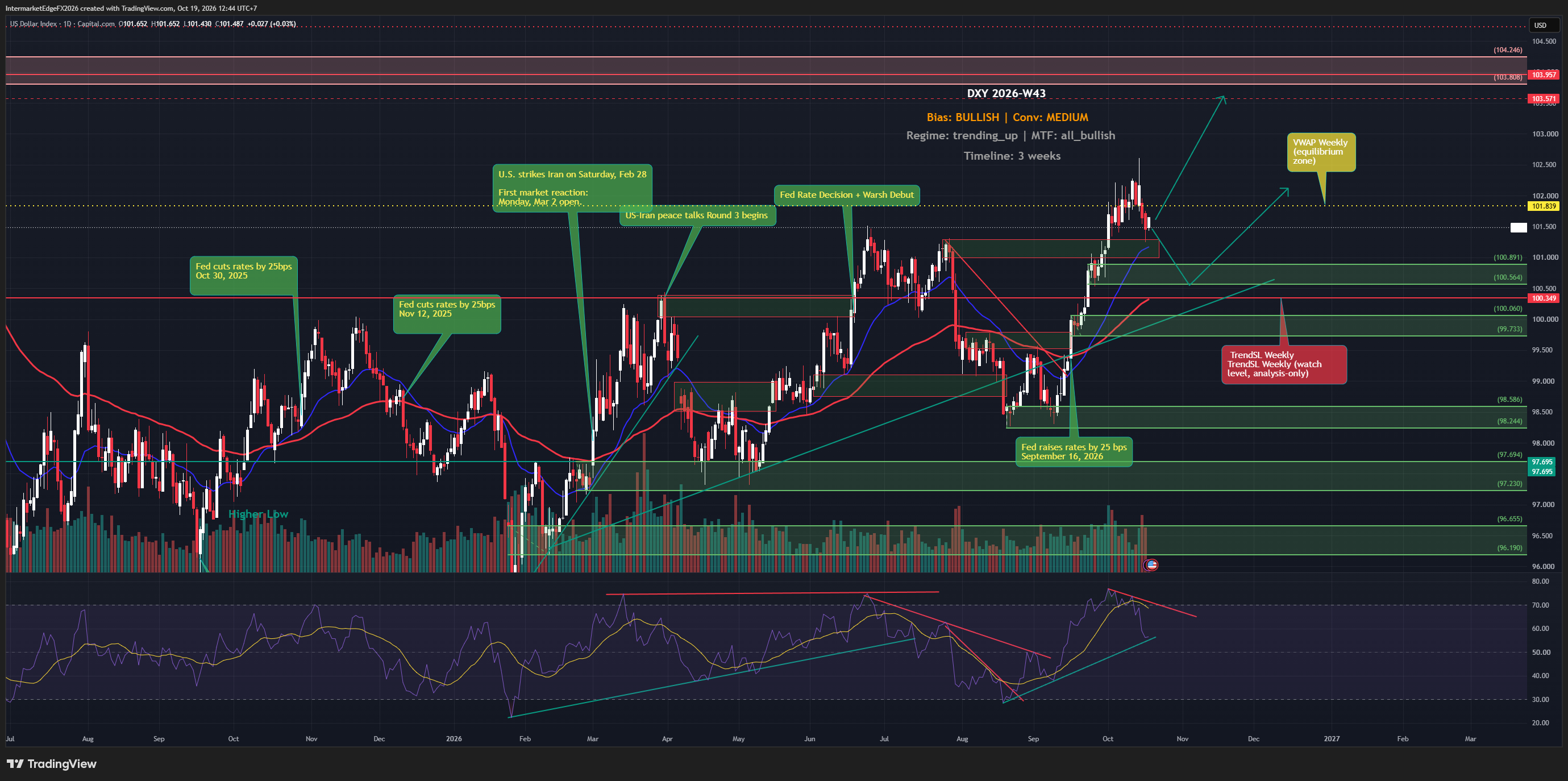
Fed Chair Kevin Warsh just opened the door to further rate hikes if inflation stays sticky, pushing the September hike probability from roughly 36% to around 58%, and the dollar responded, rising about 0.6% to the 99.6-99.7 range. That repricing sounds unambiguously bullish for the DXY. But leveraged funds are already sitting on extreme short positions in the dollar, which means the crowd most likely to fuel a sustained rally may already be largely offside. The payrolls report on September 4 is now the deciding test. The multi-timeframe structure on DXY remains bearish, with alignment across timeframes pointing in the same direction, the regime is trending down, and the framework's FX implication is to follow that trend rather than fade it. That said, the conviction behind this week's bearish read is deliberately low, and staying out of a full position is the rational response to the current evidence, not a failure of analysis. The reason conviction is suppressed comes down to a specific, unresolved conflict. Price action over the past week has been technically constructive, the dollar bounced, reclaimed short-term levels, and printed near a two-week high. Meanwhile, COT positioning data shows leveraged funds holding extreme short positions in the dollar. This is a meaningful divergence: if speculators are already heavily short, there is a contrarian question worth taking seriously, who is left to sell? A market where the bearish crowd is already crowded (crowding risk, meaning the position is so consensus that a reversal triggers forced covering rather than fresh selling) can squeeze sharply on any positive catalyst, and Warsh's hawkish signal plus the geopolitical oil spike are exactly the kind of catalysts that can trigger such covering. -- Intermarket Edge (Note: COT (Commitment of Traders) data is released weekly by the CFTC with a reporting-period lag -- it is not a real-time position feed. See cftc.gov for the exact release schedule.)

DXY Weekly Outlook: A Bearish Trend Meets a Crowded Short

DXY Weekly Outlook: A Bearish Trend Meets a Crowded Short

The US Dollar Index is trading near multi-month lows heading into Week W35-2026, and the bearish macro case looks clean on the surface, debt concerns, a weakening fiscal backdrop, and cross-timeframe alignment all pointing down. But underneath that surface, leveraged funds have already crowded into the short side, and price is actually testing from above the weekly VWAP at 98.841. When positioning is extreme and price refuses to break, the cleanest-looking trades tend to produce the messiest exits. The analytical framework carries a bearish bias on DXY for the three-week horizon, with the regime classified as trending down, meaning price structure, momentum, and multi-timeframe alignment are all oriented lower. In principle, the correct tactical posture in a trending-down regime is to follow the trend, not fade it. But the conviction here is deliberately set aside, and that deserves a clear explanation rather than a vague confidence label. Three signal sources are active this week: technical price action is actually leaning bullish, COT positioning is bearish, and macro defaults to a mild bullish tilt contingent on COT confirmation. The direct conflict between rising price action and extreme short positioning by leveraged funds, a COT divergence, is the central problem. COT divergence of this type, where price moves in one direction while professional speculators pile into the opposite side, carries two plausible readings: either the crowd is right and price is about to follow their positioning, or the crowd is too crowded and a short squeeze, a rapid, forced unwind of those short positions, is about to punish late entries. A short squeeze in this context means anyone short the dollar gets forced to cover simultaneously, driving the price sharply higher against the prevailing trend. -- Intermarket Edge (Note: COT (Commitment of Traders) data is released weekly by the CFTC with a reporting-period lag -- it is not a real-time position feed. See cftc.gov for the exac

DXY Week W34-2026: Retail Sales Shock Sends Dollar Testing 99.485 VWAP, But a Crowded Short Could Flip the Move

DXY Week W34-2026: Retail Sales Shock Sends Dollar Testing 99.485 VWAP, But a Crowded Short Could Flip the Move

The dollar is under quiet but persistent pressure this week, with DXY trading at 99.479 as of Monday 17 August 2026, just a fraction below its weekly VWAP at 99.485, testing from underneath. A surprise drop in US retail sales, a consumer sentiment index that collapsed to 51.0 against a 54.2 expectation, and a core CPI print of 0.0% against a 0.2% forecast have combined to erode the fundamental case for a stronger dollar, even as yields stay elevated. The direction leans bearish, but the evidence is not yet convincing enough to size a position. The overall lean for DXY this week is bearish, and the trend regime is clearly downward, but the conviction supporting that bias is deliberately low, and the analysis here reflects a decision to stand aside rather than treat the bearish lean as an actionable entry signal. Here is why that matters: the framework shows a direct conflict between what price has been doing and what institutional positioning implies. Price action has been constructive, technically, the trend has shown some bullish characteristics. But commitments of traders data shows leveraged funds sitting at extreme short positioning. That divergence creates what traders call crowding risk on the short side: if the majority of active participants are already short (note, the COT figures cited here reflect directional scoring from the brief and do not specify the exact report week or net-position count, so treat this as directional evidence rather than a standalone citable statistic), there are fewer fresh sellers left to push the dollar lower, and any positive catalyst can trigger a sharp short-covering rally that has nothing to do with fundamentals changing. -- Intermarket Edge

DXY Week W33-2026: Dollar Tests VWAP From Underneath as Fed Hawk Dissent and Iran Uncertainty Pull in Opposite Directions

DXY Week W33-2026: Dollar Tests VWAP From Underneath as Fed Hawk Dissent and Iran Uncertainty Pull in Opposite Directions

The US Dollar Index slipped to 99.846 as of Tuesday, 11 August 2026 at 08:40 UTC, sitting below its weekly VWAP of 99.895 and testing that level from underneath. A shocking Core CPI miss, actual 0.0% against a 0.2% forecast, has stripped one of the dollar's key near-term supports, even as Fed dissenter Hammack openly advocates for rate hikes and geopolitical noise from the Iran situation keeps traders cautious. The multi-timeframe picture is uniformly bearish, but conviction is too thin to size aggressively in either direction right now. The overall bias on DXY for W33-2026 is bearish, aligned with a confirmed trending-down regime, and every timeframe in the multi-timeframe stack is pointing in the same direction. In that sense, the directional read is not ambiguous, the regime says trend-follow short. The problem is conviction, which is assessed as skip-level, meaning this is explicitly not a week to be sizing into fresh positions aggressively, and the reasons for that are worth spelling out clearly so traders understand the risk they are taking if they choose to engage anyway. The central tension is a direct conflict between price action and Commitments of Traders (COT) positioning data. Price action over recent sessions has been constructive for the dollar, carrying a bullish short-term signal, while COT data, which tracks reported positioning across speculator categories and should be read as directional evidence rather than a precise, citable statistic given the brief does not specify the exact report week or net-position figures, shows leveraged funds at extreme short positioning. This is a classic COT divergence setup, and the rule here is contrarian: when speculative shorts are already crowded to an extreme, the pool of fresh sellers willing to push price lower is by definition shrinking. -- Intermarket Edge

DXY Week W32-2026: ISM Manufacturing Surges to 55.6 as Dollar Tests VWAP at 99.687 From Above, But Macro Signal Conflict Keeps Bears Cautious

DXY Week W32-2026: ISM Manufacturing Surges to 55.6 as Dollar Tests VWAP at 99.687 From Above, But Macro Signal Conflict Keeps Bears Cautious

The US Dollar Index is under a trending bearish regime heading into Week W32-2026, yet the setup is anything but clean. Manufacturing activity just printed its strongest reading since May 2022, core CPI missed forecasts badly, and price is currently pressing against a critical structural level, all while the overall bias remains bearish with low conviction. This is a week for watching and assessing, not for forcing a position. The overall bias on DXY for Week W32-2026 is bearish, but conviction is explicitly low, and traders must handle this carefully. The multi-timeframe technical regime is aligned bearish across all timeframes, and the broader trend regime is classified as trending down with moderate confidence. That said, the signal picture is heavily conflicted. Both price action and the macro backdrop are currently pointing toward Dollar strength, the ISM beat, the still-elevated real yield of 2.41%, and the active causal chains around Fed policy relative to the G6 central bank basket and the residual influence of the prior hot inflation environment all argue for USD resilience. The rule engine's bearish override is driven by Fed policy divergence assessed relative to the broader G6 central bank basket, not by any single domestic data point, and it represents a structural thesis rather than a tactical one. Critically, three of five signal input categories, positioning data, liquidity indicators, and sentiment surveys, fired zero confirming signals this week. That is not a minor gap; it means the bearish call is resting on a much narrower evidential base than would normally justify an active directional stance. A macro bullish signal is also present but flagged as a provisional placeholder, subject to override if positioning data aligns in future reports. -- Intermarket Edge

DXY Week W31-2026: Price Holds Above VWAP at 101.283 as Technicals and Macro Both Turn Bullish, Yet the Rule Engine Stays Bearish

DXY Week W31-2026: Price Holds Above VWAP at 101.283 as Technicals and Macro Both Turn Bullish, Yet the Rule Engine Stays Bearish

As of Monday, 27 July 2026 at 16:14 UTC (yfinance near-realtime), DXY trades at 101.46 — above weekly VWAP 101.283 by 0.18 points, testing from above, and well above TrendSL weekly 99.753 by 1.71 points. Both break conditions remain unmet: bearish structure is not invalidated. The core problem this week is a hard signal conflict. The rule engine outputs a bearish bias, but nearly every underlying input disagrees. Daily, Weekly, and Monthly TrendSL are all bullish — the strongest technical alignment available. Two active macro causal chains (Fed hawkishness and hot CPI) both carry high USD-bullish weights. Price action is bullish. The bearish label stems from a default Fed-vs-G6 rate differential assumption applied in the absence of COT confirmation; it carries low conviction. COT, liquidity, and sentiment sources fired no rules, so the bearish case has no positioning support. Treat the bias label as a placeholder, not a directional call. Yield structure adds complexity: US 10Y at 4.71%, 2Y at 4.37% — a positive term spread — with real 10Y yield at 2.43%, still supportive of USD carry. No carry unwind signal is present. Key risk event: per ForexFactory calendar data, FOMC rate decision, statement, and press conference are all scheduled for 29 July 2026; Advance GDP and Core PCE follow on 30 July 2026. These dates are from a secondary aggregator, not official Federal Reserve confirmation. Crowding risk around the FOMC is real — a dovish surprise could resolve the signal conflict bearishly; a hold-with-hawkish-tone outcome reinforces the technical bullish case. Bottom line: signals are genuinely conflicting. Do not lean into the bearish label without COT confirmation. Watch the 29–30 July data window. -- Intermarket Edge

DXY Week W29-2026: Core CPI Prints Zero Against a 0.2 Forecast, but US-Iran Escalation Keeps Safe-Haven Demand Alive and the Dollar Refuses to Break

DXY Week W29-2026: Core CPI Prints Zero Against a 0.2 Forecast, but US-Iran Escalation Keeps Safe-Haven Demand Alive and the Dollar Refuses to Break

The dollar is caught between two opposing forces this week. On one side, the intensifying US-Iran conflict has driven safe-haven demand, pushing DXY firmer with Brent rallying and Asian currencies weakening broadly. Peace prospects have since surfaced, causing the dollar to tick higher again on uncertainty — classic conflict-driven vol without a clean directional resolution. On the other side, the July CPI print landed at 0.0% MoM against a 0.2% forecast — a meaningful miss — which is structurally USD-bearish and removes near-term Fed hawkishness expectations. Technically, the picture leans bullish: MTF alignment is all-bullish, price is sitting right at the weekly VWAP of 100.77, and the TrendSL at 99.48 remains intact below. A weekly close sustaining above 100.77 keeps short-term momentum with the bulls. The overall bias remains bearish on a 3-week view, but conviction is low — and that honest assessment matters here. The regime reads trending up, the CPI miss is real but hasn't broken structure yet, and the geopolitical safe-haven flow is a wildcard that can reverse fast. Key levels to watch: a sustained hold above 100.77 pressures the bearish thesis. A weekly close below 99.48 would invalidate bullish structure entirely. China's yuan decoupling from the broader safe-haven move in Asia is worth monitoring as a canary for USD directionality. No clear edge here — wait for resolution. -- Intermarket Edge

USDJPY Week W28-2026: Yen Slides Toward 40-Year Lows at 161.51 as Fed's Waller Reverses Course and BOJ-Fed Divergence Keeps the Carry Trade Alive

USDJPY Week W28-2026: Yen Slides Toward 40-Year Lows at 161.51 as Fed's Waller Reverses Course and BOJ-Fed Divergence Keeps the Carry Trade Alive

USDJPY sits at 161.51, pinned at weekly VWAP with multi-timeframe alignment fully bullish. The pair is trending higher but conviction is low — price needs to hold above 161.51 (VWAP weekly) to keep near-term momentum intact. Trend structure stays valid down to 158.69 (TrendSL weekly). The macro setup remains straightforward: BOJ-Fed policy divergence is the dominant driver. Yen is hovering near 40-year lows against the dollar as that divergence persists. RSM's Brusuelas flagged Japan's growth-bet posture as the force keeping yen pressured ahead of any BOJ policy pivot — meaning the market isn't pricing a credible near-term shift from Tokyo. On the USD side, Fed's Waller reversed his dovish stance and signaled openness to further rate hikes if inflation stays hot. That lifted US rate-hike odds and helped USD hold gains even after a softer-than-expected June CPI print. US 10Y real yield at 2.32% supports USD as the higher-yielding, positive-carry side of this pair. COT positioning is bullish but crowding risk is worth monitoring — stretched yen shorts have a history of violent unwinds if BOJ surprises. DXY bias is bullish with medium conviction, providing base-currency support. Thesis breaks: weekly close below 158.69 invalidates bullish structure — exit longs. Sustained price below 161.51 signals momentum fade — reduce size. -- Intermarket Edge

DXY - Price Holds Above 100.98 Despite a Sharp June NFP Miss at Just 57K, Wave (5) Toward 103-104.5 Remains Intact

DXY - Price Holds Above 100.98 Despite a Sharp June NFP Miss at Just 57K, Wave (5) Toward 103-104.5 Remains Intact

DXY - SUMMARY 06/07/2026 Regime: Dollar holds steady after a sharp NFP miss, Medium Bull. June NFP came in at just +57K versus a 110K forecast, weakest in four months, yet DXY still stands at 100.982 because wave (4) had already finished absorbing at 99.1-99.6 before the data landed, real yield remains positive at +0.27%, and the Fed stays hawkish post the Warsh FOMC. Bias: Medium Bull (trimmed from Medium-High Bull last week). New factor: June NFP missed sharply at +57K, May revised down from +172K to +129K, unemployment held at 4.2%. VIX low at 15.81, no defensive risk-off yet. Data corrections: CPI 4.2% (not 2.4%); US2Y 4.12% (not 3.668%); Fed Hold with hawkish bias post-Warsh (not "40% hike odds"). D1 structure: wave (4) absorbed 99.113-99.618, price cleared to 100.982, retesting the reaction high at 101.5-102. Wave (5) targets: 101.808 then 103.957, zone 103-104.5. Invalidation below 97.695. Scenarios: wave (5) continues toward 103-104.5 (40%); weak ISM Services pulls price back to retest 99.1-99.6 (30%); range pending confirmation (15%); break below 97.695 invalidates the wave count (15%). Decisive event today: ISM Services PMI and a Waller speech. For informational purposes only, not investment advice.

Stay in the loop

Get notified about new research, macro insights, and market analysis.

InterMarketEdge

© 2026 InterMarketEdge. Financial intelligence for inter-market traders.