Tag: USOIL — InterMarketEdge

Tag: USOIL

USOIL W41: Supply Fears Meet Demand Doubts

USOIL W41: Supply Fears Meet Demand Doubts

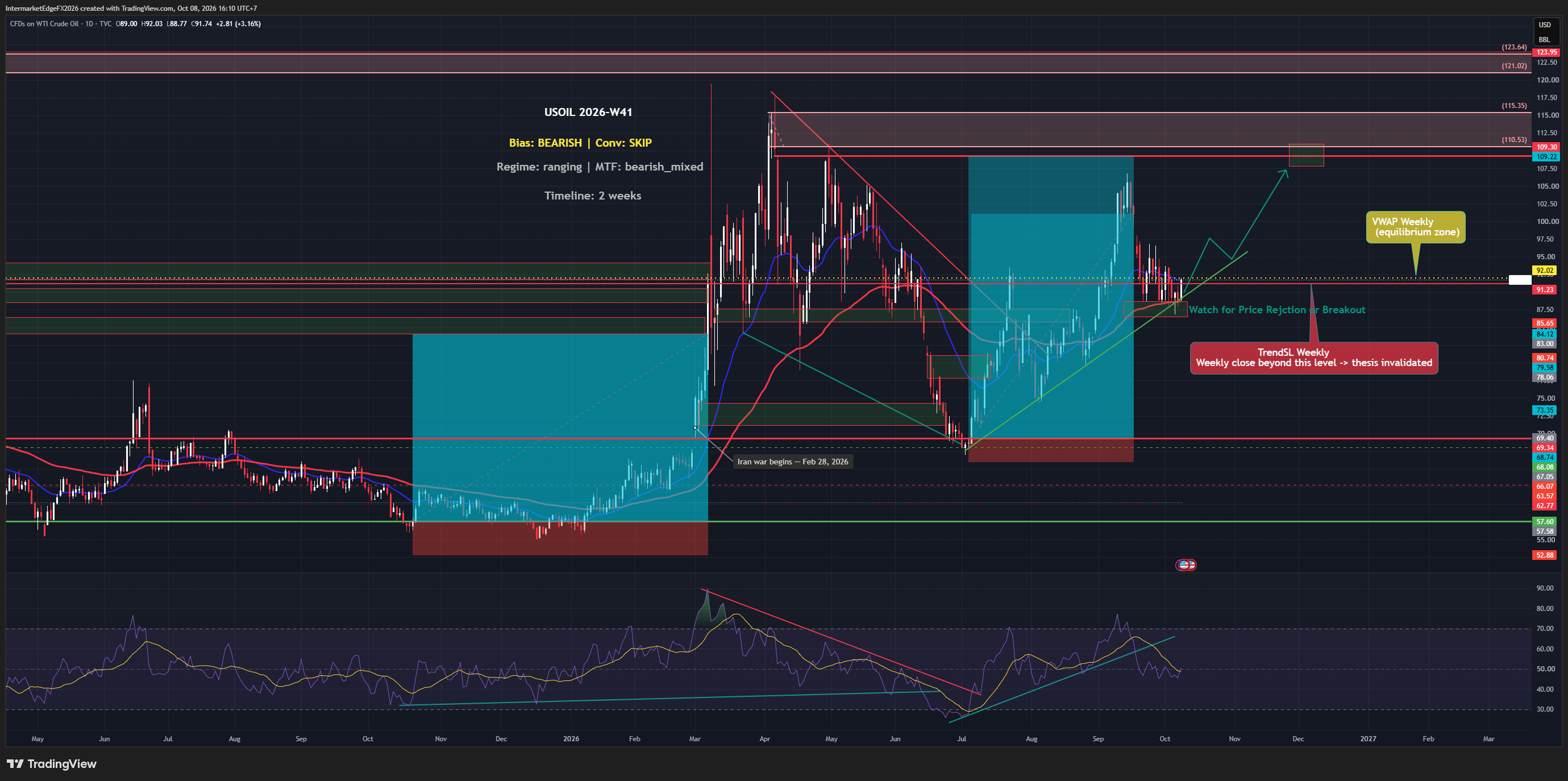
USOIL W41 | Supply fears, demand doubts, no confirmed short setup USOIL was 91.836 at 08:44 UTC on October 8, 2026 (MT5 USOIL.sml:1m), displayed as 91.84. Price is below weekly VWAP 92.02 and already above weekly TrendSL 91.23. The structural conflict with the bearish view is active now, not a future risk. A completed weekly close below 91.23 would provide bearish structural confirmation for the first time. This is confirmation, not invalidation, and remains pending. An intraday crossing is insufficient. If price sustains above 92.02, momentum would work against the bearish view and call for a short-side risk review. This warning is pending and does not require a weekly close. Shipping and storm headlines describe supply risks, not quantified outages. Trading Economics, citing EIA for the week ended October 2, reported crude stocks down 3.186 million barrels, Cushing up 0.444 million and gasoline up 0.382 million. The components are mixed. Barchart reported a demand-forecast reduction; no exact revision is asserted here. Compare fresh dollar moves with oil-specific evidence. A weaker dollar is not another bearish oil signal by itself. The decision is to stand aside over a two-week review horizon while structure and direction disagree. This is a dated broker quote, not an exchange futures settlement. Intermarket Edge | Institutional Macro & Intermarket Analysis For informational purposes only. Not financial advice.
USOIL Week W39-2026: Inventory Build Triples Expectations at 3.0 Million Barrels, But Price Refuses to Break Lower

USOIL Week W39-2026: Inventory Build Triples Expectations at 3.0 Million Barrels, But Price Refuses to Break Lower

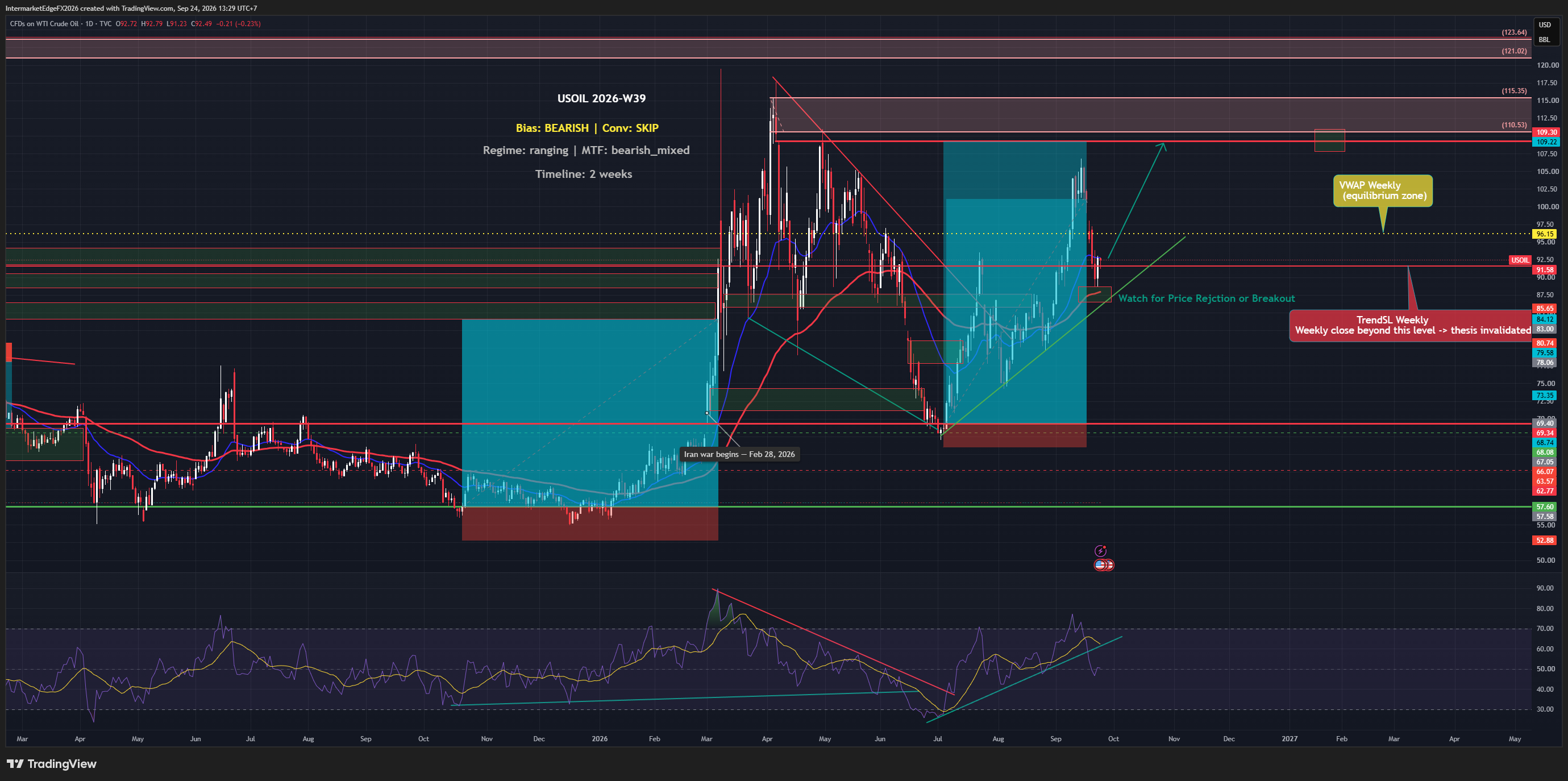
U.S. commercial crude inventories swelled by 3.0 million barrels in the week ended September 18, 2026, six times the expected draw, yet USOIL was trading near 94.86 on Thursday, September 24. That gap between a bearish supply signal and a price that won't follow is the core tension this week. The macro and positioning case leans bearish, but the technical structure hasn't confirmed it, and that conflict is what keeps the analysis at a deliberate stand-aside. The analysis leans bearish on USOIL for the two-week window, but the honest framing is that the evidence is sharply divided and the conviction is low enough that staying out is a deliberate call, not a hesitant one. What generates the bearish lean is the combination of speculator positioning and supply dynamics. COT data, which tracks the net futures positions reported by large speculative traders, though the specific report week and exact net figures are not specified in the available brief, so this should be read as directional context rather than a precise citable statistic, shows speculators already holding extreme long exposure. When the speculative community is crowded into one side, the risk of a positioning unwind rises sharply: if sentiment turns even modestly, those longs become forced sellers, and the price can fall faster than fundamentals alone would predict. This is crowding risk, the danger that the size of a consensus position itself becomes the trigger for a reversal. Simultaneously, consecutive inventory builds tell the same story from the supply side: crude is accumulating in storage rather than being drawn down, which removes a key bullish narrative. Against this, price action itself has been registering as a mild positive, price edged lower on Thursday after a strong prior-session rise, but the broader trend since the thesis snapshot at 93.2 has been upward. -- Intermarket Edge

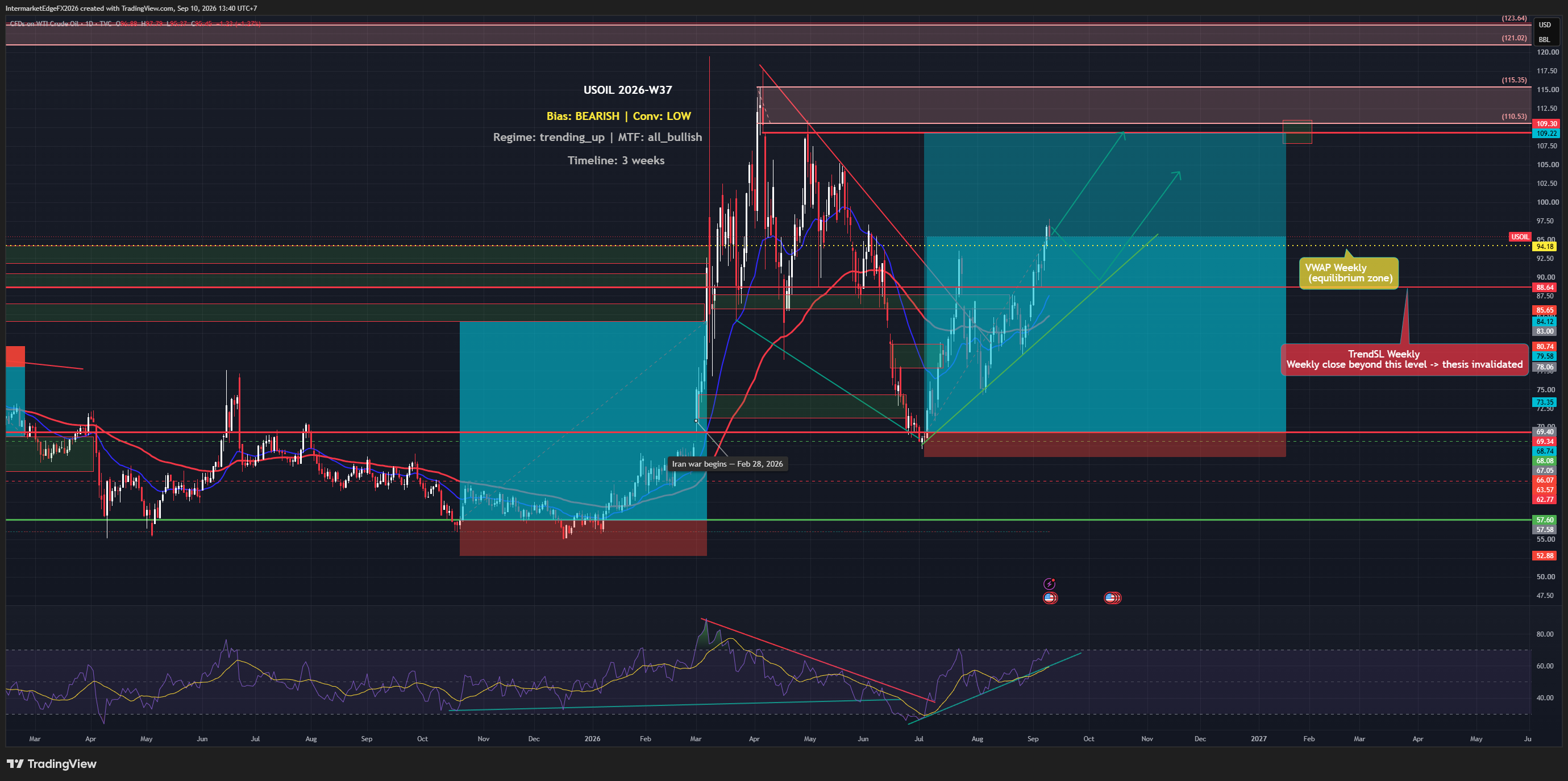
USOIL W37: Bearish Thesis Tested as Brent Tops $100

USOIL W37: Bearish Thesis Tested as Brent Tops $100

Brent crude is holding above $100 on escalating US-Iran attacks against shipping, and every major technical timeframe on USOIL is pointed higher. Yet the structural analysis this week lands bearish, not because the headline risk is wrong, but because inventory builds and a hawkish Fed create a fundamental undertow that the geopolitical premium tends to obscure. The setup is genuinely conflicted, and that conflict is the story. The structural bias for USOIL this week is bearish, but the conviction behind that call is low, and that low conviction is not a minor caveat, it is the central fact. Every quantified signal this week, price action, COT positioning, and macro scoring, registered bullish, yet the framework's structural weighting returns a bearish output. Traders need to sit with that honestly: this is not a clean bearish setup backed by converging evidence. It is a case where top-down structural logic is pushing against a wall of bottom-up signals that all point the other way. The macro case for bearishness runs through two specific channels. First, rising real yields with a hawkish Fed support USD strength, which functions as a quote-side headwind for oil, when the dollar firms, dollar-denominated commodity prices face an automatic gravitational pull lower, all else being equal. Second, the four-week average of actual crude inventory builds has exceeded 1.5 million barrels, meaning physical supply has been accumulating in the US even as the geopolitical narrative dominates the tape. Inventory builds of that magnitude sustained over a month are a concrete fundamental drag, not a sentiment reading. On the other side, COT positioning leans bullish, note that the report week and net-position figure are not specified in the available data, so this should be read as a directional tilt rather than a precisely citable number. -- Intermarket Edge

USOIL Week W35-2026: Three Straight Sessions of Losses as Hormuz Reopening Hopes Pull the Rug on Supply-Risk Bulls

USOIL Week W35-2026: Three Straight Sessions of Losses as Hormuz Reopening Hopes Pull the Rug on Supply-Risk Bulls

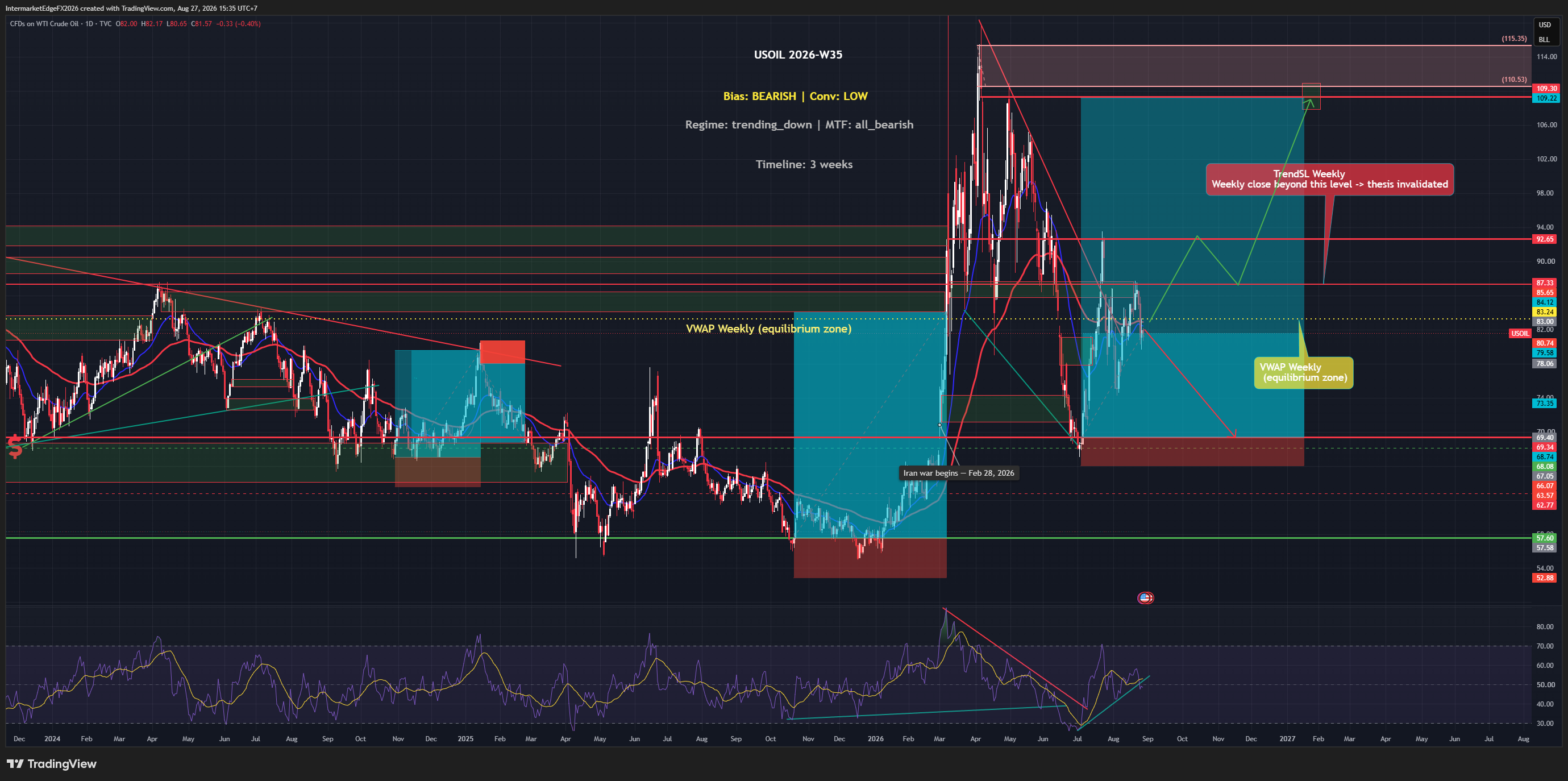
Crude oil has extended losses into a third consecutive session, with price trading at 82.49 as of Thursday 27 August, sitting below the weekly VWAP of 83.24. The headline driver this week is improved odds of the Strait of Hormuz reopening, a geopolitical shift that removes a key supply-risk premium that had been quietly supporting prices. When a fear-driven premium exits, the underlying supply picture takes over, and right now that picture shows four straight weeks of inventory builds averaging above 1.5 million barrels. The directional lean this week is bearish, though with low conviction, and that qualification matters more than the direction itself. What makes this setup structurally unusual is that the individual signals are not aligned behind the bearish view. Price action shows a technical reading that leans bullish, and COT positioning, the commitments of traders report, which tracks the aggregate stance of large speculators and commercial hedgers, also sits on the bullish side (note: the brief does not specify the exact report week, release date, or net-position figures, so this should be read as directional evidence rather than a precise citable statistic). Yet despite both of those inputs pointing higher, the macro causal chain overrides them in the aggregated framework. Fed hawkishness is driving real yields upward, which supports the dollar and creates quote-side pressure on oil. Four consecutive inventory builds confirm that physical supply is not tightening. The TGA refill adds a liquidity-drain headwind that touches all risk assets. The Hormuz reopening story is the newest entrant: improved odds of the strait remaining open mean the geopolitical risk premium, the extra dollars priced in because of potential supply disruption, is being unwound. That unwind is not a collapse, but it removes a support that was never about fundamentals to begin with. -- Intermarket Edge

USOIL Week W34-2026: Hormuz Standoff Lifts Price Above 84.95, But Three Straight Inventory Builds Tell a Different Stor

USOIL Week W34-2026: Hormuz Standoff Lifts Price Above 84.95, But Three Straight Inventory Builds Tell a Different Stor

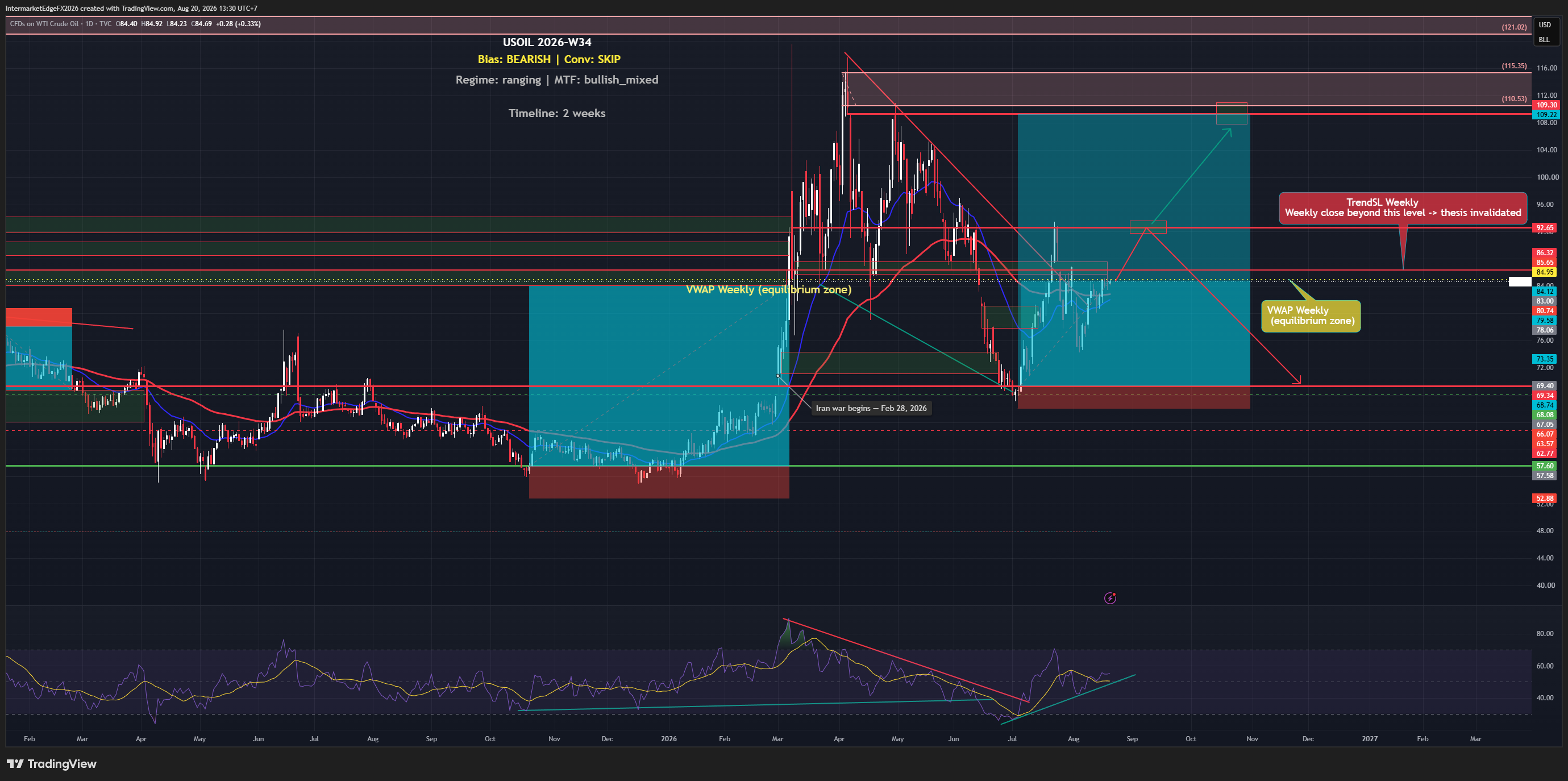
US crude oil is sitting at 85.34 on Thursday, 20 August 2026, trading above its weekly VWAP at 84.95, and that single fact already runs against the week's bearish lean. Three consecutive EIA inventory builds have added genuine supply-side pressure, yet the Hormuz standoff keeps a geopolitical floor under price. The macro and positioning signals are actually bullish, which makes the overall bearish bias here a deliberate, conflict-aware call, not a clean directional read. The overall lean for USOIL this week is bearish, but it is important to understand that this is a conflict-driven bias, not a consensus one. All three active market signals, price action, COT positioning, and the macro backdrop, are individually registering on the bullish side. COT data, which tracks futures positioning reported to regulators and should be read as directional evidence rather than a standalone citable figure since the exact report week and net-position totals are not specified here, shows notable bullish lean from large speculators. Price is above its weekly VWAP. Macro sub-signals, while mixed at the aggregate level, include a geopolitical risk premium that is actively supporting bids. The framework's output of a bearish bias exists precisely because the structural forces sitting behind those near-term signals, rising real yields, a liquidity drain from TGA refill activity, and a sustained inventory build cycle, are likely to reassert once the geopolitical noise fades or the risk premium gets priced out. This kind of internal signal conflict, where the directional call runs against most of the active sub-signals, is exactly the condition that calls for staying aside rather than forcing a position. The conviction here does not reach a threshold where the evidence is convincing enough to size into a directional trade. -- Intermarket Edge

USOIL Week W33-2026: Inventory Builds and Hormuz Uncertainty Leave Oil Caught Between 81.12 and 85.31

USOIL Week W33-2026: Inventory Builds and Hormuz Uncertainty Leave Oil Caught Between 81.12 and 85.31

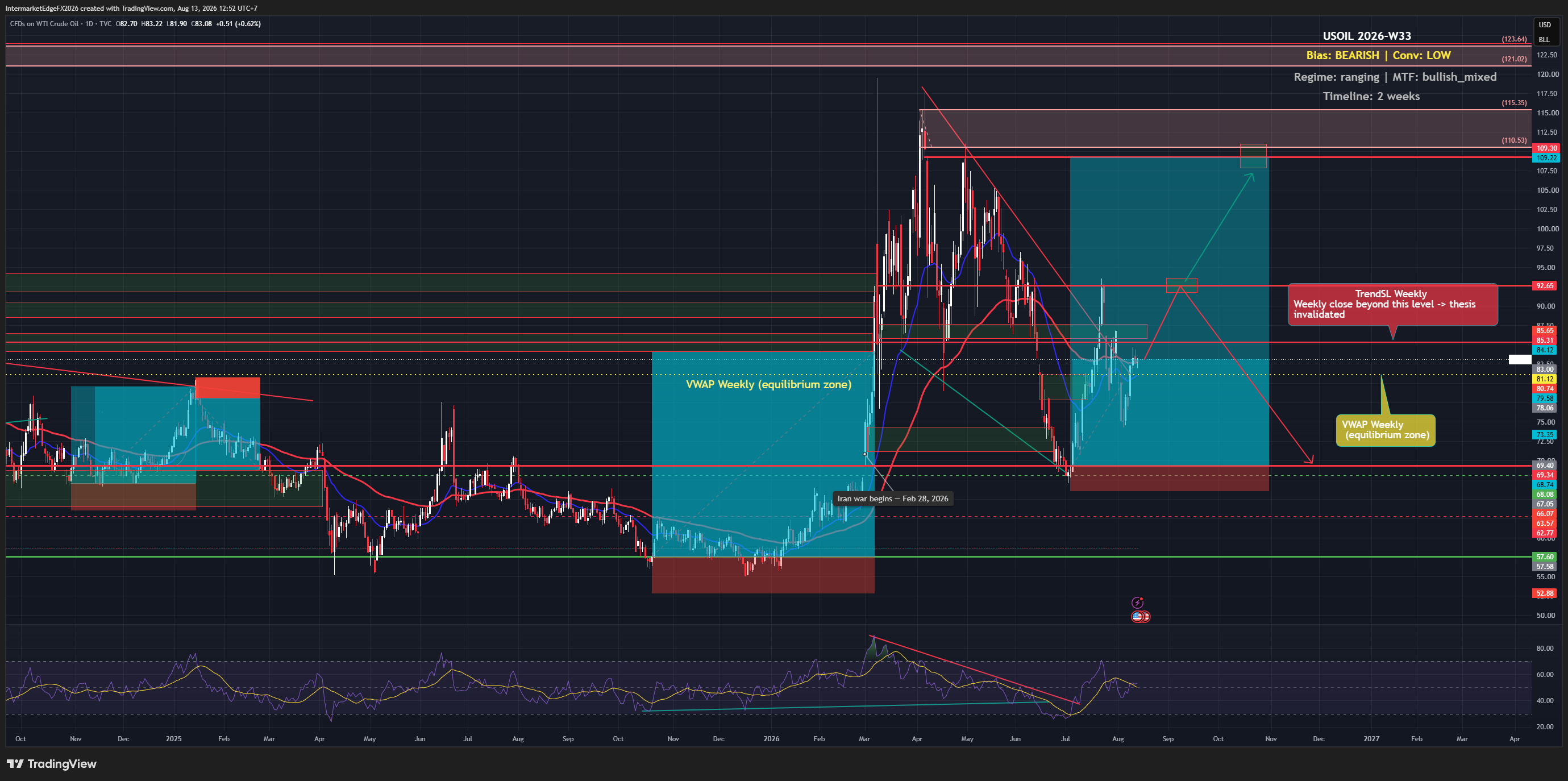
USOIL is trading at 82.90 on the CL=F futures contract used as proxy, caught between a four-week streak of crude inventory builds averaging above 1.5 million barrels and a COT positioning read that still leans bullish. The macro story, rising real yields, a stronger dollar impulse, and China's structural shift away from gasoline, points lower. But price has not broken down yet, and that gap between the fundamental case and actual price behavior is exactly where traders get into trouble this week. The framework's output for W33-2026 is a bearish bias on USOIL, but the conviction is deliberately low, and that low conviction is not a soft bearish call, it is a signal that the evidence is conflicted enough to warrant real caution before sizing any directional position. Here is why the conflict matters: price, COT positioning, and the technical read all carry bullish signals in isolation. COT data shows a bullish lean among non-commercial participants, though the brief does not specify the exact report week, net-position figure, or sample, so this should be read as directional evidence rather than a precise citable statistic. Price itself is above the weekly VWAP at 82.90, meaning short-term momentum has not rolled over yet. And the multi-timeframe alignment reads as bullish-mixed, not cleanly bearish. What flips the framework's output to bearish despite all that is the macro overlay: the combination of a rising real yield environment creating dollar-bullish pressure, four consecutive weeks of crude inventory accumulation averaging above 1.5 million barrels per the EIA's actual reported figures, and the structural demand erosion from China's accelerating EV adoption together form a weight that the bullish positioning signals have not yet been able to lift price through. -- Intermarket Edge

USDCAD Week W31-2026: Fed Holds Rates Steady and CAD Rallies to 9-Day High, Pushing Price Below VWAP at 1.40983 and Testing the Bullish Thesis

USDCAD Week W31-2026: Fed Holds Rates Steady and CAD Rallies to 9-Day High, Pushing Price Below VWAP at 1.40983 and Testing the Bullish Thesis

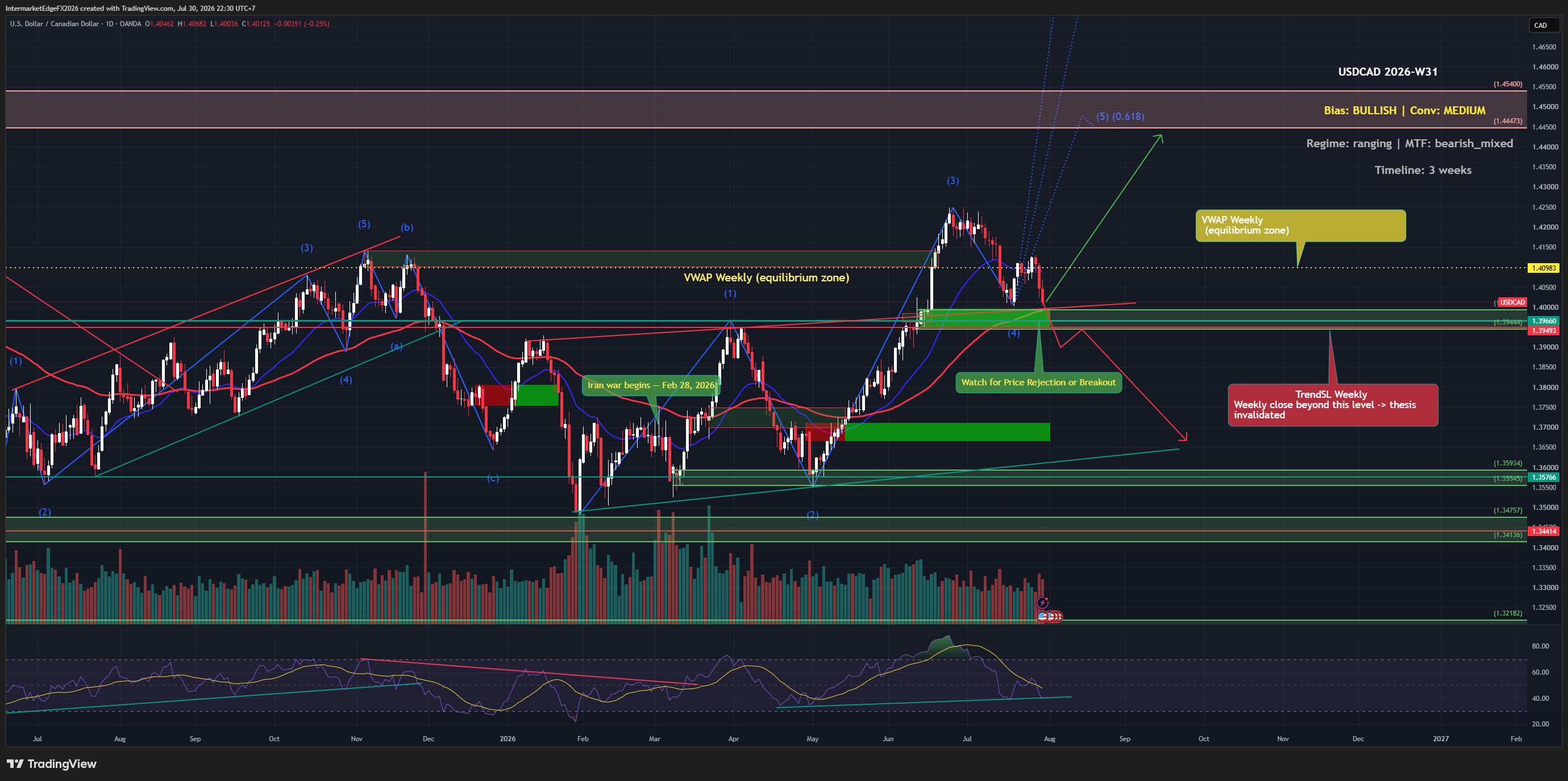
USDCAD is under immediate pressure after the Fed held rates steady, triggering a broad dollar slip and pushing the Canadian dollar to a 9-day high. As of Thursday, 30 July 2026 at 15:04 UTC, price sits at 1.40193, below the weekly VWAP of 1.40983, putting short-term momentum squarely against the bullish structural thesis. The longer-term trend structure remains intact above the weekly TrendSL at 1.39493, but bulls need to reclaim VWAP to restore confidence in the trend-follow setup. The medium-conviction bullish bias on USDCAD for the week of W31-2026 rests on three pillars: the Fed-versus-Bank-of-Canada rate differential, rising US real yields, and a multi-timeframe technical structure that remains aligned bullish across daily, weekly, and monthly frames. The rate differential argument is straightforward, with US real yields at 2.43% and the Fed maintaining a restrictive stance, the fundamental case for USD strength against a commodity-linked currency like CAD has not structurally deteriorated. COT positioning data available in the brief shows a bullish lean for this setup (though the specific report week, net-position figures, and sample context are not provided, so this should be treated as directional corroboration, not a standalone citable statistic). That said, conviction is explicitly rated at medium, not high, and the evidence base this week is narrower than ideal: no liquidity or sentiment signals fired, meaning the bullish case rests on price structure, COT direction, and macro fundamentals alone. The current market price of 1.40193 as of Thursday, 30 July 2026 at 15:04 UTC is already below the weekly VWAP of 1.40983, this is not a future contingency, it is the current reality, and it means short-term momentum is running against the bullish thesis right now. Position sizing should reflect this: this is not a moment to be adding to longs aggressively. -- Intermarket Edge

USOIL Week W30-2026: Geopolitical Escalation Pushes Price Above TrendSL 85.915 as Iran Conflict Threatens Red Sea Supply Routes

USOIL Week W30-2026: Geopolitical Escalation Pushes Price Above TrendSL 85.915 as Iran Conflict Threatens Red Sea Supply Routes

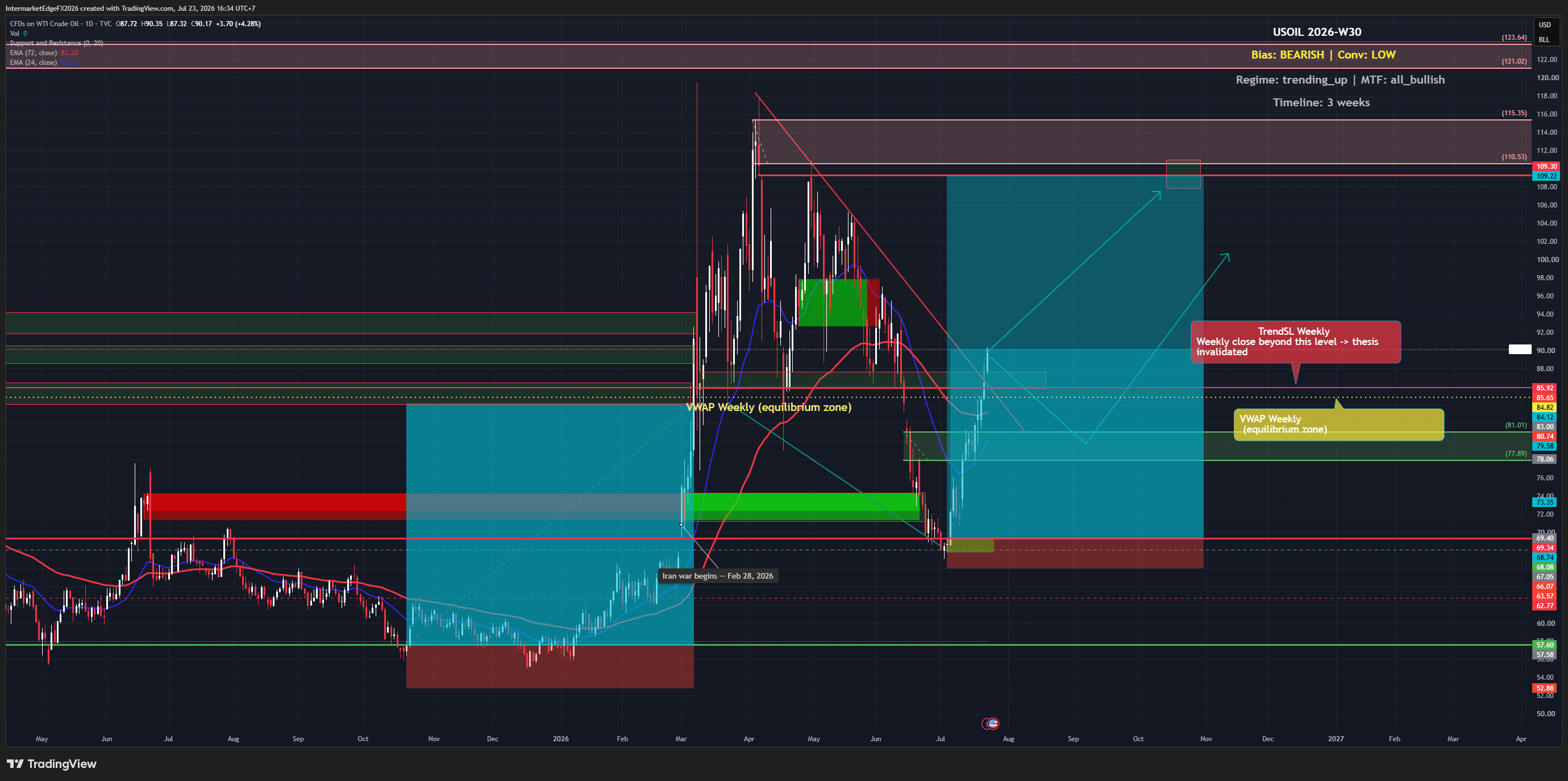
As of July 23, 2026 (~09:01 UTC), WTI is trading near 89.60 (yfinance near-realtime). The thesis snapshot was set at 88.30, so price is already running above that level — a direct challenge to the bearish top-line bias. The geopolitical backdrop is driving the move. Trump has stated that every Iranian attack on a commercial ship will be answered with strikes on bridges or power plants near Tehran. Brent has climbed past a key barrel threshold on mounting supply risks, and markets are pricing further escalation in U.S.-Iran conflict. Separately, reports note Suez and Sumed pipelines can absorb rerouted Saudi flows if the Red Sea is disrupted — a partial offset, but the headline risk premium is clearly in control right now. Technical picture is unambiguously bullish: Daily, Weekly, and Monthly trend structures are all aligned to the upside. Price is well above both the weekly VWAP (84.82) and the weekly TrendSL (85.92) — the thesis-break condition that was supposed to invalidate bearish structure has already triggered. Per the framework's own rules: weekly close above 85.92 means bearish structure is invalidated, exit shorts, reassess. The macro layer is mixed. Rising real yields (US 10Y real at 2.37%) support USD strength, which is a headwind for crude. Four-week average inventory builds exceeding +1.5Mb signal persistent supply accumulation — structurally bearish. But geopolitical supply-disruption risk is currently overriding inventory fundamentals. Bottom line: The bearish bias carries low conviction, COT/sentiment inputs are neutral, and price has broken above every defined invalidation level. No directional lean is warranted here — the conflict between the rule engine's bearish output and live price reality is too wide to trade with confidence. -- Intermarket Edge

USOIL - Last Week's Bearish Thesis Invalidated as Price Clears 73.35, Iran War Escalation Reverses the Entire Oil-Glut Narrative

USOIL - Last Week's Bearish Thesis Invalidated as Price Clears 73.35, Iran War Escalation Reverses the Entire Oil-Glut Narrative

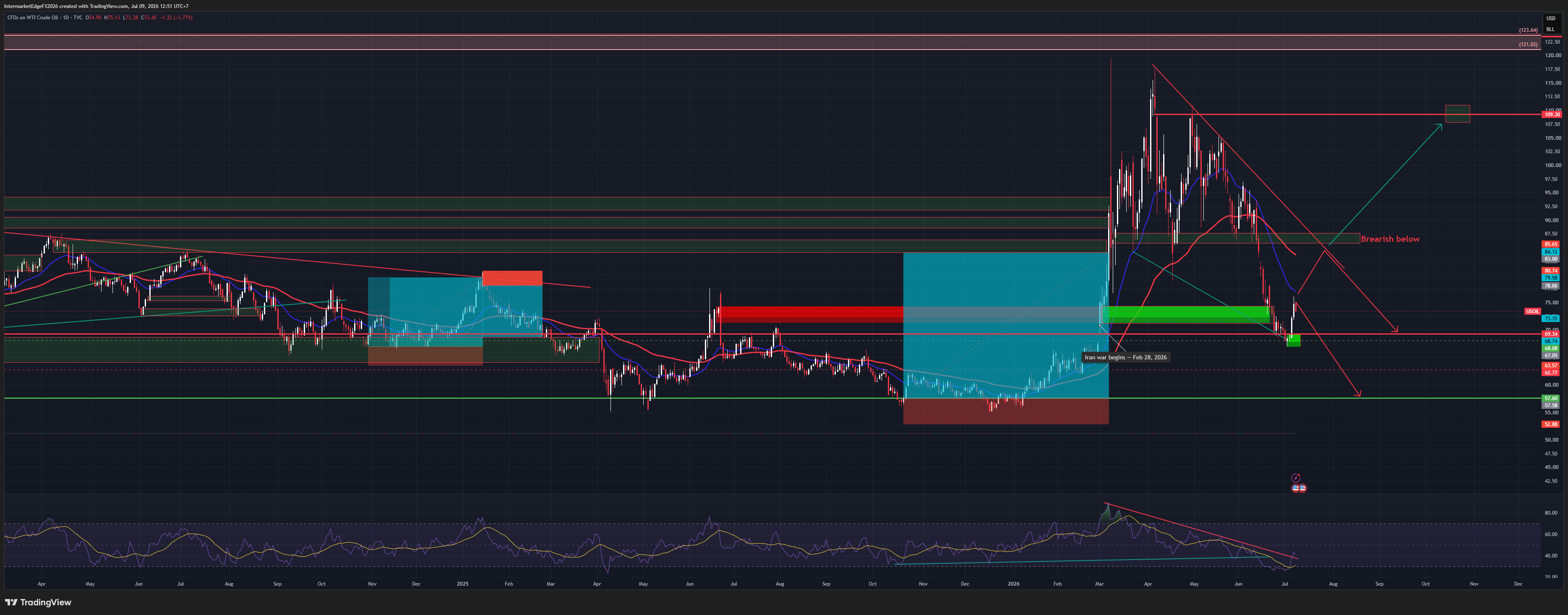
USOIL - SUMMARY 09/07/2026 Regime: Last week's High Bear thesis invalidated as price cleared the 73.35 invalidation level, due to Iran war escalation rather than analytical error. Shifted to Medium Bull (risk premium), moderate conviction. Bias: Medium Bull (risk premium), shifted from High Bear last week. New factors: US revoked Iran's oil sale authorization, struck 80+ targets, Iran retaliated against Bahrain and Kuwait, price surged as much as 7% in a session. Simultaneously, EIA reported a surprise inventory build of 2.998M, breaking an 8-week streak of draws -- a bearish fundamental signal being overwhelmed by risk premium. Key precedent: the Iran war's outbreak in February pushed Brent up 65% before fully reversing over 4 months. Caution warranted given this precedent could repeat. D1 structure: support 69-70, medium-term resistance 87.5-92.5. Upside target: 108-112. Downside target: 63.57-57.60. Scenarios: continued escalation toward 87.5-112 (35%); range 70-85 pending developments (40%); cooling as in the precedent, resuming the downtrend (25%). This is the hardest-to-forecast variable in the current 9-instrument basket; continuous monitoring of geopolitical developments is required. For informational purposes only, not investment advice.

Stay in the loop

Get notified about new research, macro insights, and market analysis.

InterMarketEdge

© 2026 InterMarketEdge. Financial intelligence for inter-market traders.