Tag: EUR/USD — InterMarketEdge

Tag: EUR/USD

EURUSD W43: A Bearish Structure With an Active Momentum Warning

EURUSD W43: A Bearish Structure With an Active Momentum Warning

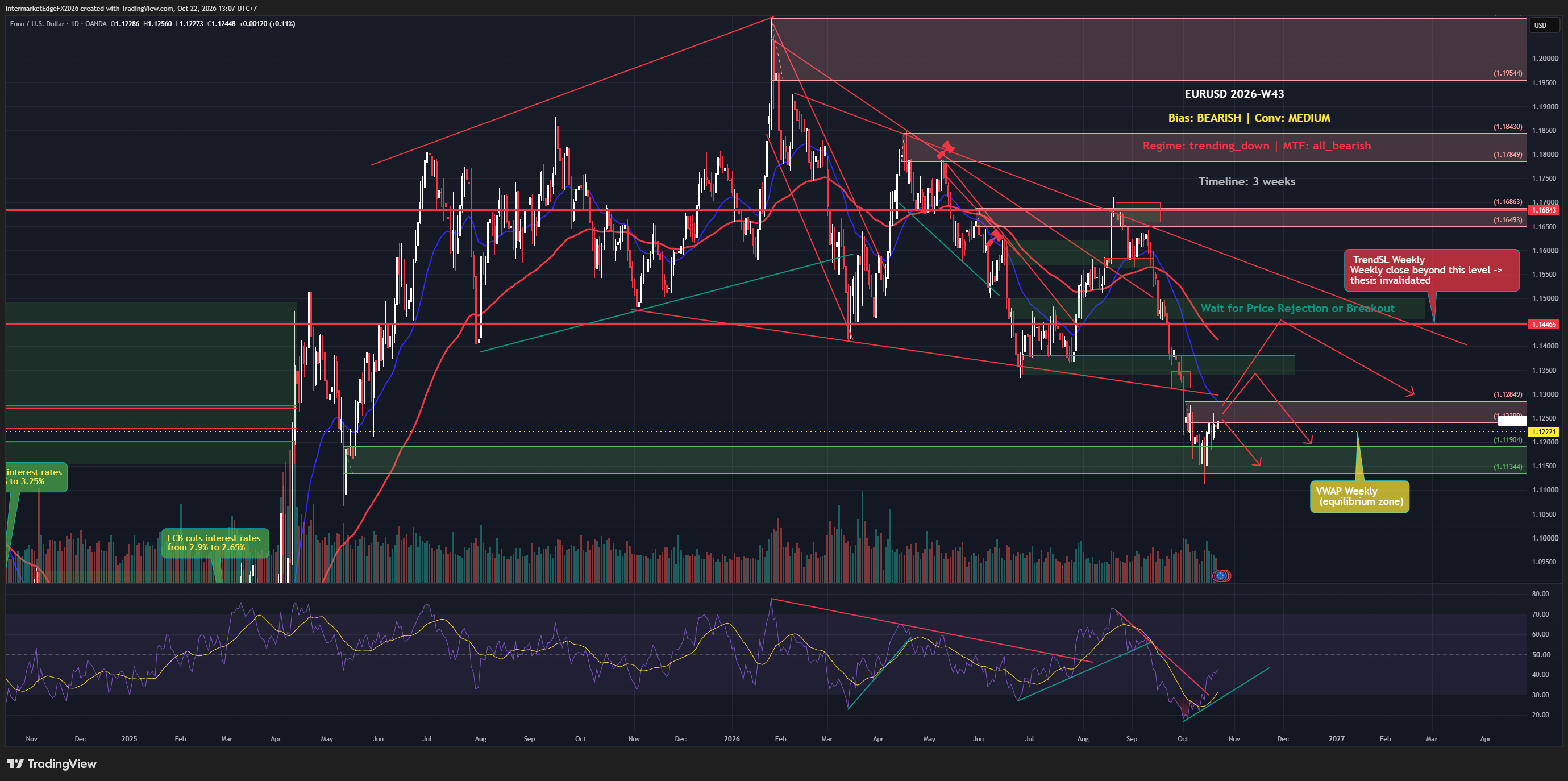
EURUSD W43: bearish three-week view, medium confidence. Downward trends conflict with bullish price action and a contrarian COT counterweight. At 05:51 UTC on Thursday, 22 October 2026, EURUSD was 1.12381, above weekly VWAP 1.12221 and below weekly TrendSL 1.14465. Source: mt5:EURUSD.sml:1m. This is a timestamped observation, not a live quote. The momentum warning is already active: existing short exposure warrants reduced size now. Structural invalidation remains pending: a weekly close above TrendSL 1.14465 would invalidate the bearish structure; exit shorts and reassess if that occurs. The weekly closing requirement belongs to structural invalidation, not to the momentum warning. COT CFTC 099741, Leveraged Funds, futures only, report date 2026-10-13: net short 68,001 contracts; net change -23,740 versus 6 October. Percentile 1.92 within 52 weeks indicates low historical net positioning, not a trader percentage. Release date unverified; lagged positions are not current flows. FXSSI: 66% long / 34% short, collected 22 October at 05:50:54 UTC. Broker sample; provider observation time unverified. Contrarian context, no independent sell signal. French risk pressures EUR, while the pause in USD declines needs confirmation from broader currency and relative-rate evidence. New exposure can wait for better agreement; a structural view is not an immediate entry trigger. Intermarket Edge | Institutional Macro & Intermarket Analysis For informational and educational purposes only. Not financial advice.
EURUSD Before CPI: Price Challenges the Bearish View

EURUSD Before CPI: Price Challenges the Bearish View

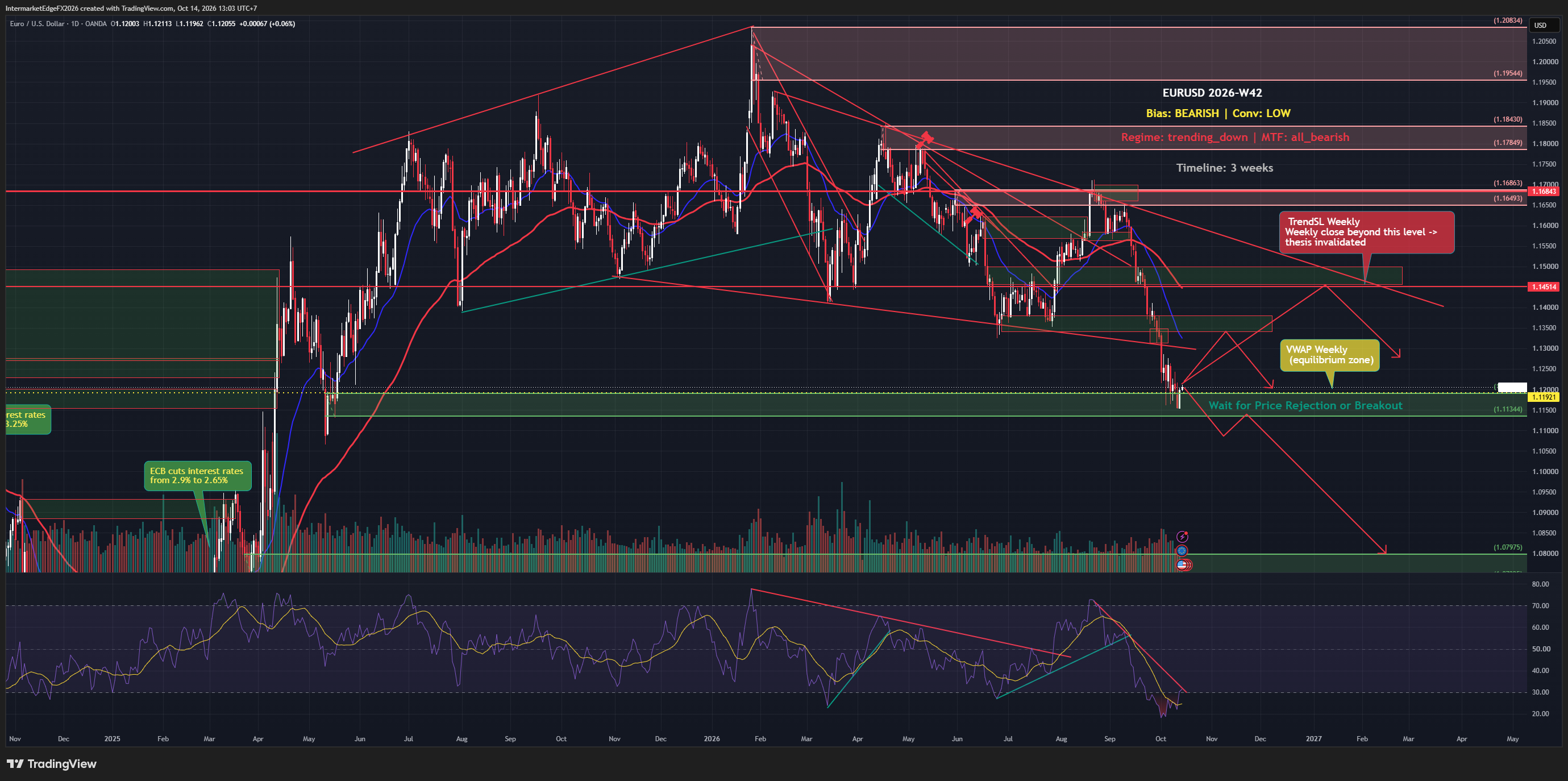
EURUSD W42: bearish three-week view, low confidence. At 14/10/2026 05:57 UTC, EURUSD was 1.12099, above weekly VWAP 1.11921. Price remains below weekly TrendSL 1.14514. Source: mt5:EURUSD.sml:1m, a timestamped broker quote. The short-term momentum warning against the bearish thesis is already active. Existing short exposure calls for reviewing and reducing risk under the trader's plan now; this warning does not require a weekly or session close. A completed weekly close above 1.14514 would invalidate the bearish structure, requiring an exit from the bearish thesis and reassessment. This condition remains pending; an intraday move is not a completed weekly close. Pre-release analysis: September US CPI is scheduled for 14 October at 12:30 UTC / 19:30 GMT+7. No actual release outcome or post-release reaction is assumed. Update this analysis after publication of the data. Watch DXY and comparable US-German yields. Fed remarks are conditional; Lane has not made an ECB rate commitment. Wait for the data response before assessing new entries. --- Intermarket Edge | Institutional Macro & Intermarket Analysis For informational and educational purposes only. Not financial advice.
EURUSD W41: Fiscal Stress Weighs, but the Entry Case Remains Unclear

EURUSD W41: Fiscal Stress Weighs, but the Entry Case Remains Unclear

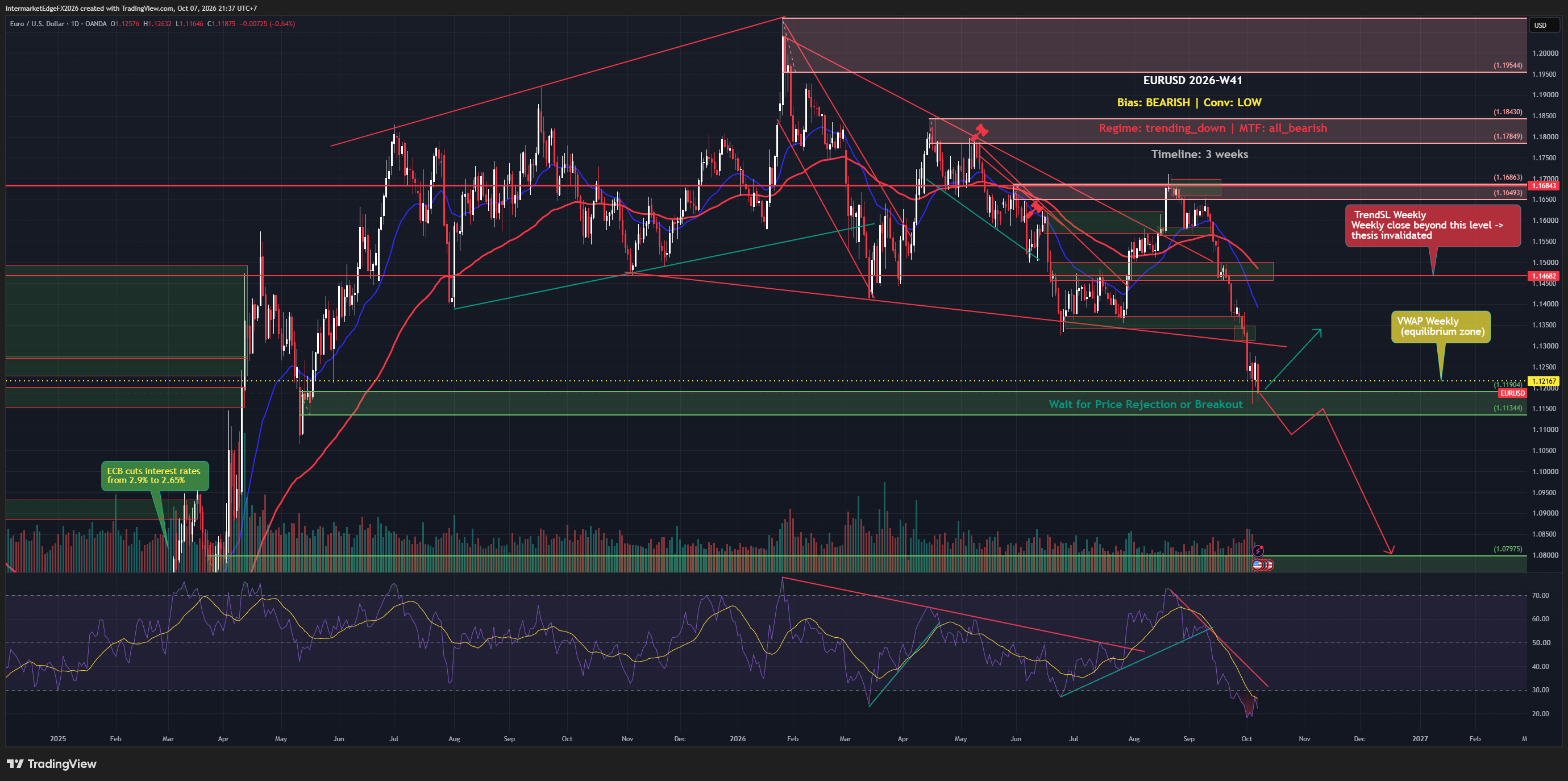
EURUSD W41 | Fiscal pressure, uncertain entry timing At 14:24 UTC on October 7, 2026, EURUSD was 1.11881 (MT5 EURUSD.sml:1m), below weekly VWAP 1.12167 and weekly TrendSL 1.14682. The broader trend points downward, but positive short-term signals reduce agreement. The bearish view has low conviction; standing aside avoids forcing a fresh entry. If price sustains above 1.12167, momentum would work against the bearish view and call for a short-side risk review. Only a completed weekly close above 1.14682 would invalidate the bearish structure. Both conditions remain pending at the quoted observation. FXSSI collected at 14:24:09 UTC on October 7: 77% Buy / 23% Sell. This is collection time. The broker retail sample does not represent the entire FX market or provide a standalone entry signal. Watch the dollar, comparable US-euro-area yields and French-German sovereign spreads. Related French fiscal headlines are not independent bearish confirmations. ForexFactory lists Fed minutes at 18:00 UTC on October 7 (01:00 GMT+7, October 8), after this snapshot. This secondary calendar is not officially verified. The minutes describe an earlier meeting, not its response to later data. Three weeks is a review horizon, not a target deadline. Prices are dated references, not live quotes. Intermarket Edge | Institutional Macro & Intermarket Analysis For informational purposes only. Not financial advice.
EURUSD Week W40-2026: Dollar Posts Its Largest September Gain at the Euro's Expense, But the Real Trap Is What Comes Next

EURUSD Week W40-2026: Dollar Posts Its Largest September Gain at the Euro's Expense, But the Real Trap Is What Comes Next

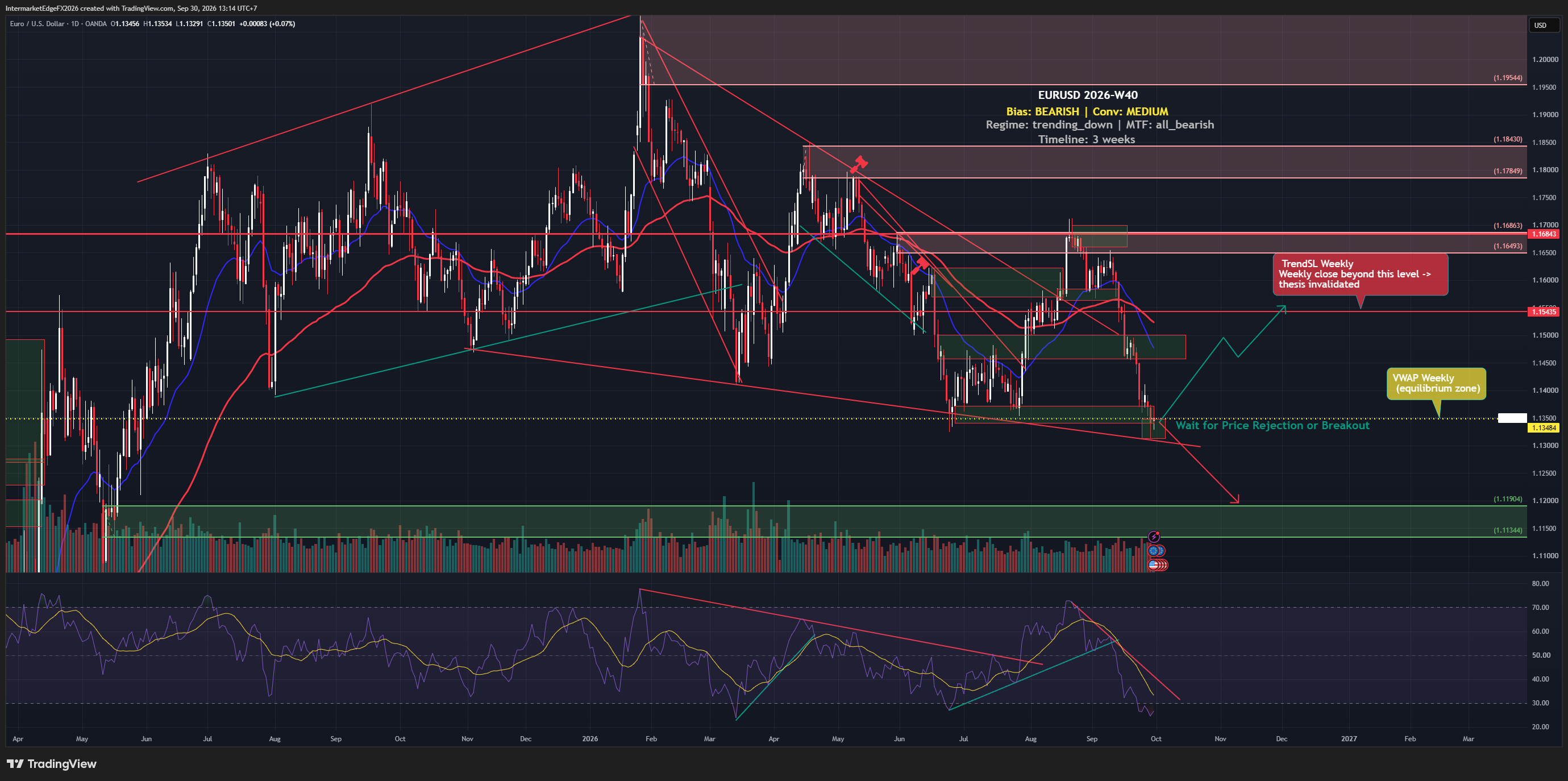
EURUSD is trading at 1.134 as of Wednesday, 30 September 2026, capping a month that Reuters confirms was the dollar's largest September gain, predominantly at the euro's expense. New York Fed President Williams has left the door open for one more rate hike this year, and with US 10-year real yields at 2.9%, the interest-rate math continues to favor the dollar structurally. The trend is down across every timeframe, but signal conflicts mean the path isn't as clean as the headline suggests. The bearish case on EURUSD rests primarily on the rate differential and the Fed's demonstrated willingness to keep it wide. When one central bank is signaling additional tightening while the other faces structurally slower growth and a different inflation profile, the currency on the higher-yield side tends to attract demand, and that demand compounds over weeks, not sessions. Reuters confirming the dollar's outsized September gain at the euro's expense is not just a data point; it's confirmation that the macro argument has already been expressing itself in price. That said, this is a medium-conviction view, not a high-conviction one, and traders should weigh that carefully. The conflict worth naming directly: price action signals and COT positioning, which reflects the aggregate stance of large futures traders, though the specific report week and net-position figures are not available here, so treat it as directional context rather than a precise citable stat, are both leaning bullish. When the macro framework points one direction and the market's actual positioning leans the other, the overall call carries more uncertainty than a clean trend setup would. The retail picture adds a contrarian lean: 72% of retail EURUSD accounts tracked by FXSSI as of 30 September are net long, and historically, when retail crowds are this lopsided on a major pair, it tends to lean against their position. -- Intermarket Edge

EURUSD Week W39-2026: Dollar Firms Toward a Ten-Week Low as the Fed-ECB Rate Gap Widens

EURUSD Week W39-2026: Dollar Firms Toward a Ten-Week Low as the Fed-ECB Rate Gap Widens

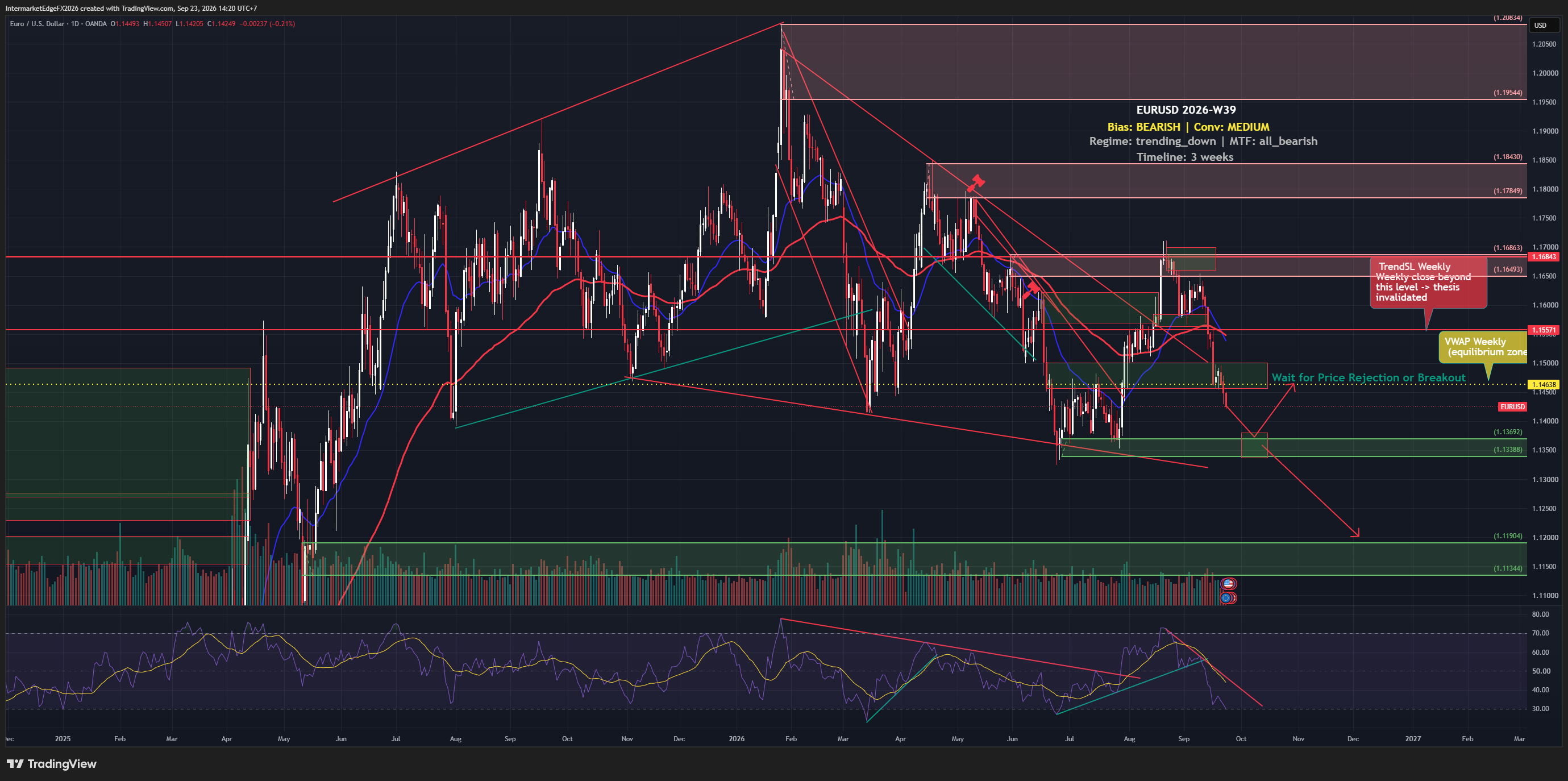
EURUSD is trading near a ten-week low, but the case is more specific than a simple strong-dollar story. At the Wednesday, 23 September 2026 observation, price was 1.14263, below weekly VWAP at 1.14638 and weekly TrendSL at 1.15571. The Fed's hawkish optionality and a US 10-year real yield of 2.62% leave the relative rate backdrop more supportive of the dollar, even after the ECB's September rate increase. Oil weakness could reduce part of the energy-inflation pressure behind the ECB's move, although that effect remains a scenario rather than a known policy outcome. DXY and short-term technical signals do not offer perfect confirmation, so conviction remains medium. FXSSI reports 66% of its broker-level sample net long EURUSD; that is contrarian context only. A sustained move above 1.14638 would warn that short-term momentum is turning against the thesis. A weekly close above 1.15571 would invalidate the bearish structure. The decision framework favors patience rather than chasing weakness near the recent low.

EURUSD Week W38-2026: Fed Pushes 10-Year Yields Toward 5%, But the Bearish Trade Is Harder to Execute Than It Looks

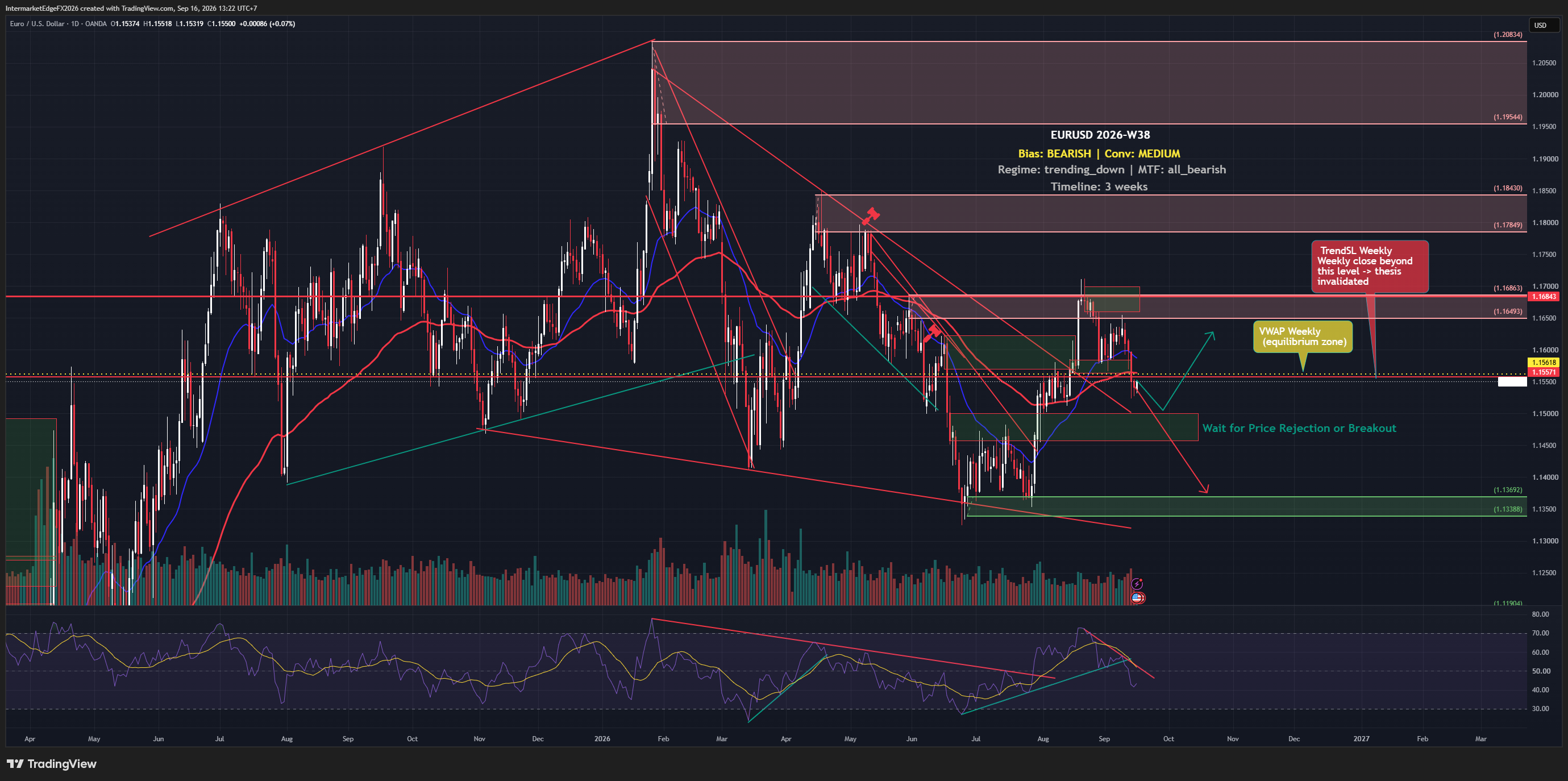
EURUSD Week W38-2026: Fed Pushes 10-Year Yields Toward 5%, But the Bearish Trade Is Harder to Execute Than It Looks

The ECB raised rates on September 10, and EURUSD is still trading near a one-month low. That disconnect is the story this week. With the US 10-year yield touching its highest level since 2007 and markets near-certain of another Fed hike on September 16, the rate differential, the yield gap that makes one currency more attractive to hold than the other, is doing the heavy lifting for the dollar. The euro got its hike; the dollar got the momentum. The bearish case for EURUSD this week rests on a clear causal chain: a Fed committed to higher-for-longer rates, rising real yields, and a rate differential that still favors the dollar over the euro even after the ECB's September 10 hike. That differential, measured not just by nominal policy rates but by the 2.6% real yield on US 10-year Treasuries, creates structural incentive to hold dollars, which means selling euros to fund that position. Every time that real yield anchors higher, the cost of being long EURUSD increases for an unhedged holder. What makes this week's setup genuinely uncertain, and why the conviction here is deliberate rather than high, is the conflict between the structural bearish overlay and several component-level signals that lean the other way. Price action itself has been constructive in recent sessions. COT positioning, non-commercial futures data showing which way large speculators are leaning, noting that the brief does not specify the exact report week or net-position figure, so this should be read as a directional lean rather than a precise statistic, shows a bullish tilt. And the macro component, somewhat counterintuitively, also scores bullish when isolated from the structural overlay. These three factors do not individually override the rate-differential thesis, but together they raise the cost of conviction. -- Intermarket Edge

EURUSD Week W37-2026: Price Reclaims 1.16274 VWAP as ECB and US CPI Collide, Bearish Case Loses Its Technical Footing

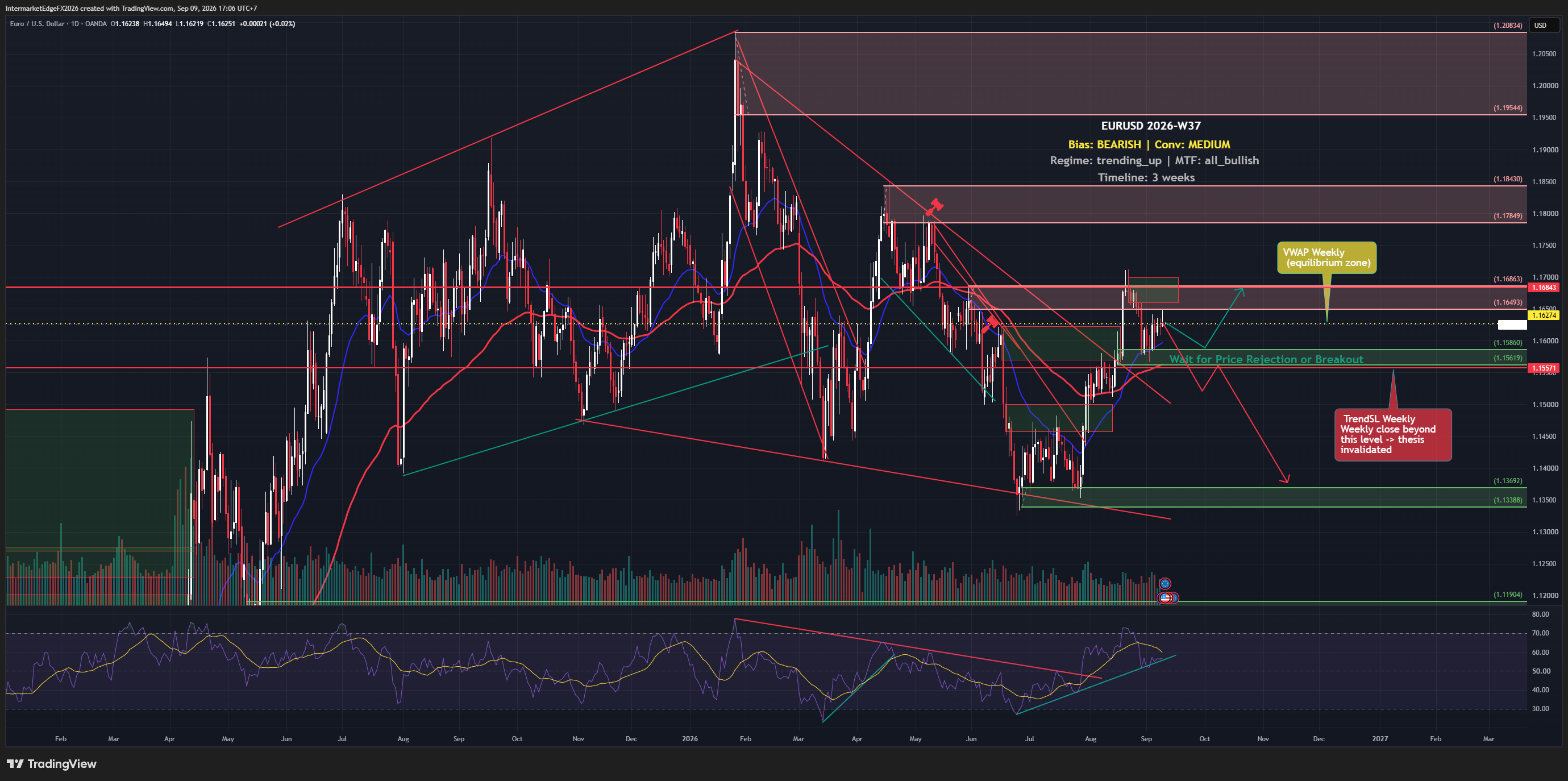
EURUSD Week W37-2026: Price Reclaims 1.16274 VWAP as ECB and US CPI Collide, Bearish Case Loses Its Technical Footing

EURUSD is sitting at 1.16393 as of Wednesday, 09 September 2026, above its weekly VWAP at 1.16274 and well above the weekly trend support at 1.15571. The structural bias is bearish, driven by the Fed-ECB rate differential. But every technical and positioning signal points the other direction. When the chart, the COT data, and the price all contradict the macro label, the trade is rarely as clean as the thesis sounds. The bearish bias on EURUSD rests on one primary structural argument: the ECB versus Fed rate differential favors the dollar. When the Fed holds rates higher for longer while the ECB faces pressure to ease amid slowing European growth, the interest-rate gap widens, and wider differentials mechanically increase the cost of holding euro versus dollar, which tends to attract selling pressure on EURUSD. That logic is sound in principle. The problem is that virtually no other input this week agrees with it. The technical picture across daily, weekly, and monthly timeframes is uniformly bullish, the highest level of technical alignment available in this framework, meaning trend-following signals are pointing up, not down. COT positioning (which reflects the directional bets of large non-commercial traders in futures markets; note that this brief does not specify the report week, net-position figure, or release date, so treat it as directional evidence rather than a standalone data point) registers a bullish lean. Price itself, on a multi-timeframe basis, confirms the upward momentum. The result is an unusual configuration where the macro thesis and the market's actual behavior are pointing in opposite directions. Liquidity and sentiment indicators contributed no signal this week, which means the bearish case stands on the rate differential argument alone, without the support of positioning or price behavior to corroborate it. -- Intermarket Edge

EURUSD Week W36-2026: Price Holds Above 1.15942 VWAP as Fed Beige Book Strengthens the Dollar Case, But the Chart Refuses to Confirm

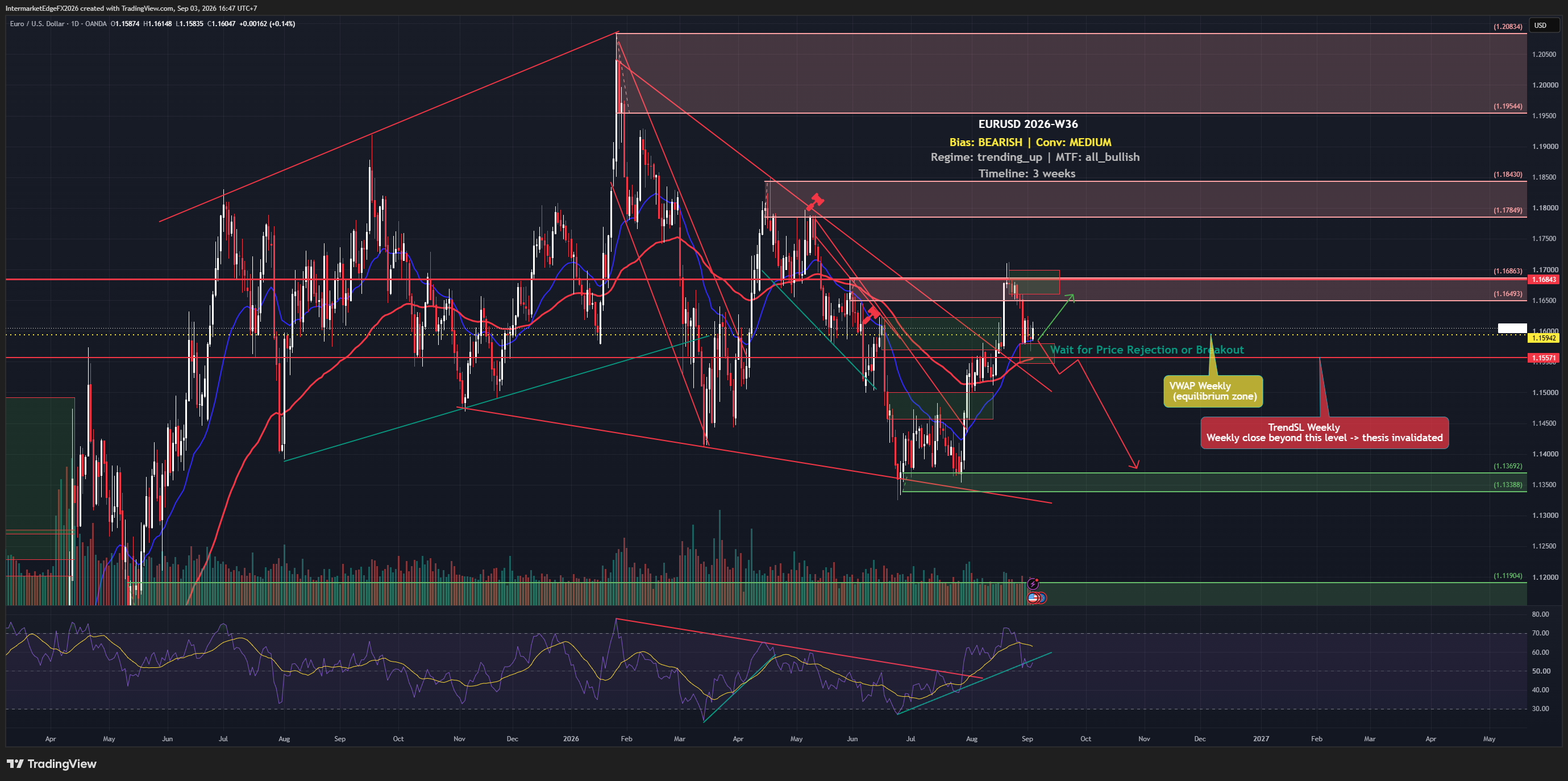
EURUSD Week W36-2026: Price Holds Above 1.15942 VWAP as Fed Beige Book Strengthens the Dollar Case, But the Chart Refuses to Confirm

EURUSD is trading at 1.15972 as of Thursday, 03 September 2026, sitting above the weekly VWAP at 1.15942, and that positioning alone tells you the bearish macro thesis has not yet found technical confirmation. The Fed Beige Book flagged modest growth and elevated input-price pressures, keeping the hawkish USD narrative alive. But daily, weekly, and monthly trend signals are all pointing the same direction: up. That conflict is the trade problem this week, not the direction call. The analytical framework carries a bearish bias on EURUSD for the next three weeks, driven primarily by the ECB-versus-Fed rate differential. The causal chain runs as follows: the Fed remains hawkish because inflation, particularly in goods inputs, has not fully cooled, which means rate cuts are off the table near-term; that keeps real US yields elevated; elevated real yields make dollar assets genuinely attractive on a return-adjusted basis, not just nominally; and that sustained demand for dollars exerts downward pressure on EURUSD over a multi-week horizon. The conviction behind this view is medium, not high, and the reason matters. The conflict embedded in this setup is serious and should not be minimized. Price, COT positioning, and the technical trend structure are all reading bullish, not marginally, but comprehensively. Daily, weekly, and monthly trend signals are simultaneously aligned to the upside, which represents the maximum level of multi-timeframe technical conviction available. COT data shows a bullish lean as well, though the specific report week and net-position figures are not disclosed in this brief, so that reading should be treated as directional evidence rather than a precise positioning snapshot. What this means practically: the bearish label here is a macro-structural override, not a technically confirmed setup. -- Intermarket Edge

EURUSD Week W35-2026: Inflation Expectations Hit 5.8% While Price Tests VWAP From Underneath, Macro and Charts Tell Opposite Stories

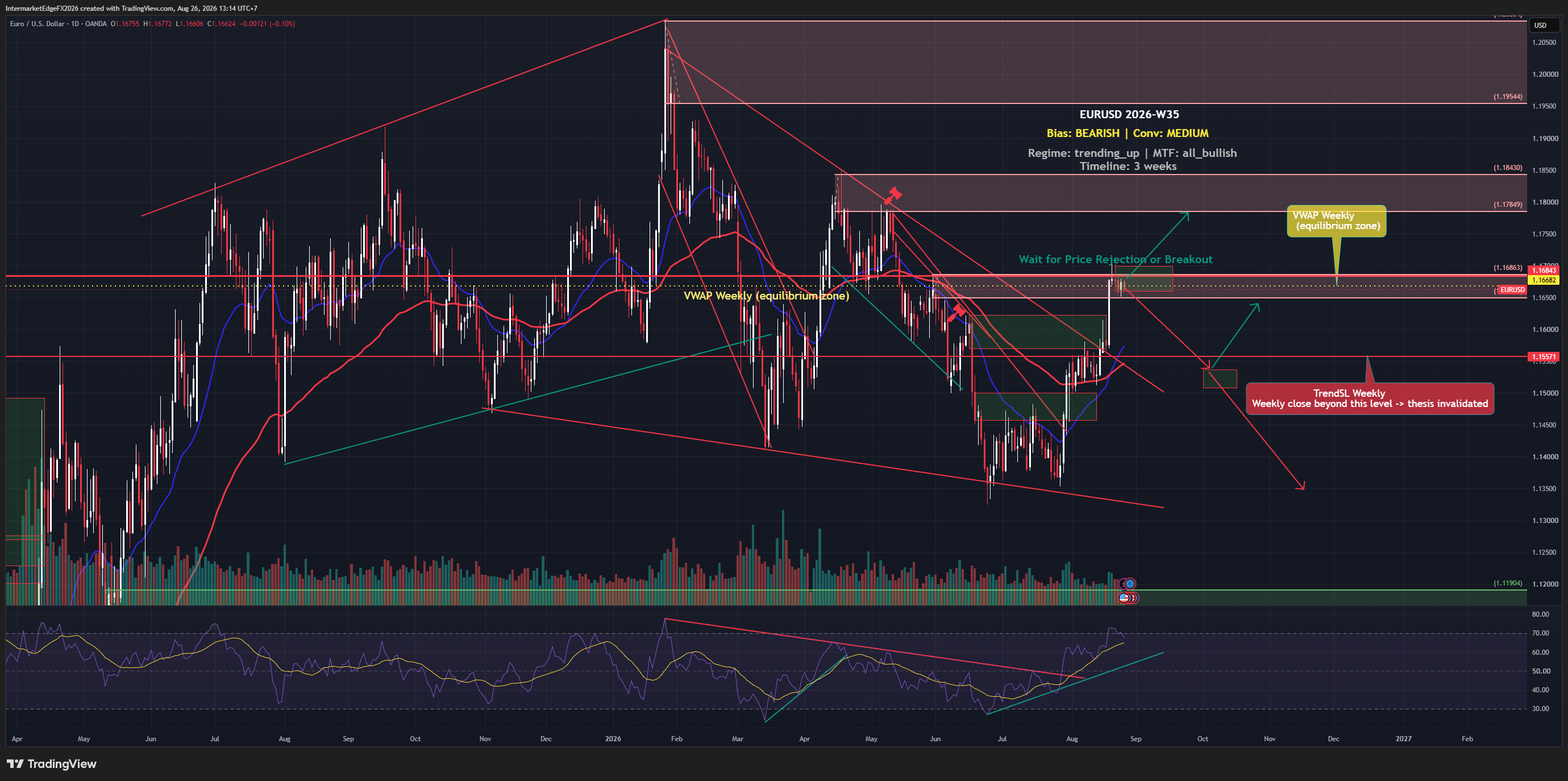
EURUSD Week W35-2026: Inflation Expectations Hit 5.8% While Price Tests VWAP From Underneath, Macro and Charts Tell Opposite Stories

EURUSD is trading at 1.16676 as of Wednesday, 26 August 2026, pressing from underneath the weekly VWAP at 1.16682, a gap so thin it is nearly invisible on a chart, yet technically meaningful. US consumer inflation expectations jumped to 5.8% in August, and Fed's Collins has signaled tightening may be appropriate soon. The macro case for USD strength is building. The problem: every technical timeframe from daily to monthly is still pointed higher on the euro, putting macro and price structure in direct conflict. The framework carries a bearish bias on EURUSD over a roughly three-week horizon, driven primarily by the ECB-versus-Fed rate differential and the structural direction of the US dollar. Rate differential, the gap between what you earn holding dollars versus euros, is the single heaviest causal weight here, and with real yields in the US sitting at 2.38% while the Fed signals further tightening, that differential is pointed in the dollar's favor. The DXY, which measures the dollar against a basket of major currencies including a heavy euro weighting, carries its own bearish bias this week but without a conviction strong enough to act on, that internal tension between a macro-bullish dollar thesis and a DXY that has not yet confirmed it is one reason the overall conviction on this EURUSD view remains at medium rather than high. What keeps this from being a straightforward bearish call is the scale of the signal conflict. -- Intermarket Edge

Stay in the loop

Get notified about new research, macro insights, and market analysis.

InterMarketEdge

© 2026 InterMarketEdge. Financial intelligence for inter-market traders.