Macro Regime — InterMarketEdge

Macro Regime

Regime-level analysis — stagflation, Fed policy shifts, and structural macro drivers moving markets

XAUUSD Week W32-2026: Gold Snaps Four-Month Losing Streak but Stalls Below VWAP 4120.87 as US-Iran Talks and a Core CPI Miss Send Conflicting Signals

XAUUSD Week W32-2026: Gold Snaps Four-Month Losing Streak but Stalls Below VWAP 4120.87 as US-Iran Talks and a Core CPI Miss Send Conflicting Signals

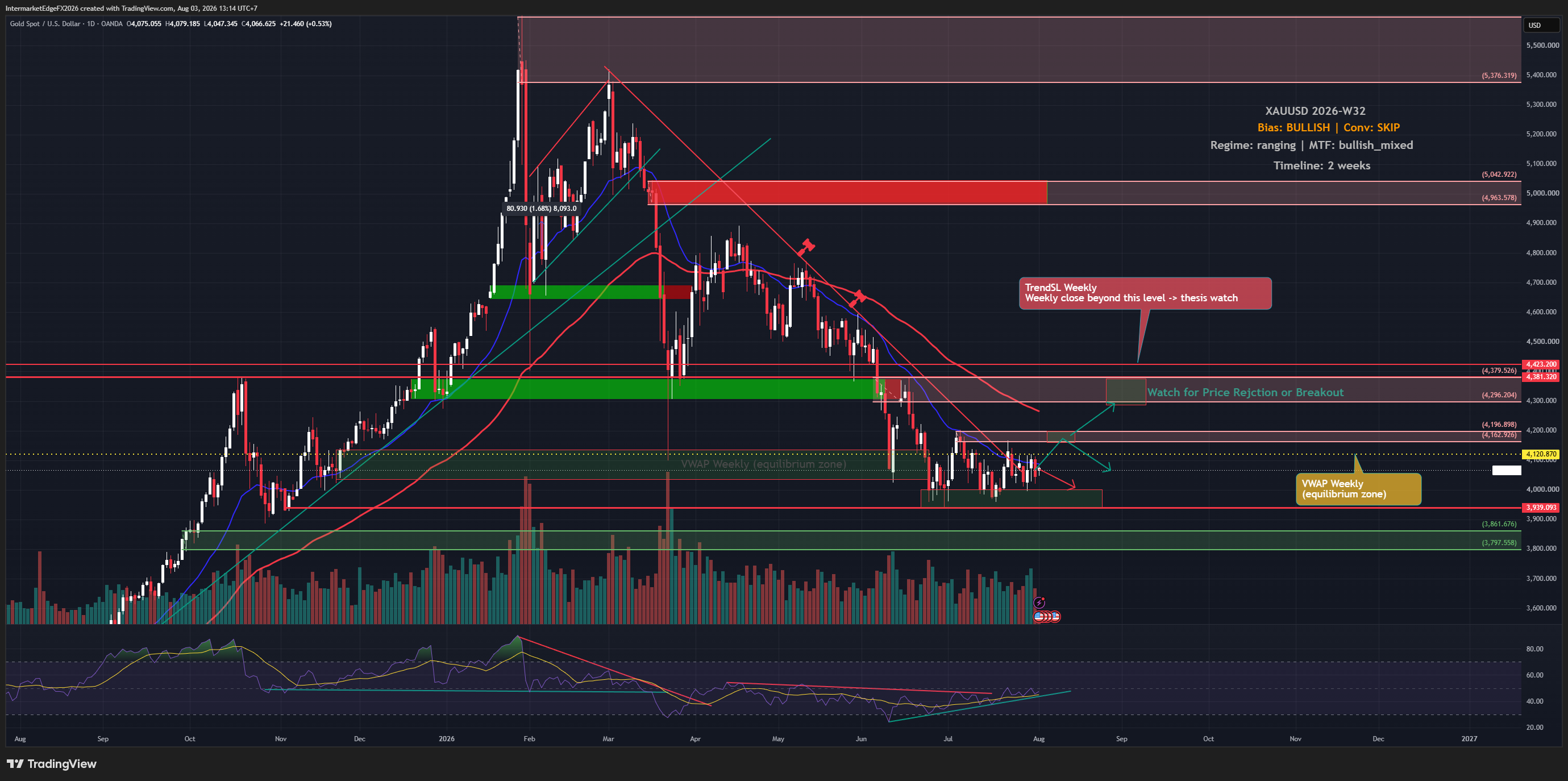
Gold just snapped a four-month losing streak, but the recovery is already showing cracks. As of Monday, 03 August 2026 at 05:50 UTC, XAUUSD on the GC=F futures contract used as proxy is trading at 4114.9, sitting below the weekly VWAP of 4120.87 and testing from underneath. The bullish label is technically alive, but the setup carries the lowest possible conviction rating this week, and the fundamental backdrop is genuinely conflicted. The formal bias for XAUUSD in Week W32-2026 is technically bullish, but traders need to understand exactly how weak that label is before acting on it. The bullish signal is being carried almost entirely by price action, no COT positioning signal, no liquidity signal, and no sentiment signal fired this week to provide corroborating evidence. The CFTC Commitments of Traders data for Comex Gold Futures and Options as of July 31 was noted in the news feed but contributed zero directional signal, which is itself meaningful: positioning is not lending support to the bullish case. It is important to note that COT data does not identify 'smart money' with precision, and the specific net-position figure, report week, and release date are not detailed in the available brief, so any inference from it should be treated cautiously. The macro contribution to the bullish score is minimal, and the active causal chains are openly conflicting: a hawkish Fed impulse driven by elevated real yields points in the bearish direction, while separate BOJ-hawkish and inflation-related signals send mixed cross-currents. The net result is that the fundamental backdrop is genuinely ambiguous, not simply unclear, the forces are offsetting rather than aligned. The ranging regime designation, assessed at 70% confidence, reinforces a mean-reversion FX implication, suggesting that sharp directional moves in either direction are statistically unlikely to sustain over the two-week horizon. -- Intermarket Edge

USDJPY Week W31-2026: BOJ Holds at 1% as Suspected FX Intervention Pushes Price Below VWAP 163.84, Bullish Trend Hangs by 0.77 Points Above TrendSL

USDJPY Week W31-2026: BOJ Holds at 1% as Suspected FX Intervention Pushes Price Below VWAP 163.84, Bullish Trend Hangs by 0.77 Points Above TrendSL

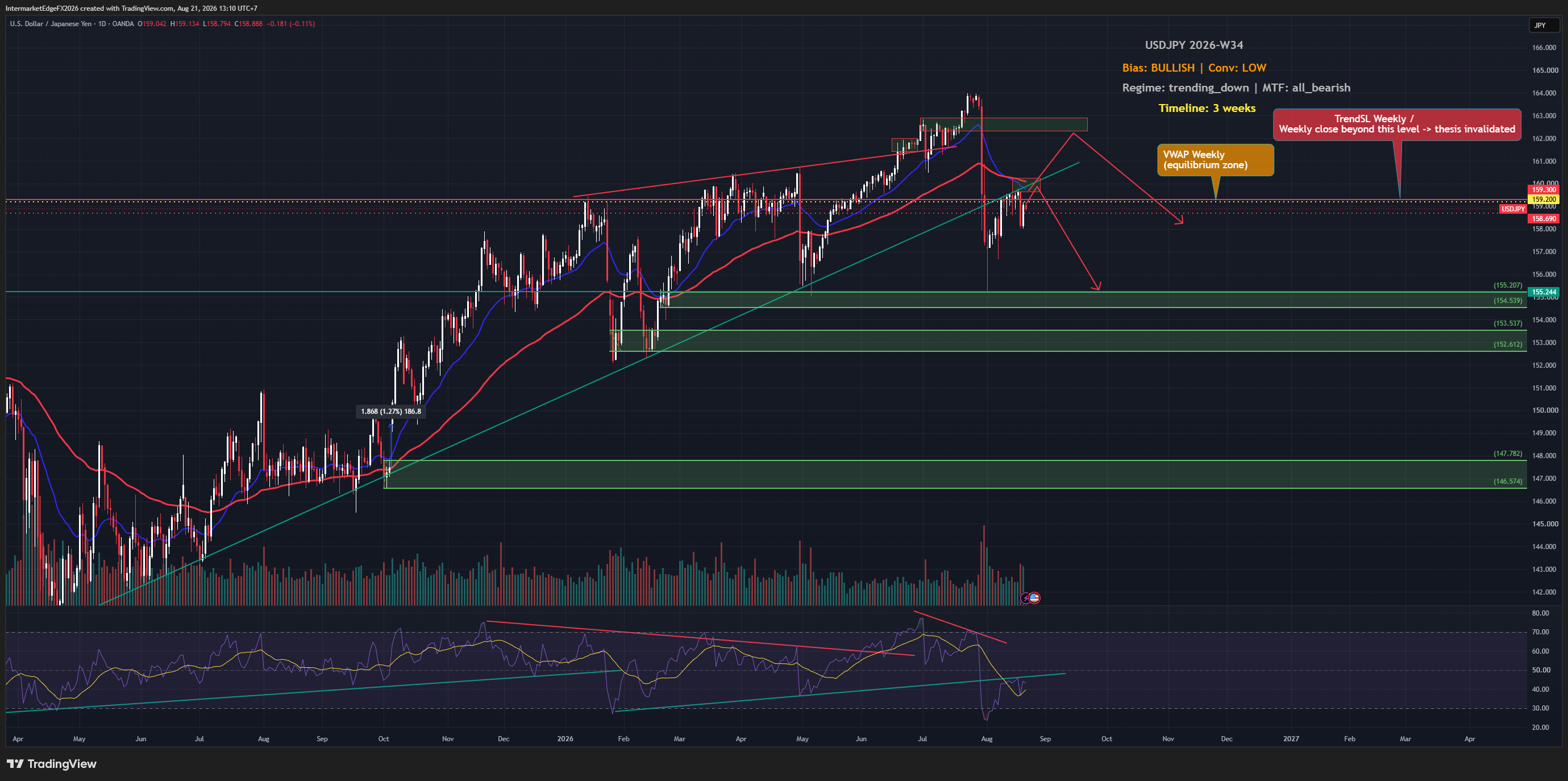
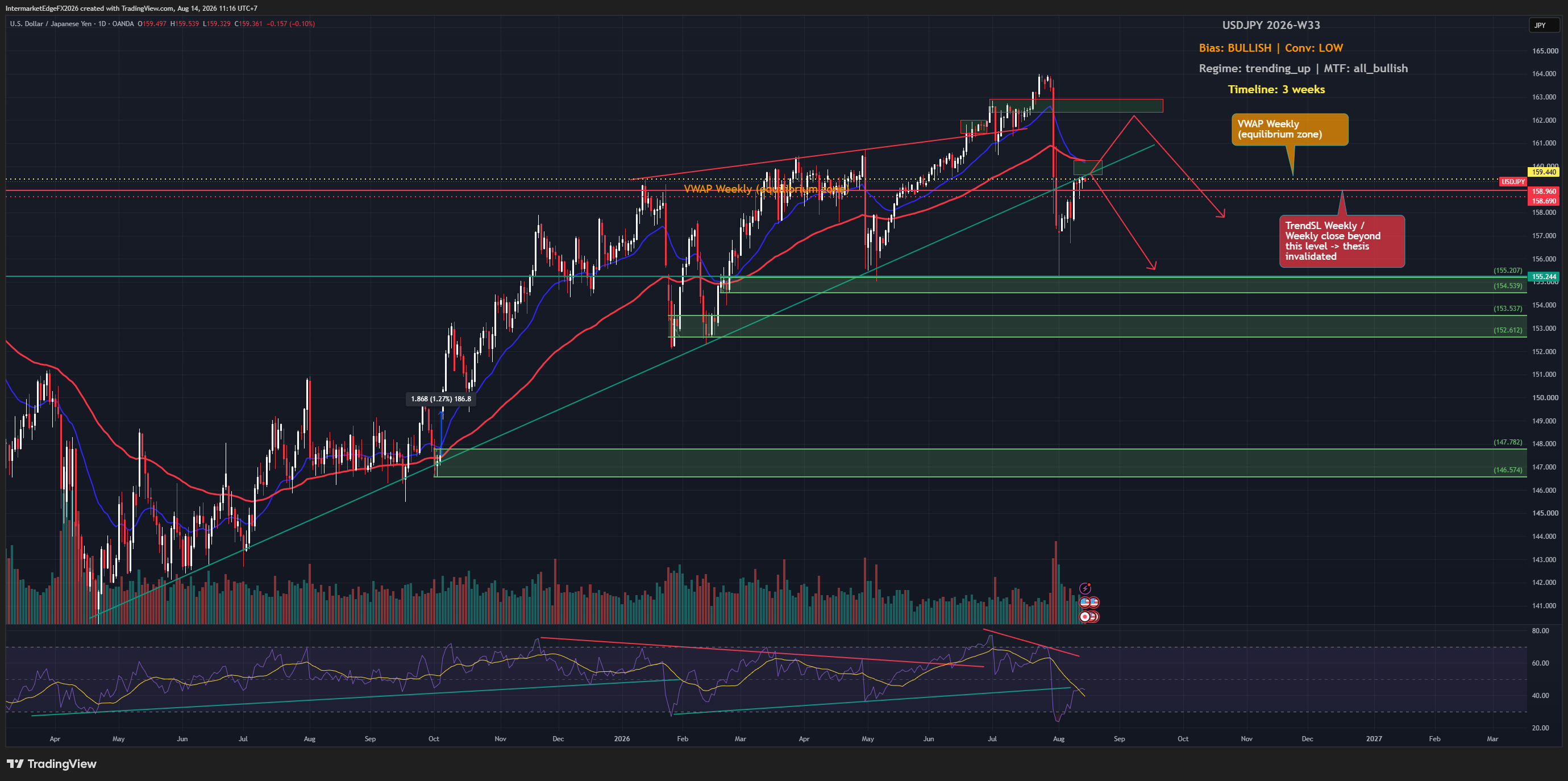
USDJPY is caught between two powerful forces this week: a Fed that remains hawkish with real yields elevated and a BOJ that just held rates at 1% while one board member openly pushed for a hike to 1.25%. As of Friday, 31 July 2026 at 05:00 UTC, price sits at 160.65, below the weekly VWAP of 163.84, with suspected FX intervention having already pushed the yen stronger. The bullish trend structure is intact, but short-term momentum is working against it. The overall bias on USDJPY for the 2026-W31 period is bullish, but conviction is low, low enough that the framework flags this as a 'skip' for active positioning, meaning conservative or zero sizing is the appropriate default, not an aggressive trend-following entry. The primary structural argument for the bullish bias is the Fed-versus-BOJ rate differential, which remains the most extreme divergence in the G7 currency space. The Fed is holding rates at elevated levels with a real yield of 2.43%, while the BOJ, even after five hikes this cycle, sits at just 1%, a gap that makes carry trades into yen-funded long-dollar positions structurally attractive when risk appetite is stable. The multi-timeframe technical trend alignment, daily, weekly, and monthly all pointing bullish, provides the strongest single input to this thesis and is the primary reason the bias is not outright neutral or bearish. However, a direct and unresolved signal conflict is present that traders must take seriously: the Fed hawkish causal chain pushes USDJPY higher through USD strength, while the BOJ hawkish chain, amplified by Takata's dissent and the suspected FX intervention, pushes USDJPY lower through JPY carry trade unwind. A carry unwind occurs when traders who borrowed yen cheaply to fund higher-yielding positions are forced or incentivized to close those trades, buying yen back and driving it higher against the dollar. -- Intermarket Edge

USDCAD Week W31-2026: Fed Holds Rates Steady and CAD Rallies to 9-Day High, Pushing Price Below VWAP at 1.40983 and Testing the Bullish Thesis

USDCAD Week W31-2026: Fed Holds Rates Steady and CAD Rallies to 9-Day High, Pushing Price Below VWAP at 1.40983 and Testing the Bullish Thesis

USDCAD is under immediate pressure after the Fed held rates steady, triggering a broad dollar slip and pushing the Canadian dollar to a 9-day high. As of Thursday, 30 July 2026 at 15:04 UTC, price sits at 1.40193, below the weekly VWAP of 1.40983, putting short-term momentum squarely against the bullish structural thesis. The longer-term trend structure remains intact above the weekly TrendSL at 1.39493, but bulls need to reclaim VWAP to restore confidence in the trend-follow setup. The medium-conviction bullish bias on USDCAD for the week of W31-2026 rests on three pillars: the Fed-versus-Bank-of-Canada rate differential, rising US real yields, and a multi-timeframe technical structure that remains aligned bullish across daily, weekly, and monthly frames. The rate differential argument is straightforward, with US real yields at 2.43% and the Fed maintaining a restrictive stance, the fundamental case for USD strength against a commodity-linked currency like CAD has not structurally deteriorated. COT positioning data available in the brief shows a bullish lean for this setup (though the specific report week, net-position figures, and sample context are not provided, so this should be treated as directional corroboration, not a standalone citable statistic). That said, conviction is explicitly rated at medium, not high, and the evidence base this week is narrower than ideal: no liquidity or sentiment signals fired, meaning the bullish case rests on price structure, COT direction, and macro fundamentals alone. The current market price of 1.40193 as of Thursday, 30 July 2026 at 15:04 UTC is already below the weekly VWAP of 1.40983, this is not a future contingency, it is the current reality, and it means short-term momentum is running against the bullish thesis right now. Position sizing should reflect this: this is not a moment to be adding to longs aggressively. -- Intermarket Edge

XAUUSD Week W31-2026: Ceasefire Pause Lifts Gold Toward VWAP at 4098.87, But All-Bearish Structure Keeps Shorts Alive

XAUUSD Week W31-2026: Ceasefire Pause Lifts Gold Toward VWAP at 4098.87, But All-Bearish Structure Keeps Shorts Alive

As of 27 Jul 2026 (08:57 UTC, yfinance GC=F), gold trades at 4098.1 — fractionally below the weekly VWAP of 4098.87, testing it from underneath. That level is a live thesis-break warning: a sustained close above VWAP would signal short-term momentum running against the bearish structural read. The week's dominant driver has been geopolitical, not macro. Gold gained over 1% on a pause in US-Iran fighting, reversing an earlier dip below $4,100 that had been triggered by Fed tightening prospects. Separately, Brent crude lost over 4% while gold rose, although the available data does not establish a direct capital rotation between the two markets. Comex futures are consolidating above $4,000. Signals are directly conflicting and that is the core risk. The multi-timeframe structure is all-bearish and regime confidence sits at 0.70 trending-down. But COT positioning is firmly bullish, and price action is technically constructive. These two inputs are not confirming each other. On the macro side, US 10Y real yield at 2.43% is a genuine headwind for gold — but the Fed hawkish causal chain has shown low historical reliability (~36% / 35.9% accuracy in back-testing, sample/period not specified in the brief), so it is downweighted here. BOJ hawkishness and hot CPI signals partially cancel each other out, adding noise rather than direction. Conviction is low. Size conservatively, avoid high-leverage directional bets. Key levels: bearish structure invalidates on a weekly close above 4467.85 (TrendSL); reduce shorts if price holds sustained above VWAP 4098.87. FOMC meets 28-29 July 2026 -- the near-term catalyst. -- Intermarket Edge

USDJPY Week W30-2026: Yen Languishes Near Four-Decade Low as US Yield Surge and BOJ Inaction Keep Dollar Bulls in Control, but Carry Unwind Risk Clouds the Outlook

USDJPY Week W30-2026: Yen Languishes Near Four-Decade Low as US Yield Surge and BOJ Inaction Keep Dollar Bulls in Control, but Carry Unwind Risk Clouds the Outlook

USDJPY is trading around 163.80 (as of 2026-07-24, source: yfinance near-realtime), right at the weekly VWAP of 163.80 — a level to watch for short-term momentum confirmation. Multi-timeframe technicals (daily/weekly/monthly) are all aligned bullish, and COT positioning leans bullish. Trend structure holds above the weekly TrendSL at 159.73. The core driver remains the Fed-BOJ rate differential. US 10Y real yield at 2.39% and nominal at 4.67% keep USD carry attractive. Dollar is also catching a bid from Middle East tensions and trade war inflation fears. However, conviction is LOW, and here's why: two forces are pulling in opposite directions. Japan June core CPI printed +1.6% YoY — below the BOJ's 2% target for a fifth straight month — which normally delays BOJ tightening and supports the yen carry trade. But the US Treasury is publicly calling for more BOJ tightening, and Japan's finance minister flagged readiness for decisive FX action. Simultaneously, US core CPI for June missed at 0.0% vs 0.2% forecast — a dovish surprise that softens the Fed hawkish narrative at the margin. Net result: technicals and COT support a bullish lean, but macro signals partially offset each other. A surprise BOJ rate hike or FX intervention remains the key tail risk — a carry unwind in JPY can reverse this setup sharply regardless of Fed policy. Bias: bullish, low conviction, 3-week horizon. Size accordingly. Exit if weekly close breaks below 159.73. -- Intermarket Edge

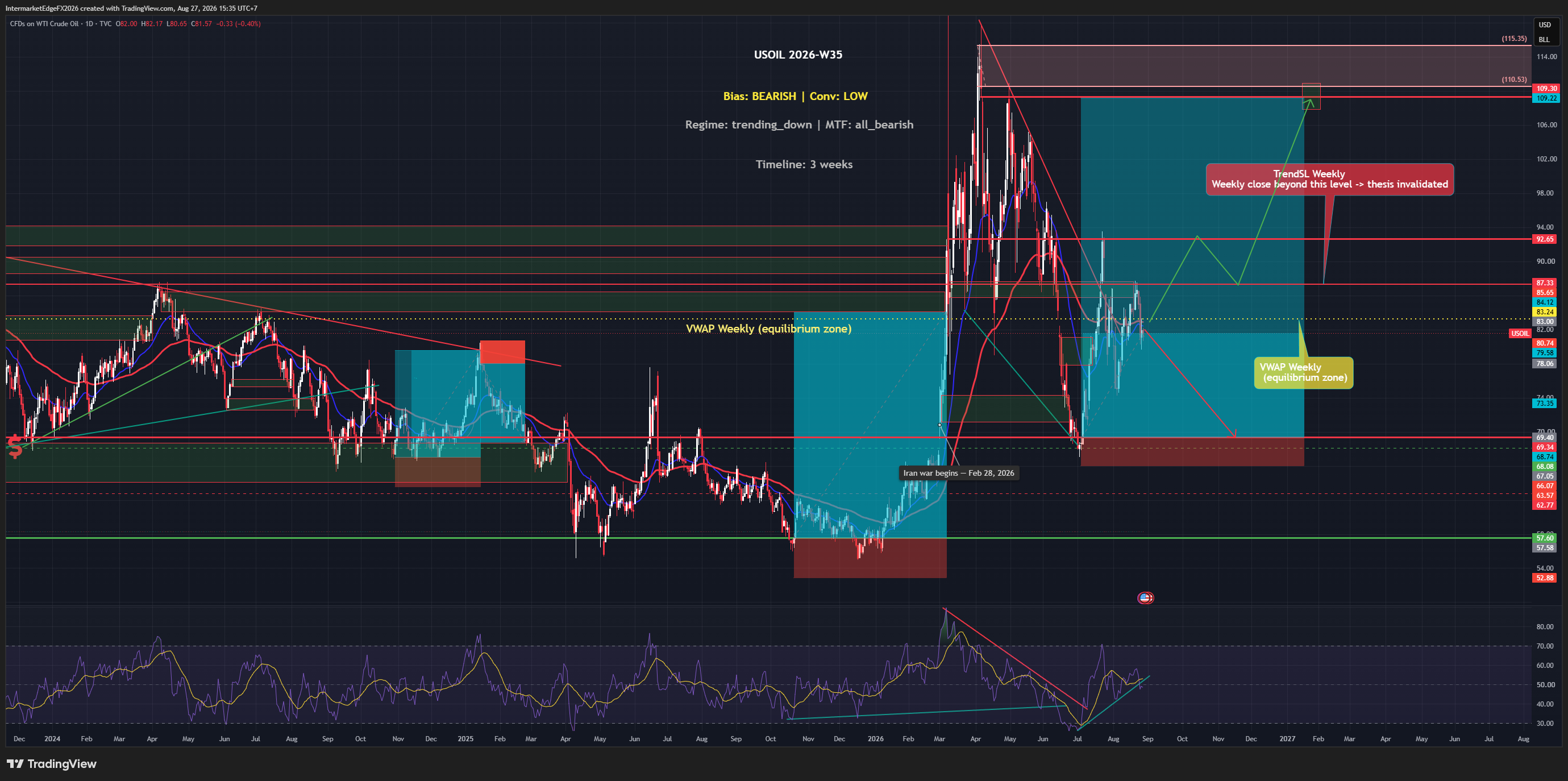
USOIL Week W30-2026: Geopolitical Escalation Pushes Price Above TrendSL 85.915 as Iran Conflict Threatens Red Sea Supply Routes

USOIL Week W30-2026: Geopolitical Escalation Pushes Price Above TrendSL 85.915 as Iran Conflict Threatens Red Sea Supply Routes

As of July 23, 2026 (~09:01 UTC), WTI is trading near 89.60 (yfinance near-realtime). The thesis snapshot was set at 88.30, so price is already running above that level — a direct challenge to the bearish top-line bias. The geopolitical backdrop is driving the move. Trump has stated that every Iranian attack on a commercial ship will be answered with strikes on bridges or power plants near Tehran. Brent has climbed past a key barrel threshold on mounting supply risks, and markets are pricing further escalation in U.S.-Iran conflict. Separately, reports note Suez and Sumed pipelines can absorb rerouted Saudi flows if the Red Sea is disrupted — a partial offset, but the headline risk premium is clearly in control right now. Technical picture is unambiguously bullish: Daily, Weekly, and Monthly trend structures are all aligned to the upside. Price is well above both the weekly VWAP (84.82) and the weekly TrendSL (85.92) — the thesis-break condition that was supposed to invalidate bearish structure has already triggered. Per the framework's own rules: weekly close above 85.92 means bearish structure is invalidated, exit shorts, reassess. The macro layer is mixed. Rising real yields (US 10Y real at 2.37%) support USD strength, which is a headwind for crude. Four-week average inventory builds exceeding +1.5Mb signal persistent supply accumulation — structurally bearish. But geopolitical supply-disruption risk is currently overriding inventory fundamentals. Bottom line: The bearish bias carries low conviction, COT/sentiment inputs are neutral, and price has broken above every defined invalidation level. No directional lean is warranted here — the conflict between the rule engine's bearish output and live price reality is too wide to trade with confidence. -- Intermarket Edge

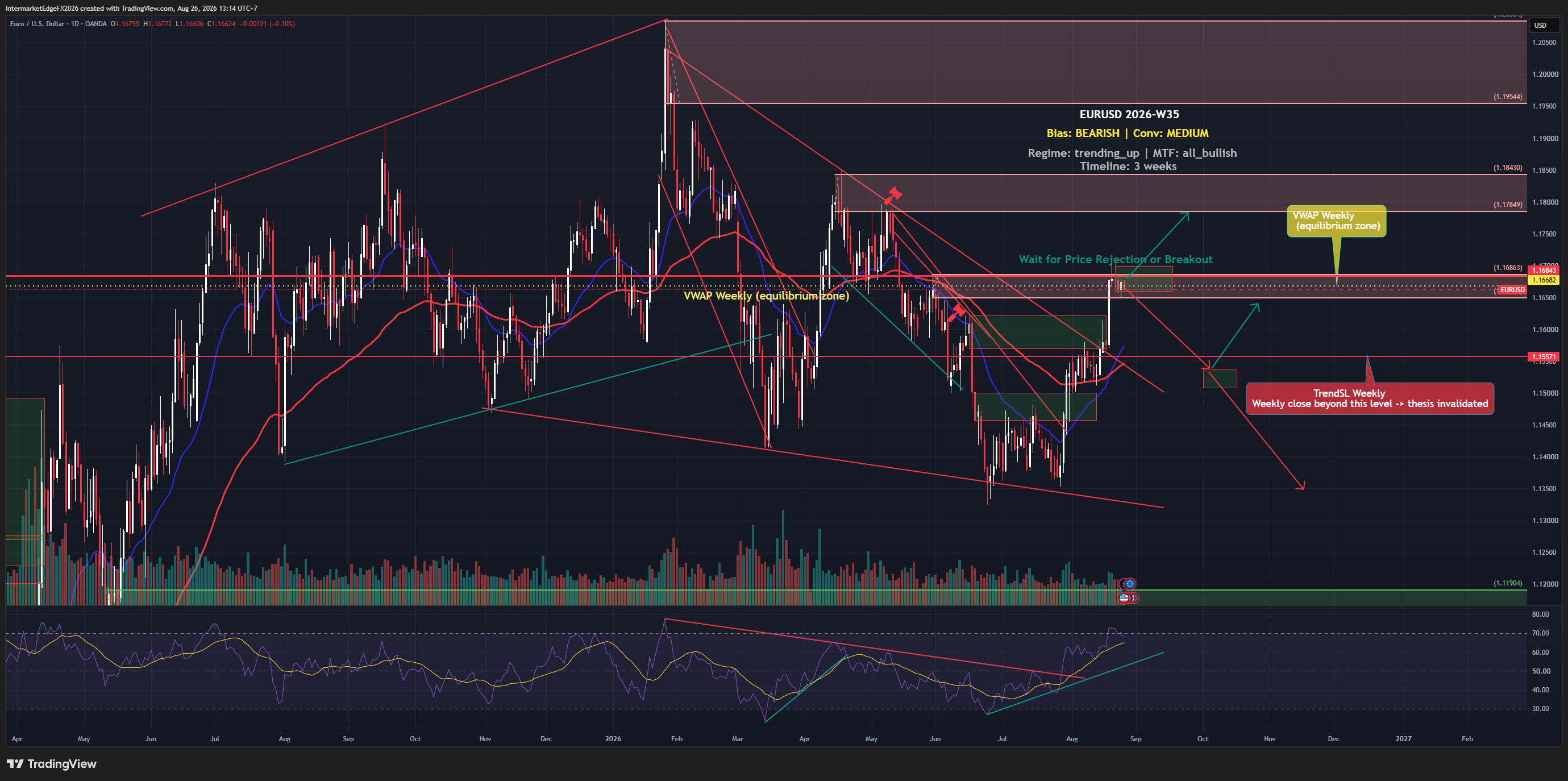
EURUSD Week W29-2026: Dollar Rallies on Iran Strikes and Yield Surge, But a Core CPI Miss at 0.0% Puts the Bullish USD Story on Trial

EURUSD Week W29-2026: Dollar Rallies on Iran Strikes and Yield Surge, But a Core CPI Miss at 0.0% Puts the Bullish USD Story on Trial

EURUSD closed the week at 1.1440, right on weekly VWAP (1.1440), a technically neutral position inside a confirmed trending-down regime. All timeframes are aligned bearish — trend-following logic favors the downside. The dominant driver was USD strength: US-Iran strikes lifted oil prices, and Treasury yields pushed to new highs, pulling the dollar broadly higher. The Euro held near 1.14 with markets in a wait-and-see posture ahead of the upcoming ECB meeting — no fresh policy signal yet. But a key contradicting data point arrived: Core CPI (MoM) printed 0.0% vs. 0.2% forecast — a clean miss. With US 10Y real yield at 2.31% and the 2Y at 4.18%, the Fed's hawkish stance is still intact structurally, but a second consecutive CPI undershoot would accelerate dovish repricing and undercut the rate differential argument for USD longs. ADP private payrolls also slowed (16,500 vs. 19,250 prior), adding softness to the labor picture. Overall bias remains bullish (EURUSD higher) with high conviction over a 3-week horizon, driven by macro and positioning factors. However, the near-term technical picture is clearly bearish — a genuine conflict that demands caution on sizing. Key levels: A weekly close below TrendSL 1.1590 invalidates the bullish structure entirely. Sustained price below VWAP 1.1440 signals momentum is working against the thesis — reduce exposure if that holds. -- Intermarket Edge

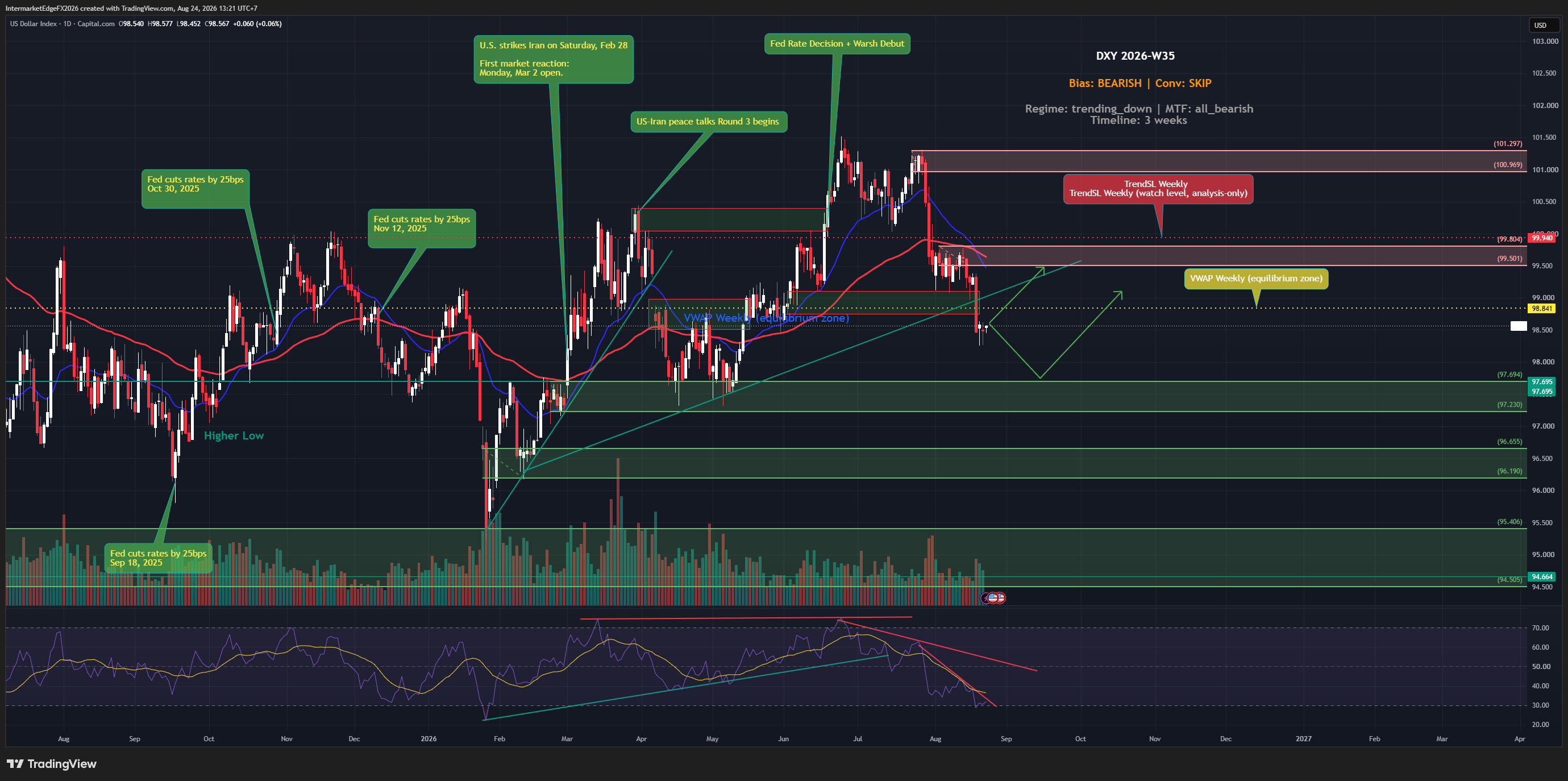
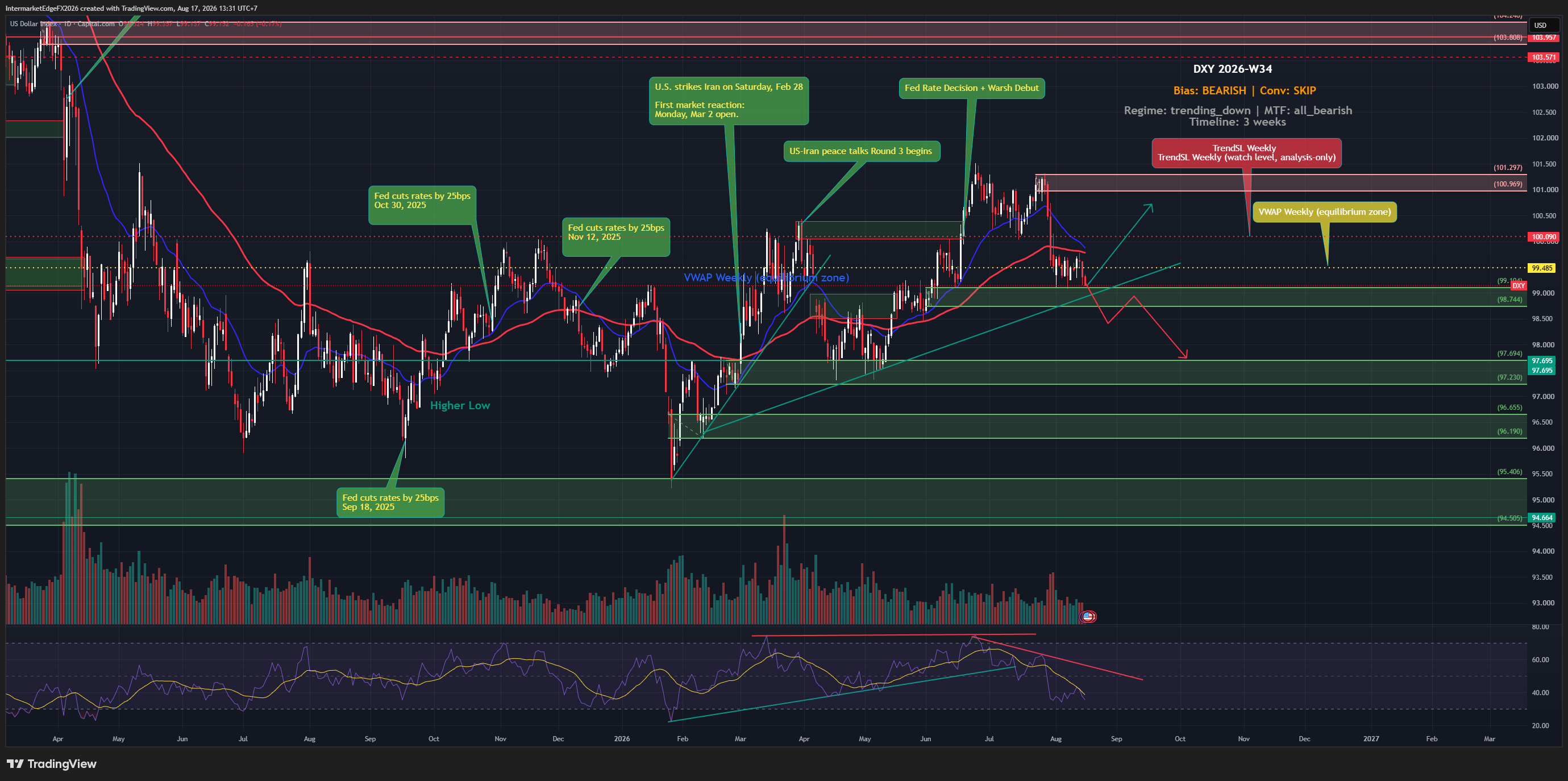
DXY Week W29-2026: Core CPI Prints Zero Against a 0.2 Forecast, but US-Iran Escalation Keeps Safe-Haven Demand Alive and the Dollar Refuses to Break

DXY Week W29-2026: Core CPI Prints Zero Against a 0.2 Forecast, but US-Iran Escalation Keeps Safe-Haven Demand Alive and the Dollar Refuses to Break

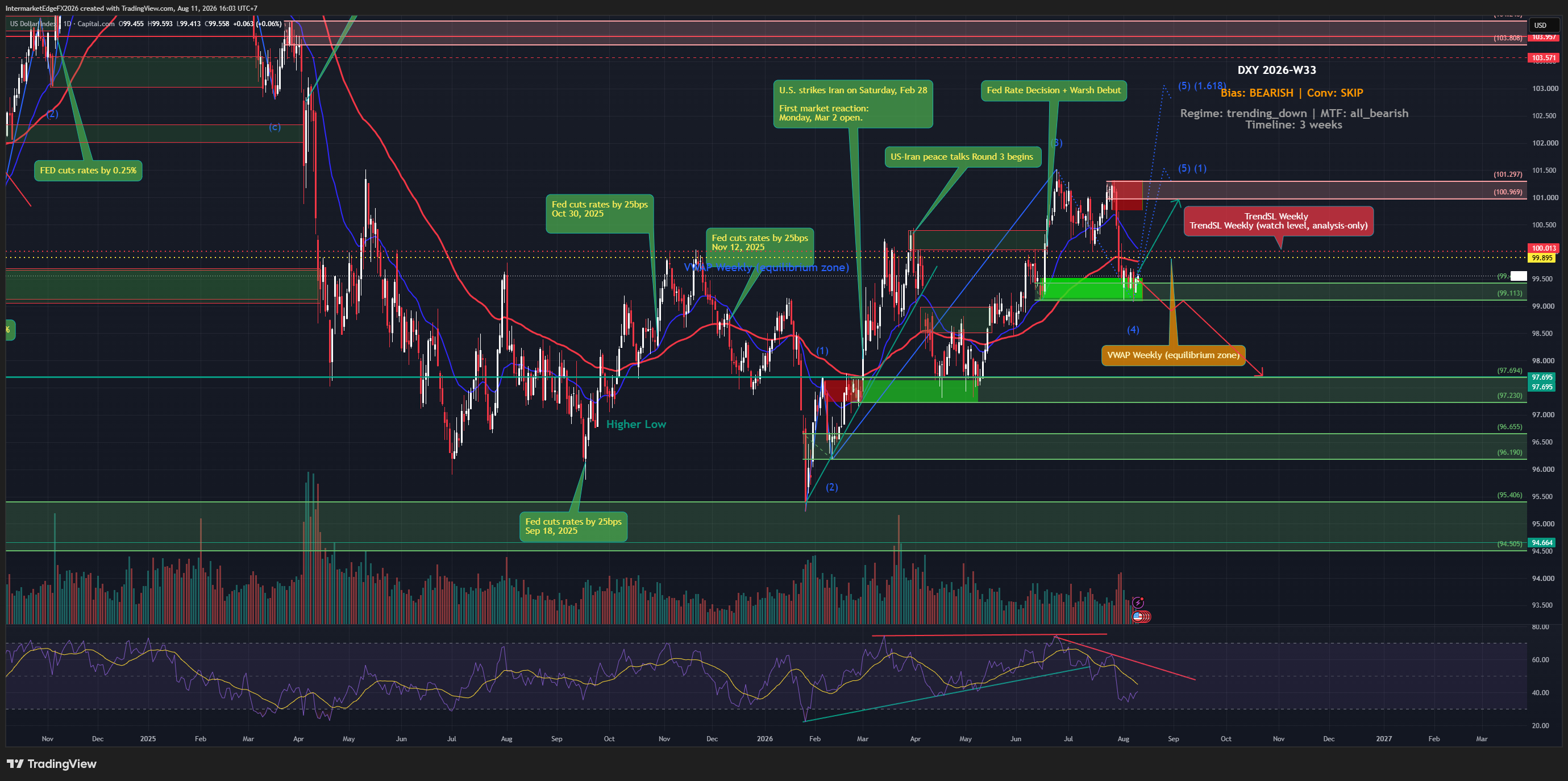
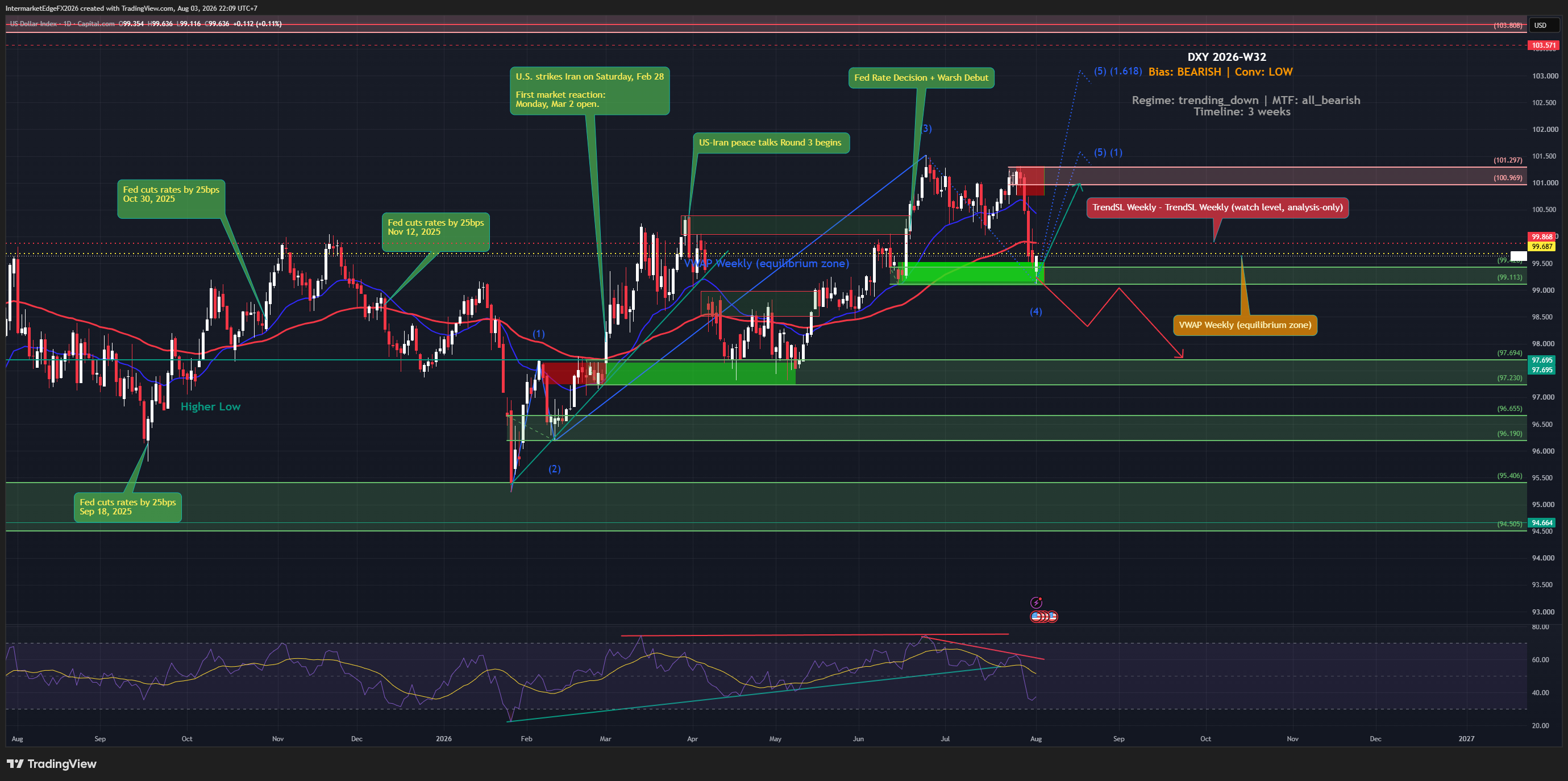
The dollar is caught between two opposing forces this week. On one side, the intensifying US-Iran conflict has driven safe-haven demand, pushing DXY firmer with Brent rallying and Asian currencies weakening broadly. Peace prospects have since surfaced, causing the dollar to tick higher again on uncertainty — classic conflict-driven vol without a clean directional resolution. On the other side, the July CPI print landed at 0.0% MoM against a 0.2% forecast — a meaningful miss — which is structurally USD-bearish and removes near-term Fed hawkishness expectations. Technically, the picture leans bullish: MTF alignment is all-bullish, price is sitting right at the weekly VWAP of 100.77, and the TrendSL at 99.48 remains intact below. A weekly close sustaining above 100.77 keeps short-term momentum with the bulls. The overall bias remains bearish on a 3-week view, but conviction is low — and that honest assessment matters here. The regime reads trending up, the CPI miss is real but hasn't broken structure yet, and the geopolitical safe-haven flow is a wildcard that can reverse fast. Key levels to watch: a sustained hold above 100.77 pressures the bearish thesis. A weekly close below 99.48 would invalidate bullish structure entirely. China's yuan decoupling from the broader safe-haven move in Asia is worth monitoring as a canary for USD directionality. No clear edge here — wait for resolution. -- Intermarket Edge

USDJPY Week W28-2026: Yen Slides Toward 40-Year Lows at 161.51 as Fed's Waller Reverses Course and BOJ-Fed Divergence Keeps the Carry Trade Alive

USDJPY Week W28-2026: Yen Slides Toward 40-Year Lows at 161.51 as Fed's Waller Reverses Course and BOJ-Fed Divergence Keeps the Carry Trade Alive

USDJPY sits at 161.51, pinned at weekly VWAP with multi-timeframe alignment fully bullish. The pair is trending higher but conviction is low — price needs to hold above 161.51 (VWAP weekly) to keep near-term momentum intact. Trend structure stays valid down to 158.69 (TrendSL weekly). The macro setup remains straightforward: BOJ-Fed policy divergence is the dominant driver. Yen is hovering near 40-year lows against the dollar as that divergence persists. RSM's Brusuelas flagged Japan's growth-bet posture as the force keeping yen pressured ahead of any BOJ policy pivot — meaning the market isn't pricing a credible near-term shift from Tokyo. On the USD side, Fed's Waller reversed his dovish stance and signaled openness to further rate hikes if inflation stays hot. That lifted US rate-hike odds and helped USD hold gains even after a softer-than-expected June CPI print. US 10Y real yield at 2.32% supports USD as the higher-yielding, positive-carry side of this pair. COT positioning is bullish but crowding risk is worth monitoring — stretched yen shorts have a history of violent unwinds if BOJ surprises. DXY bias is bullish with medium conviction, providing base-currency support. Thesis breaks: weekly close below 158.69 invalidates bullish structure — exit longs. Sustained price below 161.51 signals momentum fade — reduce size. -- Intermarket Edge

Stay in the loop

Get notified about new research, macro insights, and market analysis.

InterMarketEdge

© 2026 InterMarketEdge. Financial intelligence for inter-market traders.