Instrument Deep Dive — InterMarketEdge

Instrument Deep Dive

Full L0–L8 structural analysis on a single instrument — conviction, invalidation, and time horizon

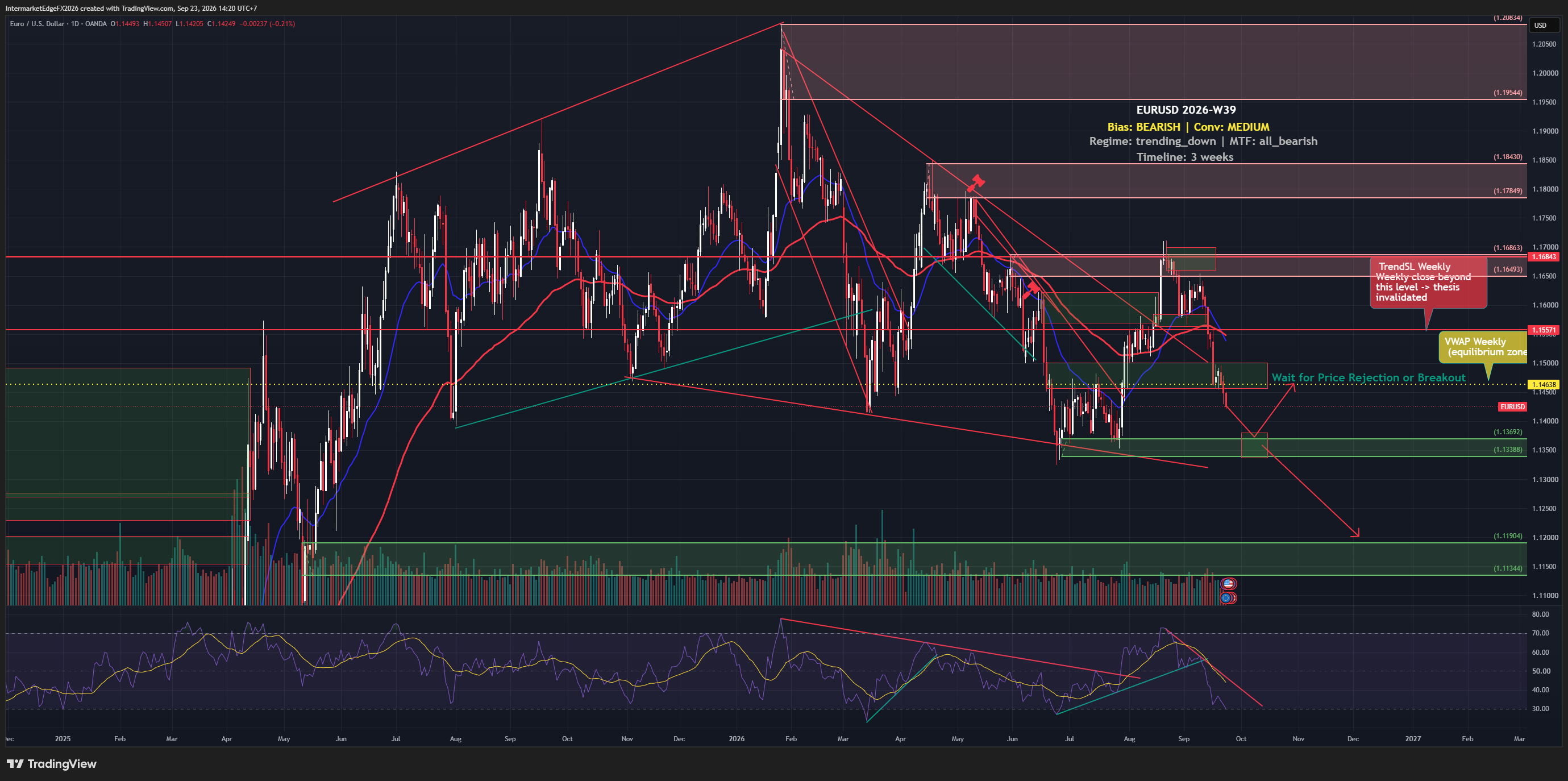
EURUSD Week W39-2026: Dollar Firms Toward a Ten-Week Low as the Fed-ECB Rate Gap Widens

EURUSD Week W39-2026: Dollar Firms Toward a Ten-Week Low as the Fed-ECB Rate Gap Widens

EURUSD is trading near a ten-week low, but the case is more specific than a simple strong-dollar story. At the Wednesday, 23 September 2026 observation, price was 1.14263, below weekly VWAP at 1.14638 and weekly TrendSL at 1.15571. The Fed's hawkish optionality and a US 10-year real yield of 2.62% leave the relative rate backdrop more supportive of the dollar, even after the ECB's September rate increase. Oil weakness could reduce part of the energy-inflation pressure behind the ECB's move, although that effect remains a scenario rather than a known policy outcome. DXY and short-term technical signals do not offer perfect confirmation, so conviction remains medium. FXSSI reports 66% of its broker-level sample net long EURUSD; that is contrarian context only. A sustained move above 1.14638 would warn that short-term momentum is turning against the thesis. A weekly close above 1.15571 would invalidate the bearish structure. The decision framework favors patience rather than chasing weakness near the recent low.
GBPUSD Week W39-2026: Pound Dips Near Seven-Week Lows as Fed-BoE Divergence Tightens the Trap

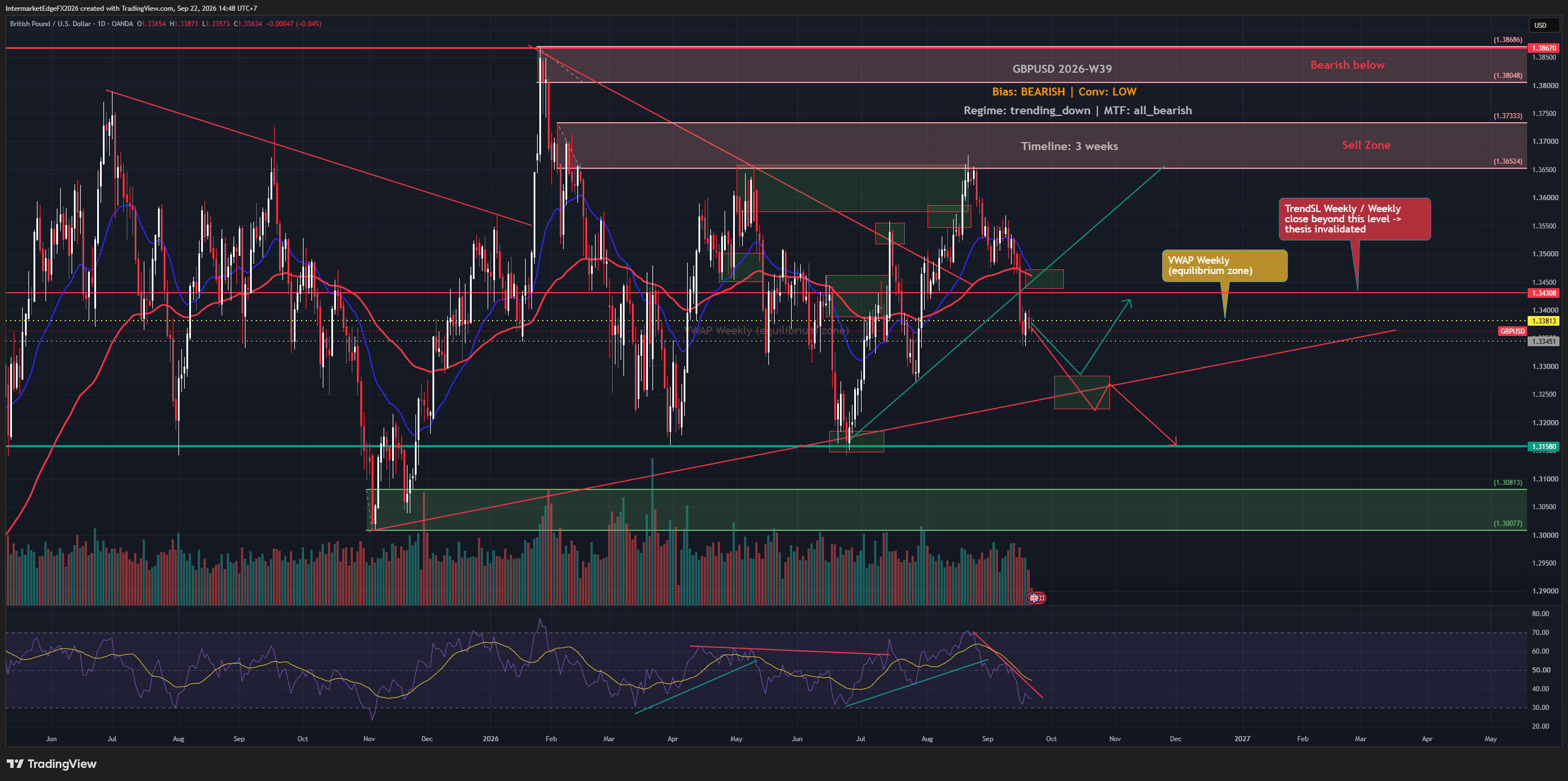
GBPUSD Week W39-2026: Pound Dips Near Seven-Week Lows as Fed-BoE Divergence Tightens the Trap

Sterling is trading near seven-week lows as the Fed-BoE policy gap favors the dollar, but this is not a clean sell setup. At the Tuesday, 22 September 2026 observation, GBPUSD was already above weekly VWAP at 1.33813 and testing it from above, so short-term momentum was running against the bearish macro thesis. The broader assessment remains bearish because the rate differential and multi-timeframe structure still point lower, but conviction is low and the timing evidence is incomplete. FXSSI reports that 67% of its broker-level retail sample is net long GBPUSD, which provides contrarian context but no calibrated directional signal and no evidence about institutional flows. The decision is to stand aside. A weekly close above TrendSL at 1.34308 would invalidate the bearish structure and require a reassessment. -- Intermarket Edge

XAUUSD Week W39-2026: A Rebound Has Yet to Change the Bearish Structure

XAUUSD Week W39-2026: A Rebound Has Yet to Change the Bearish Structure

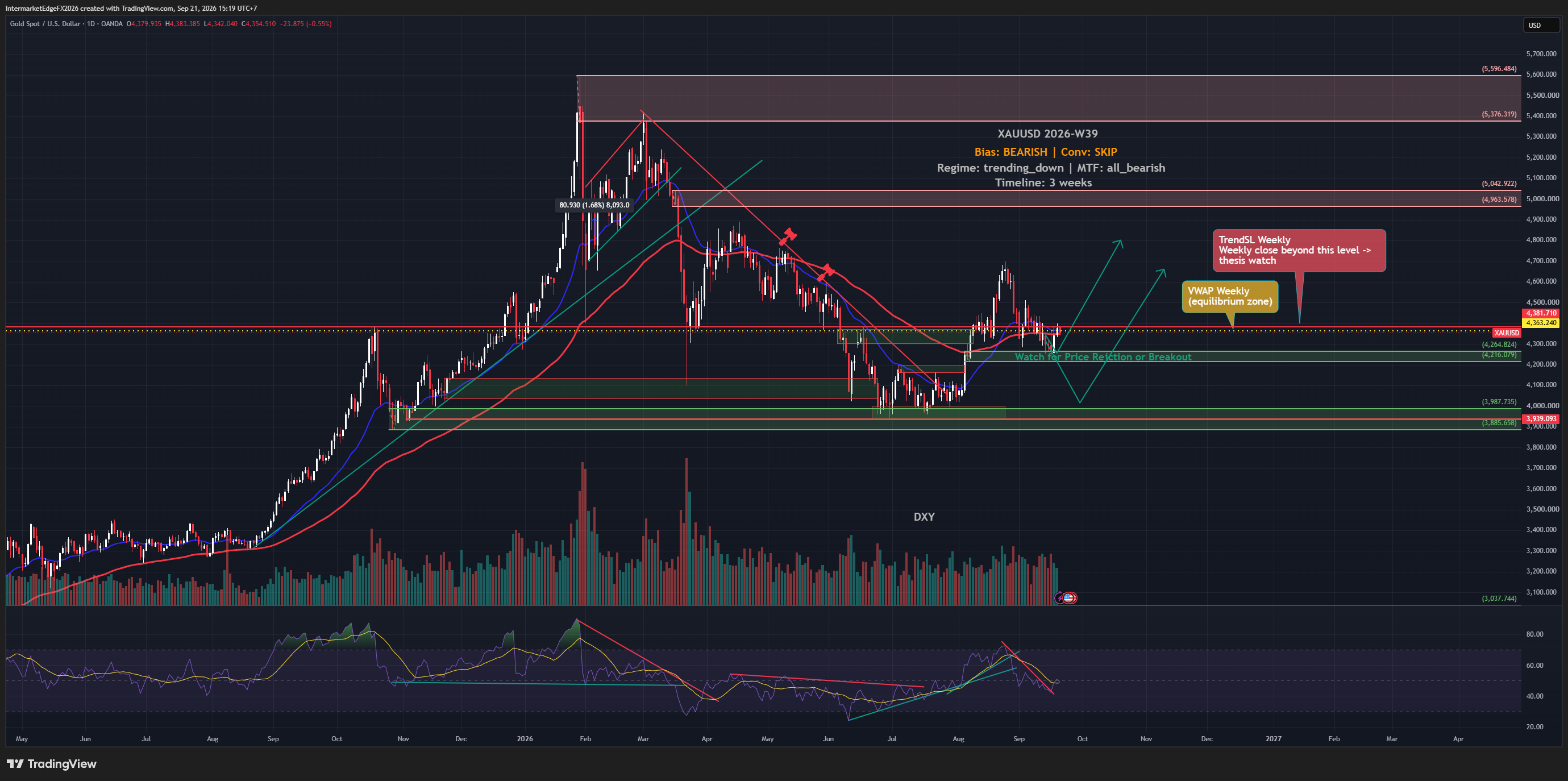
Gold W39: the rebound has not changed the bearish structure NEXUS retains a bearish assessment but deliberately stands aside over a three-week horizon. Daily, weekly and monthly trend readings point down; a short-term rebound does not establish a reversal. At the reference time, gold was 4360.85, below weekly VWAP 4363.24 by about 2.4 dollars and below TrendSL 4381.71 by about 20.86 dollars, testing from underneath. If price sustains above VWAP, short-term momentum would oppose the bearish thesis. That is a watch condition, not structural invalidation. If price closes the week above TrendSL 4381.71, the bearish structure would be invalidated. Neither condition was met at the reference time. Reuters reported a gold rally of more than 2% on 17 September alongside declines in the dollar, oil and nominal Treasury yields. Its 18 September update described cheaper oil supporting gold while a stronger dollar limited gains. The 21 September report focused on Middle East developments and rate expectations. A nominal yield decline does not establish a decline in real yields. DXY was checked at 100.326 at 07:58 UTC on 21 September, from yfinance. A bearish analytical assessment is not an observed dollar decline. Gold reference quote: 06:53 UTC, 21 September 2026, MT5 XAUUSD.sml. This is a timestamped reference, not a live quote at reading time. Intermarket Edge

GBPUSD Week W38-2026: Yield Pushes Toward 5% but the Dollar Refuses to Confirm

GBPUSD Week W38-2026: Yield Pushes Toward 5% but the Dollar Refuses to Confirm

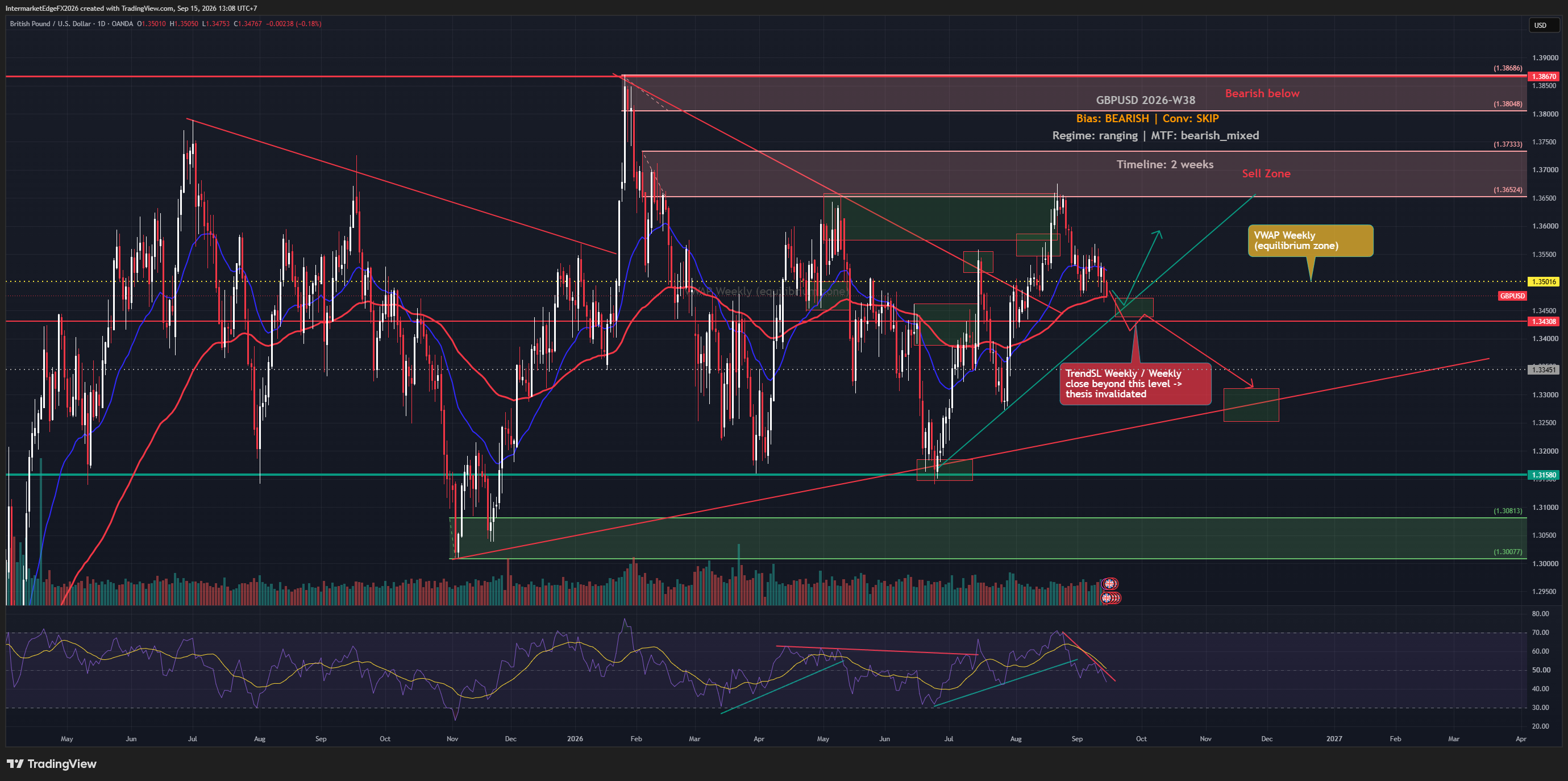
The US 10-year yield is pressing toward 5%, a level not seen since 2007, and that alone is enough to keep a bearish lean on GBPUSD for this week. But with the Federal Reserve decision due September 16 and the Bank of England following on September 17, the rate-differential story is incomplete. GBPUSD touched 1.3474 before recovering, and how it responds to those two decisions will matter far more than where it sits right now. The directional lean for GBPUSD this week is bearish, but the conviction behind that lean is deliberately thin, thin enough that staying out of a new position is the more defensible choice until the evidence consolidates. The entire bearish argument rests on one causal chain: a hawkish Fed stance pushes real yields higher, which widens the rate differential, the return gap between dollar and sterling assets, in the dollar's favor, making GBPUSD a structurally weaker pair. That chain is real and it is the clearest force in the setup. What is missing is any confirmation from price behavior or institutional positioning. COT data, which tracks how large speculative traders are aligned, contributes no directional score this week, meaning there is no evidence that professional money has built a meaningful short sterling position to amplify the macro thesis. Retail positioning at 54% long and 46% short, per broker sample data from fxssi on September 15, is effectively balanced and offers no contrarian signal in either direction. The TGA fell roughly 12% over four weeks to $843.7 billion as of September 9. A Treasury cash drawdown generally returns cash to the banking system, which can ease dollar funding conditions and work against the bullish dollar narrative at the margin. None of these cross-currents produce a clean picture. -- Intermarket Edge (Note: COT (Commitment of Traders) data is released weekly by the CFTC with a reporting-period lag -- it is not a real-time position feed. See cftc.gov for the exact release schedule.)

EURUSD Week W37-2026: Price Reclaims 1.16274 VWAP as ECB and US CPI Collide, Bearish Case Loses Its Technical Footing

EURUSD Week W37-2026: Price Reclaims 1.16274 VWAP as ECB and US CPI Collide, Bearish Case Loses Its Technical Footing

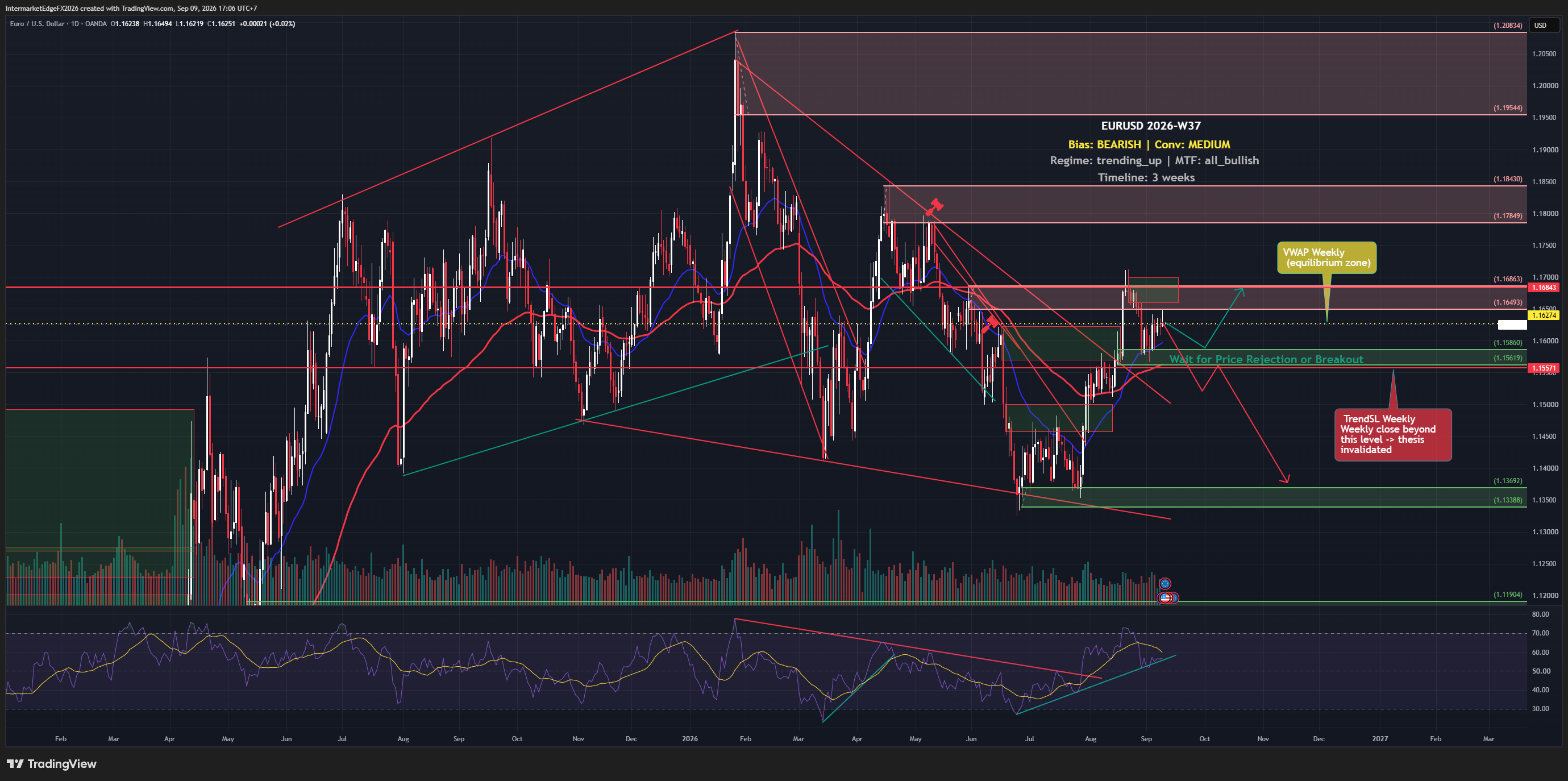
EURUSD is sitting at 1.16393 as of Wednesday, 09 September 2026, above its weekly VWAP at 1.16274 and well above the weekly trend support at 1.15571. The structural bias is bearish, driven by the Fed-ECB rate differential. But every technical and positioning signal points the other direction. When the chart, the COT data, and the price all contradict the macro label, the trade is rarely as clean as the thesis sounds. The bearish bias on EURUSD rests on one primary structural argument: the ECB versus Fed rate differential favors the dollar. When the Fed holds rates higher for longer while the ECB faces pressure to ease amid slowing European growth, the interest-rate gap widens, and wider differentials mechanically increase the cost of holding euro versus dollar, which tends to attract selling pressure on EURUSD. That logic is sound in principle. The problem is that virtually no other input this week agrees with it. The technical picture across daily, weekly, and monthly timeframes is uniformly bullish, the highest level of technical alignment available in this framework, meaning trend-following signals are pointing up, not down. COT positioning (which reflects the directional bets of large non-commercial traders in futures markets; note that this brief does not specify the report week, net-position figure, or release date, so treat it as directional evidence rather than a standalone data point) registers a bullish lean. Price itself, on a multi-timeframe basis, confirms the upward momentum. The result is an unusual configuration where the macro thesis and the market's actual behavior are pointing in opposite directions. Liquidity and sentiment indicators contributed no signal this week, which means the bearish case stands on the rate differential argument alone, without the support of positioning or price behavior to corroborate it. -- Intermarket Edge

GBPUSD W37-2026: Bullish Technical Structure Conflicts With the Bearish Macro View

GBPUSD W37-2026: Bullish Technical Structure Conflicts With the Bearish Macro View

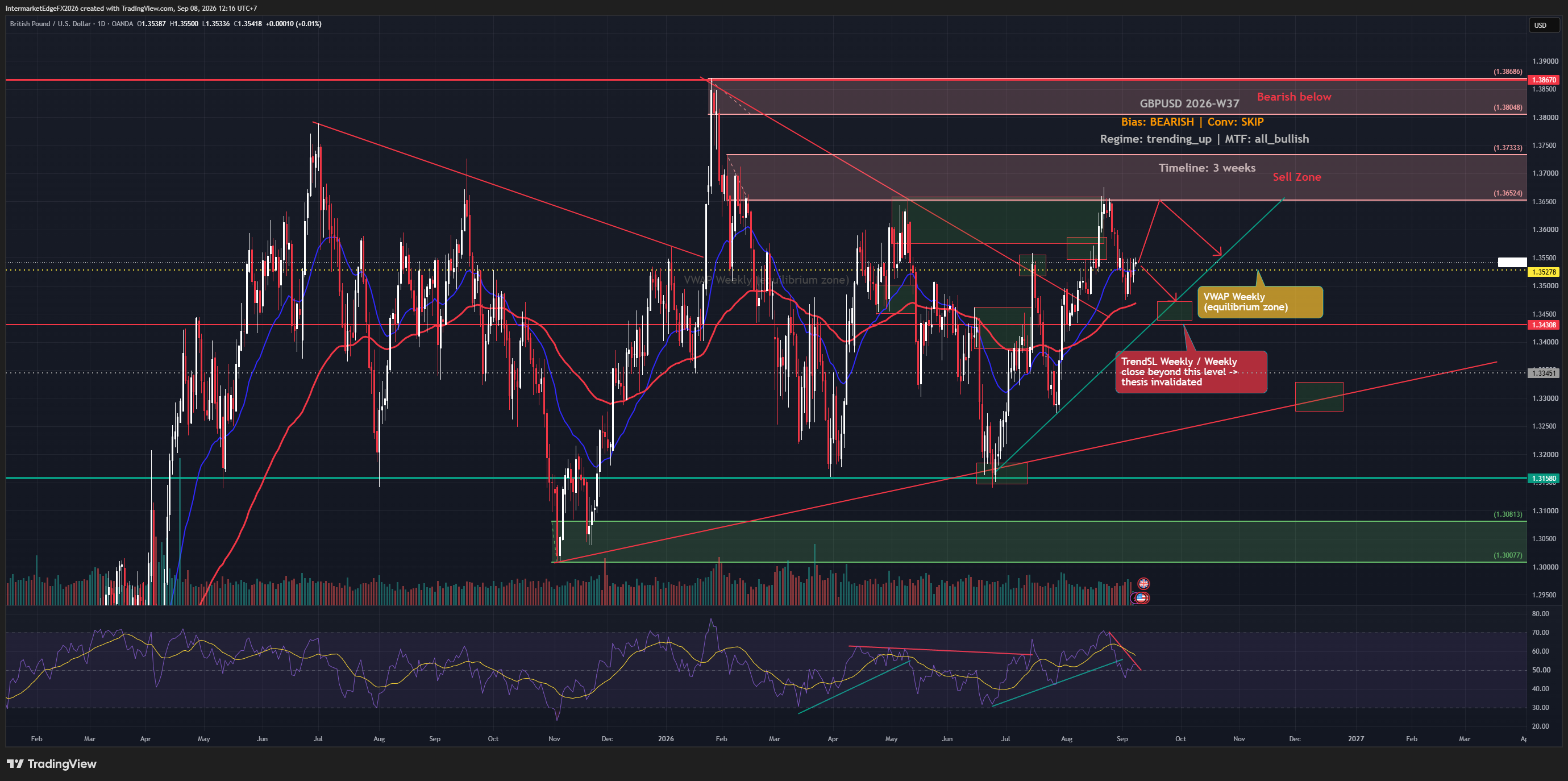
GBPUSD is technically bullish but carries a low-confidence bearish macro bias for W37-2026. The practical decision is to stand aside over a three-week analysis horizon. The locked price was 1.35479 at 05:03 UTC on Tuesday, September 8, 2026, from mt5:GBPUSD.sml:1m. Price was above weekly VWAP 1.35278 by about 20 pips and above weekly TrendSL 1.34308 by about 117 pips. The bullish structure is already active; the bearish label is not technically confirmed. A weekly close below 1.34308 is the defined bearish confirmation condition, not an automatic sell instruction. Strong US payrolls increased expectations of a Fed rate hike, while Reuters reported broad dollar softness ahead of August CPI. The CPI outcome is unknown. The US 10-year real-yield reference is 2.42%, but one level does not prove yields rose or that the US–UK rate differential widened. Huw Pill supported raising Bank Rate to 4% and warned about persistent second-round inflation effects from energy shocks. John Healey pledged fiscal discipline, but sterling received little clear direction from the speech. The COT input is directionally bearish for GBPUSD; its report week, release date and net position are missing, so it cannot establish current crowding or flows. Watch US PPI on September 10, then UK monthly GDP and US CPI on September 11, per ForexFactory calendar data. Outcomes remain unknown. Reassess after the releases and price reaction. Intermarket Edge For informational and educational purposes only. Not financial advice.

DXY Week W37-2026: Strong Payrolls, but the Dollar Cannot Hold Its Gains

DXY Week W37-2026: Strong Payrolls, but the Dollar Cannot Hold Its Gains

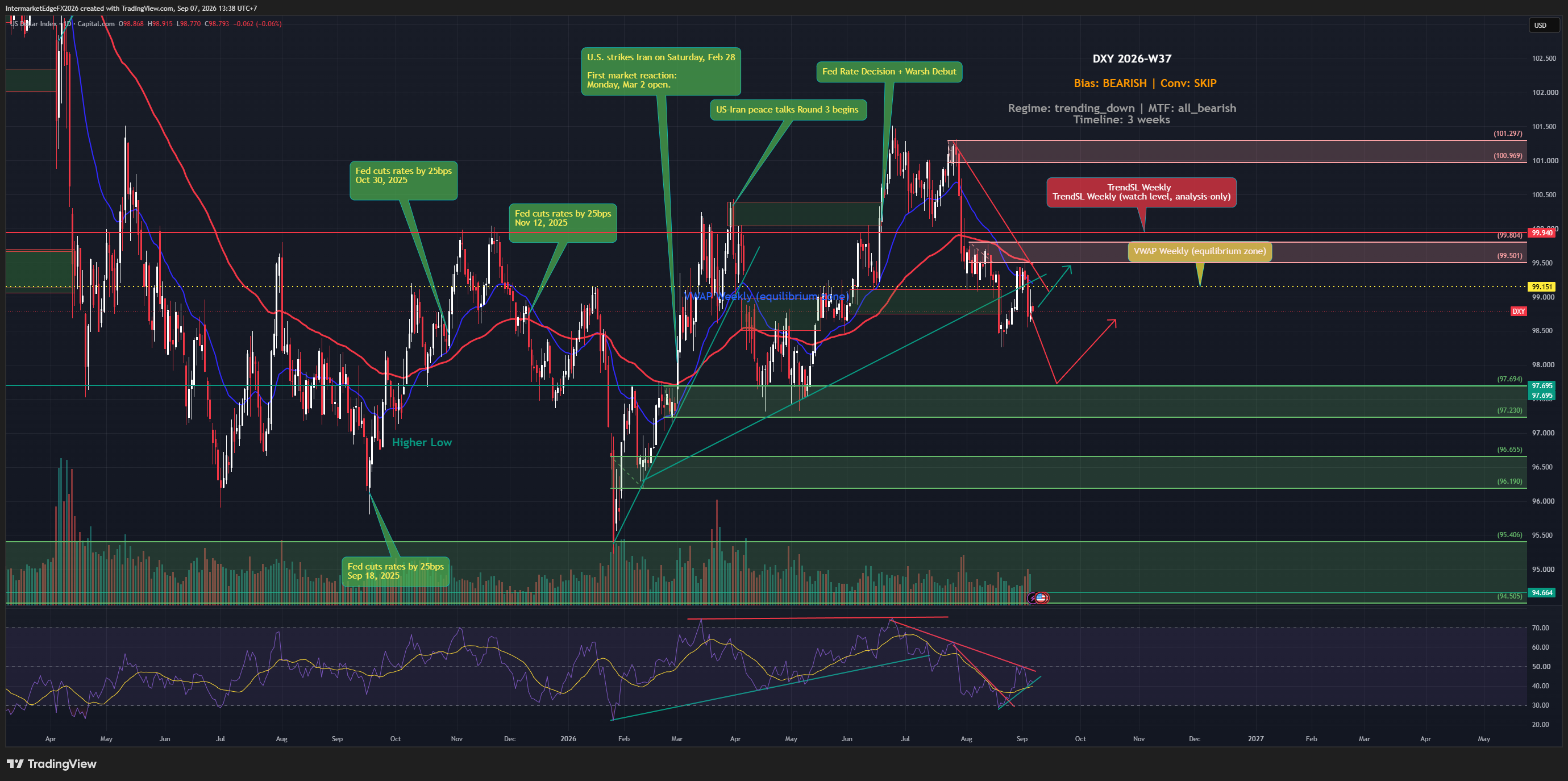
DXY Week W37-2026: strong payrolls, weak follow-through. August payrolls rose 162,000 against the Reuters consensus of 56,000, but the dollar pared its initial gains. Expectations of ECB and BOJ tightening can limit the relative US rate advantage; these remain expectations, not policy decisions. The locked quote is 99.165 at 03:58 UTC on Monday, September 7, 2026, from yfinance:DX-Y.NYB:1m. Price is ABOVE VWAP weekly at 99.151, testing from above by 0.014 points. That is an active short-term momentum conflict with the bearish view. Price remains BELOW TrendSL weekly at 99.94. The bias is bearish, the regime is a downtrend, and monitored timeframes are bearish. The horizon is three weeks. The action state is SKIP: stand aside. Neither the directional classification nor a later VWAP crossing is permission to enter a trade. A weekly close above TrendSL weekly at 99.94 would invalidate the bearish structure. This condition is pending; an intraday move would not be sufficient. August PPI is scheduled for September 10 and August CPI for September 11, both at 08:30 US Eastern / 19:30 Vietnam time, per ForexFactory calendar data. Outcomes are not yet known. For information and education only. Not financial advice.

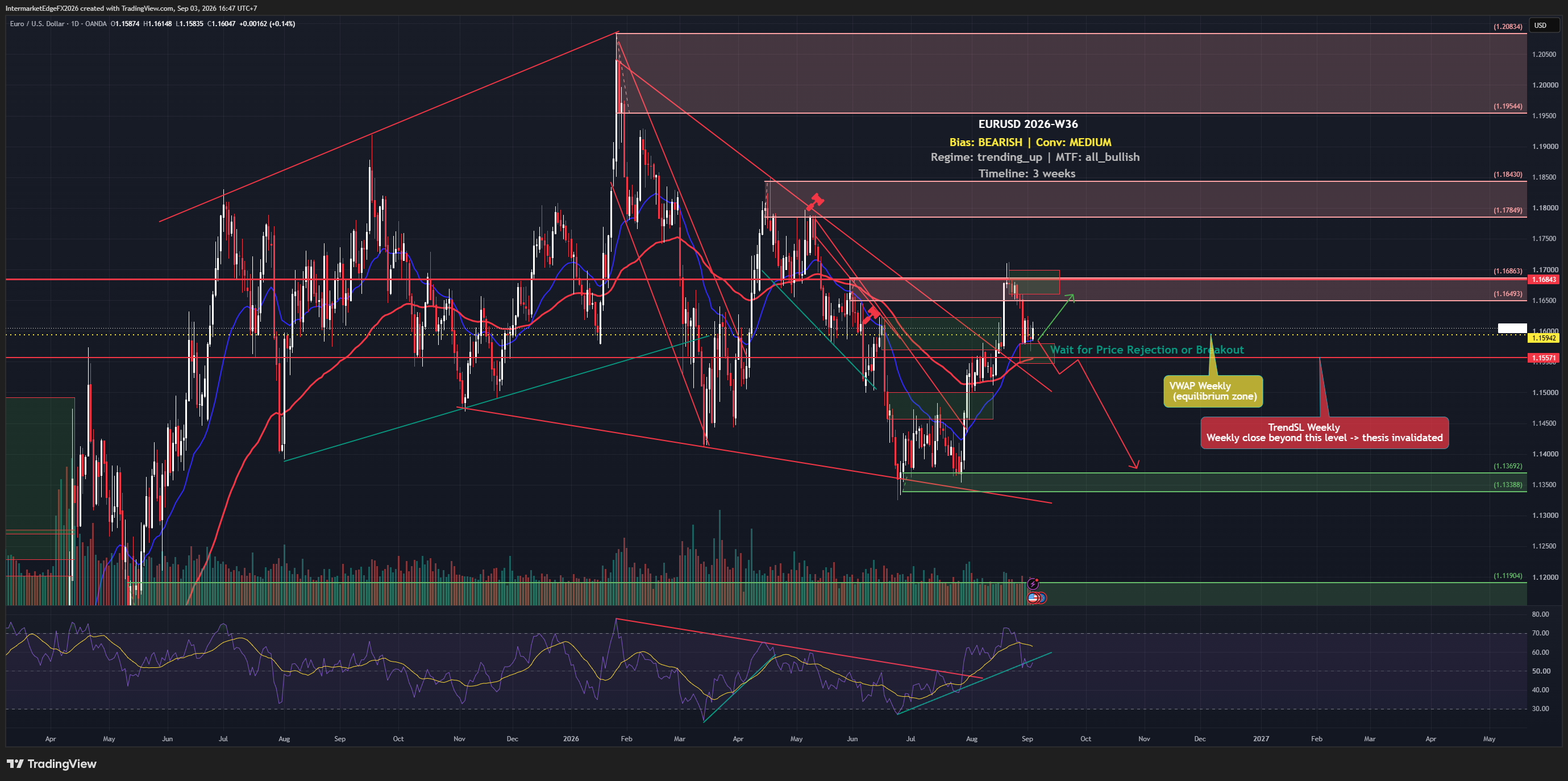
EURUSD Week W36-2026: Price Holds Above 1.15942 VWAP as Fed Beige Book Strengthens the Dollar Case, But the Chart Refuses to Confirm

EURUSD Week W36-2026: Price Holds Above 1.15942 VWAP as Fed Beige Book Strengthens the Dollar Case, But the Chart Refuses to Confirm

EURUSD is trading at 1.15972 as of Thursday, 03 September 2026, sitting above the weekly VWAP at 1.15942, and that positioning alone tells you the bearish macro thesis has not yet found technical confirmation. The Fed Beige Book flagged modest growth and elevated input-price pressures, keeping the hawkish USD narrative alive. But daily, weekly, and monthly trend signals are all pointing the same direction: up. That conflict is the trade problem this week, not the direction call. The analytical framework carries a bearish bias on EURUSD for the next three weeks, driven primarily by the ECB-versus-Fed rate differential. The causal chain runs as follows: the Fed remains hawkish because inflation, particularly in goods inputs, has not fully cooled, which means rate cuts are off the table near-term; that keeps real US yields elevated; elevated real yields make dollar assets genuinely attractive on a return-adjusted basis, not just nominally; and that sustained demand for dollars exerts downward pressure on EURUSD over a multi-week horizon. The conviction behind this view is medium, not high, and the reason matters. The conflict embedded in this setup is serious and should not be minimized. Price, COT positioning, and the technical trend structure are all reading bullish, not marginally, but comprehensively. Daily, weekly, and monthly trend signals are simultaneously aligned to the upside, which represents the maximum level of multi-timeframe technical conviction available. COT data shows a bullish lean as well, though the specific report week and net-position figures are not disclosed in this brief, so that reading should be treated as directional evidence rather than a precise positioning snapshot. What this means practically: the bearish label here is a macro-structural override, not a technically confirmed setup. -- Intermarket Edge

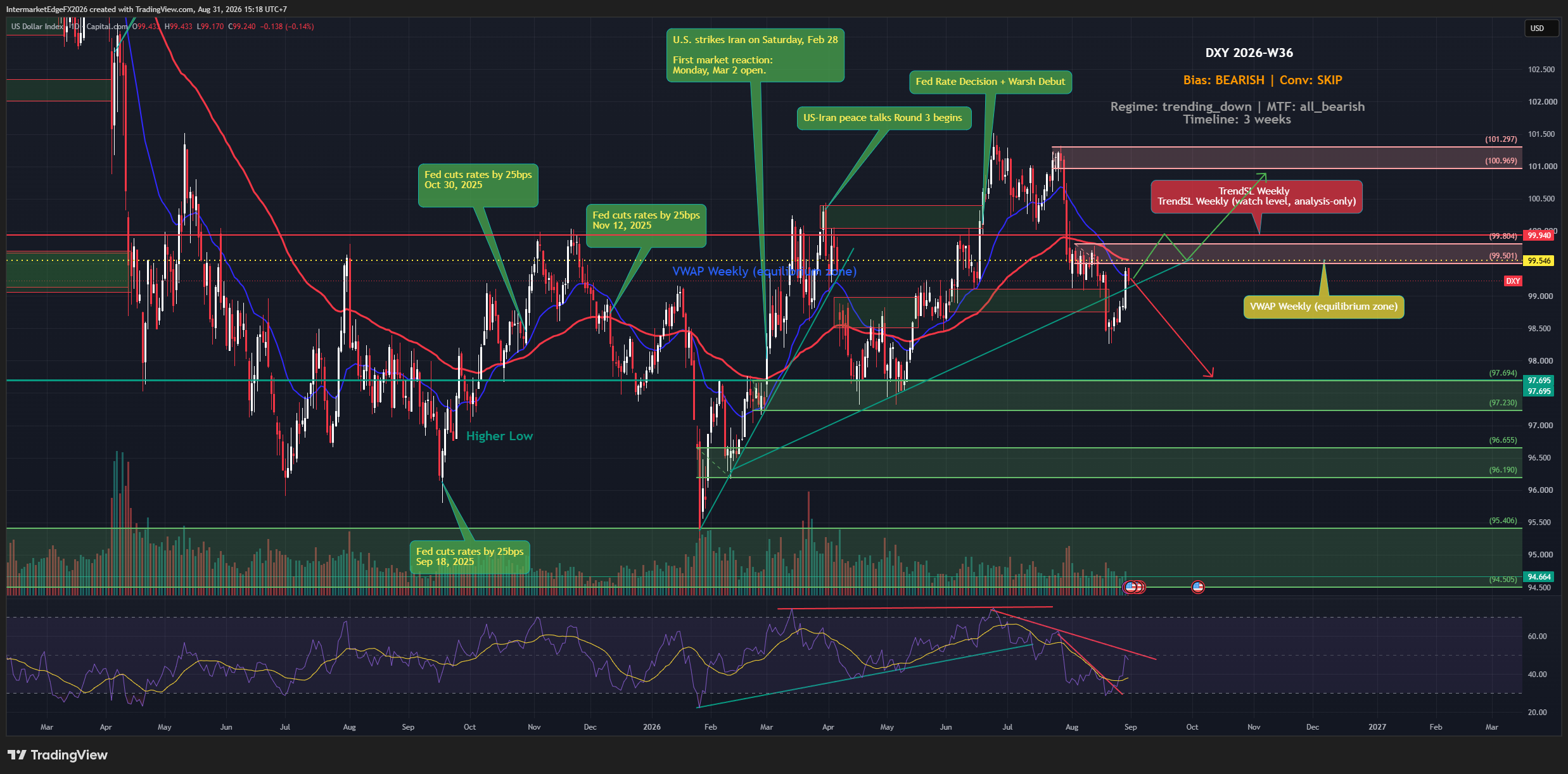
DXY Weekly Outlook W36: Hawkish Fed, Bearish Structure

DXY Weekly Outlook W36: Hawkish Fed, Bearish Structure

Fed Chair Kevin Warsh just opened the door to further rate hikes if inflation stays sticky, pushing the September hike probability from roughly 36% to around 58%, and the dollar responded, rising about 0.6% to the 99.6-99.7 range. That repricing sounds unambiguously bullish for the DXY. But leveraged funds are already sitting on extreme short positions in the dollar, which means the crowd most likely to fuel a sustained rally may already be largely offside. The payrolls report on September 4 is now the deciding test. The multi-timeframe structure on DXY remains bearish, with alignment across timeframes pointing in the same direction, the regime is trending down, and the framework's FX implication is to follow that trend rather than fade it. That said, the conviction behind this week's bearish read is deliberately low, and staying out of a full position is the rational response to the current evidence, not a failure of analysis. The reason conviction is suppressed comes down to a specific, unresolved conflict. Price action over the past week has been technically constructive, the dollar bounced, reclaimed short-term levels, and printed near a two-week high. Meanwhile, COT positioning data shows leveraged funds holding extreme short positions in the dollar. This is a meaningful divergence: if speculators are already heavily short, there is a contrarian question worth taking seriously, who is left to sell? A market where the bearish crowd is already crowded (crowding risk, meaning the position is so consensus that a reversal triggers forced covering rather than fresh selling) can squeeze sharply on any positive catalyst, and Warsh's hawkish signal plus the geopolitical oil spike are exactly the kind of catalysts that can trigger such covering. -- Intermarket Edge (Note: COT (Commitment of Traders) data is released weekly by the CFTC with a reporting-period lag -- it is not a real-time position feed. See cftc.gov for the exact release schedule.)

Stay in the loop

Get notified about new research, macro insights, and market analysis.

InterMarketEdge

© 2026 InterMarketEdge. Financial intelligence for inter-market traders.