Tag: GBPUSD — InterMarketEdge

Tag: GBPUSD

GBPUSD W41: Sterling Outperforms the Euro, but the Dollar Test Remains

GBPUSD W41: Sterling Outperforms the Euro, but the Dollar Test Remains

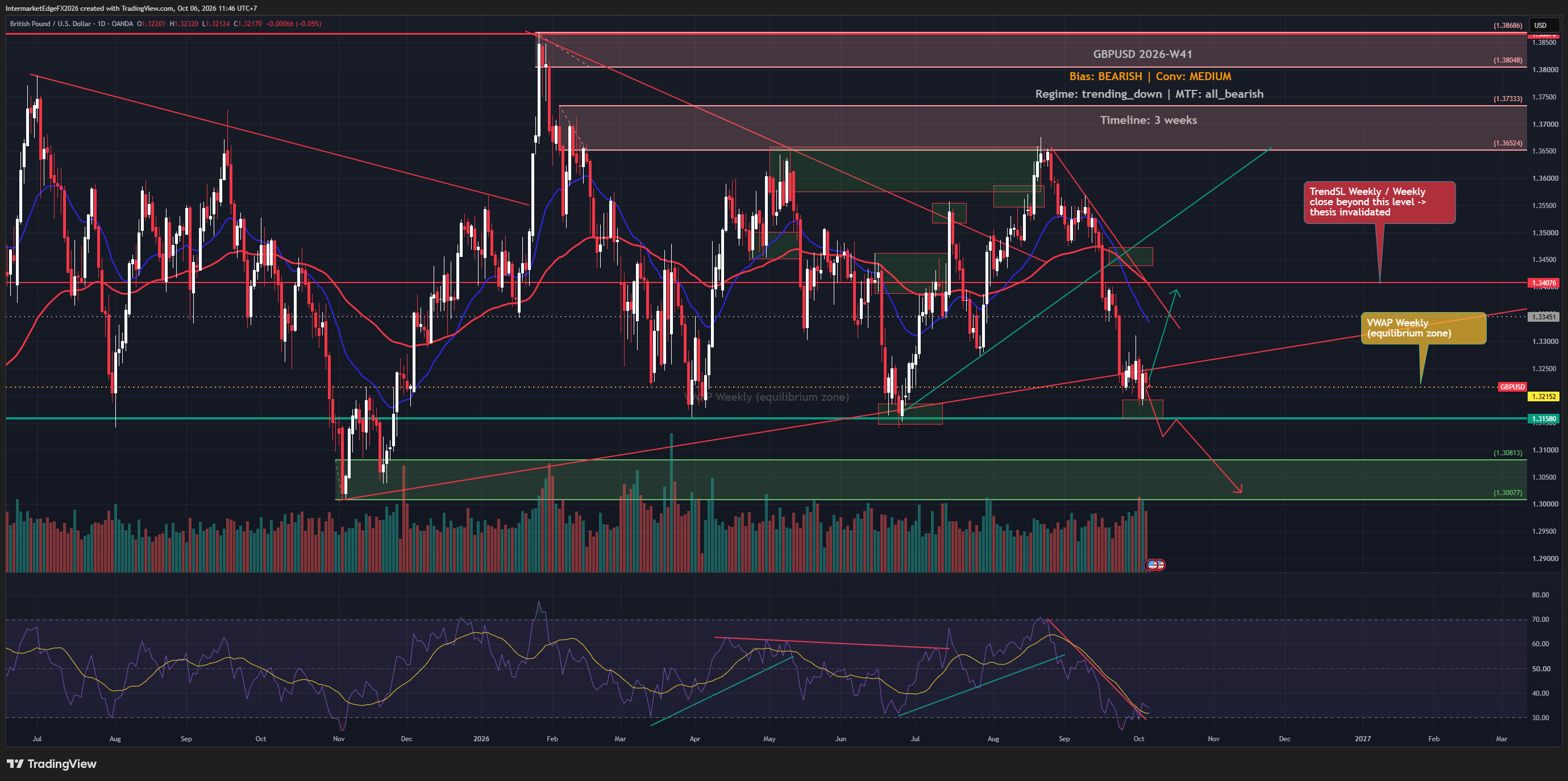
GBPUSD W41 | A bearish structure with an active momentum warning Sterling strength against the euro does not establish strength against USD. Amundi's more favorable GBP view also came alongside a positive dollar view. At 04:36 UTC on 06 October 2026, GBPUSD was 1.3228 (MT5 GBPUSD.sml:1m). Price is already above weekly VWAP 1.32152; the warning against bearish momentum is active now. Price is below weekly TrendSL 1.34076. Only a completed weekly close above 1.34076 would invalidate the bearish structure. That condition remains pending; an intraday touch is insufficient. The outlook remains bearish with medium conviction over a three-week review horizon. Timing is less clear. Existing shorts warrant a risk review now; a new position can wait for stronger agreement. Compare fresh dollar moves and matching UK-US yield observations rather than inferring the pair's direction from EURGBP alone. ForexFactory lists FOMC minutes for October 7 and Bailey remarks for October 8 on its UTC calendar. These are secondary-source listings, not officially verified schedules. Prices above are dated references, not live quotes. FXSSI collected on October 6 at 04:36:18 UTC: 69% Buy / 31% Sell for GBPUSD. Collection time, not provider observation time. This broker retail sample does not represent the entire FX market and is not a standalone entry signal. Intermarket Edge | Institutional Macro & Intermarket Analysis For informational purposes only. Not financial advice.
GBPUSD Week W40-2026: Sterling Remains Under Pressure as the BoE Bounce Fades

GBPUSD Week W40-2026: Sterling Remains Under Pressure as the BoE Bounce Fades

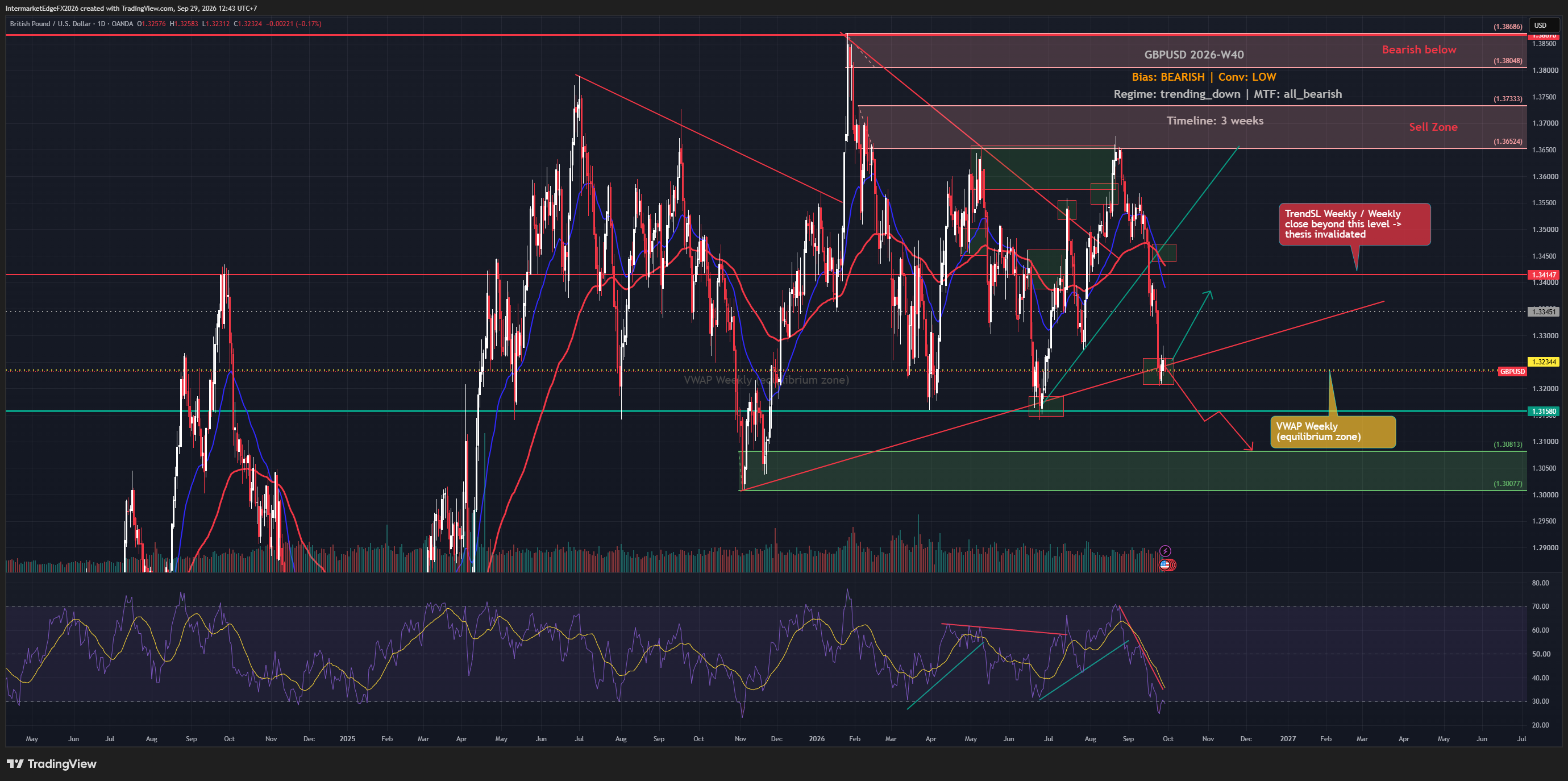
GBPUSD is sitting just above its weekly VWAP at 1.32344 as of Tuesday 29 September, close enough to look like support, but the structural current underneath is still running lower. The BoE's Deputy Governor Ramsden flagged upside inflation risks and hinted at a possible rate increase, producing a short-lived sterling rebound. The problem: US real yields at 2.85% are one of the most powerful headwinds the pound can face, and that wall hasn't moved. The structural bias for GBPUSD remains bearish, but this is a low-conviction bearish call, and that distinction matters enormously for how to treat any signal from the current price. The dominant driver is the Fed hawkish causal chain: rising US real yields attract capital toward dollar assets, which strengthens DXY, which in turn presses GBPUSD lower through the rate differential. That chain is active and has clear mechanical weight in the analysis. What makes conviction low rather than high is the internal conflict visible across signal types. Price action itself is registering near-term bullish momentum, the pair is trading above its weekly VWAP at 1.32344 as of Tuesday 29 September, which means short-term momentum is already running against the bearish thesis. That is not a future risk; it is the current reality. The BoE's hawkish shift adds a fundamental reason why sterling might hold or recover near-term, even if the longer-term rate differential remains dollar-positive. Retail positioning, 75% of retail traders net long GBPUSD as of 29 September (FXSSI, broker sample, not the full market), provides contrarian context that leans bearish, but without a calibrated framework it cannot lift conviction on its own. The multi-timeframe structure is aligned bearish from the weekly level down, which keeps the directional bias intact, but the signals that would normally support sizing a position with confidence are not consistently pointing the same way. -- Intermarket Edge

GBPUSD Week W39-2026: Pound Dips Near Seven-Week Lows as Fed-BoE Divergence Tightens the Trap

GBPUSD Week W39-2026: Pound Dips Near Seven-Week Lows as Fed-BoE Divergence Tightens the Trap

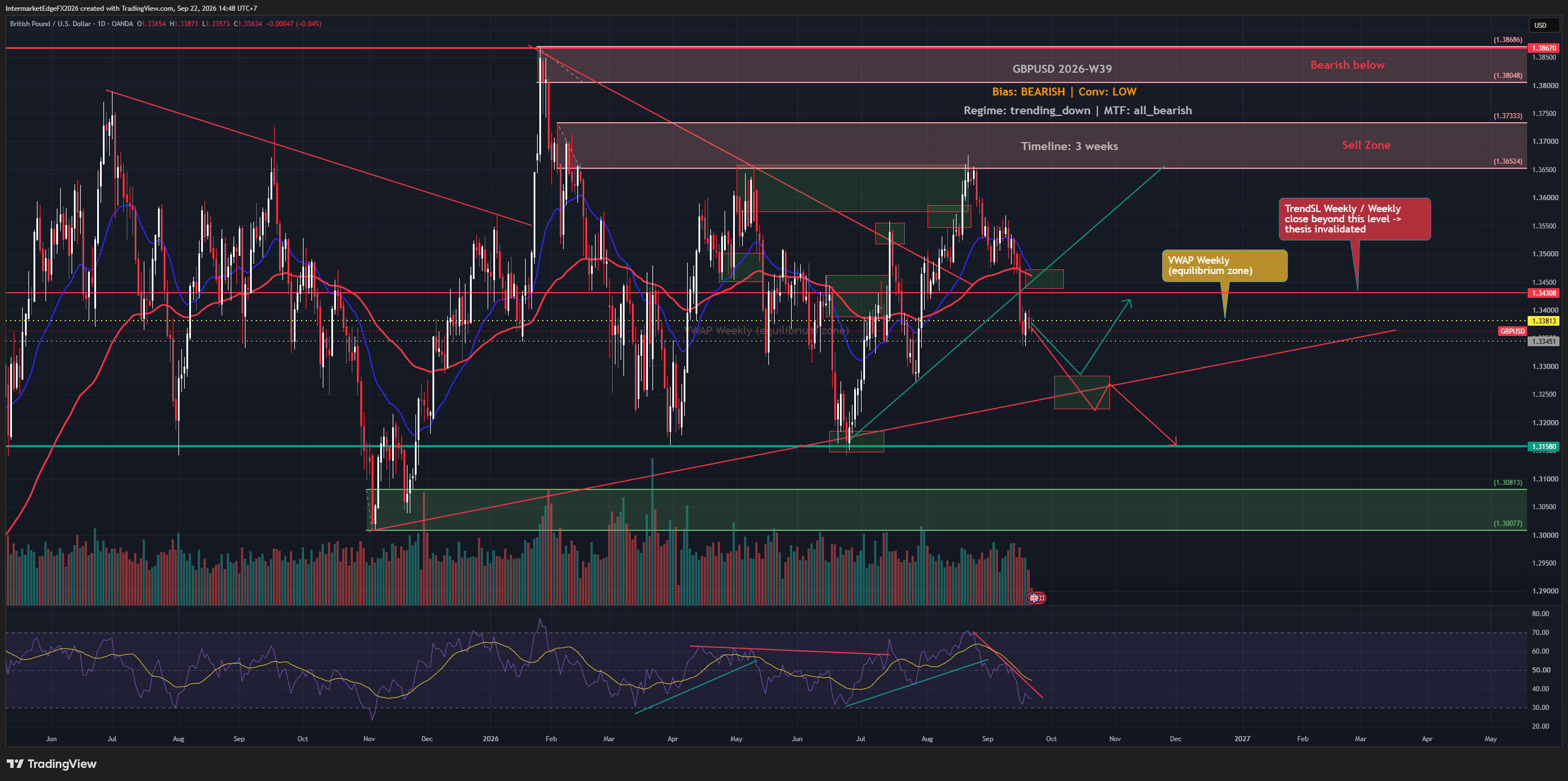
Sterling is trading near seven-week lows as the Fed-BoE policy gap favors the dollar, but this is not a clean sell setup. At the Tuesday, 22 September 2026 observation, GBPUSD was already above weekly VWAP at 1.33813 and testing it from above, so short-term momentum was running against the bearish macro thesis. The broader assessment remains bearish because the rate differential and multi-timeframe structure still point lower, but conviction is low and the timing evidence is incomplete. FXSSI reports that 67% of its broker-level retail sample is net long GBPUSD, which provides contrarian context but no calibrated directional signal and no evidence about institutional flows. The decision is to stand aside. A weekly close above TrendSL at 1.34308 would invalidate the bearish structure and require a reassessment. -- Intermarket Edge

GBPUSD Week W38-2026: Yield Pushes Toward 5% but the Dollar Refuses to Confirm

GBPUSD Week W38-2026: Yield Pushes Toward 5% but the Dollar Refuses to Confirm

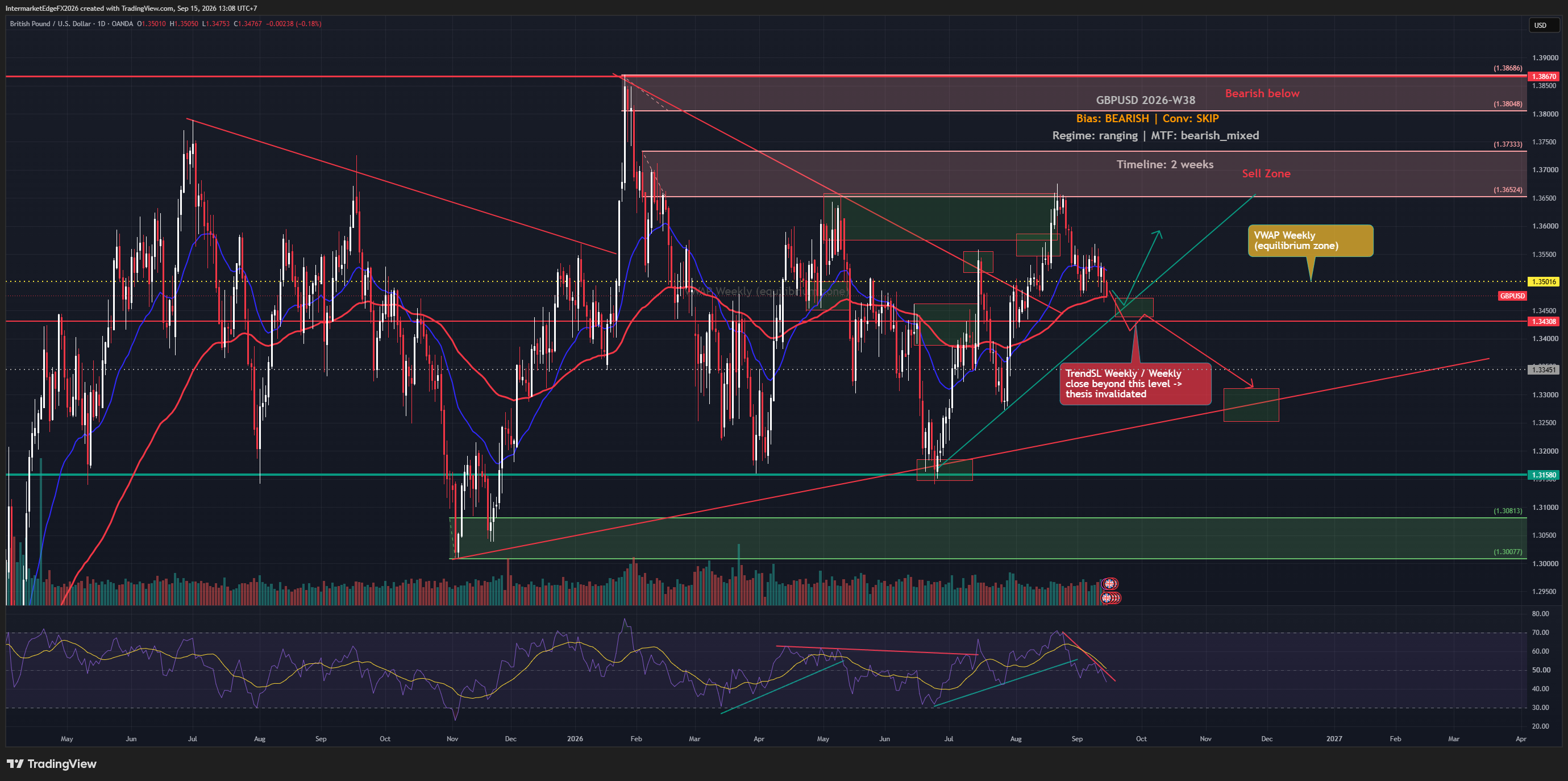
The US 10-year yield is pressing toward 5%, a level not seen since 2007, and that alone is enough to keep a bearish lean on GBPUSD for this week. But with the Federal Reserve decision due September 16 and the Bank of England following on September 17, the rate-differential story is incomplete. GBPUSD touched 1.3474 before recovering, and how it responds to those two decisions will matter far more than where it sits right now. The directional lean for GBPUSD this week is bearish, but the conviction behind that lean is deliberately thin, thin enough that staying out of a new position is the more defensible choice until the evidence consolidates. The entire bearish argument rests on one causal chain: a hawkish Fed stance pushes real yields higher, which widens the rate differential, the return gap between dollar and sterling assets, in the dollar's favor, making GBPUSD a structurally weaker pair. That chain is real and it is the clearest force in the setup. What is missing is any confirmation from price behavior or institutional positioning. COT data, which tracks how large speculative traders are aligned, contributes no directional score this week, meaning there is no evidence that professional money has built a meaningful short sterling position to amplify the macro thesis. Retail positioning at 54% long and 46% short, per broker sample data from fxssi on September 15, is effectively balanced and offers no contrarian signal in either direction. The TGA fell roughly 12% over four weeks to $843.7 billion as of September 9. A Treasury cash drawdown generally returns cash to the banking system, which can ease dollar funding conditions and work against the bullish dollar narrative at the margin. None of these cross-currents produce a clean picture. -- Intermarket Edge (Note: COT (Commitment of Traders) data is released weekly by the CFTC with a reporting-period lag -- it is not a real-time position feed. See cftc.gov for the exact release schedule.)

GBPUSD W37-2026: Bullish Technical Structure Conflicts With the Bearish Macro View

GBPUSD W37-2026: Bullish Technical Structure Conflicts With the Bearish Macro View

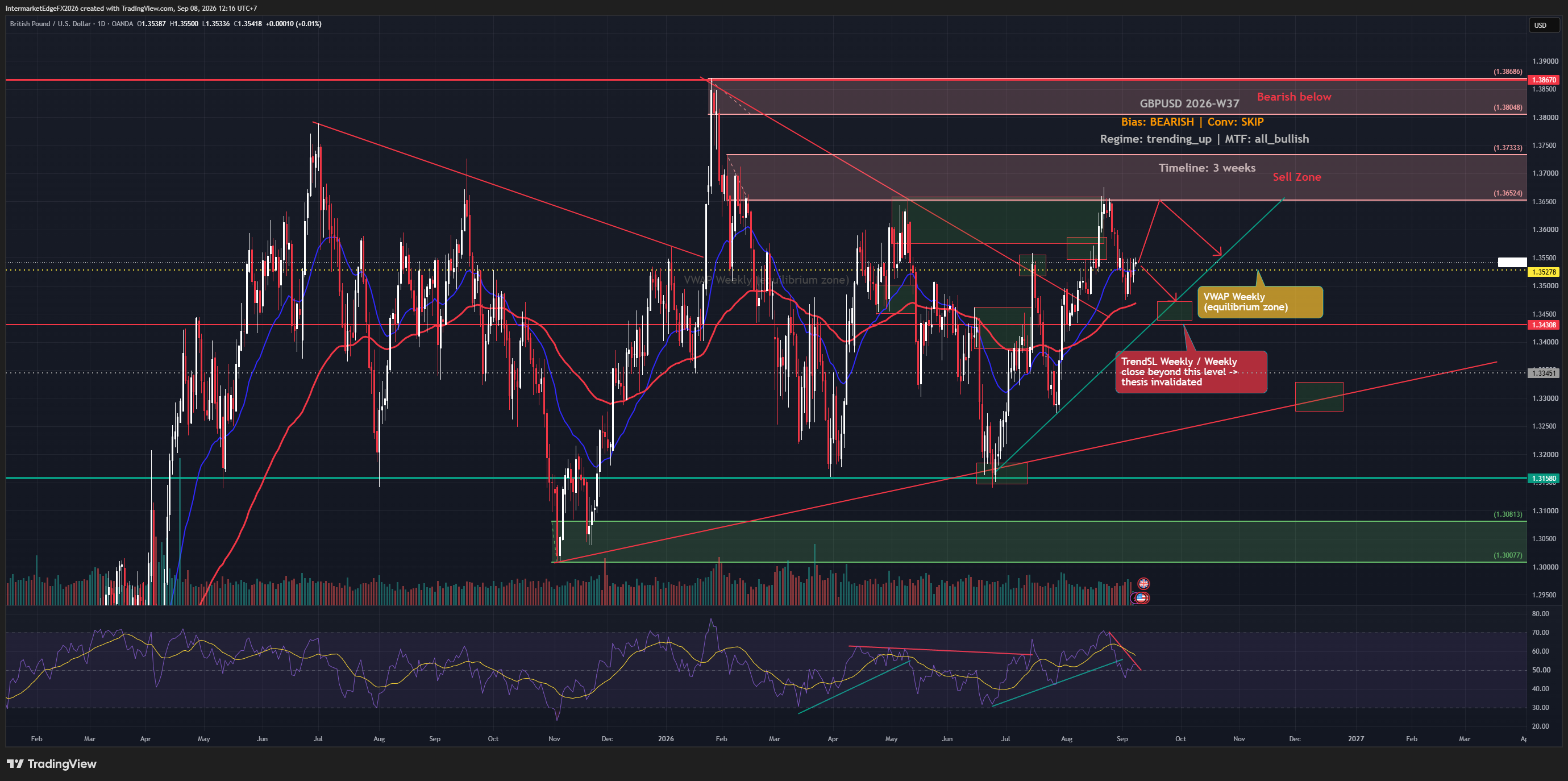
GBPUSD is technically bullish but carries a low-confidence bearish macro bias for W37-2026. The practical decision is to stand aside over a three-week analysis horizon. The locked price was 1.35479 at 05:03 UTC on Tuesday, September 8, 2026, from mt5:GBPUSD.sml:1m. Price was above weekly VWAP 1.35278 by about 20 pips and above weekly TrendSL 1.34308 by about 117 pips. The bullish structure is already active; the bearish label is not technically confirmed. A weekly close below 1.34308 is the defined bearish confirmation condition, not an automatic sell instruction. Strong US payrolls increased expectations of a Fed rate hike, while Reuters reported broad dollar softness ahead of August CPI. The CPI outcome is unknown. The US 10-year real-yield reference is 2.42%, but one level does not prove yields rose or that the US–UK rate differential widened. Huw Pill supported raising Bank Rate to 4% and warned about persistent second-round inflation effects from energy shocks. John Healey pledged fiscal discipline, but sterling received little clear direction from the speech. The COT input is directionally bearish for GBPUSD; its report week, release date and net position are missing, so it cannot establish current crowding or flows. Watch US PPI on September 10, then UK monthly GDP and US CPI on September 11, per ForexFactory calendar data. Outcomes remain unknown. Reassess after the releases and price reaction. Intermarket Edge For informational and educational purposes only. Not financial advice.
GBPUSD Weekly Outlook W36: Bullish Structure, Bearish Macro Pressure

GBPUSD Weekly Outlook W36: Bullish Structure, Bearish Macro Pressure

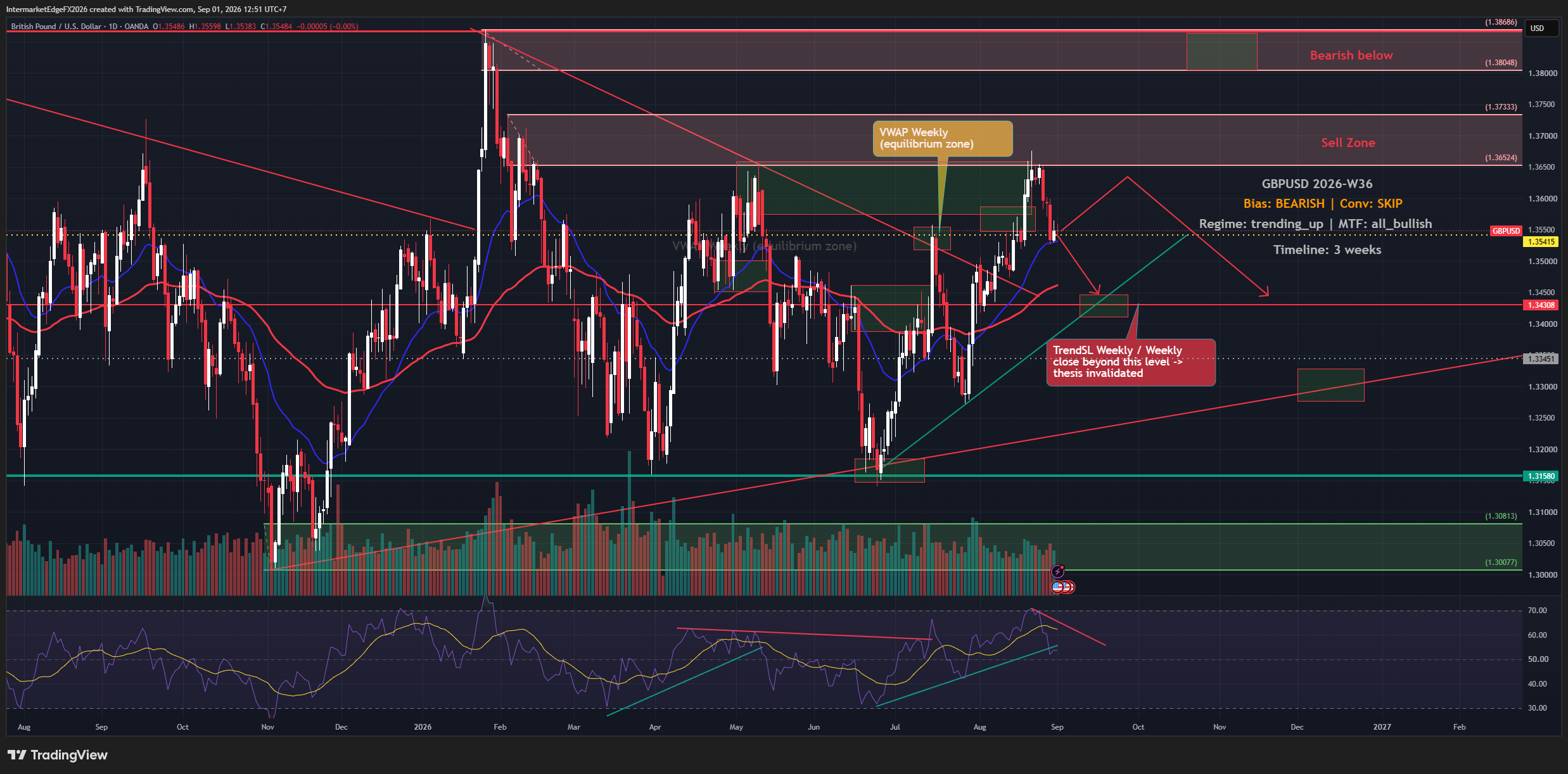
GBPUSD is printing a weekly loss as markets reassess the BoE-Fed policy divergence, but the technical structure refuses to cooperate with the bearish story. As of Tuesday, 01 September 2026, price sits at 1.35433, holding above the weekly VWAP at 1.35415 and well above the weekly trend support at 1.34308. The macro case for sterling weakness is building, yet the chart is not confirming it. That disconnect is the entire trade problem this week. The framework lands on a bearish bias for GBPUSD over a three-week horizon, but that label carries a deliberate caveat: this is a case where the evidence is not yet convincing enough to size a position, and staying out is itself a reasoned decision rather than the absence of a view. The bearish case rests on two causal chains that are both active right now. First, Fed hawkishness combined with rising real yields creates a structural USD bid, when real yields rise, the opportunity cost of holding non-dollar assets increases, pulling capital toward the dollar and mechanically weighing on GBPUSD. Second, DXY strength, itself driven by the same real yield dynamic, amplifies that pressure through a separate channel, since broad dollar appreciation tends to compress GBPUSD regardless of sterling-specific factors. COT data adds a warning layer: speculative positioning in GBP is already tilted heavily long, which matters because crowding risk, the danger that most participants who want to be long are already long, leaving fewer buyers to sustain the move, raises the probability of a disorderly unwind if sentiment shifts. The positioning evidence here should be read as directional in character, not as a citable statistic, since the specific report date, net position figure, and sample context are not available in this brief. -- Intermarket Edge

GBPUSD Week W35-2026: Sterling Pauses at Six-Month Highs as Iran Sanctions and Debt Nerves Pull in Opposite Directions

GBPUSD Week W35-2026: Sterling Pauses at Six-Month Highs as Iran Sanctions and Debt Nerves Pull in Opposite Directions

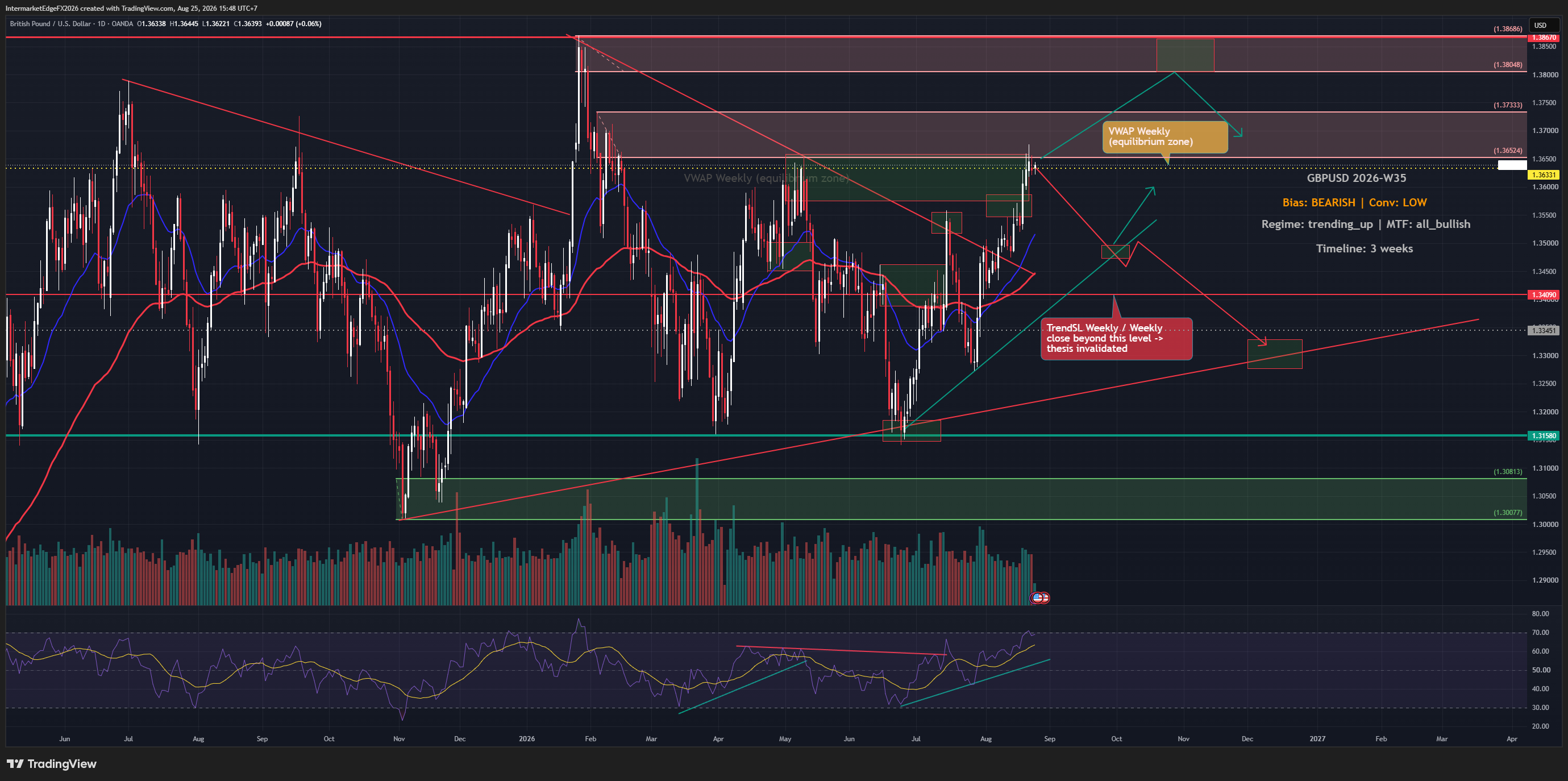
Sterling has climbed for four straight weeks, but as of Tuesday 25 August the rally has quietly stalled just beneath the weekly VWAP at 1.36331, a ceiling the market is testing from underneath. The pause is not random: speculators are already extreme long GBP according to COT data, and US real yields are sitting at 2.4%, a level that mechanically favors dollar strength. The direction everyone thinks they know may be the setup that punishes them. The framework carries a bearish bias on GBPUSD this week, but the conviction behind that call is deliberately low, and understanding why matters more than the label itself. The bearish case rests on two pillars: macro and positioning. On the macro side, Fed hawkishness combined with a 2.4% real yield creates conditions where the dollar should attract flows regardless of what the BOE does, because the USD is offering inflation-adjusted return that sterling cannot easily match. On the positioning side, COT data, which tracks the net futures positioning of speculative accounts, used here as a directional sentiment gauge rather than a standalone citable statistic since the specific report week and net-position figures are not available in this brief, shows speculators are already extremely long GBP. The practical implication of crowding risk, meaning positioning so concentrated on one side that the market runs out of new buyers, is that any negative catalyst does not just stop the rally: it triggers a cascade of exits from the same crowded trade, accelerating the move lower far beyond what fundamentals alone would justify. The problem is that everything else is still pointing up. Price action scores bullishly, the multi-timeframe alignment is entirely bullish, and the macro backdrop for sterling, firm rate-hike bets, subdued dollar, has not broken down. -- Intermarket Edge

GBPUSD Week W34-2026: Pound Climbs Toward $1.36 as UK Inflation Test Looms, but Crowded Longs Warn of a Trap

GBPUSD Week W34-2026: Pound Climbs Toward $1.36 as UK Inflation Test Looms, but Crowded Longs Warn of a Trap

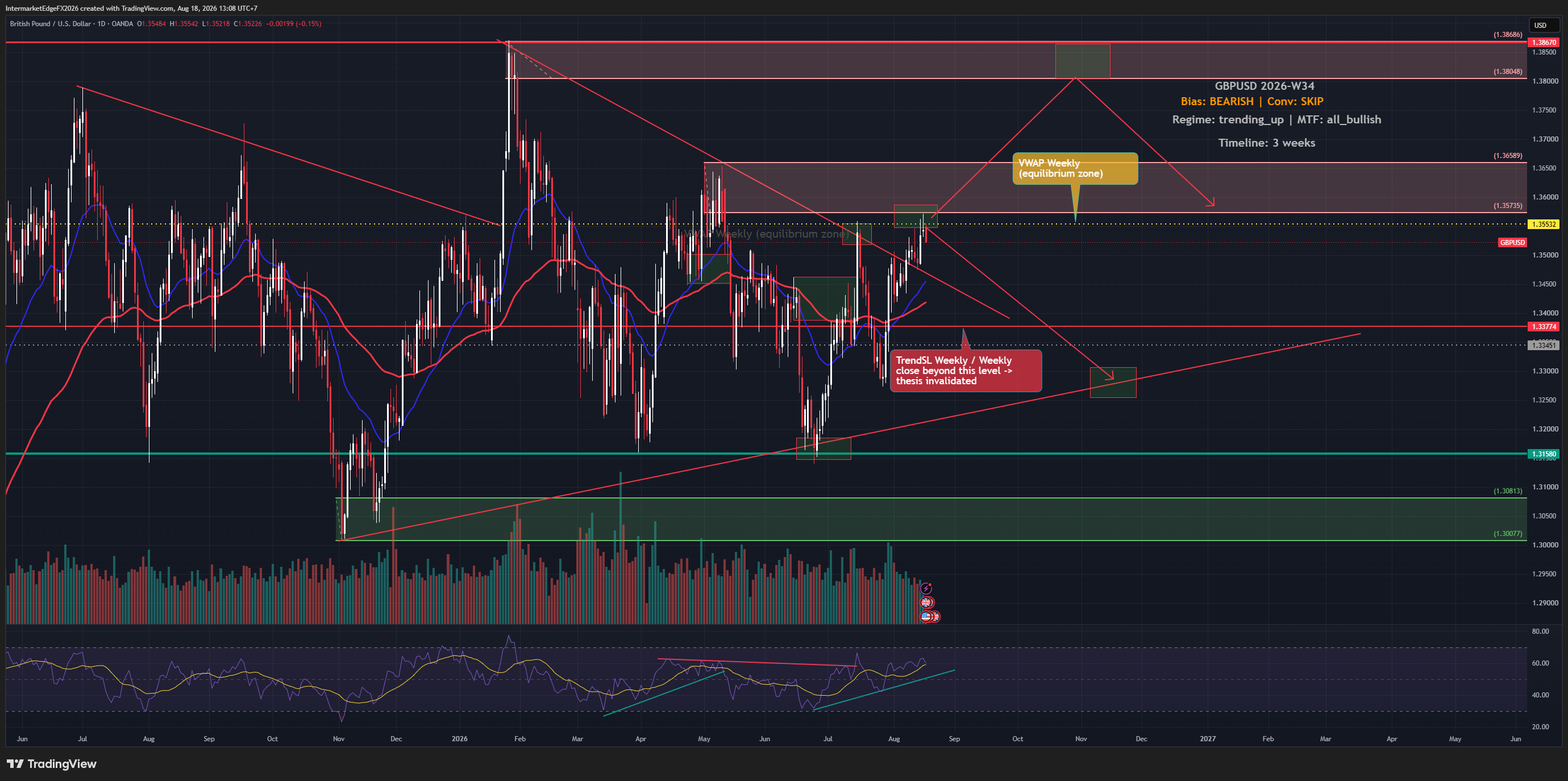
GBPUSD is trading at 1.35421 as of Tuesday, 18 August 2026, 06:14 UTC, trading below the weekly VWAP at 1.35532 while remaining above weekly TrendSL at 1.33774. The broader technical structure remains bullish, but price has lost the weekly VWAP in the short term. The available COT summary points to crowded long positioning, but it lacks the report week, release date, and exact net-position figure. Treat it as a directional risk flag, not standalone proof. The macro headwind from Fed real yields at 2.39% hasn't gone away. The framework carries a bearish bias on GBPUSD for the next three weeks, but the evidence supporting that bearish label is not currently strong enough to act on, and that distinction matters enormously. The primary bearish driver is the BOE-versus-Fed rate differential, where rising US real yields at 2.39% create structural pressure on GBPUSD by making dollar-denominated assets more attractive on a return-adjusted basis. A hawkish Fed, one that keeps real yields elevated even as nominal rate hike bets fluctuate, sustains that pressure without needing an outright rate increase. Layered on top is a qualified COT crowding risk: the available summary leans toward heavy sterling longs, but missing provenance prevents treating that description as a standalone statistic. When everyone is already long, the fuel for the next leg higher is thin, and any negative catalyst, a hot CPI that reprices UK rate cuts, or FOMC Minutes more hawkish than expected, can trigger a carry unwind, where traders exit leveraged long positions simultaneously, accelerating the move down far faster than fundamentals alone would justify. However, the higher-timeframe structure remains aligned bullish. Price remains above weekly TrendSL at 1.33774, but it has slipped below weekly VWAP at 1.35532. Short-term momentum now supports the bearish warning while the broader trend still conflicts with it. That technical structure directly contradicts the bearish label. -- Intermarket Edge (

GBPUSD Week W33-2026: Sterling Climbs to a One-Month High While the Bearish Macro Case Quietly Builds Against It

GBPUSD Week W33-2026: Sterling Climbs to a One-Month High While the Bearish Macro Case Quietly Builds Against It

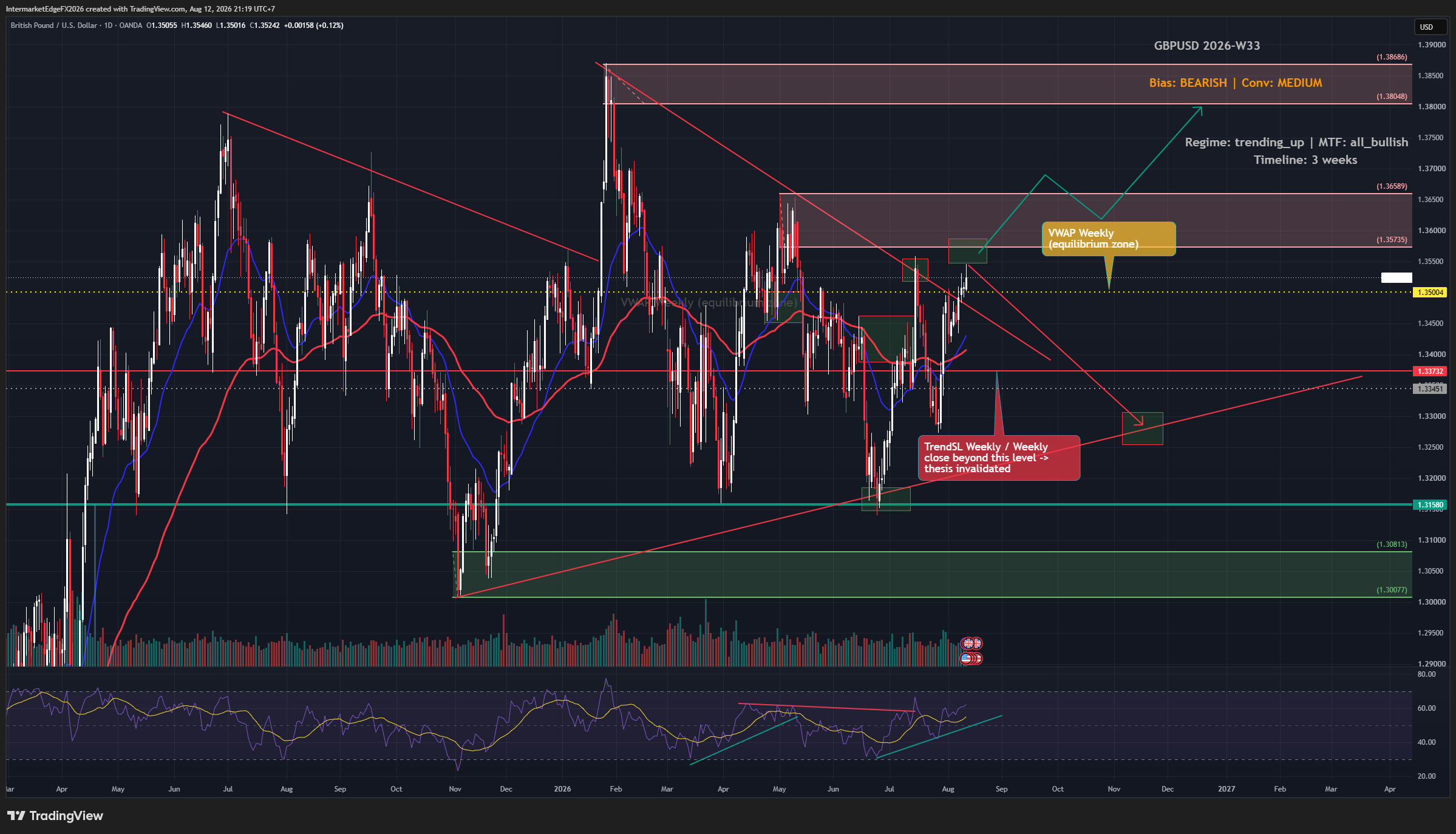
GBPUSD is trading at 1.35276 as of Wednesday, 12 August 2026, sitting above its weekly VWAP at 1.35004 and hovering near a one-month high for Sterling. A surprise Core CPI miss-actual 0.0% against a 0.2% forecast-briefly knocked the dollar's footing, but the broader macro argument for USD strength through elevated real yields hasn't structurally changed. The tension between what price is doing right now and what the macro environment implies is exactly the kind of setup that quietly catches traders off-guard. The framework's overall bias for GBPUSD this week is bearish over a three-week horizon, driven primarily by the BOE-versus-Fed rate differential-the gap between where each central bank's policy rate sits and where markets expect it to go-which currently favors the dollar because the Fed's commitment to restrictive policy is backed by real yields that remain historically elevated. When real yields are positive and rising, as the 2.4% US 10-year real yield suggests, capital tends to seek dollar exposure, which mechanically pressures currency pairs where the dollar is the quote side, like GBPUSD. Several reinforcing causal chains support this logic: Fed hawkishness sustains USD demand, and a DXY that finds its footing would directly compound downward pressure on Cable. The critical caveat-and it is not a minor one-is that the price-based and positioning-based evidence is pointing in the opposite direction. COT data (directional evidence only; the brief does not specify the report week, net-position figure, or release date, so treat this as a sentiment lean rather than a precise citable statistic) is reading bullish on Cable positioning. -- Intermarket Edge

Stay in the loop

Get notified about new research, macro insights, and market analysis.

InterMarketEdge

© 2026 InterMarketEdge. Financial intelligence for inter-market traders.