Tag: EURJPY — InterMarketEdge

Tag: EURJPY

EURJPY W42: A Bearish View Without a Clear Entry

EURJPY W42: A Bearish View Without a Clear Entry

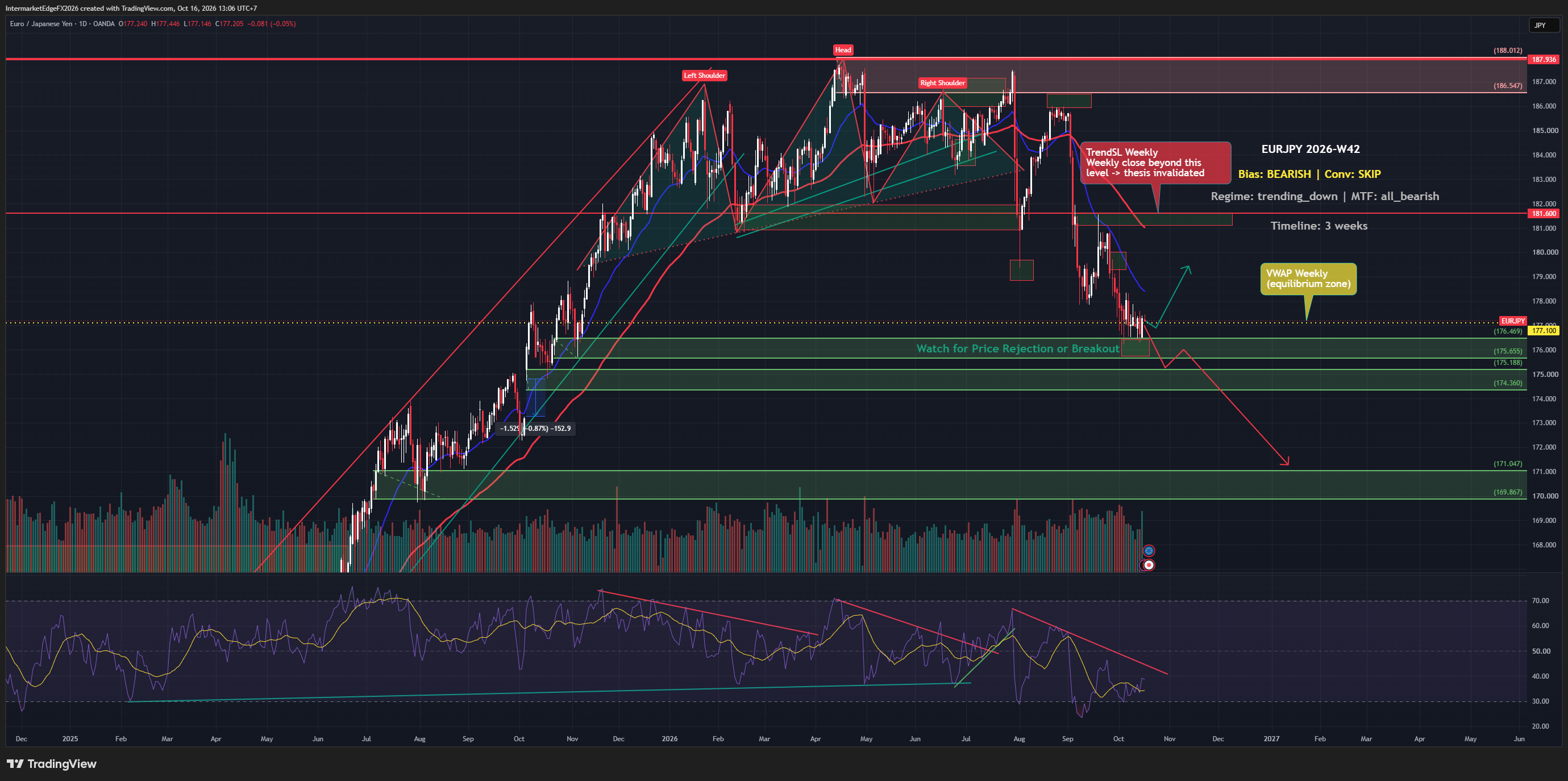
EURJPY W42: bearish three-week view; stand aside for new exposure. At 16/10/2026 06:03 UTC, EURJPY was 177.186, above weekly VWAP 177.102 and below weekly TrendSL 181.597. Source: mt5:EURJPY:1m, a timestamped broker quote. The momentum warning is already active: price is above the weekly average, running against the bearish thesis. For existing shorts, reduce position size now. This condition requires no daily or weekly close. A completed weekly close above 181.597 would invalidate the bearish structure, requiring an exit from shorts and reassessment. This structural invalidation condition remains pending. Compare EURUSD, USDJPY and matching German-Japanese yields. A euro recovery against USD does not establish this cross's direction. The opposing bullish assessment remains a reason to wait for stronger evidence. --- Intermarket Edge | Institutional Macro & Intermarket Analysis For information and education only. Not financial advice.
EURJPY W40: Hotter Tokyo Inflation Supports Yen, but Bears Still Lack Confirmation

EURJPY W40: Hotter Tokyo Inflation Supports Yen, but Bears Still Lack Confirmation

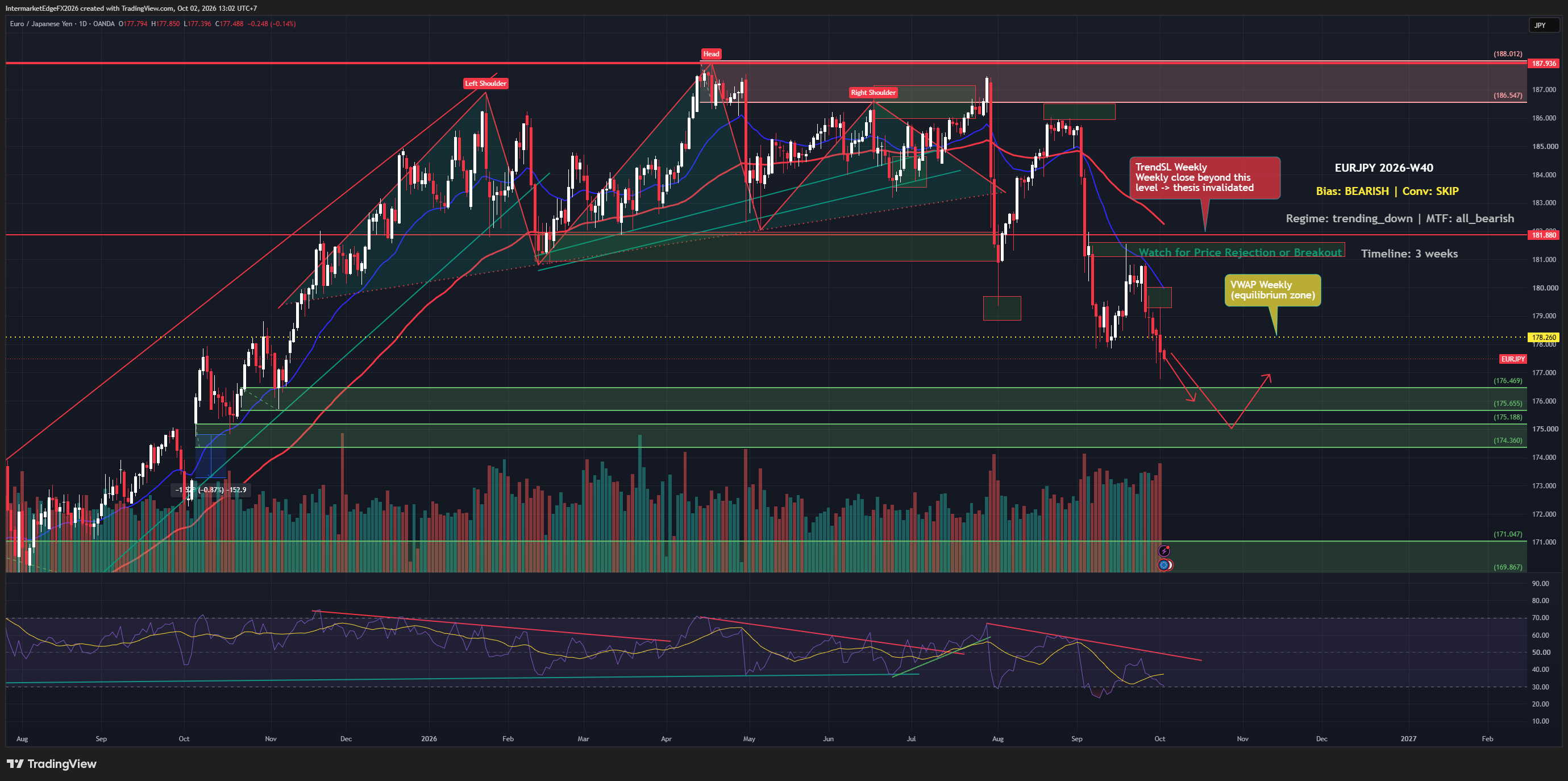
Japan's September Tokyo core-core CPI just printed 3.0% year-on-year against a 2.4% forecast, a significant beat that strengthens the case for BOJ policy tightening and yen appreciation. EURJPY is sitting at 177.59 early Friday, below the weekly VWAP at 178.26, with all timeframes aligned bearishly. The directional case looks clean. The conviction, however, does not, and that gap between direction and certainty is exactly where traders get hurt. The directional lean for EURJPY over the next three weeks is bearish, driven by two converging forces: a BOJ that is being pushed toward further tightening by inflation data that keeps exceeding expectations, and a euro that Reuters described as lagging the dollar during September. When the yen strengthens and the euro weakens simultaneously, EURJPY gets hit from both sides, the numerator falls and the denominator rises. That is the structural setup here. However, the analytical framework is deliberately standing aside rather than treating this as an actionable bearish entry. The reason is a direct conflict between the macro and technical signals: while the regime reads trending-down and all timeframes align bearishly, raw price action is generating a bullish technical signal that cannot be dismissed. This is not a minor discrepancy, it is an explicit disagreement between two evidence streams that normally need to be in agreement before sizing a position. Layered on top of this, the structural longer-term bias for EURJPY remains bullish, meaning that any short positioning is trading against the underlying trend. The retail crowd is 60% net long the pair as of October 2, which provides a contrarian lean toward the bear case, when the crowd is wrong, it tends to be wrong in the direction they are positioned, but this reading alone is not enough to override the technical conflict. -- Intermarket Edge

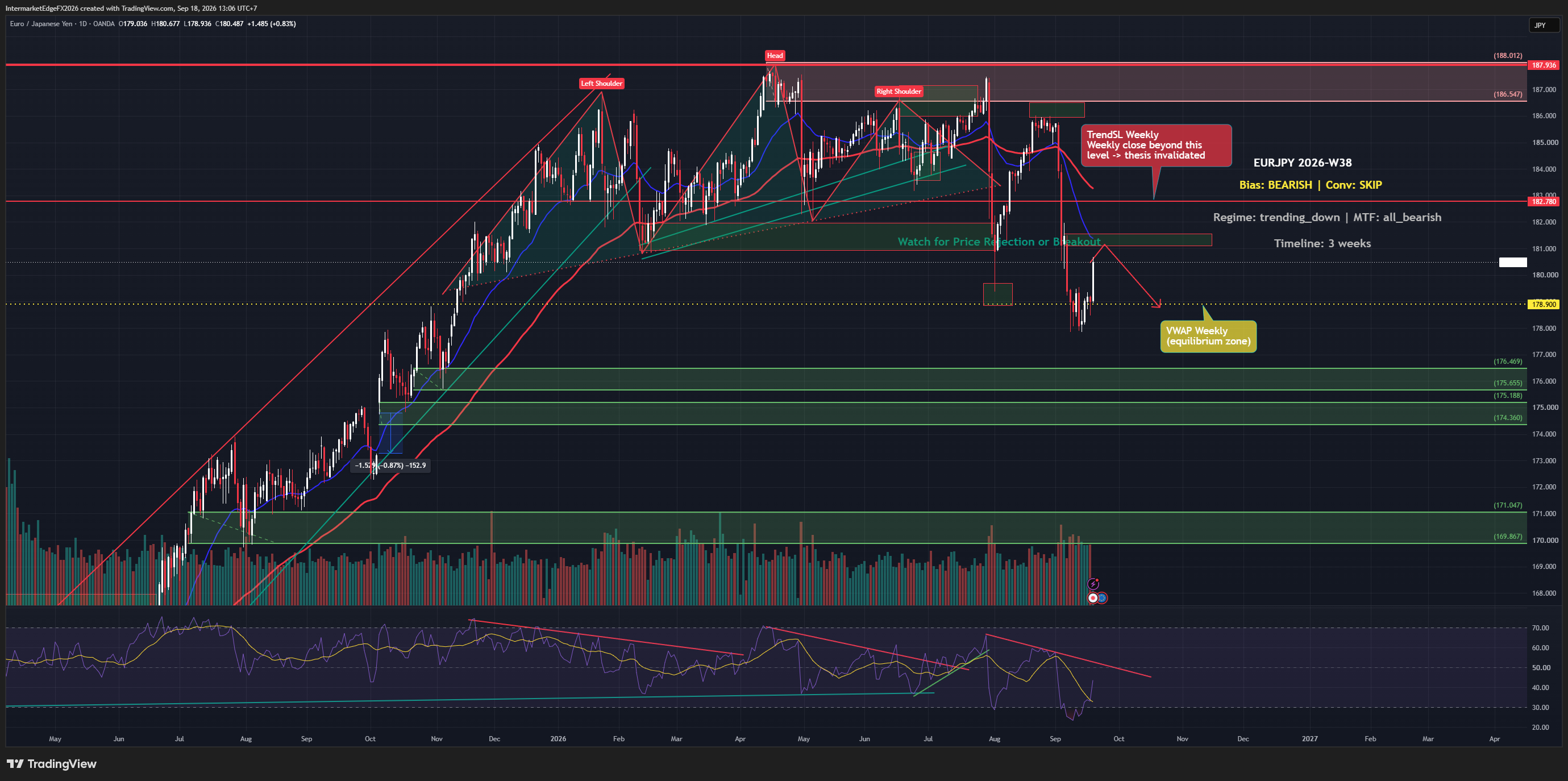
EURJPY W38: BOJ Hikes, but Yen Weakness Leaves Bears Without a Clear Entry

EURJPY W38: BOJ Hikes, but Yen Weakness Leaves Bears Without a Clear Entry

The Bank of Japan just delivered its highest policy rate in 31 years, lifting to 1.25% on September 18, and the yen weakened 0.8% in response. That gap between the headline and the market reaction is the most important signal EURJPY traders need to understand this week. When a hawkish catalyst fails to move the currency in the expected direction, the burden of proof for a carry unwind, where yen-funded positions get rapidly unwound, driving JPY sharply stronger, shifts materially higher. The directional lean on EURJPY is bearish, anchored by two structural arguments that point the same way without yet delivering the confirmation needed to size a position with confidence. The first is regime: the cross has been in a trending-down structure across multiple timeframes, with all timeframe signals aligned bearish. In a trending regime, the path of least resistance is continuation, the question is always whether the trend retains enough energy to keep pulling price lower, or whether it is exhausting itself before a meaningful catalyst arrives. The second argument is the carry unwind risk that the BOJ's rate path creates. A carry unwind happens when the cost of maintaining a short-yen, long-risk position rises fast enough, or when risk sentiment deteriorates sharply enough, that traders close those positions simultaneously, buying back yen and selling the funded assets. The BOJ's September 18 hike was a 7-2 vote with two board members explicitly opposing it on the grounds that growth was insufficient and inflation had not accelerated enough. The BOJ itself retained guidance for further increases, conditional on the inflation outlook being realized, but Japan's August core CPI came in at 1.7% year-over-year, below the 1.8% expected. That miss matters: it suggests the conditions the BOJ needs to justify the next hike are not yet in place, which reduces the urgency of carry unwind pressure in the near term. -- Intermarket Edge

EURJPY W37: ECB Hikes, but the Euro Sells the News

EURJPY W37: ECB Hikes, but the Euro Sells the News

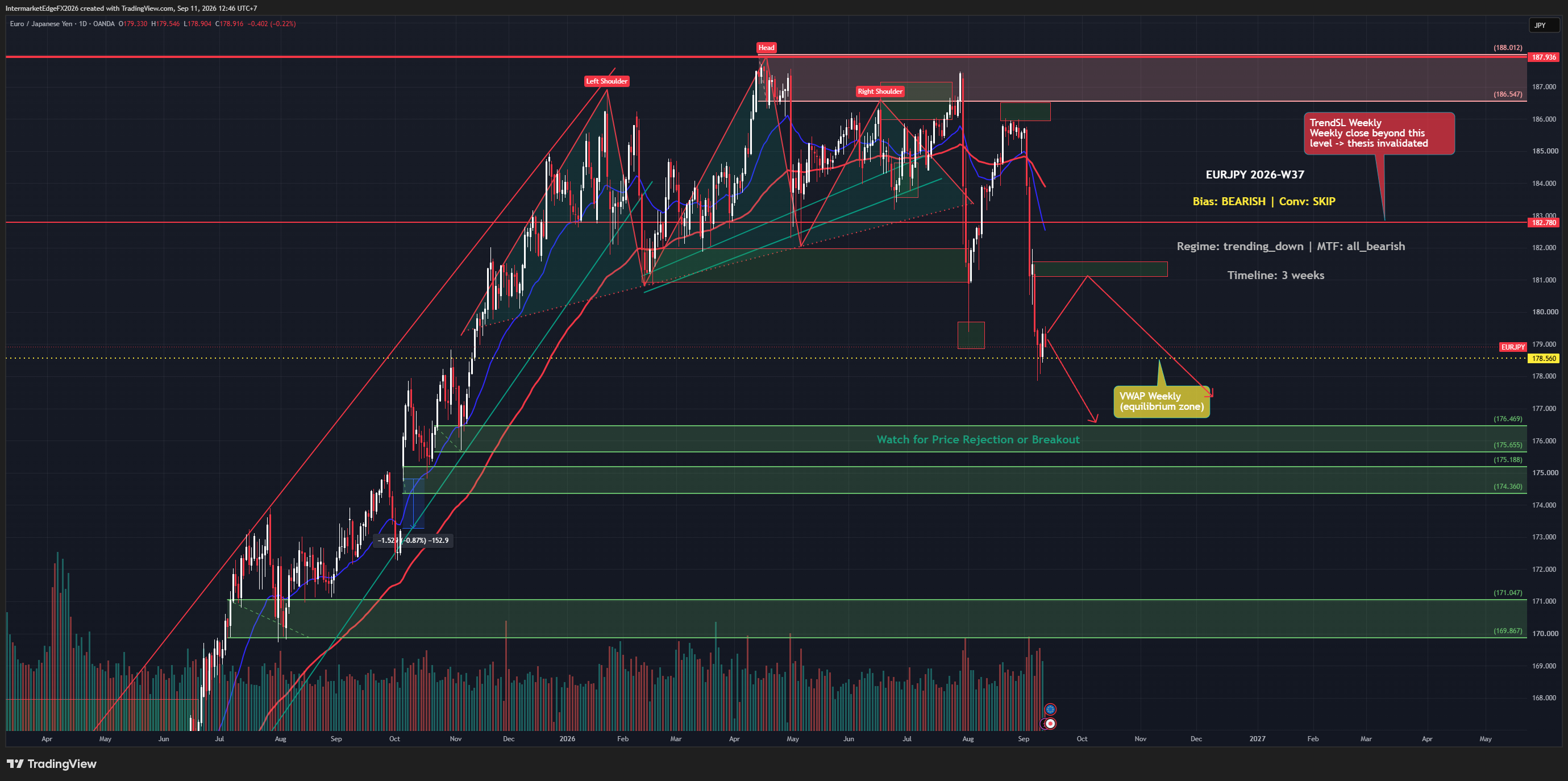
The ECB delivered its expected 25-basis-point rate hike on September 10, lifting the deposit facility to 2.50%, and the euro immediately weakened. That post-decision fade is a warning sign: when a currency falls after a rate hike, it suggests the market had already positioned for that outcome, not that bearish momentum has suddenly taken over. As of Friday, September 11 at 05:28 UTC, EURJPY is trading at 179.29, sitting above its weekly VWAP of 178.56, with the Bank of Japan's next policy meeting just days away. The structural bias on EURJPY this week is bearish, driven by the regime reading of a sustained downtrend across multiple timeframes, all of which are aligned to the downside. But here is where the analysis demands honesty: the evidence supporting that bearish thesis is not yet strong enough to act on with conviction. The framework flags this explicitly as a deliberate decision to stand aside rather than chase a setup that has not confirmed. The core bearish logic runs through the JPY leg. The active causal chain is straightforward: BOJ hawkishness tightens the rate differential, the gap between Japanese and European borrowing costs, and when that differential narrows, the carry trade that has historically supported EURJPY begins to unwind. A carry unwind means investors who borrowed cheap yen to hold higher-yielding euro assets start reversing those positions, selling EURJPY mechanically. Japan's CGPI data keeps that scenario alive: with producer inflation running 7.6% year-over-year, the BOJ has credible inflation data to support further normalization at or after the September 17-18 meeting. That meeting is the single largest near-term risk to any long exposure in this pair. -- Intermarket Edge

EURJPY Week W36-2026: Technicals Hold Above 185.37 as Japan's Retail Sales Surge Meets a Dollar Bidding for Rate Hikes

EURJPY Week W36-2026: Technicals Hold Above 185.37 as Japan's Retail Sales Surge Meets a Dollar Bidding for Rate Hikes

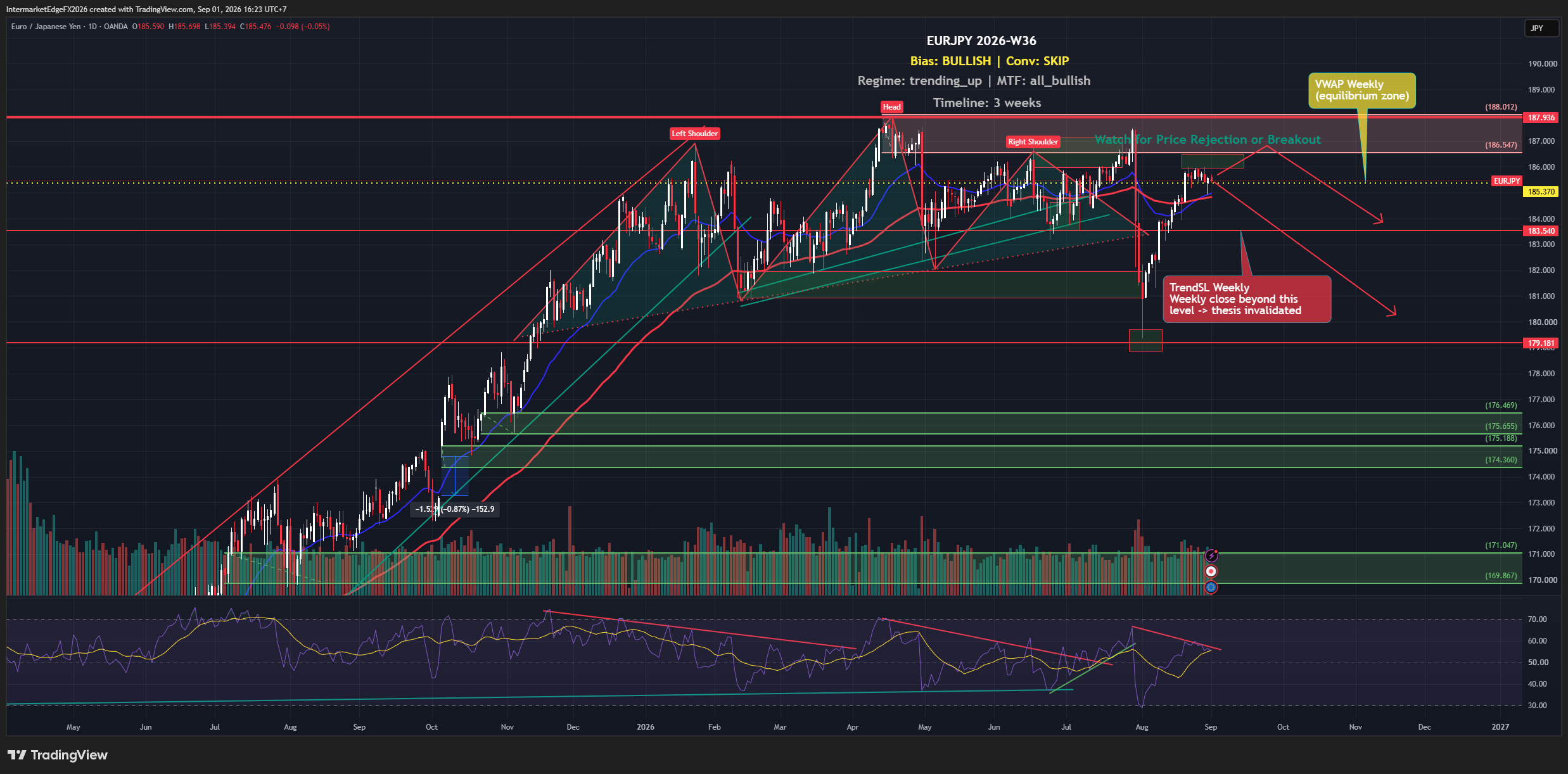
EURJPY is trading at 185.6 as of Tuesday, 01 September 2026, sitting just above its weekly VWAP at 185.37 with every timeframe technically aligned to the upside. Japan just delivered a retail sales print of 4.0% YoY, nearly double the forecast, and industrial output surprised to the upside as well. Yet the overall bullish conviction here is deliberately low, and that gap between clean technicals and absent macro support is exactly the tension worth understanding before sizing any exposure. The bullish bias on EURJPY for week W36-2026 rests on a single, structurally sound but narrowly sourced pillar: every technical timeframe, daily, weekly, and monthly, is aligned to the upside. That kind of multi-timeframe agreement is not common and is not trivial; it indicates the dominant trend is consistently reproduced at every analytical resolution, which reduces the probability that any one signal is noise. The practical effect is that the path of least resistance, absent a disrupting catalyst, points higher. What complicates this is that technical alignment is the only signal firing. COT positioning, which measures how leveraged and institutional accounts are positioned and would indicate whether professional capital is actually behind the move, has returned neutral with no directional read this week, so it is not possible to say the trend is being driven by the kind of committed positioning that sustains extended moves. Macro signals, sentiment gauges, and liquidity conditions have all returned similarly flat. This matters because a trend that rests solely on price-derived signals, without confirmation from who is positioned and why, carries crowding risk in a different form: the risk that the apparent trend is thin and vulnerable to a rapid unwind the moment a real macro trigger appears. The BOJ policy trajectory is the most direct potential disruptor on the JPY leg. -- Intermarket Edge (Note: COT (Commitment of Traders) data is released weekly by the CFTC with a report

EURJPY Week W34-2026: Trend Holds Above 184.86, But a BOJ Carry-Unwind Warning Keeps Buyers Cautious

EURJPY Week W34-2026: Trend Holds Above 184.86, But a BOJ Carry-Unwind Warning Keeps Buyers Cautious

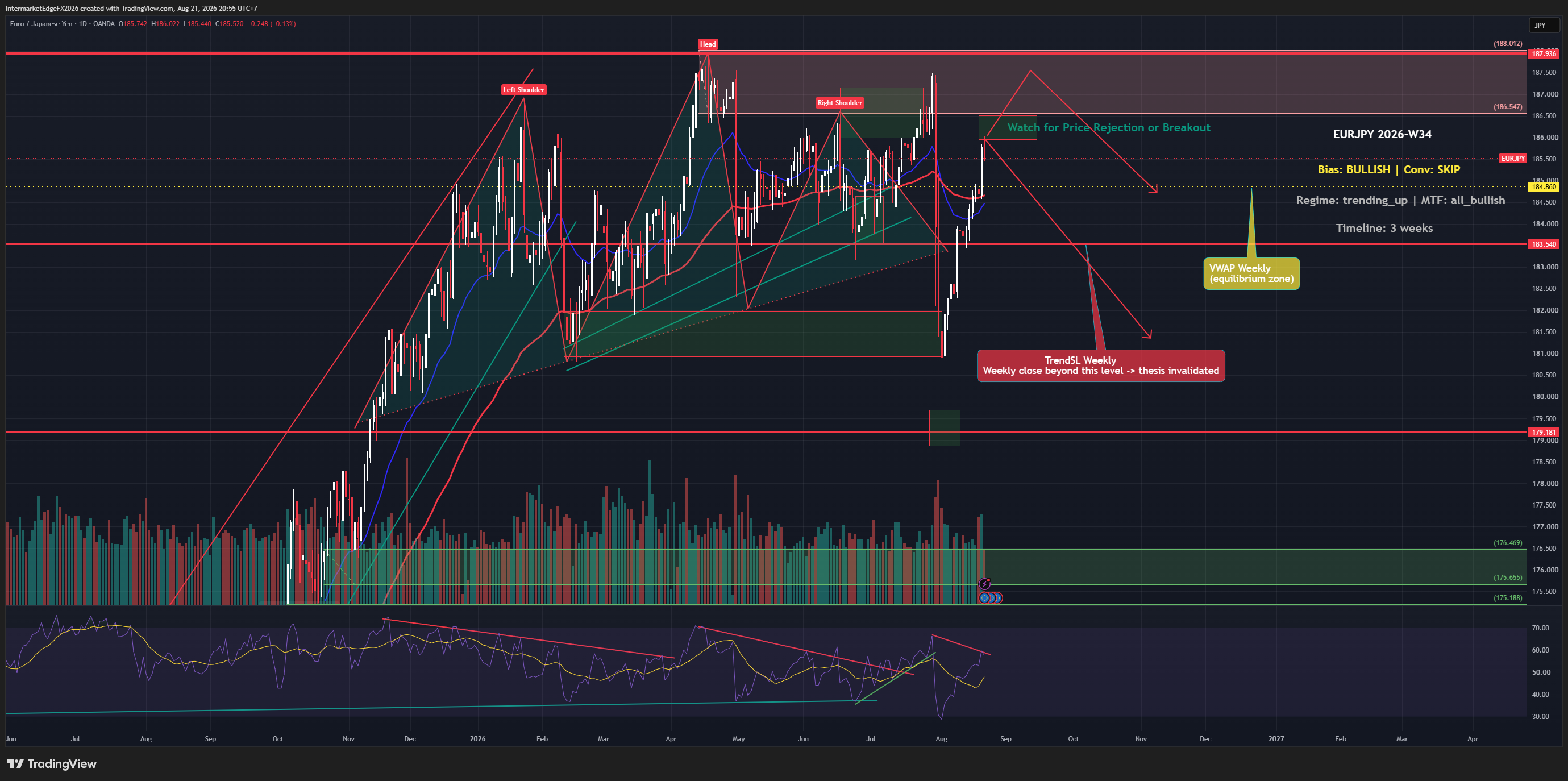
EURJPY is trading at 185.65 as of Friday, 21 August 2026, above its weekly VWAP at 184.86, with daily, weekly, and monthly trend all pointing the same direction. That alignment sounds clean, but Japan's 52nd consecutive Core-Core CPI increase is keeping BOJ rate-hike expectations alive, and a carry unwind triggered by BOJ policy tightening could erase a technically sound bullish setup faster than most traders anticipate. The structure is bullish. The macro is not cooperating. The structural bias for EURJPY through the next three weeks is bullish, and that verdict rests entirely on price action: daily, weekly, and monthly trend are all aligned upward simultaneously, which is the highest-conviction technical signal this framework can register. When all three timeframes agree, trend-following logic argues for giving the move room to continue rather than fighting it. The current market price of 185.65, recorded on Friday, 21 August 2026, sits above both the weekly VWAP of 184.86 and the weekly trend stop-loss at 183.54, meaning the price structure has not yet given a technical reason to abandon the bullish read. The honest complication is that price action is operating in isolation here. COT positioning, liquidity signals, and sentiment data are all neutral, no confirming flows are reinforcing what the charts suggest. That leaves the bull case technically sound but fundamentally thin. More significantly, macro signals are leaning bearish, driven by BOJ hawkishness carry-unwind risk carrying a meaningful weight in the overall picture. A carry unwind, where yen funding costs rise enough to force traders out of long EURJPY positions regardless of chart structure, does not care about multi-timeframe alignment; it can override technical setups quickly and with little warning. The result is a bullish directional bias that the framework cannot yet support with enough confirming evidence to justify sizing a position. -- Intermarket Edge (Note: COT (Commitment of Traders) data

EURJPY Week W32-2026: US Yen-Buying Intervention Drives Price Below 184.58 VWAP as BOJ Holds at 1% and Flags Further Hike

EURJPY Week W32-2026: US Yen-Buying Intervention Drives Price Below 184.58 VWAP as BOJ Holds at 1% and Flags Further Hike

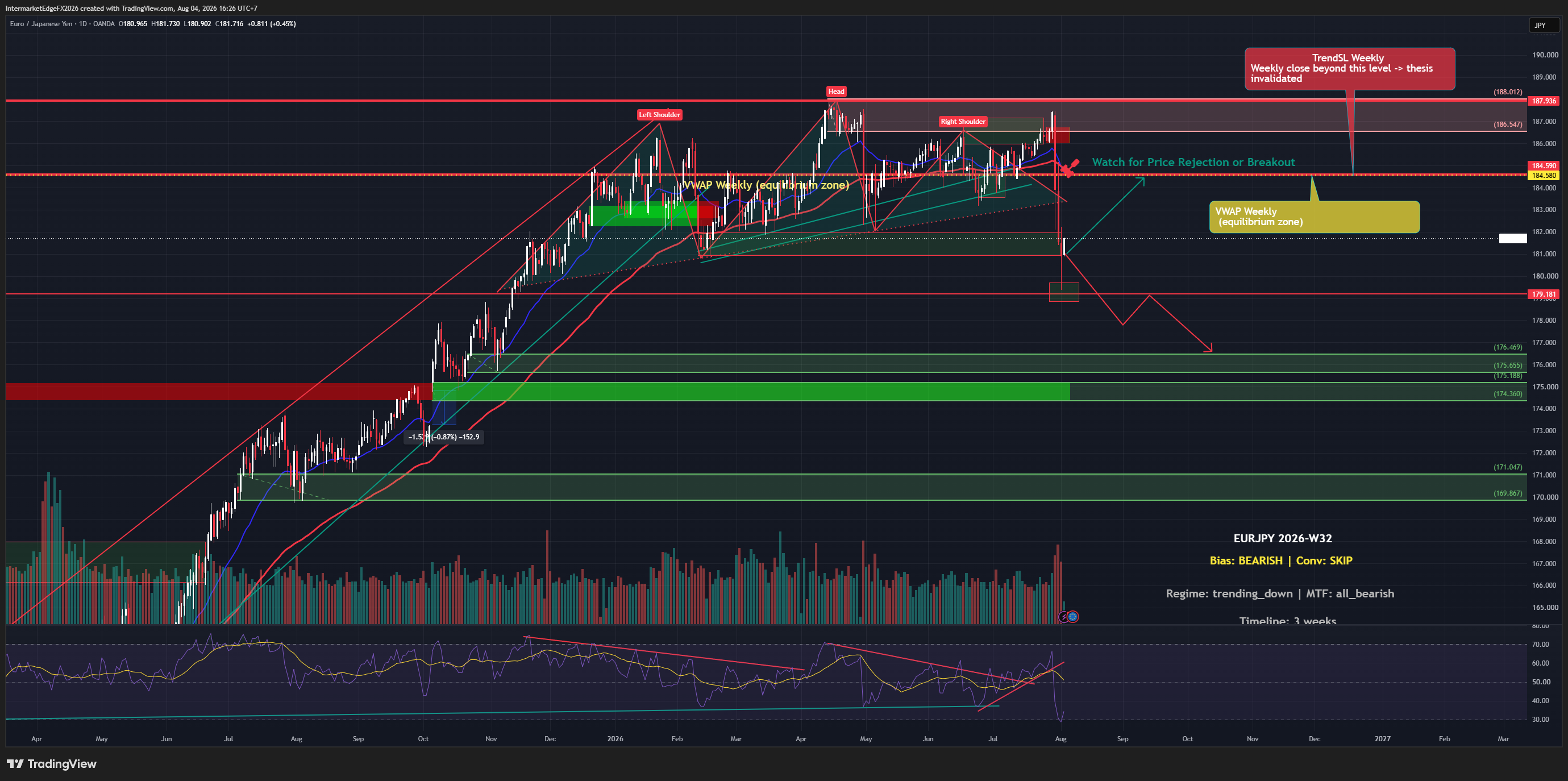
EURJPY is trading at 181.67 as of Tuesday, 04 August 2026, 09:09 UTC, nearly 3 full points below the weekly VWAP of 184.58, after the US shook currency markets by buying yen directly through euro sales. The BOJ held its overnight rate at 1% but reiterated its hiking path, keeping carry-unwind pressure alive. The multi-timeframe picture is all-bearish, yet conflicting signals between price action and macro mean conviction sits at skip level: the trend is real, but the evidence base is thin. The overall bias for EURJPY in Week W32-2026 is bearish, but the conviction level is explicitly rated skip, meaning the signal exists, but the evidence base is too thin and too conflicted to support a high-confidence directional trade. Let that framing govern everything that follows. The primary bearish driver is structural: BOJ hawkishness, reinforced by this week's hold-with-hike-guidance, pressures the rate differential that underpins euro-yen carry positioning. When the BOJ signals continued tightening while the ECB faces disinflationary data, the carry unwind dynamic, where traders exit long-EURJPY positions funded by cheap yen borrowing, becomes a credible medium-term force. The US intervention reported this week, specifically buying yen through euro sales rather than through the conventional dollar channel, is an unusually direct policy statement that adds event-driven downside pressure on top of the structural story. The regime is classified as trending down with moderate confidence, and the multi-timeframe alignment reads all-bearish, which in isolation would support a trend-follow posture. However, the thesis-level signal contains a direct conflict: price action scores bullish while the macro overlay scores bearish, producing a weak net bearish read with very low conviction overall. -- Intermarket Edge

EURJPY - US Strikes Iran, VIX Jumps 14%, Head and Shoulders Retests the Right Shoulder Right as Geopolitical Risk Escalates

EURJPY - US Strikes Iran, VIX Jumps 14%, Head and Shoulders Retests the Right Shoulder Right as Geopolitical Risk Escalates

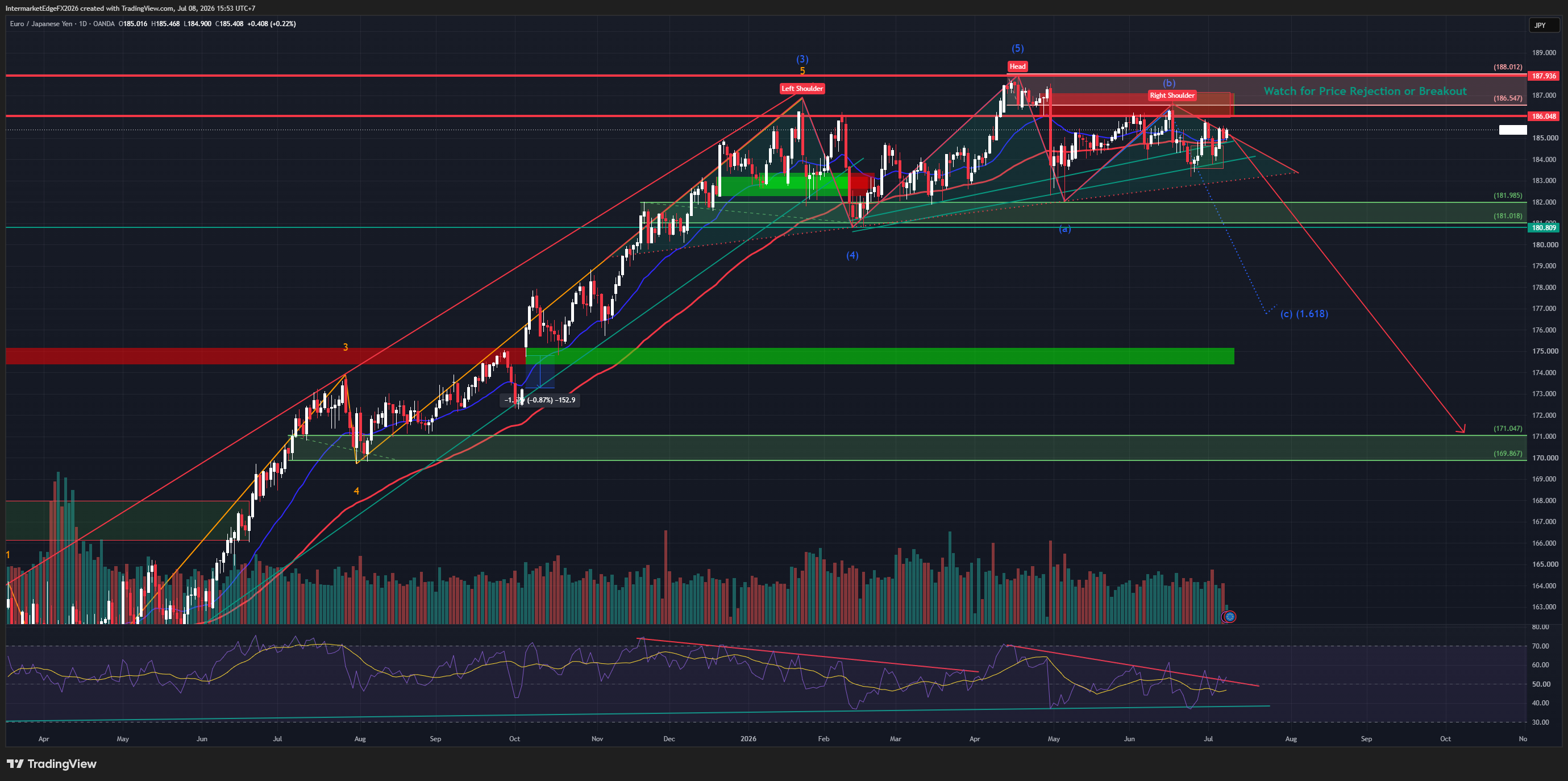
EURJPY - SUMMARY 08/07/2026 Regime: US struck 80+ targets in Iran, reimposed oil sanctions, Iran retaliated against Kuwait and Bahrain. VIX spiked 14.25%, oil rose over 3.7%. High Bear, unchanged from last week, potentially reinforced by risk-off. Bias: High Bear. New factors: recalculated DE-JP spread narrowed to just +0.18%, nearly collapsed. Escalating US-Iran geopolitical risk, ceasefire highly fragile. Data corrections: JP10Y 2.87% (not 1.47%); BoJ already hiked to 1.00% hawkish (not "gradual hike path"); ECB neutral hold 2.00% (not cutting cycle). D1 structure: confirmed head and shoulders, left shoulder 186.5-187, head 187.936-188.012, right shoulder 186.048-187.936, neckline 181.018-181.985. Price at 185.279 testing the right shoulder. Target: 177 then 171.047. Invalidation above 186.547. Scenarios: neckline break toward 177-171 if escalation continues (45%); range 181-186.5 pending developments (35%); bounce, break above 186.547 invalidating the pattern (20%). Close monitoring needed over the next 24-48 hours to confirm price reaction to geopolitical developments. For informational purposes only, not investment advice.

USDJPY - Resistance at 161.94 Still Unbroken After Repeated Tests, MoF Intervention Risk Rising, Wave (a) Correction Targets 155.2

USDJPY - Resistance at 161.94 Still Unbroken After Repeated Tests, MoF Intervention Risk Rising, Wave (a) Correction Targets 155.2

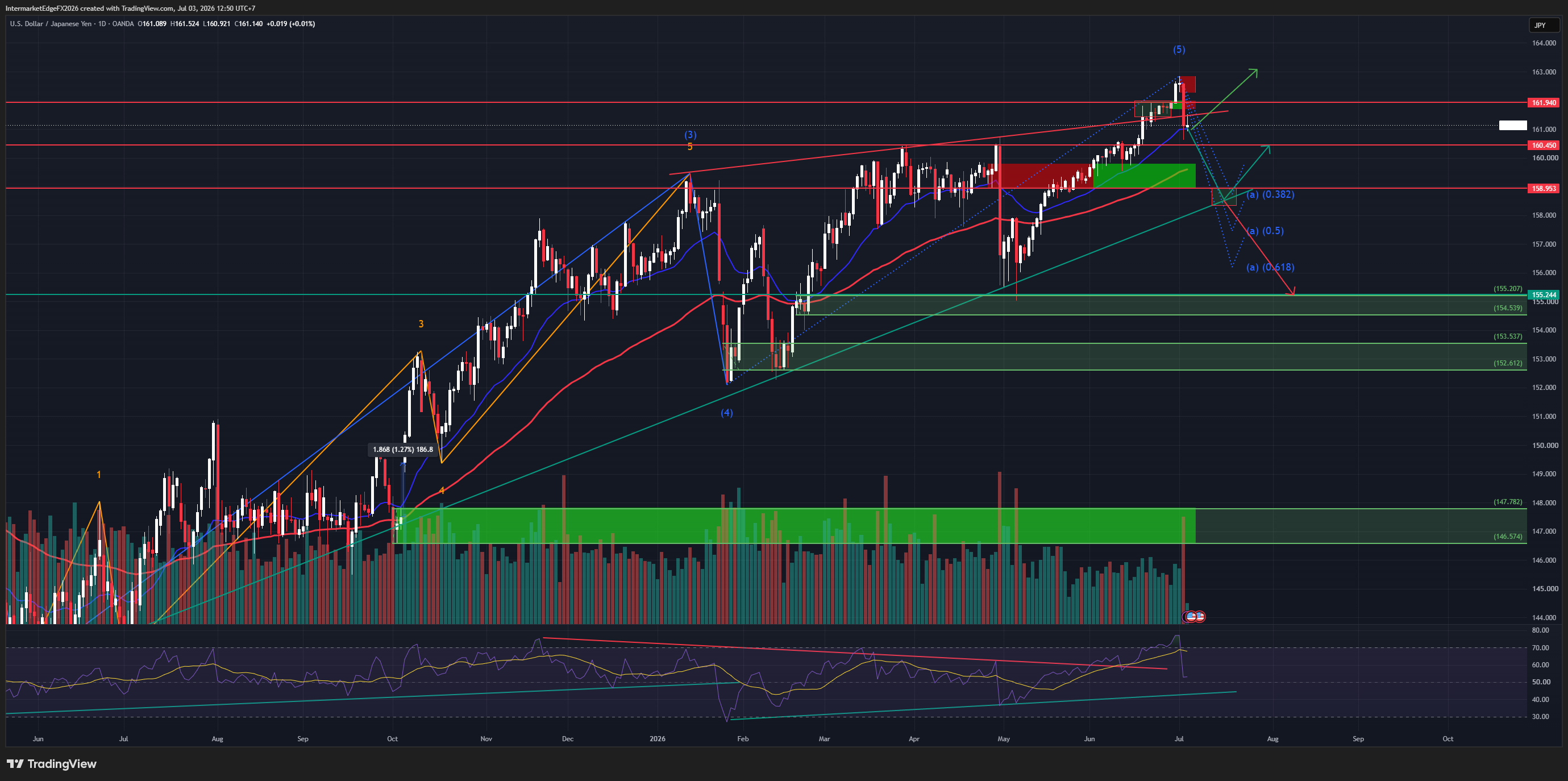
USDJPY - SUMMARY 03/07/2026 Regime: Wave (5) Exhaustion Confirmed, Medium Bear Near-Term. USDJPY 161.11 (0.00%), the 161.940 resistance has been tested repeatedly for over a week without breaking. Bias: Medium Bear near-term (not High given the wildcards). Three high-conviction bearish forces: (1) classic 161.940 resistance exhaustion, (2) actual US-JP carry spread only 1.71% (pipeline wrongly reports 3.015% using stale JP10Y 1.47%), (3) rising MoF intervention risk (Katayama remarks, confirmed "ambush tactics" per news). Additionally: NFP preview shows June expected to slow to 110K -- dovish risk if accurate. Further confirmation: VIX -2.65% risk-on today yet resistance still unbroken -- 161.940 is a genuine technical chokepoint. Data corrections: JP10Y 2.77% (not 1.47%); US-JP spread 1.71% (not 3.015%); US CPI 4.2% (not 2.4%); real yield +0.28% (not 2.085%); BoJ already hiked to 1.00% (not Hold). D1 structure: wave (a) correction expected along Fib 158.953 (0.382) → ~157 (0.5) → 155.207-154.539 (0.618, primary target). Scenarios: wave (a) confirmed toward 155.2 (45%); sideways awaiting NFP (25%); NFP strong, final breakout before correcting (15%); actual MoF intervention, sharp decline (15%). Do not chase long at resistance without confirmed breakout. Invalidation: daily close above 161.940. For informational purposes only. Not financial advice.

Stay in the loop

Get notified about new research, macro insights, and market analysis.

InterMarketEdge

© 2026 InterMarketEdge. Financial intelligence for inter-market traders.