Tag: ECB — InterMarketEdge

Tag: ECB

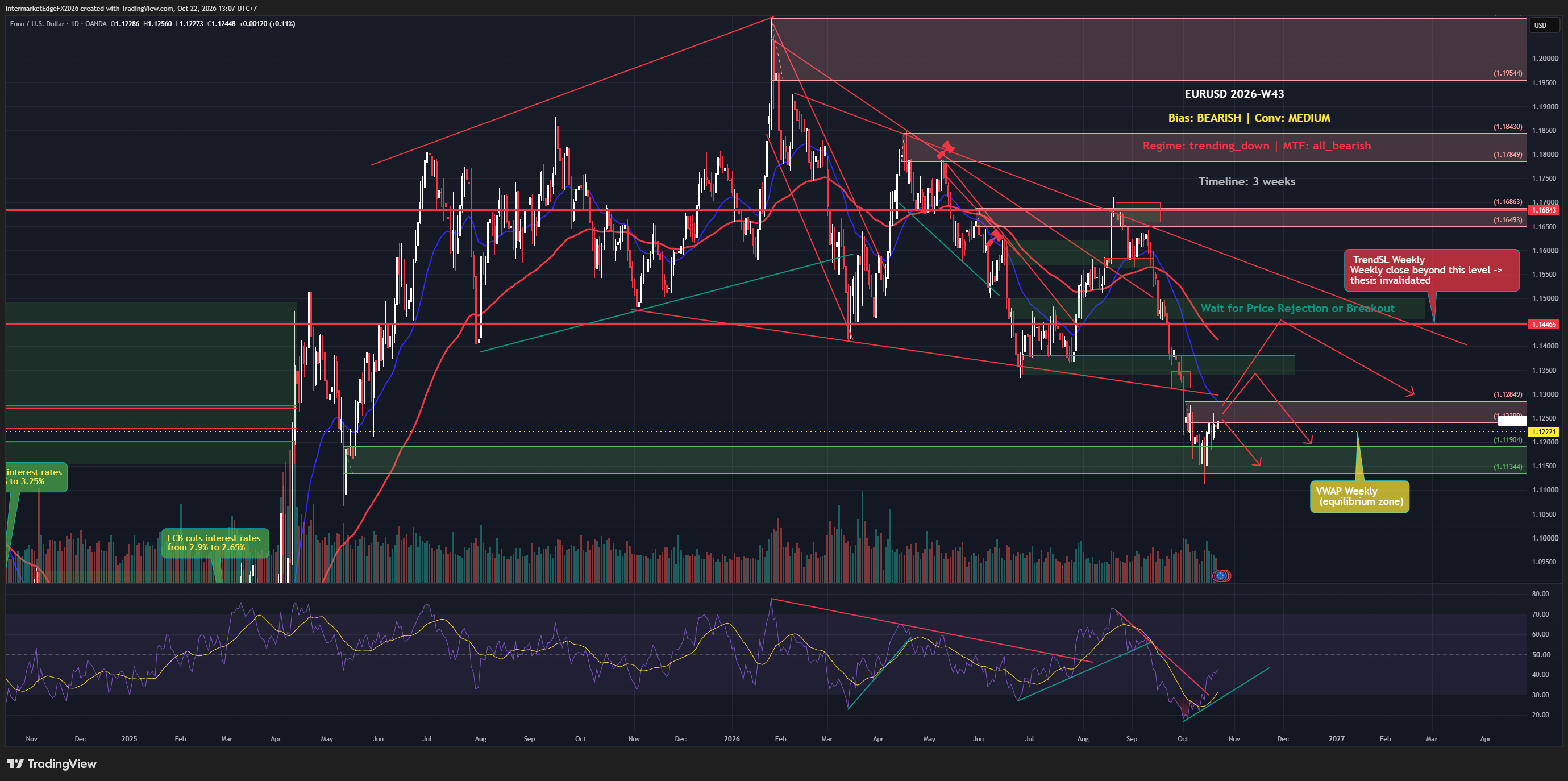
EURUSD W43: A Bearish Structure With an Active Momentum Warning

EURUSD W43: A Bearish Structure With an Active Momentum Warning

EURUSD W43: bearish three-week view, medium confidence. Downward trends conflict with bullish price action and a contrarian COT counterweight. At 05:51 UTC on Thursday, 22 October 2026, EURUSD was 1.12381, above weekly VWAP 1.12221 and below weekly TrendSL 1.14465. Source: mt5:EURUSD.sml:1m. This is a timestamped observation, not a live quote. The momentum warning is already active: existing short exposure warrants reduced size now. Structural invalidation remains pending: a weekly close above TrendSL 1.14465 would invalidate the bearish structure; exit shorts and reassess if that occurs. The weekly closing requirement belongs to structural invalidation, not to the momentum warning. COT CFTC 099741, Leveraged Funds, futures only, report date 2026-10-13: net short 68,001 contracts; net change -23,740 versus 6 October. Percentile 1.92 within 52 weeks indicates low historical net positioning, not a trader percentage. Release date unverified; lagged positions are not current flows. FXSSI: 66% long / 34% short, collected 22 October at 05:50:54 UTC. Broker sample; provider observation time unverified. Contrarian context, no independent sell signal. French risk pressures EUR, while the pause in USD declines needs confirmation from broader currency and relative-rate evidence. New exposure can wait for better agreement; a structural view is not an immediate entry trigger. Intermarket Edge | Institutional Macro & Intermarket Analysis For informational and educational purposes only. Not financial advice.
EURGBP W43: Sterling Support Meets an Unresolved Price Conflict

EURGBP W43: Sterling Support Meets an Unresolved Price Conflict

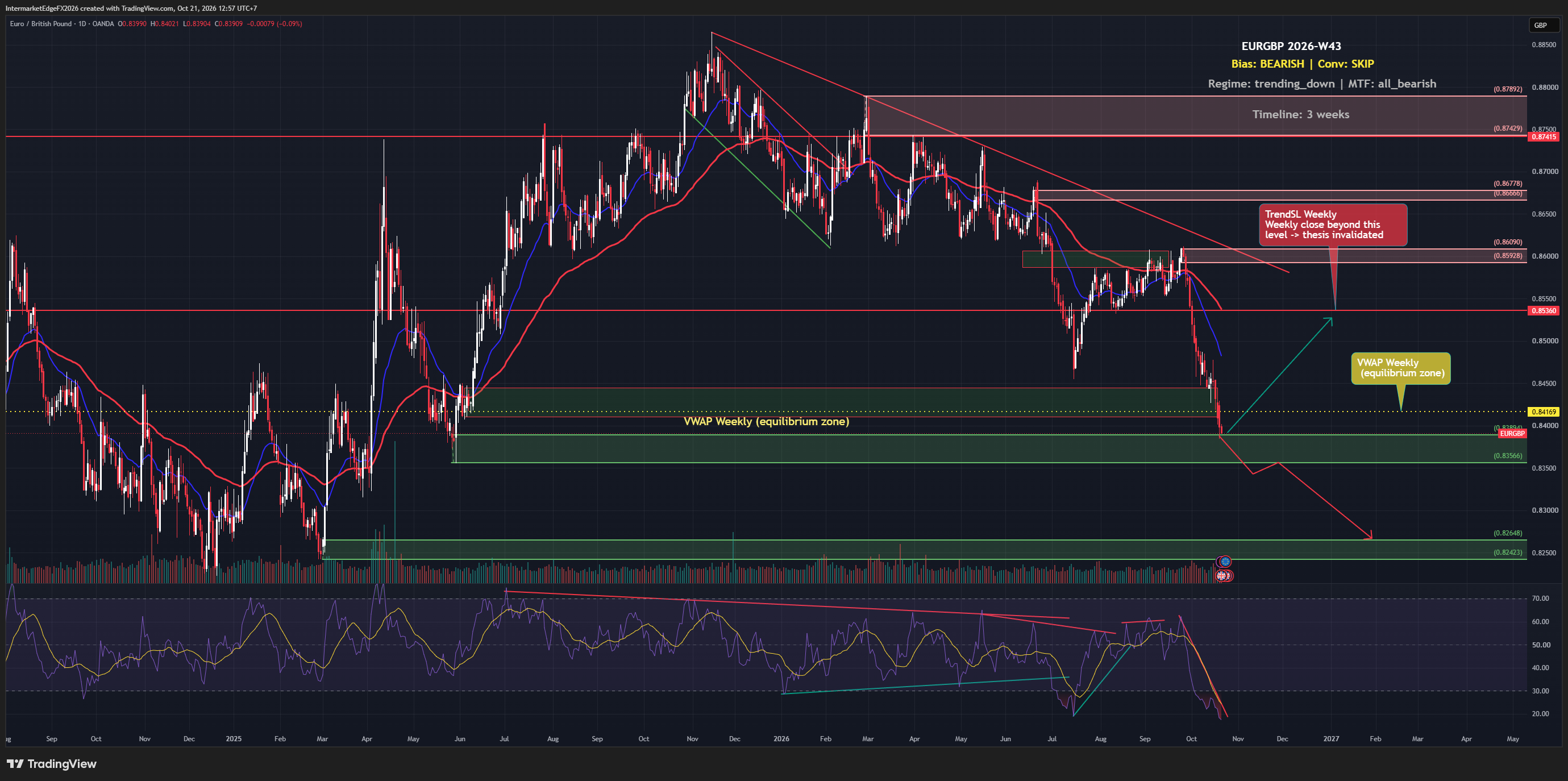
EURGBP W43: bearish three-week view; stand aside. Downward trends coexist with bullish price action. At 05:38 UTC on Wednesday, 21 October 2026, EURGBP was 0.83944, below weekly VWAP 0.84169 and below weekly TrendSL 0.85360. Source: mt5:EURGBP.sml:1m. This is a dated observation, not a live quote. Both risk conditions remain pending in this observation. If price sustains above weekly VWAP 0.84169, momentum would run against the bearish view and short exposure would warrant reduced size. A weekly close above TrendSL 0.85360 would invalidate the bearish structure: exit shorts and reassess. The momentum watch has no added daily or weekly closing requirement. FXSSI: 72% long / 28% short, collected 21 October at 05:38:28 UTC. Broker sample, provider observation time unverified; contrarian context, not an independent sell signal. COT CFTC TFF, Leveraged Funds, report date 2026-10-13: EUR 099741 net short 68,001, net change -23,740; GBP 096742 net long 10,313, change -2,119 contracts versus 6 October. Separate futures components, not direct EURGBP positions; release dates unverified. This is a pre-CPI assessment. ONS scheduled UK September CPI for 21 October at 06:00 UTC. No actual outcome is included. Hotter UK inflation could support GBP if relative rate expectations rise; softer inflation could support a recovery in EURGBP. Check price and relative yields after the release. Intermarket Edge | Institutional Macro & Intermarket Analysis For informational and educational purposes only. Not financial advice.
EURJPY W42: A Bearish View Without a Clear Entry

EURJPY W42: A Bearish View Without a Clear Entry

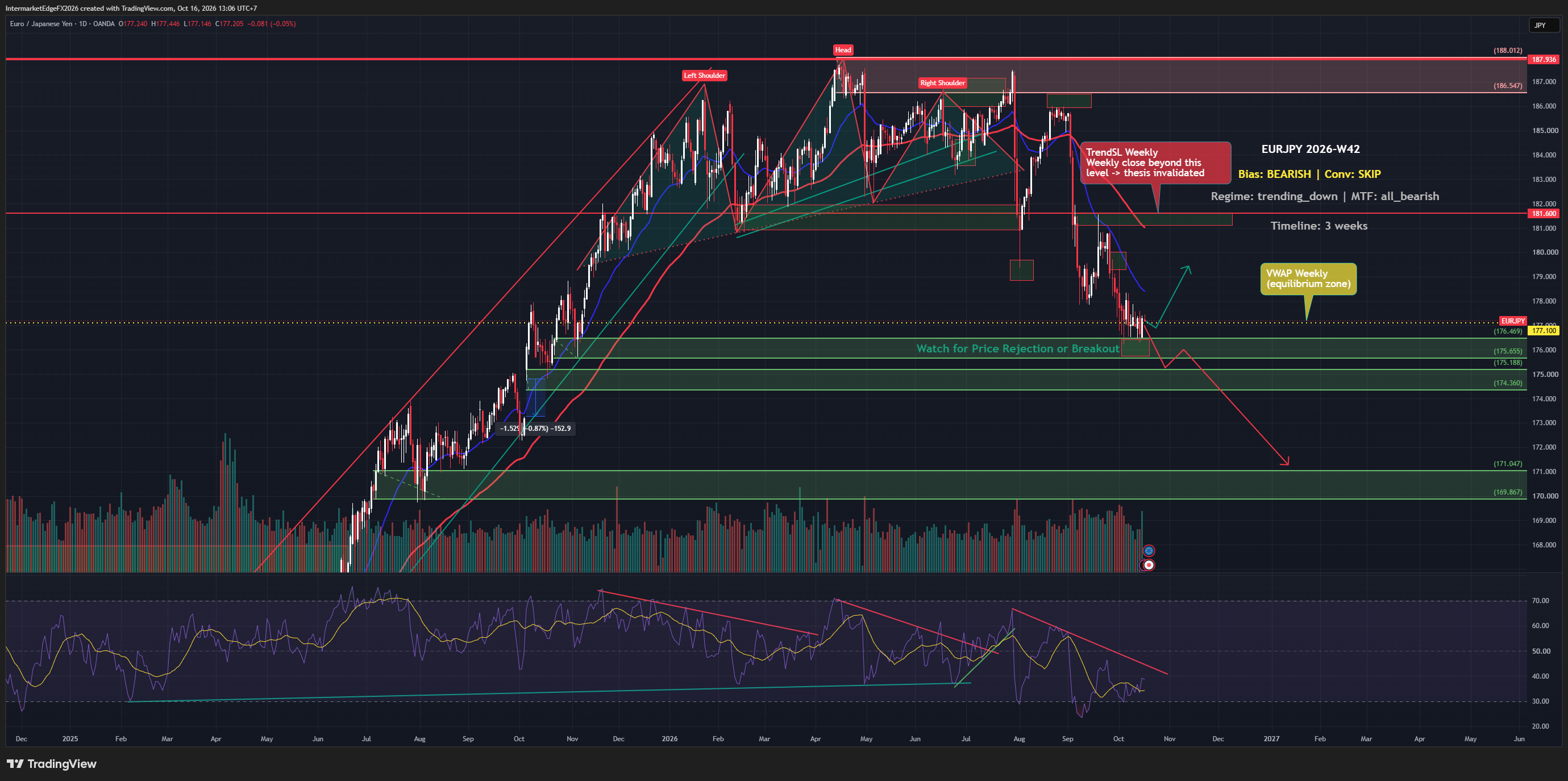
EURJPY W42: bearish three-week view; stand aside for new exposure. At 16/10/2026 06:03 UTC, EURJPY was 177.186, above weekly VWAP 177.102 and below weekly TrendSL 181.597. Source: mt5:EURJPY:1m, a timestamped broker quote. The momentum warning is already active: price is above the weekly average, running against the bearish thesis. For existing shorts, reduce position size now. This condition requires no daily or weekly close. A completed weekly close above 181.597 would invalidate the bearish structure, requiring an exit from shorts and reassessment. This structural invalidation condition remains pending. Compare EURUSD, USDJPY and matching German-Japanese yields. A euro recovery against USD does not establish this cross's direction. The opposing bullish assessment remains a reason to wait for stronger evidence. --- Intermarket Edge | Institutional Macro & Intermarket Analysis For information and education only. Not financial advice.

EURUSD Before CPI: Price Challenges the Bearish View

EURUSD Before CPI: Price Challenges the Bearish View

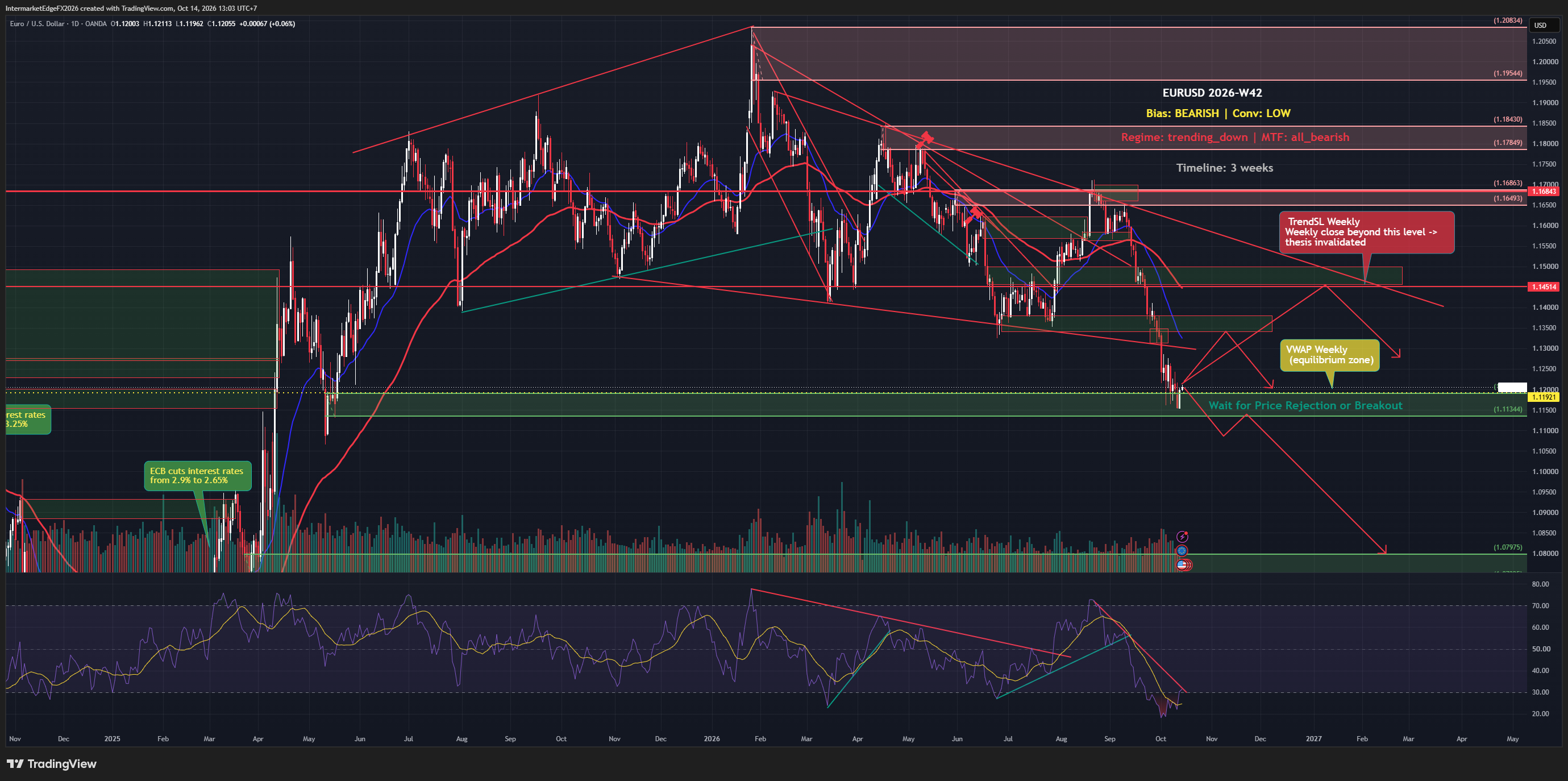
EURUSD W42: bearish three-week view, low confidence. At 14/10/2026 05:57 UTC, EURUSD was 1.12099, above weekly VWAP 1.11921. Price remains below weekly TrendSL 1.14514. Source: mt5:EURUSD.sml:1m, a timestamped broker quote. The short-term momentum warning against the bearish thesis is already active. Existing short exposure calls for reviewing and reducing risk under the trader's plan now; this warning does not require a weekly or session close. A completed weekly close above 1.14514 would invalidate the bearish structure, requiring an exit from the bearish thesis and reassessment. This condition remains pending; an intraday move is not a completed weekly close. Pre-release analysis: September US CPI is scheduled for 14 October at 12:30 UTC / 19:30 GMT+7. No actual release outcome or post-release reaction is assumed. Update this analysis after publication of the data. Watch DXY and comparable US-German yields. Fed remarks are conditional; Lane has not made an ECB rate commitment. Wait for the data response before assessing new entries. --- Intermarket Edge | Institutional Macro & Intermarket Analysis For informational and educational purposes only. Not financial advice.
EURUSD W41: Fiscal Stress Weighs, but the Entry Case Remains Unclear

EURUSD W41: Fiscal Stress Weighs, but the Entry Case Remains Unclear

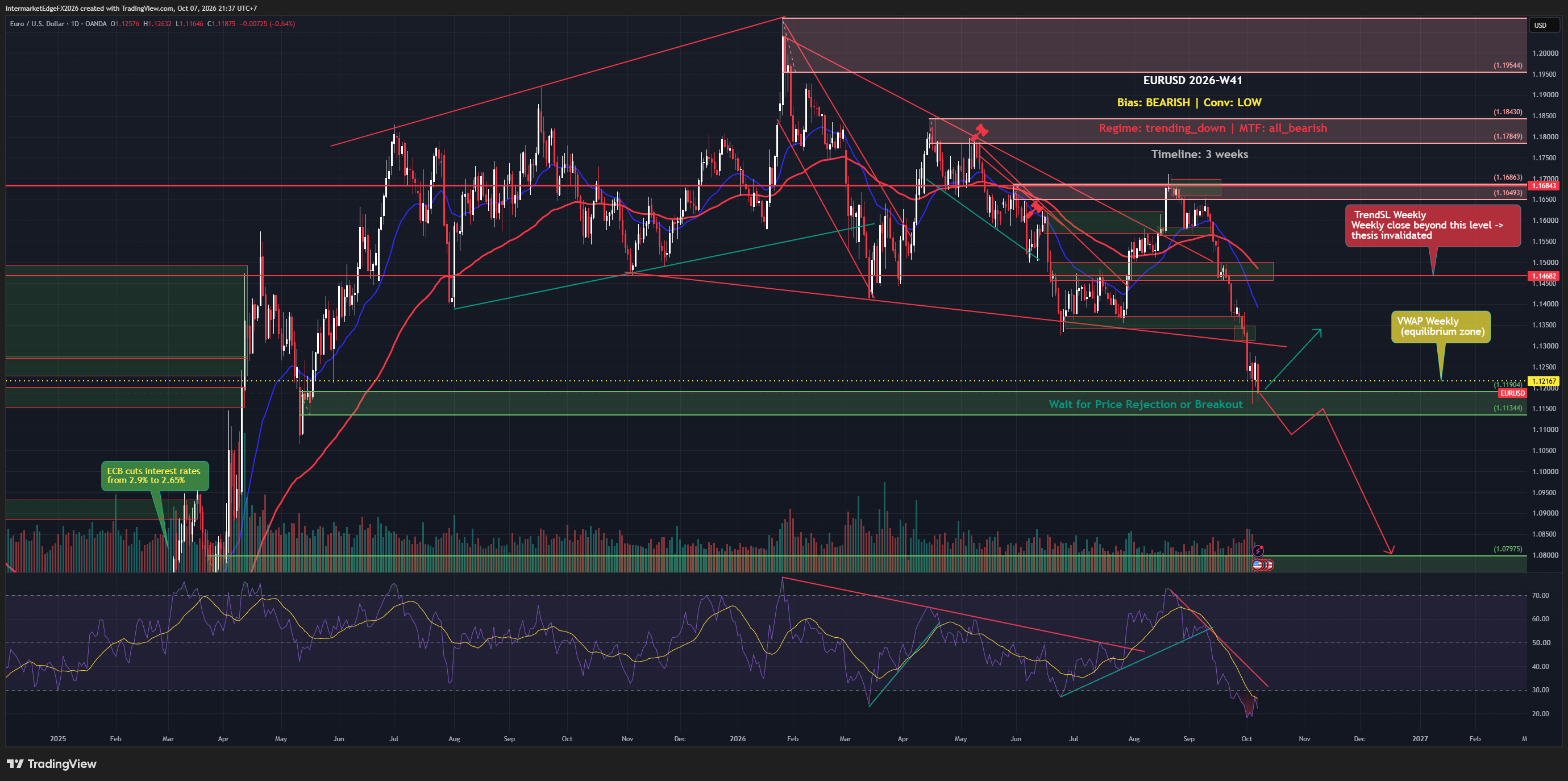
EURUSD W41 | Fiscal pressure, uncertain entry timing At 14:24 UTC on October 7, 2026, EURUSD was 1.11881 (MT5 EURUSD.sml:1m), below weekly VWAP 1.12167 and weekly TrendSL 1.14682. The broader trend points downward, but positive short-term signals reduce agreement. The bearish view has low conviction; standing aside avoids forcing a fresh entry. If price sustains above 1.12167, momentum would work against the bearish view and call for a short-side risk review. Only a completed weekly close above 1.14682 would invalidate the bearish structure. Both conditions remain pending at the quoted observation. FXSSI collected at 14:24:09 UTC on October 7: 77% Buy / 23% Sell. This is collection time. The broker retail sample does not represent the entire FX market or provide a standalone entry signal. Watch the dollar, comparable US-euro-area yields and French-German sovereign spreads. Related French fiscal headlines are not independent bearish confirmations. ForexFactory lists Fed minutes at 18:00 UTC on October 7 (01:00 GMT+7, October 8), after this snapshot. This secondary calendar is not officially verified. The minutes describe an earlier meeting, not its response to later data. Three weeks is a review horizon, not a target deadline. Prices are dated references, not live quotes. Intermarket Edge | Institutional Macro & Intermarket Analysis For informational purposes only. Not financial advice.
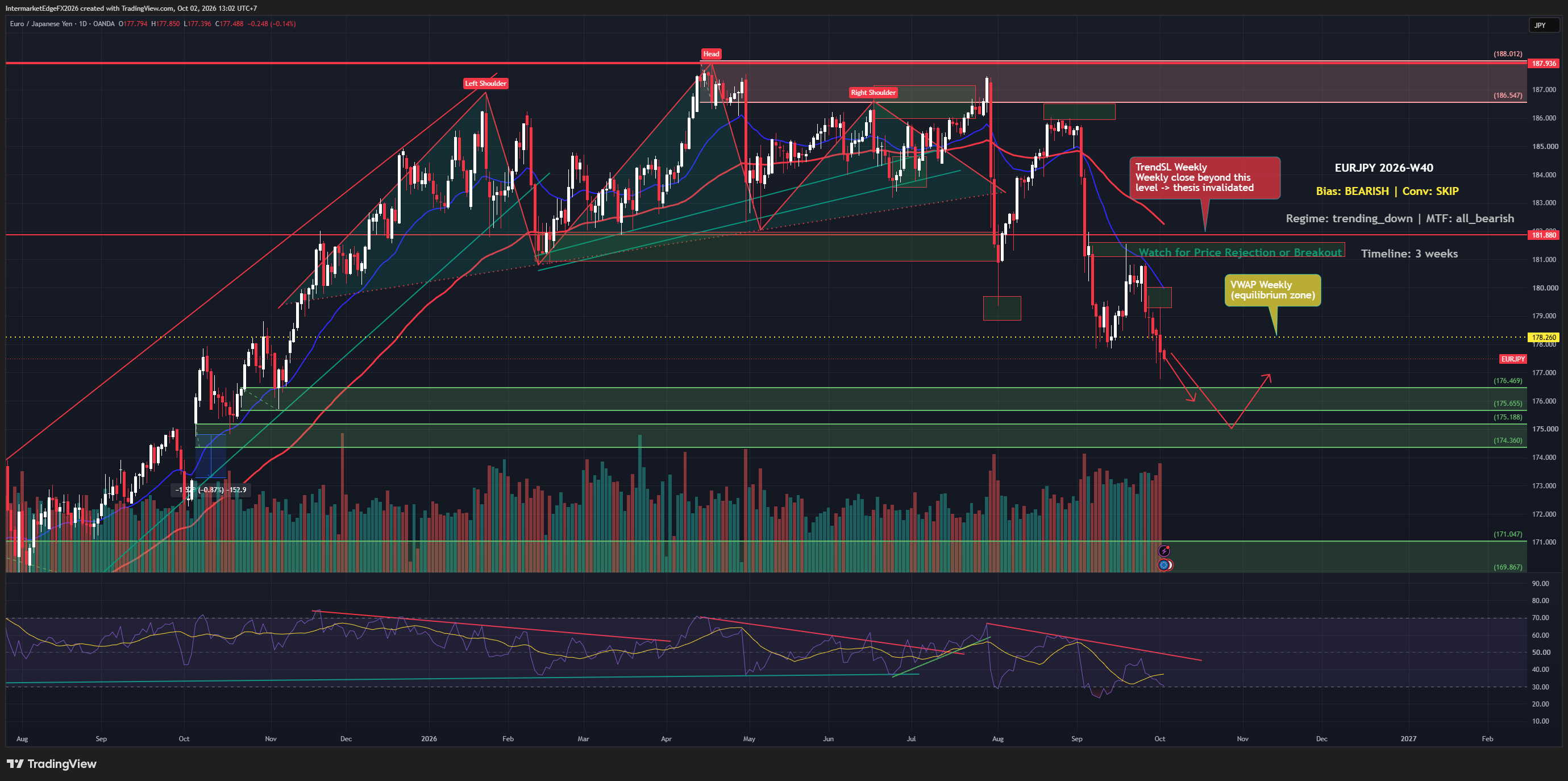
EURJPY W40: Hotter Tokyo Inflation Supports Yen, but Bears Still Lack Confirmation

EURJPY W40: Hotter Tokyo Inflation Supports Yen, but Bears Still Lack Confirmation

Japan's September Tokyo core-core CPI just printed 3.0% year-on-year against a 2.4% forecast, a significant beat that strengthens the case for BOJ policy tightening and yen appreciation. EURJPY is sitting at 177.59 early Friday, below the weekly VWAP at 178.26, with all timeframes aligned bearishly. The directional case looks clean. The conviction, however, does not, and that gap between direction and certainty is exactly where traders get hurt. The directional lean for EURJPY over the next three weeks is bearish, driven by two converging forces: a BOJ that is being pushed toward further tightening by inflation data that keeps exceeding expectations, and a euro that Reuters described as lagging the dollar during September. When the yen strengthens and the euro weakens simultaneously, EURJPY gets hit from both sides, the numerator falls and the denominator rises. That is the structural setup here. However, the analytical framework is deliberately standing aside rather than treating this as an actionable bearish entry. The reason is a direct conflict between the macro and technical signals: while the regime reads trending-down and all timeframes align bearishly, raw price action is generating a bullish technical signal that cannot be dismissed. This is not a minor discrepancy, it is an explicit disagreement between two evidence streams that normally need to be in agreement before sizing a position. Layered on top of this, the structural longer-term bias for EURJPY remains bullish, meaning that any short positioning is trading against the underlying trend. The retail crowd is 60% net long the pair as of October 2, which provides a contrarian lean toward the bear case, when the crowd is wrong, it tends to be wrong in the direction they are positioned, but this reading alone is not enough to override the technical conflict. -- Intermarket Edge

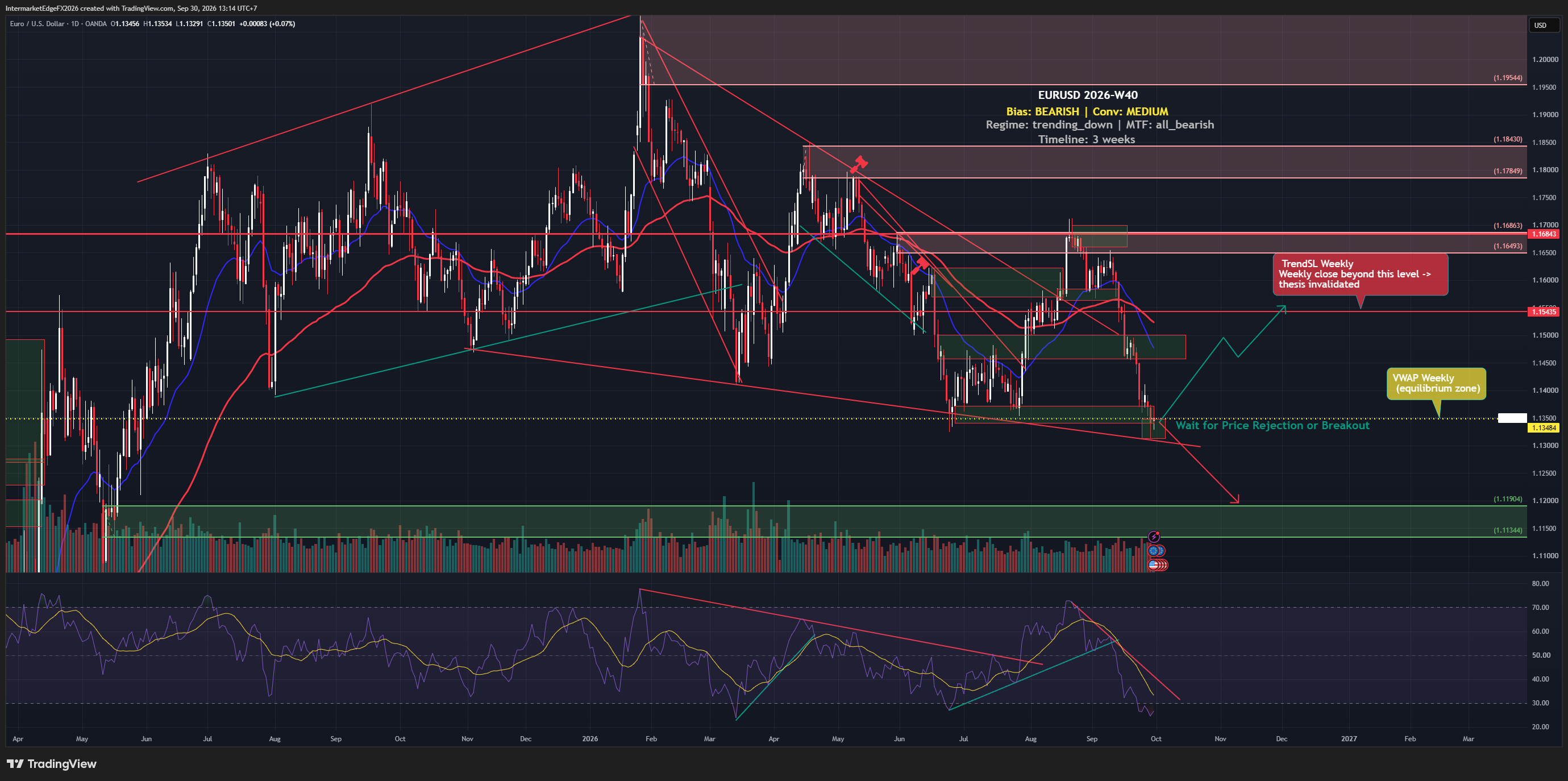
EURUSD Week W40-2026: Dollar Posts Its Largest September Gain at the Euro's Expense, But the Real Trap Is What Comes Next

EURUSD Week W40-2026: Dollar Posts Its Largest September Gain at the Euro's Expense, But the Real Trap Is What Comes Next

EURUSD is trading at 1.134 as of Wednesday, 30 September 2026, capping a month that Reuters confirms was the dollar's largest September gain, predominantly at the euro's expense. New York Fed President Williams has left the door open for one more rate hike this year, and with US 10-year real yields at 2.9%, the interest-rate math continues to favor the dollar structurally. The trend is down across every timeframe, but signal conflicts mean the path isn't as clean as the headline suggests. The bearish case on EURUSD rests primarily on the rate differential and the Fed's demonstrated willingness to keep it wide. When one central bank is signaling additional tightening while the other faces structurally slower growth and a different inflation profile, the currency on the higher-yield side tends to attract demand, and that demand compounds over weeks, not sessions. Reuters confirming the dollar's outsized September gain at the euro's expense is not just a data point; it's confirmation that the macro argument has already been expressing itself in price. That said, this is a medium-conviction view, not a high-conviction one, and traders should weigh that carefully. The conflict worth naming directly: price action signals and COT positioning, which reflects the aggregate stance of large futures traders, though the specific report week and net-position figures are not available here, so treat it as directional context rather than a precise citable stat, are both leaning bullish. When the macro framework points one direction and the market's actual positioning leans the other, the overall call carries more uncertainty than a clean trend setup would. The retail picture adds a contrarian lean: 72% of retail EURUSD accounts tracked by FXSSI as of 30 September are net long, and historically, when retail crowds are this lopsided on a major pair, it tends to lean against their position. -- Intermarket Edge

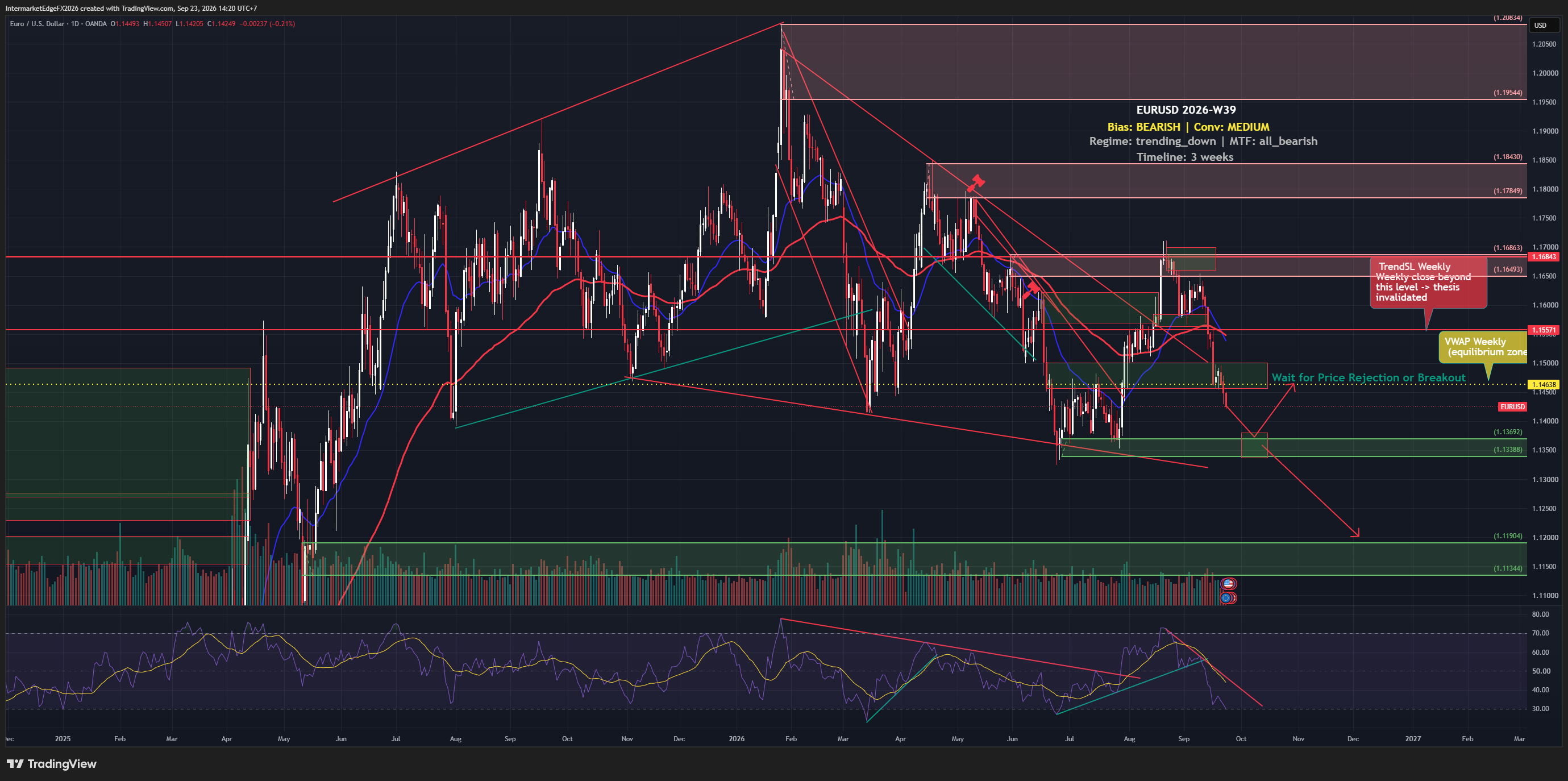
EURUSD Week W39-2026: Dollar Firms Toward a Ten-Week Low as the Fed-ECB Rate Gap Widens

EURUSD Week W39-2026: Dollar Firms Toward a Ten-Week Low as the Fed-ECB Rate Gap Widens

EURUSD is trading near a ten-week low, but the case is more specific than a simple strong-dollar story. At the Wednesday, 23 September 2026 observation, price was 1.14263, below weekly VWAP at 1.14638 and weekly TrendSL at 1.15571. The Fed's hawkish optionality and a US 10-year real yield of 2.62% leave the relative rate backdrop more supportive of the dollar, even after the ECB's September rate increase. Oil weakness could reduce part of the energy-inflation pressure behind the ECB's move, although that effect remains a scenario rather than a known policy outcome. DXY and short-term technical signals do not offer perfect confirmation, so conviction remains medium. FXSSI reports 66% of its broker-level sample net long EURUSD; that is contrarian context only. A sustained move above 1.14638 would warn that short-term momentum is turning against the thesis. A weekly close above 1.15571 would invalidate the bearish structure. The decision framework favors patience rather than chasing weakness near the recent low.

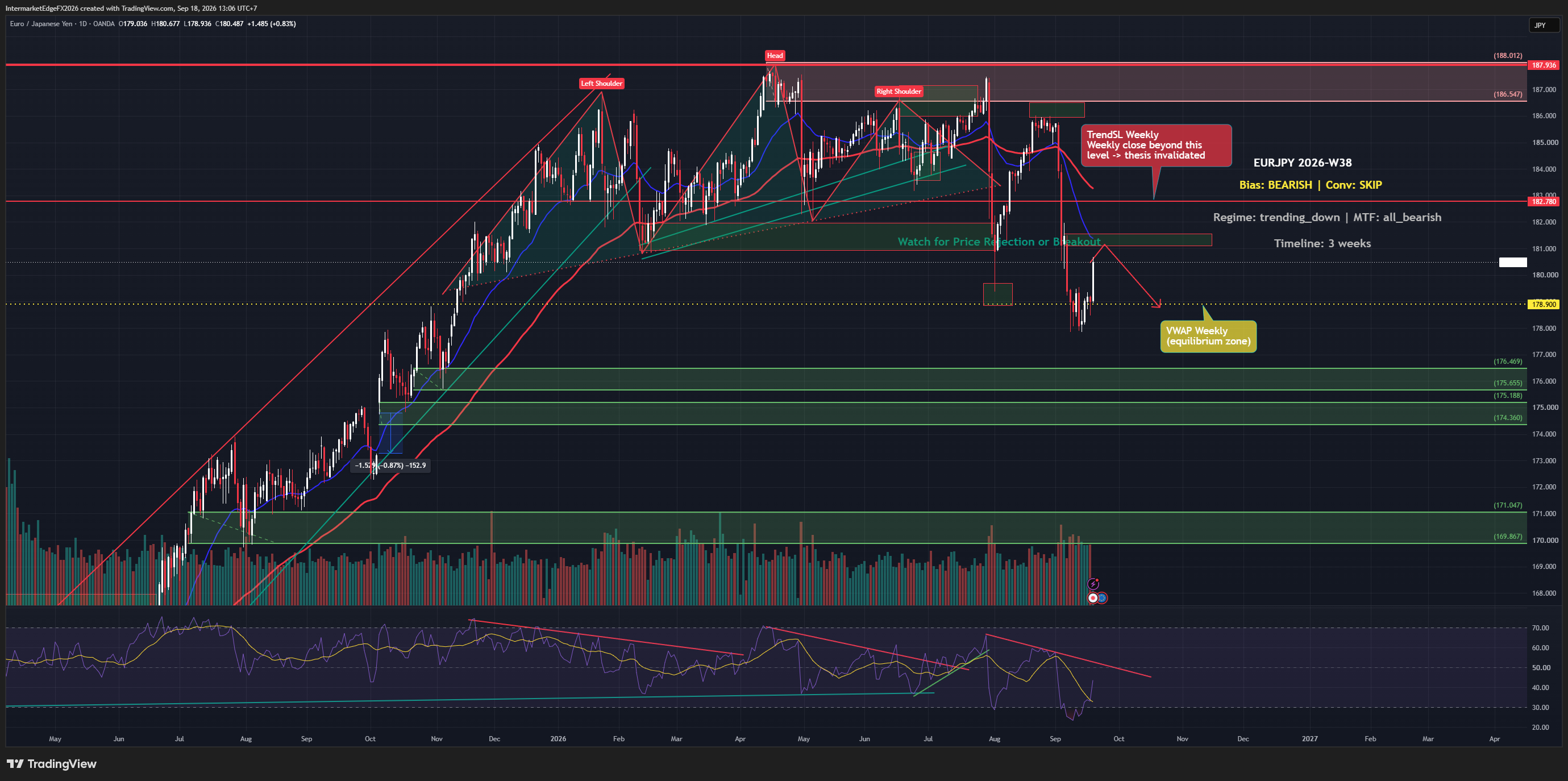
EURJPY W38: BOJ Hikes, but Yen Weakness Leaves Bears Without a Clear Entry

EURJPY W38: BOJ Hikes, but Yen Weakness Leaves Bears Without a Clear Entry

The Bank of Japan just delivered its highest policy rate in 31 years, lifting to 1.25% on September 18, and the yen weakened 0.8% in response. That gap between the headline and the market reaction is the most important signal EURJPY traders need to understand this week. When a hawkish catalyst fails to move the currency in the expected direction, the burden of proof for a carry unwind, where yen-funded positions get rapidly unwound, driving JPY sharply stronger, shifts materially higher. The directional lean on EURJPY is bearish, anchored by two structural arguments that point the same way without yet delivering the confirmation needed to size a position with confidence. The first is regime: the cross has been in a trending-down structure across multiple timeframes, with all timeframe signals aligned bearish. In a trending regime, the path of least resistance is continuation, the question is always whether the trend retains enough energy to keep pulling price lower, or whether it is exhausting itself before a meaningful catalyst arrives. The second argument is the carry unwind risk that the BOJ's rate path creates. A carry unwind happens when the cost of maintaining a short-yen, long-risk position rises fast enough, or when risk sentiment deteriorates sharply enough, that traders close those positions simultaneously, buying back yen and selling the funded assets. The BOJ's September 18 hike was a 7-2 vote with two board members explicitly opposing it on the grounds that growth was insufficient and inflation had not accelerated enough. The BOJ itself retained guidance for further increases, conditional on the inflation outlook being realized, but Japan's August core CPI came in at 1.7% year-over-year, below the 1.8% expected. That miss matters: it suggests the conditions the BOJ needs to justify the next hike are not yet in place, which reduces the urgency of carry unwind pressure in the near term. -- Intermarket Edge

Stay in the loop

Get notified about new research, macro insights, and market analysis.

InterMarketEdge

© 2026 InterMarketEdge. Financial intelligence for inter-market traders.