Tag: BOJ — InterMarketEdge

Tag: BOJ

EURJPY Week W36-2026: Technicals Hold Above 185.37 as Japan's Retail Sales Surge Meets a Dollar Bidding for Rate Hikes

EURJPY Week W36-2026: Technicals Hold Above 185.37 as Japan's Retail Sales Surge Meets a Dollar Bidding for Rate Hikes

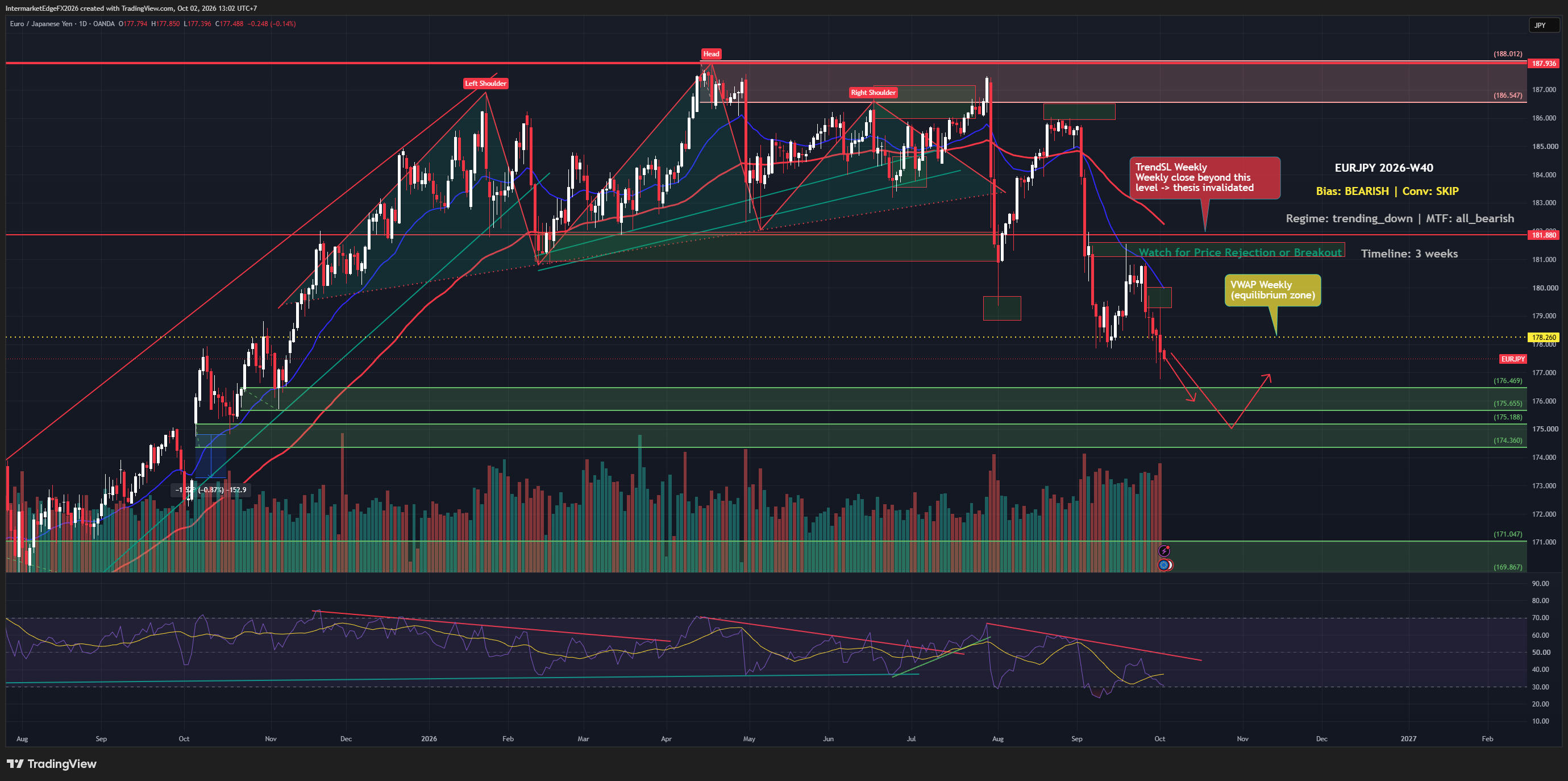
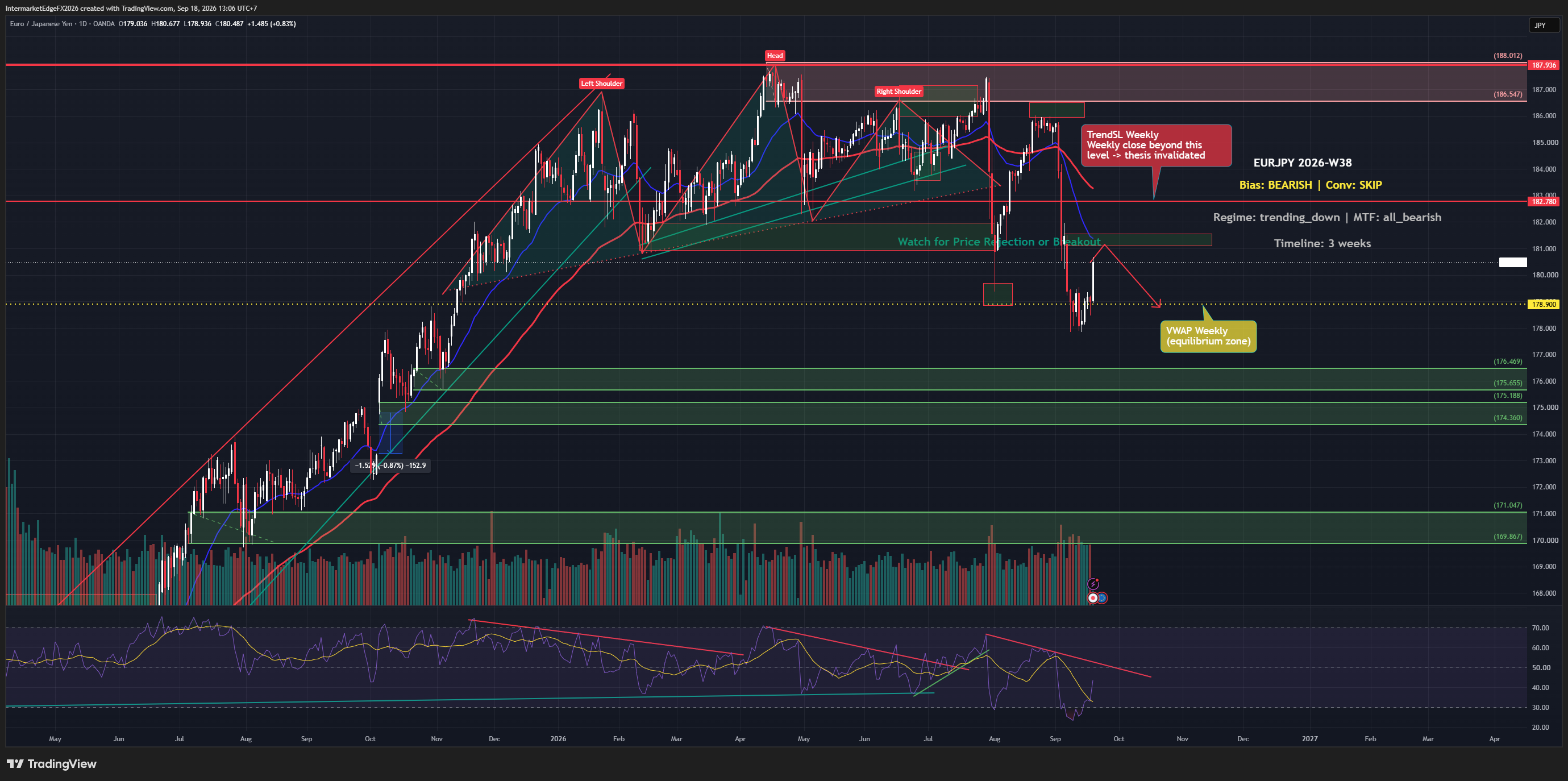
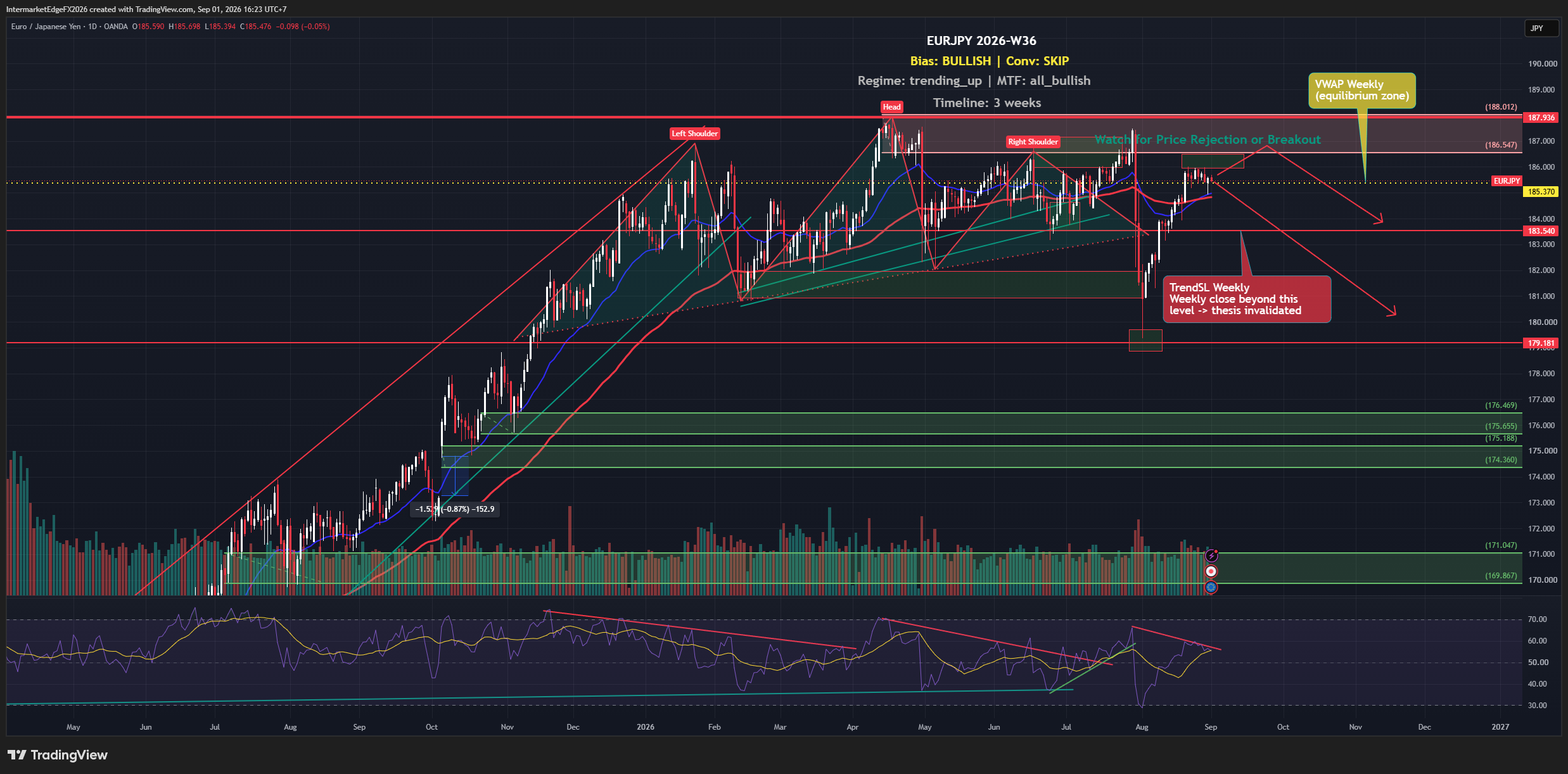
EURJPY is trading at 185.6 as of Tuesday, 01 September 2026, sitting just above its weekly VWAP at 185.37 with every timeframe technically aligned to the upside. Japan just delivered a retail sales print of 4.0% YoY, nearly double the forecast, and industrial output surprised to the upside as well. Yet the overall bullish conviction here is deliberately low, and that gap between clean technicals and absent macro support is exactly the tension worth understanding before sizing any exposure. The bullish bias on EURJPY for week W36-2026 rests on a single, structurally sound but narrowly sourced pillar: every technical timeframe, daily, weekly, and monthly, is aligned to the upside. That kind of multi-timeframe agreement is not common and is not trivial; it indicates the dominant trend is consistently reproduced at every analytical resolution, which reduces the probability that any one signal is noise. The practical effect is that the path of least resistance, absent a disrupting catalyst, points higher. What complicates this is that technical alignment is the only signal firing. COT positioning, which measures how leveraged and institutional accounts are positioned and would indicate whether professional capital is actually behind the move, has returned neutral with no directional read this week, so it is not possible to say the trend is being driven by the kind of committed positioning that sustains extended moves. Macro signals, sentiment gauges, and liquidity conditions have all returned similarly flat. This matters because a trend that rests solely on price-derived signals, without confirmation from who is positioned and why, carries crowding risk in a different form: the risk that the apparent trend is thin and vulnerable to a rapid unwind the moment a real macro trigger appears. The BOJ policy trajectory is the most direct potential disruptor on the JPY leg. -- Intermarket Edge (Note: COT (Commitment of Traders) data is released weekly by the CFTC with a report

USDJPY: A Bullish Macro Lean Still Lacks Technical Confirmation

USDJPY: A Bullish Macro Lean Still Lacks Technical Confirmation

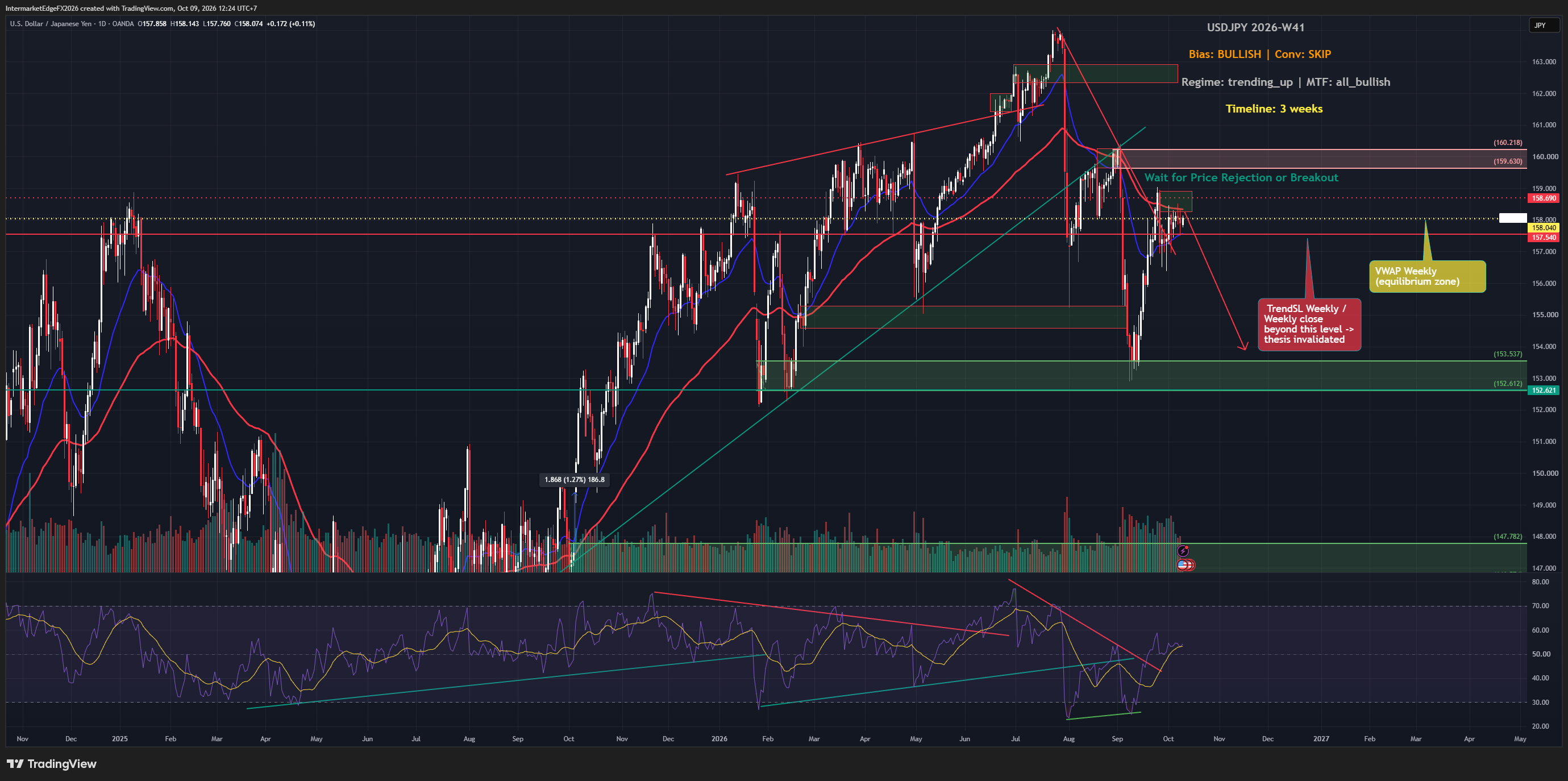
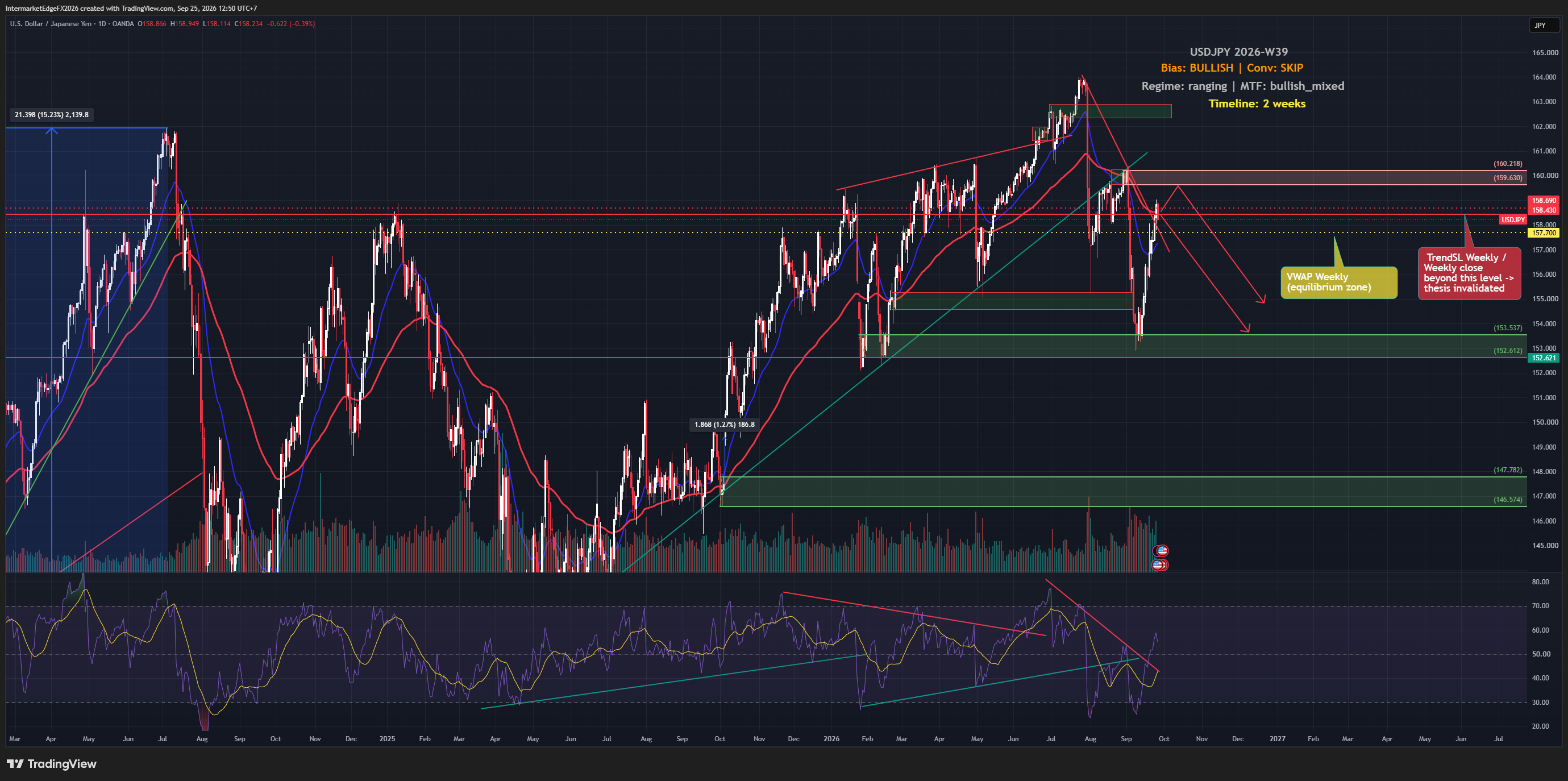
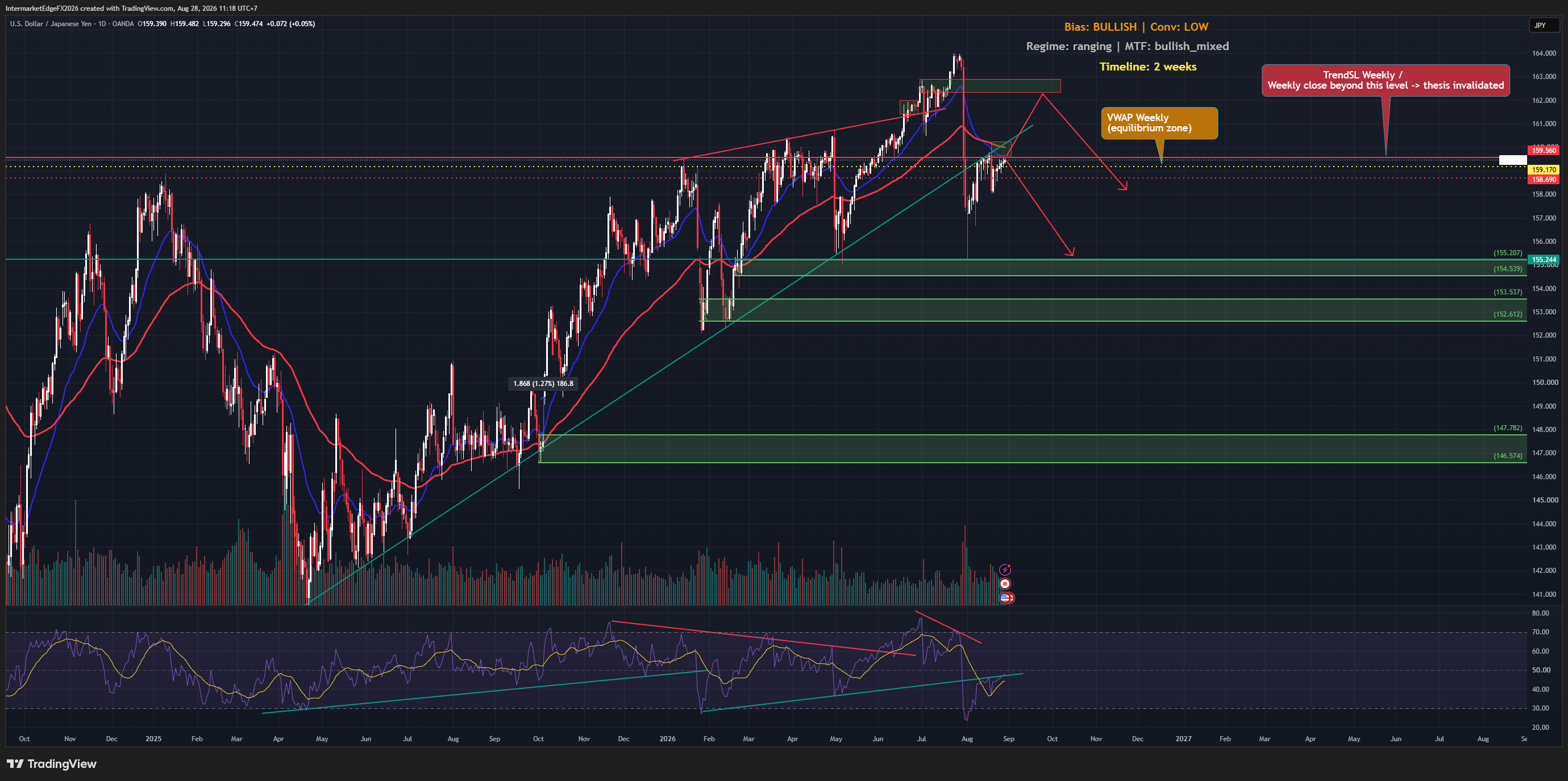
USDJPY is caught between two equally weighted forces right now: a Fed that keeps real yields at 2.34%, firmly supporting the dollar side of the trade, and a BOJ whose hawkish posture remains the single biggest tail risk capable of unraveling the entire carry position. As of Friday 28 August 2026 at 03:59 UTC, the pair sits at 159.37, holding above the weekly VWAP at 159.17 but unable to push through the TrendSL at 159.56. That gap tells the real story this week. The framework flags a bullish bias on USDJPY for the next two weeks, but the conviction attached to that label is deliberately low, meaning the evidence tilts directionally positive without being strong enough to justify aggressive sizing. The two pillars holding the bullish case together are COT positioning, which leans bullish (though the specific report week, net-position figure, and release date are not specified in the available data, so this should be read as directional evidence rather than a precise statistic), and price action itself, which is currently holding above the weekly VWAP at 159.17 as of Friday 28 August at 03:59 UTC. The critical tension sits in the causal chains pulling in opposite directions with roughly equal force. Fed hawkishness, anchored by real yields at 2.34%, pushes USDJPY higher by widening the rate differential and reinforcing dollar demand. BOJ hawkishness, simultaneously, pushes it lower by threatening to narrow that same differential and triggering carry unwinds. Both forces carry substantial weight, and the data this week does not resolve which dominates. Tokyo CPI missed slightly, which temporarily reduces immediate BOJ pressure, but the improving labor market and the BOJ's own gradual recovery narrative keep the hawkish scenario on the table. -- Intermarket Edge

EURJPY Week W34-2026: Trend Holds Above 184.86, But a BOJ Carry-Unwind Warning Keeps Buyers Cautious

EURJPY Week W34-2026: Trend Holds Above 184.86, But a BOJ Carry-Unwind Warning Keeps Buyers Cautious

EURJPY is trading at 185.65 as of Friday, 21 August 2026, above its weekly VWAP at 184.86, with daily, weekly, and monthly trend all pointing the same direction. That alignment sounds clean, but Japan's 52nd consecutive Core-Core CPI increase is keeping BOJ rate-hike expectations alive, and a carry unwind triggered by BOJ policy tightening could erase a technically sound bullish setup faster than most traders anticipate. The structure is bullish. The macro is not cooperating. The structural bias for EURJPY through the next three weeks is bullish, and that verdict rests entirely on price action: daily, weekly, and monthly trend are all aligned upward simultaneously, which is the highest-conviction technical signal this framework can register. When all three timeframes agree, trend-following logic argues for giving the move room to continue rather than fighting it. The current market price of 185.65, recorded on Friday, 21 August 2026, sits above both the weekly VWAP of 184.86 and the weekly trend stop-loss at 183.54, meaning the price structure has not yet given a technical reason to abandon the bullish read. The honest complication is that price action is operating in isolation here. COT positioning, liquidity signals, and sentiment data are all neutral, no confirming flows are reinforcing what the charts suggest. That leaves the bull case technically sound but fundamentally thin. More significantly, macro signals are leaning bearish, driven by BOJ hawkishness carry-unwind risk carrying a meaningful weight in the overall picture. A carry unwind, where yen funding costs rise enough to force traders out of long EURJPY positions regardless of chart structure, does not care about multi-timeframe alignment; it can override technical setups quickly and with little warning. The result is a bullish directional bias that the framework cannot yet support with enough confirming evidence to justify sizing a position. -- Intermarket Edge (Note: COT (Commitment of Traders) data

USDJPY Week W34-2026: Price Stalls Below 159.2 as Fed Minutes Flag a September Hike, But the Technical Structure Disagrees

USDJPY Week W34-2026: Price Stalls Below 159.2 as Fed Minutes Flag a September Hike, But the Technical Structure Disagrees

USDJPY carries a bullish bias into Week W34-2026, but the pair is already trading below both the weekly VWAP at 159.2 and the weekly TrendSL at 159.3, testing from underneath, as of Friday, 21 August 2026 at 05:48 UTC. Fed minutes confirming a September hike is still on the table gave the dollar a fundamental argument, yet price has not followed through. The tension between a macro case for dollar strength and a technical structure that disagrees is exactly where traders get hurt. The bullish case for USDJPY rests on one dominant structural argument: the Fed-versus-BOJ rate differential is the most extreme in the G7. Rate differential, in practical terms, means that holding dollars earns you materially more than holding yen, and as long as that gap stays wide, there is a persistent mechanical incentive for traders and institutions to be long USDJPY. COT positioning, which tracks the net futures commitments of large speculators, though the specific report week and net-position figure are not confirmed here, so treat this as directional context rather than a precise citable number, leans clearly bullish, reinforcing the demand-side argument. Fed hawkishness and a real yield above 2% give that rate differential a durable foundation, not just a near-term nominal quirk. That combination is what generates a bullish label. But the conviction attached to that label is explicitly low, and the reason is structural: the thesis was generated with price already below both key weekly levels. The technical read and the macro read are pointing in opposite directions, which means the bullish label is best understood as a macro override of a bearish technical setup, not a technically confirmed trend entry. Adding to the complexity, BOJ hawkishness carries a real bearish weight on USDJPY. If the BOJ accelerates its tightening path, the carry trade that has funded so much yen weakness could begin to unwind rapidly. -- Intermarket Edge

USDJPY W33: The Uptrend Meets a Yen Intervention Test

USDJPY W33: The Uptrend Meets a Yen Intervention Test

The yen is heading for a weekly loss and Reuters is already reporting bets for another intervention, yet USDJPY is trading below its weekly VWAP at 159.35 as of Friday, 14 August 2026, meaning short-term momentum is running against the very bullish structure that underpins the trend. The Fed-BOJ rate differential remains the most extreme in the G7, but a flat CPI print has cooled rate-hike expectations. The setup is directionally bullish but tactically uncomfortable right now. The directional case for USDJPY remains bullish, but the conviction sitting behind that call is deliberately low, not because the trend is broken, but because the evidence is not yet strong enough to justify sizing a position with confidence. The Fed-BOJ rate differential is the structural anchor: the US 10-year yield at 4.7% against a BOJ that is only beginning to normalize policy creates the widest carry spread in the G7, and COT positioning data, which tracks how large speculative and commercial participants are positioned in futures markets, has been leaning bullish, suggesting the broader market has not abandoned the yen-weakness trade. The caveat is that the COT read here is directional evidence rather than a precise citable statistic, since the brief does not specify the exact report week or net-position figure. What makes the current picture complicated is a direct and acknowledged signal conflict: the Fed's hawkish stance is bullish for USDJPY, while the BOJ's own hawkish pivot is bearish, because a BOJ rate hike erodes the yield advantage that makes holding yen-funded carry trades profitable. Both signals carry equal analytical weight. Add to that a CPI miss that has already begun to cool hike expectations, and the macro pillar of the bullish case is noticeably thinner than it was a week ago. -- Intermarket Edge

EURJPY Week W32-2026: US Yen-Buying Intervention Drives Price Below 184.58 VWAP as BOJ Holds at 1% and Flags Further Hike

EURJPY Week W32-2026: US Yen-Buying Intervention Drives Price Below 184.58 VWAP as BOJ Holds at 1% and Flags Further Hike

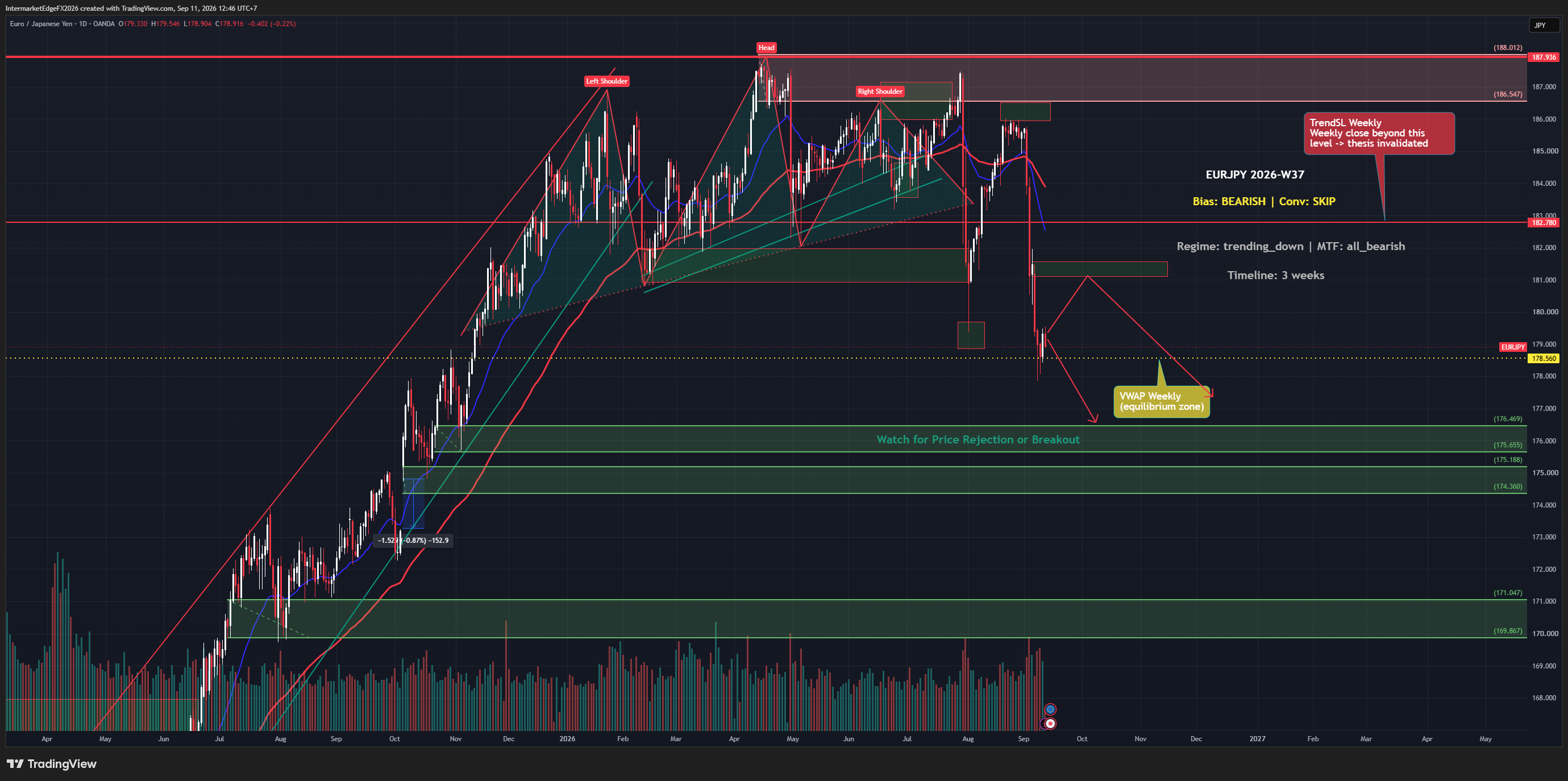
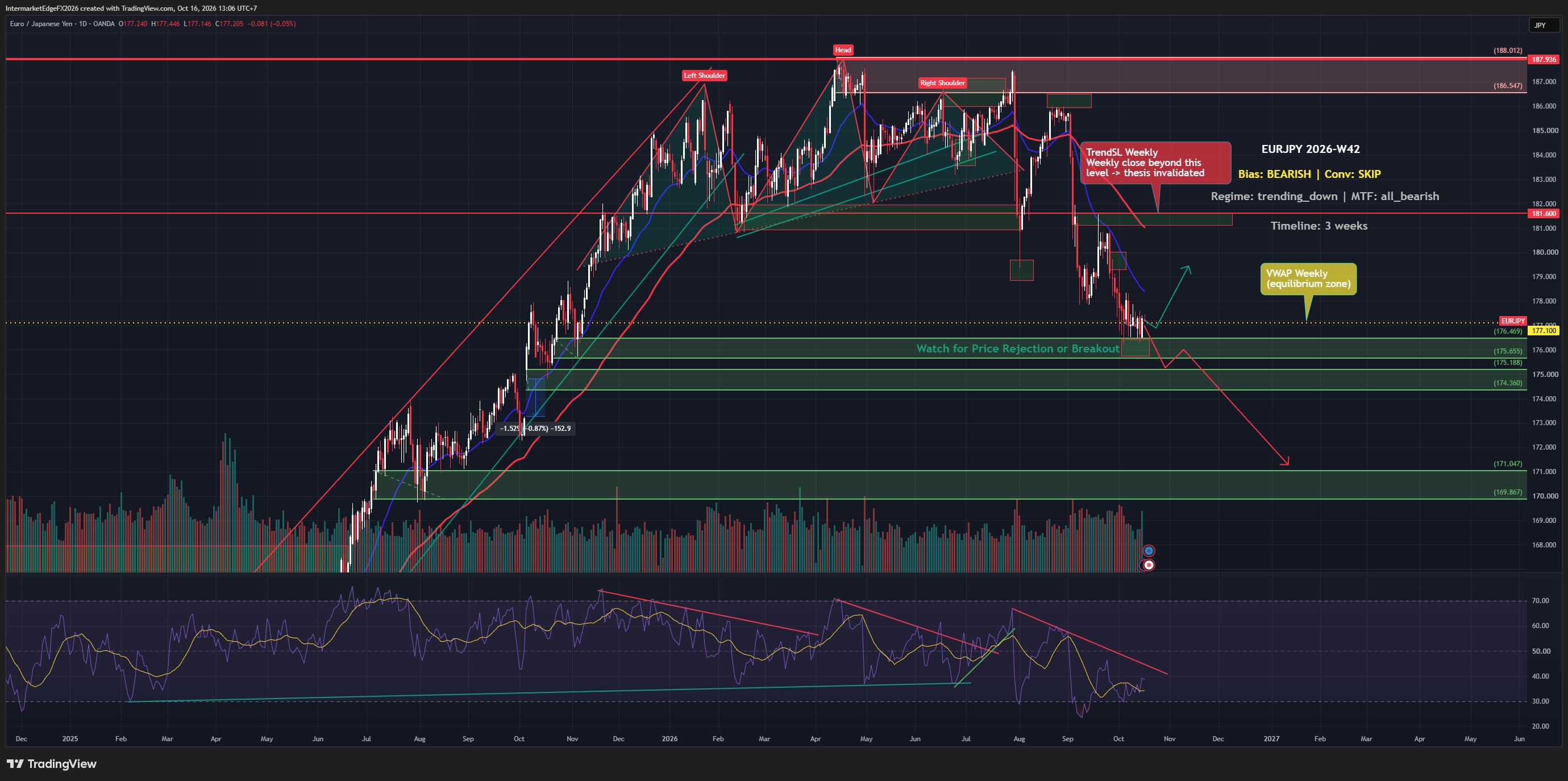
EURJPY is trading at 181.67 as of Tuesday, 04 August 2026, 09:09 UTC, nearly 3 full points below the weekly VWAP of 184.58, after the US shook currency markets by buying yen directly through euro sales. The BOJ held its overnight rate at 1% but reiterated its hiking path, keeping carry-unwind pressure alive. The multi-timeframe picture is all-bearish, yet conflicting signals between price action and macro mean conviction sits at skip level: the trend is real, but the evidence base is thin. The overall bias for EURJPY in Week W32-2026 is bearish, but the conviction level is explicitly rated skip, meaning the signal exists, but the evidence base is too thin and too conflicted to support a high-confidence directional trade. Let that framing govern everything that follows. The primary bearish driver is structural: BOJ hawkishness, reinforced by this week's hold-with-hike-guidance, pressures the rate differential that underpins euro-yen carry positioning. When the BOJ signals continued tightening while the ECB faces disinflationary data, the carry unwind dynamic, where traders exit long-EURJPY positions funded by cheap yen borrowing, becomes a credible medium-term force. The US intervention reported this week, specifically buying yen through euro sales rather than through the conventional dollar channel, is an unusually direct policy statement that adds event-driven downside pressure on top of the structural story. The regime is classified as trending down with moderate confidence, and the multi-timeframe alignment reads all-bearish, which in isolation would support a trend-follow posture. However, the thesis-level signal contains a direct conflict: price action scores bullish while the macro overlay scores bearish, producing a weak net bearish read with very low conviction overall. -- Intermarket Edge

USDJPY Week W31-2026: BOJ Holds at 1% as Suspected FX Intervention Pushes Price Below VWAP 163.84, Bullish Trend Hangs by 0.77 Points Above TrendSL

USDJPY Week W31-2026: BOJ Holds at 1% as Suspected FX Intervention Pushes Price Below VWAP 163.84, Bullish Trend Hangs by 0.77 Points Above TrendSL

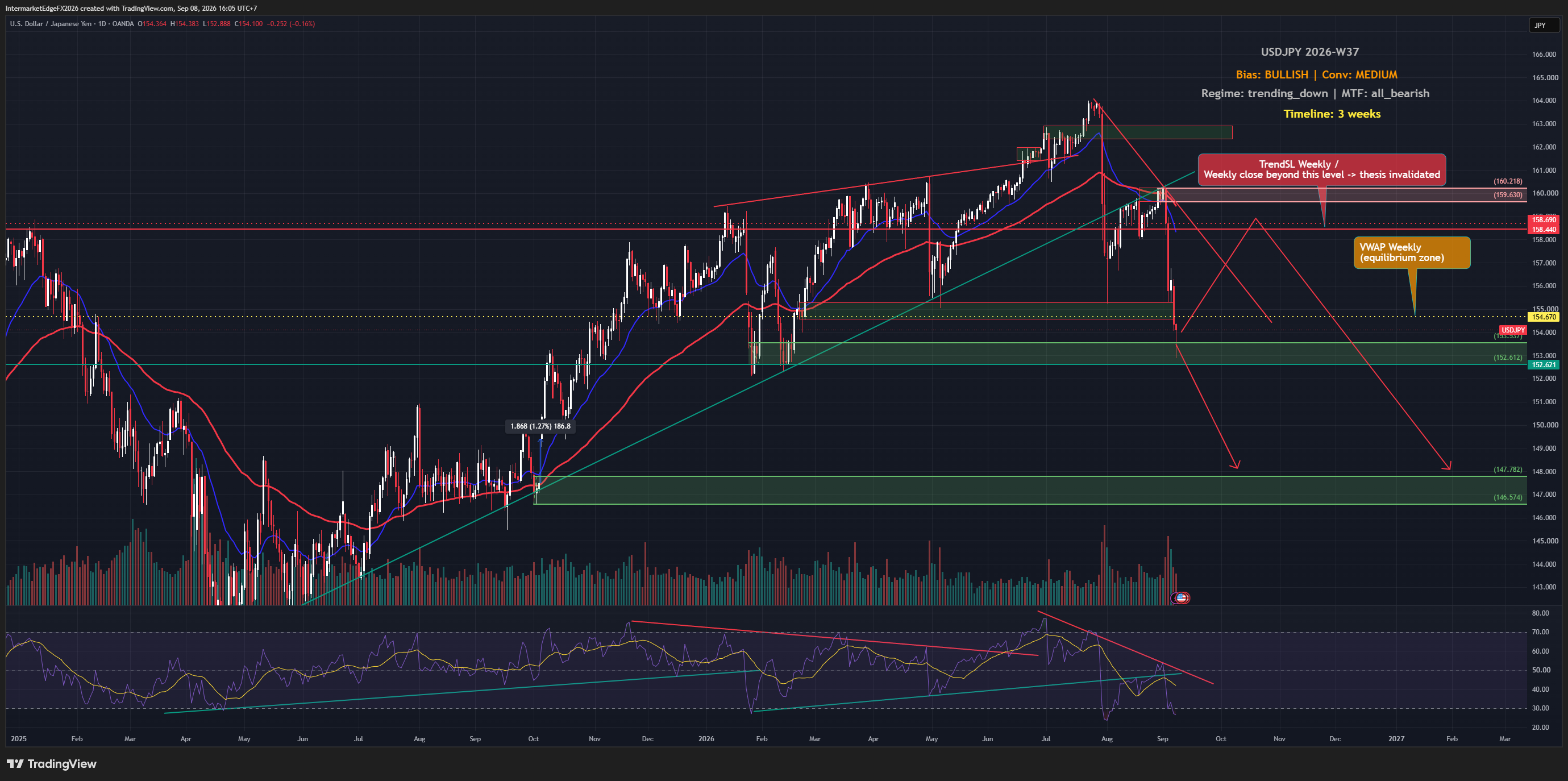
USDJPY is caught between two powerful forces this week: a Fed that remains hawkish with real yields elevated and a BOJ that just held rates at 1% while one board member openly pushed for a hike to 1.25%. As of Friday, 31 July 2026 at 05:00 UTC, price sits at 160.65, below the weekly VWAP of 163.84, with suspected FX intervention having already pushed the yen stronger. The bullish trend structure is intact, but short-term momentum is working against it. The overall bias on USDJPY for the 2026-W31 period is bullish, but conviction is low, low enough that the framework flags this as a 'skip' for active positioning, meaning conservative or zero sizing is the appropriate default, not an aggressive trend-following entry. The primary structural argument for the bullish bias is the Fed-versus-BOJ rate differential, which remains the most extreme divergence in the G7 currency space. The Fed is holding rates at elevated levels with a real yield of 2.43%, while the BOJ, even after five hikes this cycle, sits at just 1%, a gap that makes carry trades into yen-funded long-dollar positions structurally attractive when risk appetite is stable. The multi-timeframe technical trend alignment, daily, weekly, and monthly all pointing bullish, provides the strongest single input to this thesis and is the primary reason the bias is not outright neutral or bearish. However, a direct and unresolved signal conflict is present that traders must take seriously: the Fed hawkish causal chain pushes USDJPY higher through USD strength, while the BOJ hawkish chain, amplified by Takata's dissent and the suspected FX intervention, pushes USDJPY lower through JPY carry trade unwind. A carry unwind occurs when traders who borrowed yen cheaply to fund higher-yielding positions are forced or incentivized to close those trades, buying yen back and driving it higher against the dollar. -- Intermarket Edge

USDJPY Week W30-2026: Yen Languishes Near Four-Decade Low as US Yield Surge and BOJ Inaction Keep Dollar Bulls in Control, but Carry Unwind Risk Clouds the Outlook

USDJPY Week W30-2026: Yen Languishes Near Four-Decade Low as US Yield Surge and BOJ Inaction Keep Dollar Bulls in Control, but Carry Unwind Risk Clouds the Outlook

USDJPY is trading around 163.80 (as of 2026-07-24, source: yfinance near-realtime), right at the weekly VWAP of 163.80 — a level to watch for short-term momentum confirmation. Multi-timeframe technicals (daily/weekly/monthly) are all aligned bullish, and COT positioning leans bullish. Trend structure holds above the weekly TrendSL at 159.73. The core driver remains the Fed-BOJ rate differential. US 10Y real yield at 2.39% and nominal at 4.67% keep USD carry attractive. Dollar is also catching a bid from Middle East tensions and trade war inflation fears. However, conviction is LOW, and here's why: two forces are pulling in opposite directions. Japan June core CPI printed +1.6% YoY — below the BOJ's 2% target for a fifth straight month — which normally delays BOJ tightening and supports the yen carry trade. But the US Treasury is publicly calling for more BOJ tightening, and Japan's finance minister flagged readiness for decisive FX action. Simultaneously, US core CPI for June missed at 0.0% vs 0.2% forecast — a dovish surprise that softens the Fed hawkish narrative at the margin. Net result: technicals and COT support a bullish lean, but macro signals partially offset each other. A surprise BOJ rate hike or FX intervention remains the key tail risk — a carry unwind in JPY can reverse this setup sharply regardless of Fed policy. Bias: bullish, low conviction, 3-week horizon. Size accordingly. Exit if weekly close breaks below 159.73. -- Intermarket Edge

EURJPY Week W29-2026: Yen Slides Past 163 as Intervention Talks Mount, Bullish Trend Holds Above 184.56 But Carry-Unwind Risk Keeps Conviction Muted

EURJPY Week W29-2026: Yen Slides Past 163 as Intervention Talks Mount, Bullish Trend Holds Above 184.56 But Carry-Unwind Risk Keeps Conviction Muted

EURJPY sits at 185.75, hugging weekly VWAP exactly, with multi-timeframe alignment fully bullish and the trending regime intact. The technical picture hasn't broken — TrendSL at 184.56 remains unchallenged. That's the straightforward part. The macro backdrop is far messier. The yen has slid past 163, triggering intervention alerts and raising the prospect of a sudden BOJ/MOF response. Intervention risk is not theoretical at these levels — it's the single biggest tail risk to any long EURJPY position. Meanwhile, Japan's economy faces inflationary pressure partly driven by the weak yen making imports expensive, which ironically supports BOJ rate-hike bets. A surprise hike or credible intervention threat can produce a violent carry unwind (rapid JPY short-covering) with little warning. Adding complexity: US-Iran conflict has intensified, lifting Brent and supporting the dollar near-term. DXY bias is bearish but conviction is low, so EUR-side support is tepid at best. Euro CPI came in at 2.4% vs 2.6% forecast — a miss that modestly softens ECB hawkishness and limits EUR upside. Bottom line: bias is bullish, regime is trending up, but conviction is skip-level this week. The conflict between clean technicals and elevated geopolitical/intervention risk is real. If price closes below 184.56, the bullish structure is invalidated. Below 185.75 VWAP on a sustained basis, reduce exposure. Do not size aggressively into a crowded yen-short trade when intervention chatter is this loud. -- Intermarket Edge

Stay in the loop

Get notified about new research, macro insights, and market analysis.

InterMarketEdge

© 2026 InterMarketEdge. Financial intelligence for inter-market traders.