Macro Regime SLUG — InterMarketEdge

Macro Regime SLUG

Regime-level analysis — stagflation, Fed policy shifts, and structural macro drivers moving markets

EURJPY — MOF Intervenes for the Fourth Time, BoJ June 16 Hike Now Imminent, and Wave (c) Is Targeting 171.047

EURJPY — MOF Intervenes for the Fourth Time, BoJ June 16 Hike Now Imminent, and Wave (c) Is Targeting 171.047

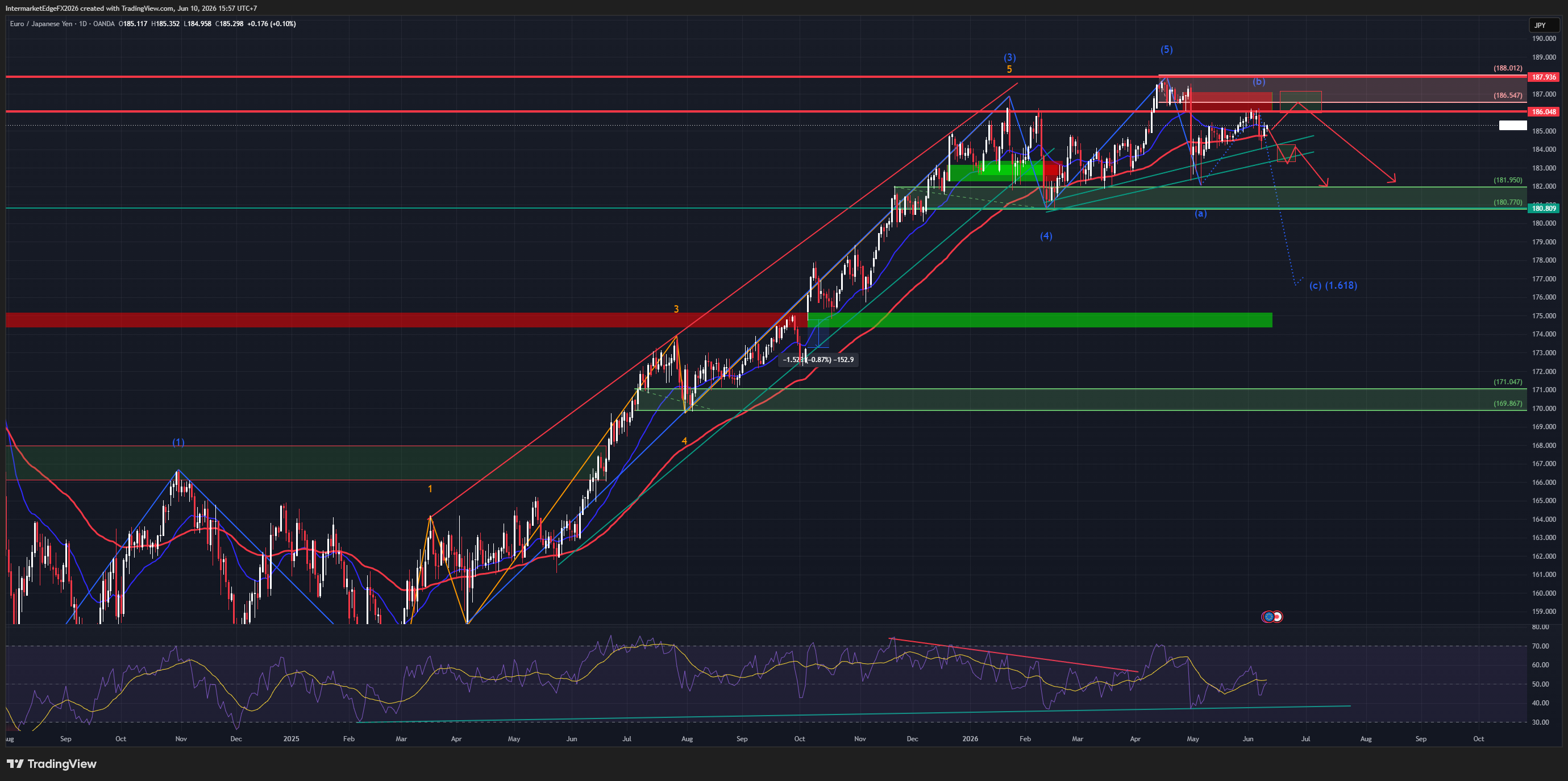
EURJPY 185.258 | Three simultaneous yen-positive forces | 10 June 2026 The most powerful yen-positive setup since the Iran war began. Three catalysts converging today. The MOF intervened for the fourth time this morning. Japan spent USD 73 billion defending the yen since late April — its largest-ever campaign. USDJPY at 160.405, 40 pips above the intervention line. Asymmetry: upside capped at 160-161, downside from intervention is 800-1000 pips. A 3-5% USDJPY decline translates to 5.5-9.3 EURJPY points from current levels. The BoJ hike on June 16 is now validated. Japan's May CGPI: crude oil/coal products +13.8% MoM (was +5.3% in April). Non-ferrous metals +42.2% YoY. Japan imports 90% of its oil from the Middle East — Iran escalation makes June CGPI worse. Three BoJ dissenters voted to hike immediately at April 28. Today's data validates them. Hike probability: 66%. Six days. Iran struck the Fifth Fleet headquarters in Bahrain, bases in Kuwait and Jordan. IRGC claims 21 US military targets. VIX at 20.59. EURJPY is the archetypal carry trade — VIX above 20 means carry unwind pressure is active. The pipeline's JP10Y reads 1.47% (stale). Sidebar shows 2.690%. The corrected DE-JP spread is only -0.30%, not the pipeline's -1.538%. The carry foundation is near collapse. A BoJ hike takes it to near zero. Invalidation: 187.936. Wave (c) targets: 171.047 → 169.867. BoJ June 16 is the tell. Conviction: Medium-High Bear.
EURJPY at the Ceiling — ECB Cuts Into BoJ Normalization, Oil Rebounds, and 187.936 Is the Line That Cannot Hold

EURJPY at the Ceiling — ECB Cuts Into BoJ Normalization, Oil Rebounds, and 187.936 Is the Line That Cannot Hold

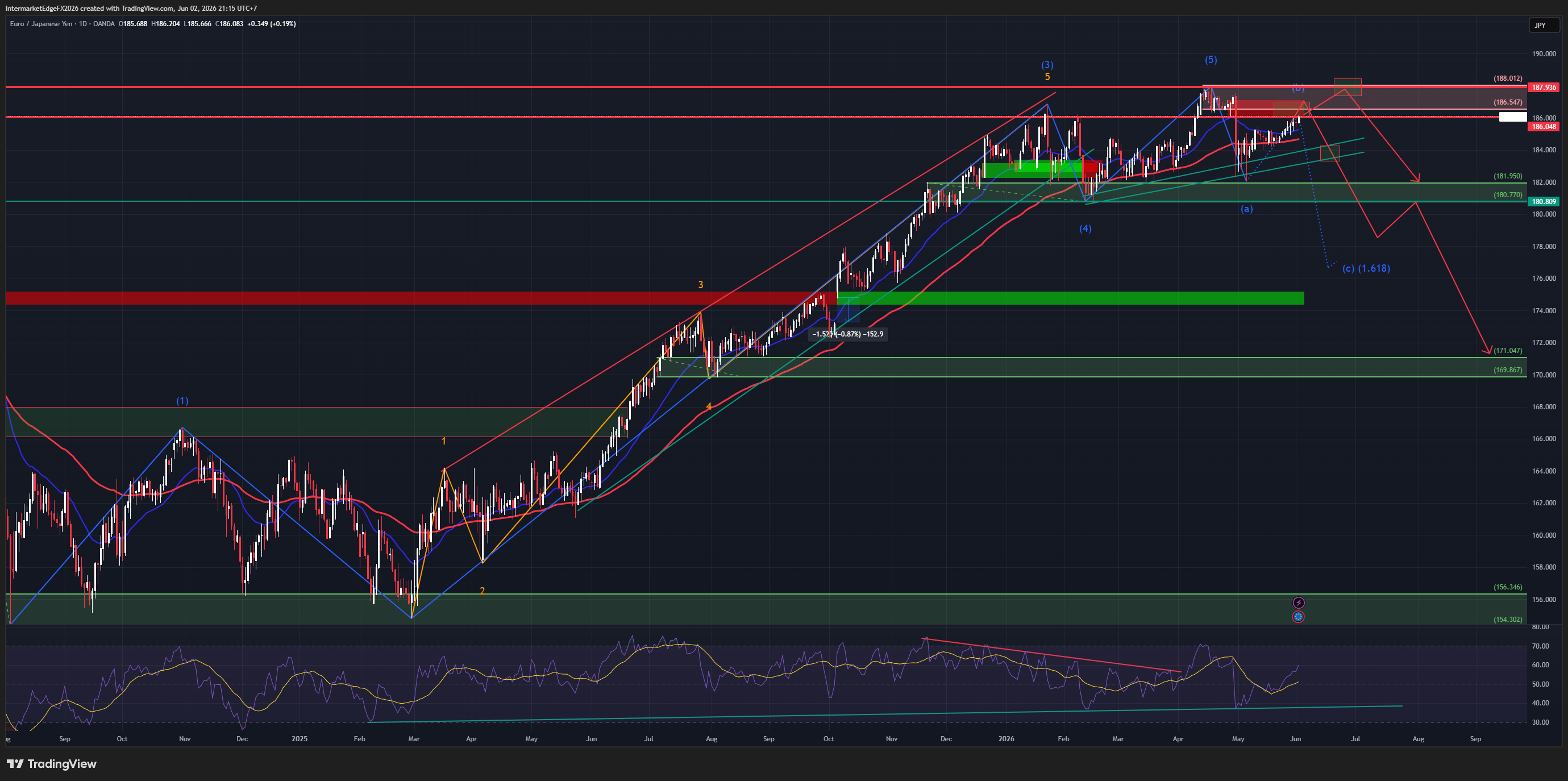
EURJPY 186.063 | 02 June 2026 EURJPY is sitting inside the red resistance zone at 186.00–188.012, and the bear case here is the highest-conviction position in this week's entire instrument coverage. Three structural forces are aligned in the same direction. The ECB is cutting. The June 5 decision — two days away — takes the deposit rate from 2.50% to 2.25%. The rate differential between the ECB and BoJ is compressing, and it will compress further with every subsequent cut. A cutting central bank does not produce a strong currency. The euro is the structurally weaker leg of this cross. The BoJ is normalizing. The pipeline's JP10Y reads 1.47% — stale, last updated May 9. The chart sidebar shows 2.563%. That 110 basis point gap is not a rounding error; it reflects a Japanese bond market that is pricing significantly more BoJ tightening than the pipeline implies. The yen leg of EURJPY has structural support the data pipeline is obscuring. The intervention ceiling is live. USDJPY at 159.852 is 15 pips from 160.00 — the threshold that triggered verbal and physical BoJ intervention in 2024 and that the market universally treats as the current line. A physical intervention would produce a 3–5% yen rally and drive EURJPY down 500–700 pips rapidly. The asymmetry is severe: upside above 160 is capped, downside from intervention is sharp. The single countervailing factor is today's Brent rebound from $91.69 to $98 on Iran deal uncertainty. Japan is the world's fourth-largest oil importer — oil up means yen weakens mechanically. This is why EURJPY is holding near 186 rather than already declining. It is transitional noise, not a structural reversal. Invalidation: daily close above 187.936. Bear confirmation: daily close below 184.00. Wave (c) targets: 171.047 → 169.867. ECB June 5 is the trigger. Conviction: Medium-High Bear.

USDJPY: Yen Holds Steady Amid Fresh Verbal Warning - USDJPY Is Sitting at the Peak of a Completed Wave Structure

USDJPY: Yen Holds Steady Amid Fresh Verbal Warning - USDJPY Is Sitting at the Peak of a Completed Wave Structure

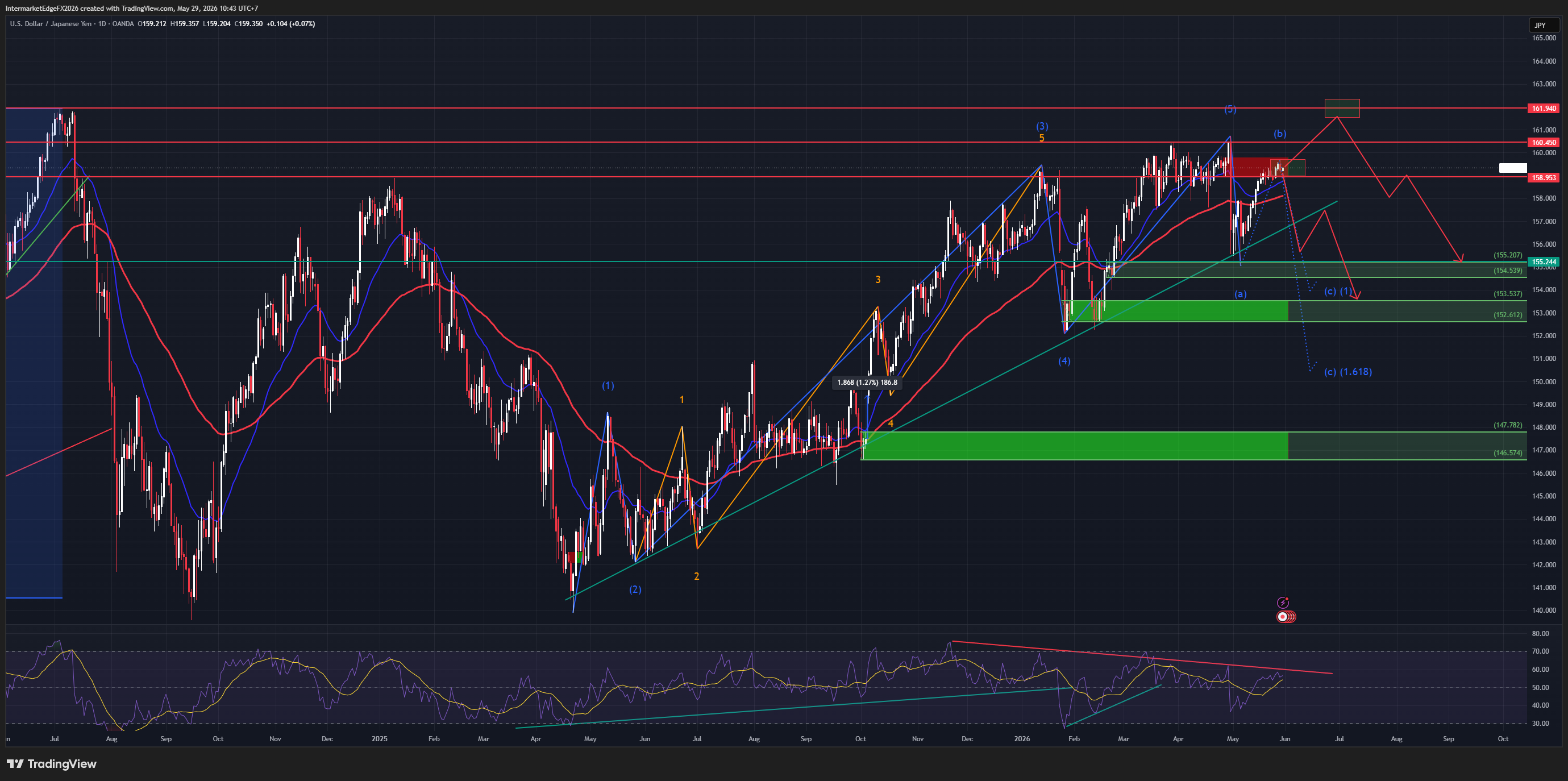
USDJPY 159.329 ngày 29/05/2026 đang ở đỉnh của một wave structure đã hoàn chỉnh, với ba lực bearish align đồng thời - và 160.00 là line phân định mọi thứ. Headline sáng nay: "Yen holds steady amid fresh verbal warning." BoJ đã escalate language - đây là bước đầu trong ladder: verbal warning, strong verbal warning, actual intervention. Với USDJPY ở 159.329 và approaching 160, thị trường đang ở giữa bước 1 và 2. Lịch sử BoJ confirm: họ đã intervene tại 160-162 trước đây. "Fresh verbal warning" hôm nay là signal họ sẽ làm lại. Brent drop thêm $3.18 chỉ trong một đêm, từ $94.87 xuống $91.69. Total drop từ đỉnh $111.27 ngày 18/05 là $19.58 trong 11 ngày. Iran deal decompression đang accelerate, không slow down. Điều này hit USDJPY qua double channel: Japan là net energy importer lớn nhất thế giới nên oil rẻ hơn là structural JPY bid, đồng thời oil drop compress US inflation expectations, giảm Fed hike odds, weaken USD. Cả hai vector cùng bearish USDJPY. Chart D1 confirm bằng Elliott Wave structure rõ ràng: completed 5-wave impulse từ đáy 130 lên đỉnh 161-163, ABC correction đang trong wave (c) với measured targets 152.612 (1.0 extension) và 147.782 (1.618 extension). PCE 3.8% hôm qua là short-term USD support nhưng không reverse structural bear thesis - nó chỉ confirm oil shock đang transmit vào inflation, và khi oil tiếp tục drop, PCE sẽ compress và Fed pivot path sẽ reopen. Conviction Medium-High Bear. Tell duy nhất: 160.00. Approach đó thì BoJ intervenes và wave (c) về 152.612 accelerates. Brent dưới $88 trong 24-48h là tell thứ hai.

USOIL: Iran Deal Decompression Meets OPEC+ Supply Unlock - EIA Crude Draw of 7.9M bbl Confirms: Today's Bounce Is Fundamental

USOIL: Iran Deal Decompression Meets OPEC+ Supply Unlock - EIA Crude Draw of 7.9M bbl Confirms: Today's Bounce Is Fundamental

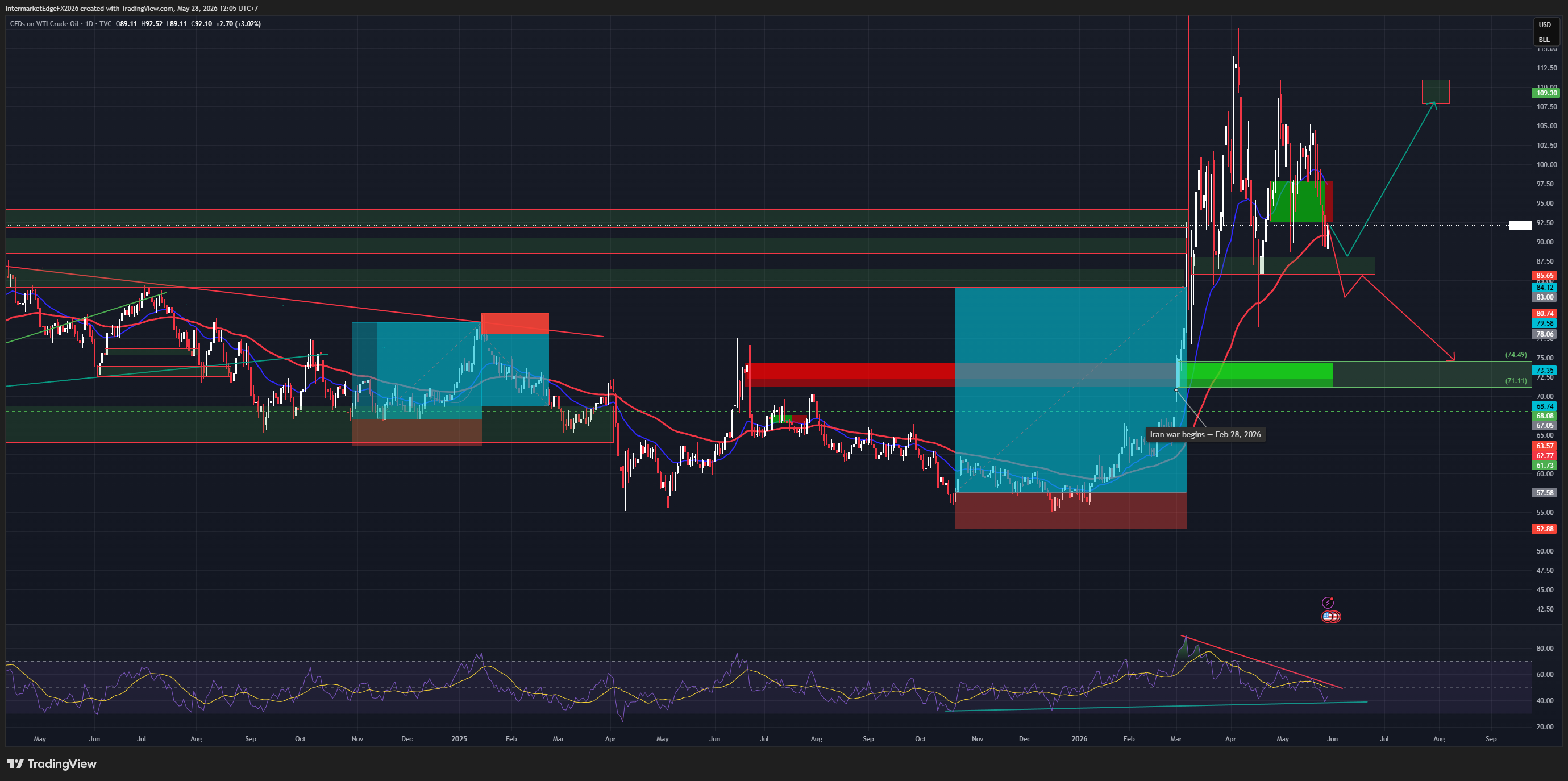
WTI is up 3% today. The reason is not what you think. Everyone is calling it a "deal waver" bounce. They are partially right. But there is a more important number underneath that headline. EIA crude draw: -7.9M bbl. Week ending May 15. That is not a technical bounce. That is demand outpacing supply by a significant margin even as Iran deal decompression has been pulling prices lower for 10 straight days. Here is what that number means in context: Brent fell from $111.27 on May 18 to $93.23 yesterday. That is $18.04 in 9 days - the market was aggressively pricing a deal. But demand never blinked. Commercial crude stocks at 445.0M bbl, down from 452.9M. Gasoline also drew down 1.5M bbl. Consumer demand intact. This changes the bear thesis. Not the direction - still bearish toward $74-71 when the deal materializes. But the timeline. Strong demand means WTI will not collapse in one day after a deal signing. The $88-92 demand zone is a real floor, not just a technical level. The battle for Q2-Q3 2026 oil price is now clear: Bear side: Iran deal + OPEC+ adding +411kbpd from June = double supply pressure Bull side: EIA draws showing demand running well above pre-war equilibrium Neither side wins cleanly. Which is why WTI oscillates rather than trends. The one level that matters above everything else: $88. Hold above it and the bounce targets $97-100. Break below it - which requires both a large EIA build AND confirmed deal progress - and $74.49 is next. Tonight at 23:30 GMT+7, EIA releases week ending May 22 data. That is the tell. Large draw again = demand floor is structural = bounce is real. Large build = prior week was seasonal = bear resumes. This is the anchor instrument for the entire macro series this week. Oil is not a consequence of the macro regime. Oil is the cause. Conviction: Medium-High bounce near-term. Medium bear medium-term. #USOIL #WTI #CrudeOil #IranDeal #EIAInventory #OilPrice #MacroAnalysis #OPEC #Stagflation #IntermarketAnalysis

AUDUSD | May 22, 2026 The Commodity Currency That Lost Its Commodity Story

AUDUSD | May 22, 2026 The Commodity Currency That Lost Its Commodity Story

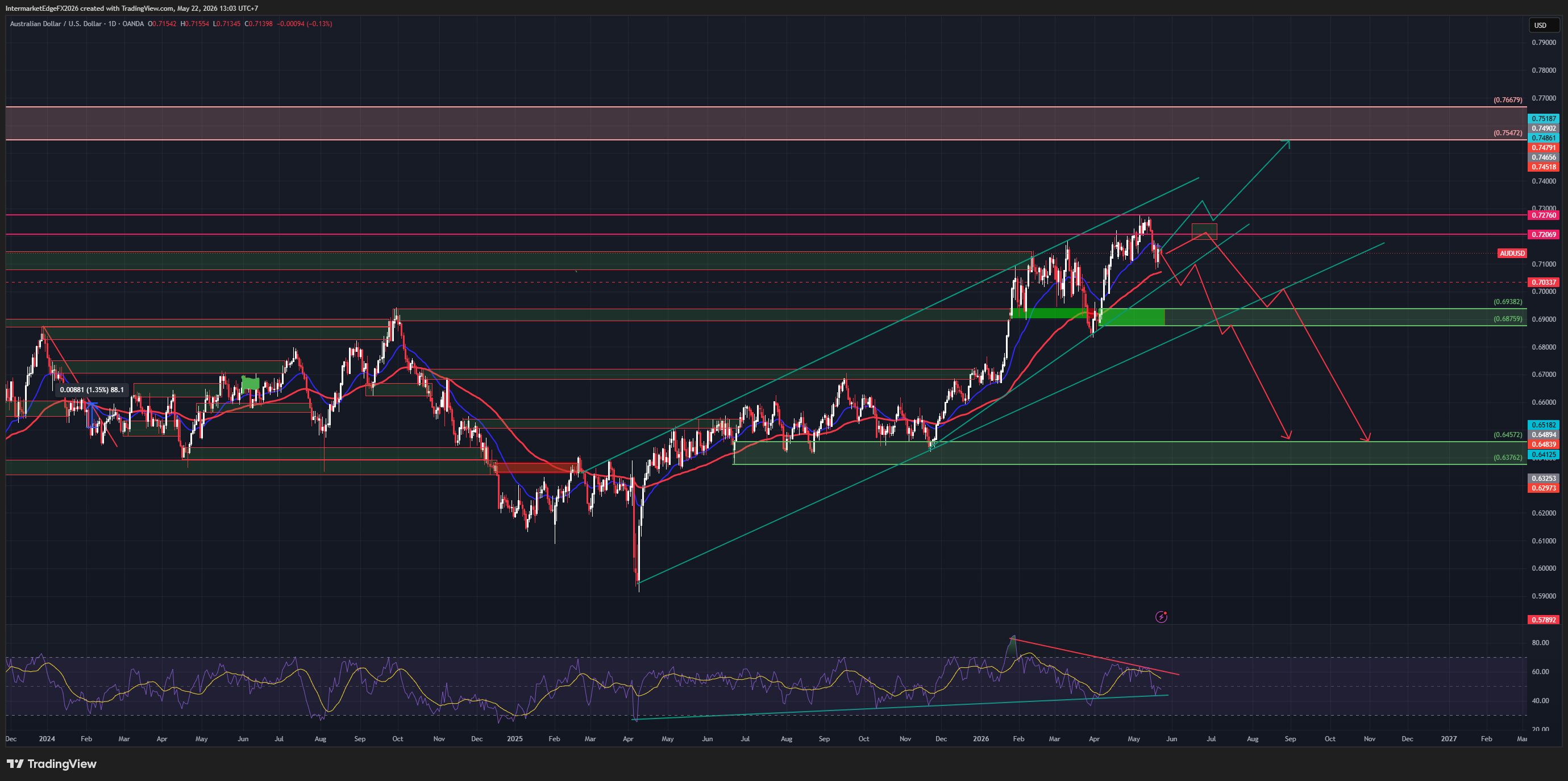
**AUDUSD | May 22, 2026** AUDUSD is trading at 0.7143. That number looks stable. It is not. Three structural forces are converging simultaneously against the Australian dollar, and the catalyst that ties them together arrived on Wednesday when the ABS released April labor force data. Australia's unemployment rate rose to 4.5% - the highest since November 2021. Employment fell by 18,600, the first contraction in five months, against expectations of a 17,500 gain. The participation rate declined. The underemployment rate ticked higher. Every measure of labor market health deteriorated simultaneously. The market partially priced it: AUDUSD dipped to 0.7106 on the release before recovering to 0.7143 on Iran deal optimism. That recovery is borrowed time, not structural support. The unemployment shock matters because it changes the RBA calculus. Before Wednesday, the RBA was "Hold 4.10%, watching CPI." After Wednesday, the labor market is cooling faster than expected, unemployment is approaching the RBA's own NAIRU estimate of 4.5-5.0%, and the case for rate cuts is building. A cutting RBA versus a holding-or-hiking Fed is a structural AUD-negative that plays out over months, not sessions. The second force is the commodity premium compression. AUD rode the Iran war commodity shock higher, but the RBA's own May Statement acknowledges this boost is short-lived with few lasting implications for Australian mining. Brent has now fallen from $111.27 at the start of this week's analysis series to $104.62 today. The terms-of-trade tailwind is fading. The third force is AUD's high risk-sentiment beta. VIX at 16.76 and equities at new week-highs are providing a temporary floor. When that floor is removed - whether by an Iran deal collapse, a China disappointment, or an EIA inventory build - AUD reprices fast. Key levels: 0.7276-0.7200 resistance, 0.6938-0.6879 near-term target, 0.6491-0.6438 structural floor if both commodity and RBA premium exit simultaneously. Conviction:

EURUSD | May 19, 2026 The Euro at 1.1621 - Holding Above 1.14 While the World Reprices the Dollar

EURUSD | May 19, 2026 The Euro at 1.1621 - Holding Above 1.14 While the World Reprices the Dollar

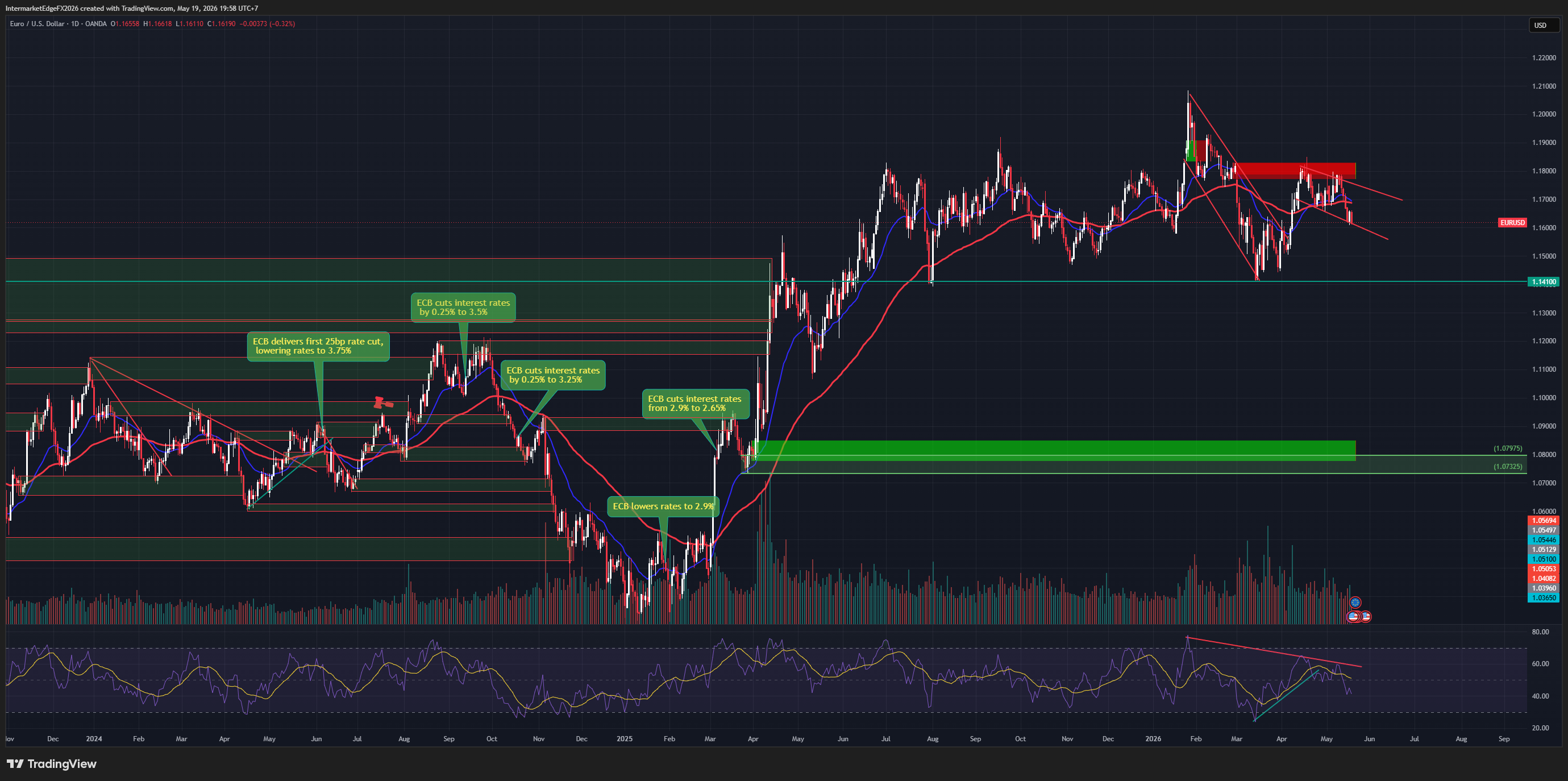
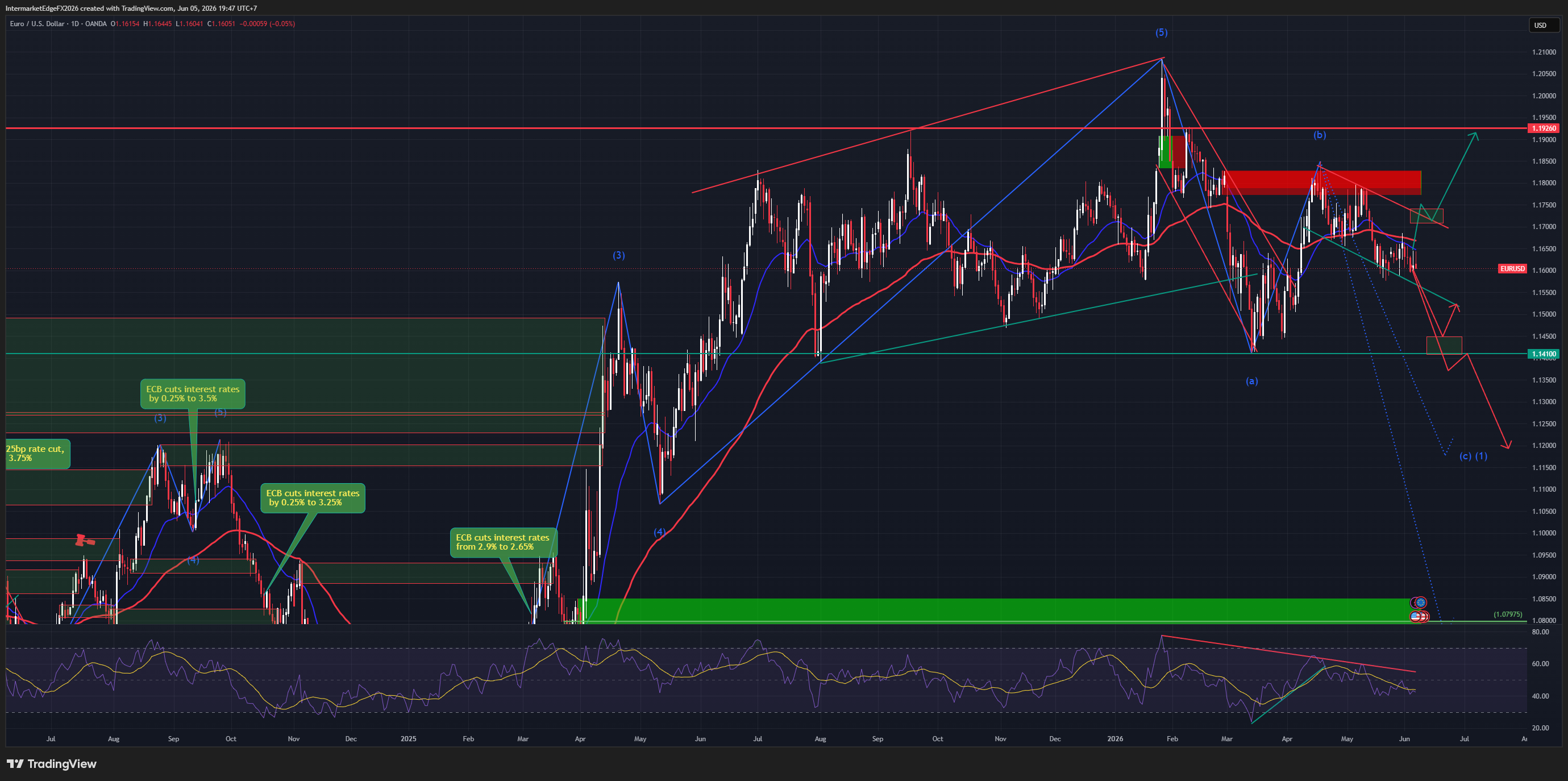
**EURUSD | May 19, 2026** EURUSD is trading at 1.1621 tonight. By every classical measure, it should not be here. The ECB is in a cutting cycle with the deposit rate at 2.50%. Eurozone CPI is at 2.2%. The DE-US 10Y yield spread is -163 basis points - one of the widest structural disadvantages for EUR in over a decade. Every rate differential model says EURUSD should be closer to 1.08-1.10. The fact that it is trading 600 pips above that range is the most important macro signal in FX right now. Something structural has changed. Global central banks and sovereign wealth funds - particularly from the Middle East, Asia, and emerging markets - have been systematically reducing USD exposure since the SWIFT exclusion of Russia in 2022. The Iran war shock of February 2026 accelerated that process. EUR is the deepest and most liquid alternative to USD in global reserve portfolios, and it is absorbing a structural bid that has nothing to do with ECB versus Fed policy. This is the regime that explains the anomaly. De-dollarization flows are non-price-sensitive and do not stop for weekly data releases. They provide a persistent floor under EUR demand that the standard interest rate model cannot see. Two additional forces are reinforcing this bid: Warsh uncertainty - the new Fed Chair has zero established reaction function, keeping institutional dollar positioning tentative - and Brent crude above $110, which signals the Hormuz premium is still active and the geopolitical urgency driving reserve reallocation has not eased. The near-term structure is consolidation between 1.14 and 1.19. No collapse without a hawkish Warsh shock or genuine Hormuz resolution. No breakout above 1.19 without US data deterioration or further geopolitical escalation. Watch Brent and EURGBP daily - they tell you whether the regime is intact before EURUSD price does.

Stay in the loop

Get notified about new research, macro insights, and market analysis.

InterMarketEdge

© 2026 InterMarketEdge. Financial intelligence for inter-market traders.